
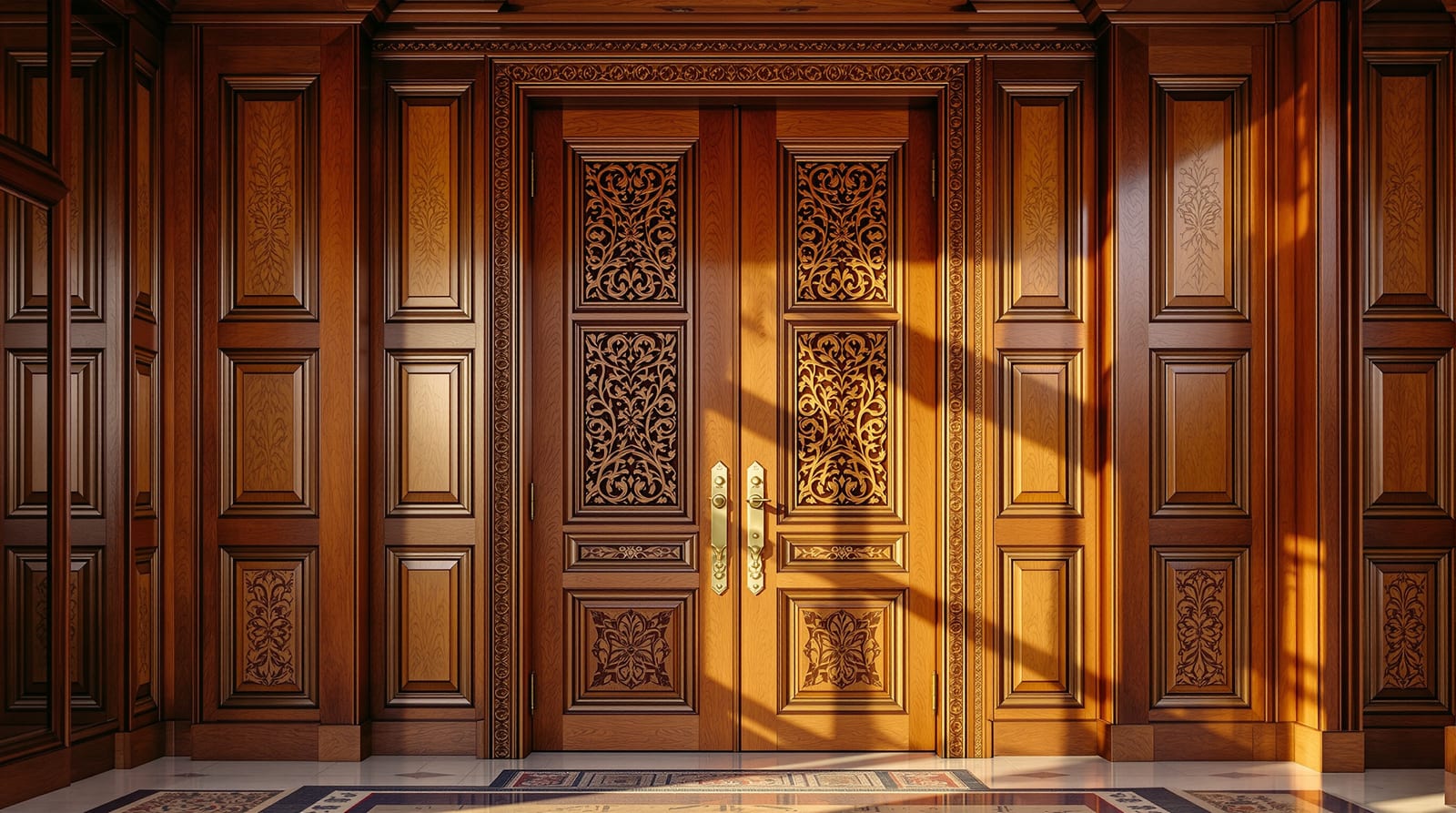
Teak Wood Doors in India: Burma vs CP vs African Teak, Quality & 2026 Cost
Why teak is the king of Indian doors - how Burma, CP/plantation and African teak compare on grain, durability, termite and water resistance, how to spot genuine teak from fakes, and what it really costs per sq ft and for a carved main door.
In India, "teak" is shorthand for the best door money can buy. When a builder wants to signal quality, a family wants the front entrance to last three generations, or a grandparent insists on sagwan for the pooja room, the conversation always lands on teak. The reputation is earned: teak (botanically Tectona grandis) carries its own natural oils and silica that shrug off termites, rot and monsoon swelling in ways no other affordable timber matches. But "teak" is also one of the most abused words in the Indian wood trade - sold by three very different grades, imitated by cheaper lookalikes, and faked outright with veneers and stains. This guide separates the real thing from the marketing, compares the teak grades you will actually be offered, and gives you honest 2026 rupee numbers so you can buy a teak door with your eyes open.
Why teak earns the premium
Teak is not expensive by accident. Three properties, all natural to the timber, explain why it has been the gold standard for Indian doors, ship decks and colonial furniture for centuries.
Natural oil and silica. Teak heartwood is rich in a natural oil (tectoquinone) and contains fine silica. Together these make the wood naturally water-repellent and deeply unattractive to termites and wood-boring insects - the two threats that destroy most Indian doors. A teak door does not need chemical termite treatment to survive; sal, mango or rubberwood doors do. In a country where white ants can hollow a door frame in a single damp season, that is the headline benefit.
Dimensional stability. Teak moves remarkably little between the swollen monsoon and the bone-dry summer. A well-seasoned teak shutter binds, swells and warps far less than almost any other solid timber, which is exactly why teak main doors stay square and shut cleanly decade after decade while cheaper solid-wood doors stick every July.
Strength, grain and repairability. Teak is a hard, dense, close-grained hardwood that holds carving crisply, takes screws and hinges firmly, and machines cleanly. It also ages gracefully: scratch it, sand it, re-oil it, and the surface comes back. A teak door is genuinely a lifetime asset that can be re-planed and re-polished many times. For where teak sits among all the timbers, see the wider wooden doors guide and the door materials comparison.
The three teaks: Burma vs CP vs African
This is the part most buyers get wrong. When a shop says "teak", always ask which teak - the price and quality gap between them is enormous.
Burma teak (Burmese / old-growth). The original benchmark, from naturally grown forests in Myanmar (and historically prized across colonial India). Slow-grown over many decades, it has the highest oil content, the finest and straightest golden-brown grain, the best durability and the deepest natural lustre. It is also the most expensive and increasingly scarce, since Myanmar restricts log exports - so genuine Burma teak today is largely reclaimed or from older stock and commands a steep premium. If a "Burma teak" door is being sold cheaply, be sceptical.
CP teak (Central Province / Indian plantation teak). "CP" historically meant the Central Provinces of India; today it broadly covers Indian-grown and plantation teak (Nagpur, Maharashtra and similar regions are famous for it). Plantation-grown teak grows faster, so the grain is a little coarser, the colour slightly lighter and oil content lower than aged Burma teak - but it is still genuine teak with real termite and water resistance. For most Indian homes, good CP teak is the sensible, available, value-for-money choice, and the grade the brief's benchmark prices are built around.
African teak (Ghana teak / Ivory Coast / Nigerian). Plantation teak grown in West Africa and imported in large volume into India. The botanical species is the same Tectona grandis, so it is "real teak", but fast tropical growth gives a coarser, more open grain, more colour variation and somewhat lower density and oil than Indian or Burma teak. It is the most affordable genuine teak and dominates the budget-teak market. (Beware: a separate, unrelated timber called "African teak" or iroko also exists - confirm you are buying Tectona grandis, not a lookalike sold under the same nickname.)
| Grade | Origin | Grain & colour | Oil / durability | Indicative cost per cu ft (timber) | Best for |
|---|---|---|---|---|---|
| Burma teak | Myanmar (old-growth / reclaimed) | Finest, straight, deep golden | Highest - top termite & water resistance | Premium / scarce (often 2-4x CP) | Heirloom main doors, carved statement entrances |
| CP / Indian plantation teak | India (Nagpur, Central India etc.) | Fine-medium, warm golden-brown | High - genuine resistance | Mid (the common benchmark) | Main doors, pooja doors, quality internal doors |
| African / Ghana teak | West Africa (plantation) | Coarser, more variation | Good - real but lower oil | Most affordable genuine teak | Value teak doors, budget-conscious main doors |
The honest takeaway: Burma teak is the connoisseur's choice and a true heirloom; CP teak is the practical sweet spot for most homes; African teak is a legitimate, affordable way to get real teak's termite and water resistance without the top-tier price - just expect a busier grain.
What a teak door costs in 2026
Teak is priced on the volume of timber and the labour of making and carving, so size and design drive the bill as much as grade. Treat all figures as indicative and varying by city, current timber rate and vendor; you can run your own numbers with the door cost calculator and read the focused teak door cost guide for the full breakdown.
| Item | Indicative 2026 cost | Notes |
|---|---|---|
| Teak door (shutter), per sq ft | from about Rs 800 to Rs 1,500+ per sq ft | Burma teak highest; African teak lowest; rises with thickness |
| Plain solid teak door (standard size, shutter only) | about Rs 18,000-40,000+ | A 3.5 ft x 7 ft main shutter at the above per-sq-ft rates |
| Carved teak main door | Rs 25,000 to Rs 1,50,000+ | Carving labour and design can exceed the timber cost |
| Teak door frame (chowkat), per running foot | about Rs 350-900 per ft run | A full main-door frame adds several thousand rupees |
| Hardware (hinges, handle, mortice/multi-point lock, stopper) | about Rs 1,500-8,000 | A heavy main door deserves heavy hardware |
| Fitting / installation labour | about Rs 800-3,000 per door | More for a heavy carved leaf needing two fitters |
| GST | +18% typical | Applies to material and often the make |
So a realistic installed premium teak main door - solid leaf plus frame, good hardware, fitting and GST - lands roughly in the Rs 25,000 to Rs 1,50,000+ band, exactly as you would budget for a flagship entrance. A modest internal teak door costs far less. For how this sits against every other material, see the 2026 door cost guide and the main door cost guide.
A quick reality check on the per-square-foot maths, since teak is the timber most often sold by the cubic foot of wood that goes into it:
How to spot genuine teak from fakes
Because teak commands a premium, the market is full of substitutes and outright fakes. Here is how buyers get fooled, and how to check.
- The teak veneer trick. The single most common deception is a plywood or MDF flush door faced with a thin teak veneer (or even a printed teak-look laminate), sold as a "teak door". It looks like teak on the surface but is a fraction of the strength and value. Check the edge and bottom of the door: solid teak shows the same grain running right through the thickness; a veneered door reveals ply layers or a different core material at the edges.
- Lookalike timbers. "Country teak", "Ghana teak" sold as Burma, iroko, and various reddish hardwoods are passed off as teak. Genuine teak has a distinctive warm golden-brown colour, a slightly oily or leathery feel, and a faint characteristic smell (like old leather) when freshly cut or sanded.
- The oil and water test. Teak heartwood feels naturally oily and water beads on a freshly planed surface rather than soaking straight in. A dry, thirsty surface that drinks water quickly is unlikely to be good teak.
- Grain and weight. Real teak is dense and heavy with straight, fine to medium grain and subtle darker streaks. Suspiciously light weight, very open coarse grain, or a perfectly uniform "printed" grain are red flags.
- Ask the right questions and get it in writing. Insist the seller names the grade (Burma / CP / African), confirms it is solid teak (not veneered), and states it on the invoice. Reputable timber merchants and door makers will. A price that looks too good for "Burma teak" almost always is.
A practical rule: if you are paying teak money, ask to see the door's cut edge before the finish goes on, and buy from an established merchant rather than the cheapest roadside quote.
Teak versus the alternatives
Teak is wonderful, but it is not the only sensible choice - and for many openings it is overkill.
| Factor | Teak (solid) | Sal / other solid hardwood | Engineered wood | WPC |
|---|---|---|---|---|
| Termite resistance | Excellent (natural) | Poor-fair (needs treatment) | Fair (treated core) | Excellent (no food for termites) |
| Water / monsoon | Excellent | Fair | Good if sealed | Excellent (waterproof) |
| Dimensional stability | Excellent | Moderate (moves) | Very good | Excellent |
| Look & feel | Premium, carvable, ages well | Solid but plainer | Stable, less character | Synthetic look, paintable |
| Repairability | Excellent (re-plane, re-oil) | Good | Limited | Limited |
| Cost | Highest | Mid | Mid | Low-mid |
The sensible strategy in most Indian homes is teak where it shows and matters - the main entrance and the pooja room - and cheaper, stable materials elsewhere: engineered-wood or flush doors for bedrooms (see engineered wood doors) and WPC doors for bathrooms and wet utility areas where even teak's edge over moisture is not worth its price. For the entrance specifically, browse main door design ideas, and remember that a teak slab is only as secure as its lock - pair it with serious hardware and read door security.
Finishes, Vastu and where teak shines
Finishes. Teak's grain is too good to hide, so most owners choose a clear or tinted finish that lets the wood show: natural teak oil (traditional, easy to re-apply, gives a soft matte glow but needs re-oiling yearly on exposed doors), melamine (a harder, smoother sealed finish), or PU/polyurethane (the most durable, glossy or matte, best for an exposed main door). Avoid heavy opaque paint on real teak - it wastes the timber's chief asset. On a fully sun-and-rain-exposed external door, a deep porch overhang plus an annual oil or PU re-coat keeps the surface from greying and checking.
Vastu and tradition. Teak (sagwan) is the favoured timber for the main door and the pooja room in traditional practice - prized as auspicious, durable and "noble" wood. Custom holds that the main door should be the largest in the house, open inward and clockwise, sit over a threshold (dehleez), and ideally face north, east or north-east. Treat these as belief plus sensible reasoning rather than rigid rules; if you are planning the entrance around direction and proportion, the dedicated entrance Vastu guide is the place to start. For how doors and the wider opening relate, see windows and doors design.
Where teak truly shines. Its best home is the front door - where its presence, security mass, carvability and weatherproofing all pay off at once - and the pooja room, where tradition and longevity meet. Everywhere else, decide whether you are buying teak for genuine performance or for the name on the invoice.
Frequently asked questions
Which is best - Burma, CP or African teak?
Burma teak is the finest: slow-grown, highest oil content, best grain and durability, and the most expensive and scarce - a true heirloom choice. CP (Central Province / Indian plantation) teak is the practical sweet spot for most homes: genuine teak resistance at a sensible price. African (Ghana) teak is the most affordable real teak, with coarser grain but real termite and water resistance. Choose Burma for a statement heirloom door, CP for the best all-round value, African to get teak's benefits on a tighter budget.
How much does a teak wood door cost in India in 2026?
The shutter alone runs from about Rs 800 to Rs 1,500+ per square foot, so a standard solid teak main door is roughly Rs 18,000-40,000+, while carved teak main doors run Rs 25,000 to well over Rs 1,50,000 depending on the carving. Add the frame (Rs 350-900 per running foot), hardware (Rs 1,500-8,000), fitting (Rs 800-3,000) and 18% GST. Figures are indicative and vary by city, grade and timber rate.
How can I tell genuine teak from a fake?
Check the door's cut edge and bottom: solid teak shows the same grain through its full thickness, whereas a veneered "teak" door reveals plywood or MDF layers. Genuine teak is heavy and dense, has a warm golden-brown colour, feels slightly oily, sheds water rather than soaking it, and smells faintly of old leather when sanded. Insist the seller names the grade and confirms "solid teak, not veneer" on the invoice.
Do teak doors really resist termites and water?
Yes - more than any other affordable timber. Teak heartwood contains natural oils and silica that make it naturally water-repellent and unappealing to termites and borers, which is why a teak door usually survives Indian monsoons and white-ant pressure without chemical treatment. It is not fully indestructible: a fully exposed external door still needs an overhang and periodic oil or PU re-coating to stop greying and surface checking.
Is teak worth it over engineered wood or WPC?
For the main door and pooja room, often yes - teak's presence, security, carvability and natural durability justify the cost where the door is seen and matters. For bedrooms, an engineered-wood or flush door is more stable and far cheaper; for bathrooms and wet utilities, WPC is waterproof and termite-proof at a fraction of the price. The smart play is teak where it counts and value materials everywhere else.
Export this guide
Related Guides — Deep-dive reading
The Complete Home Door Guide for Indian Homes (2026): Types, Materials, Cost, Security & Vastu
Everything an Indian homeowner needs to specify the right door for every opening — from main entrance to bathroom — with real 2026 prices, IS/NBC standards and Vastu sense.
Home Doors & EntrancesWooden Door Frames in India: Species, Cost & Care (India 2026)
How to choose, season and treat a timber chowkhat that survives India's termites, monsoon and heat — and what it costs per running foot.
Home Doors & EntrancesGuest Room Door in India: Privacy, Quiet and Smart Picks Without Overspending (2026)
How to choose a guest bedroom door for an Indian home - privacy and acoustics so visitors feel comfortable, but budget-sensible for a room used only now and then: solid-core flush for quiet, panel or laminate for looks, the right privacy lock, simple soundproofing, and a finish that matches the rest of your doors - with picks ranked and indicative rupee costs.
Home Doors & EntrancesRelated Tools — Try Free
Door Cost Calculator
Estimate the all-in cost of a door — leaf, frame, hardware, fitting and GST — by type, material and size.
Door CalculatorDoor Material Comparison Tool
Compare 2–4 door materials on cost, durability, maintenance, security and moisture resistance.
Comparison ToolCross-Ventilation Analyzer
Estimate airflow and air changes per hour (ACH) from room size, window areas, layout, and local wind — with NBC 2016 Part 8 compliance check.
Ventilation Calculator