
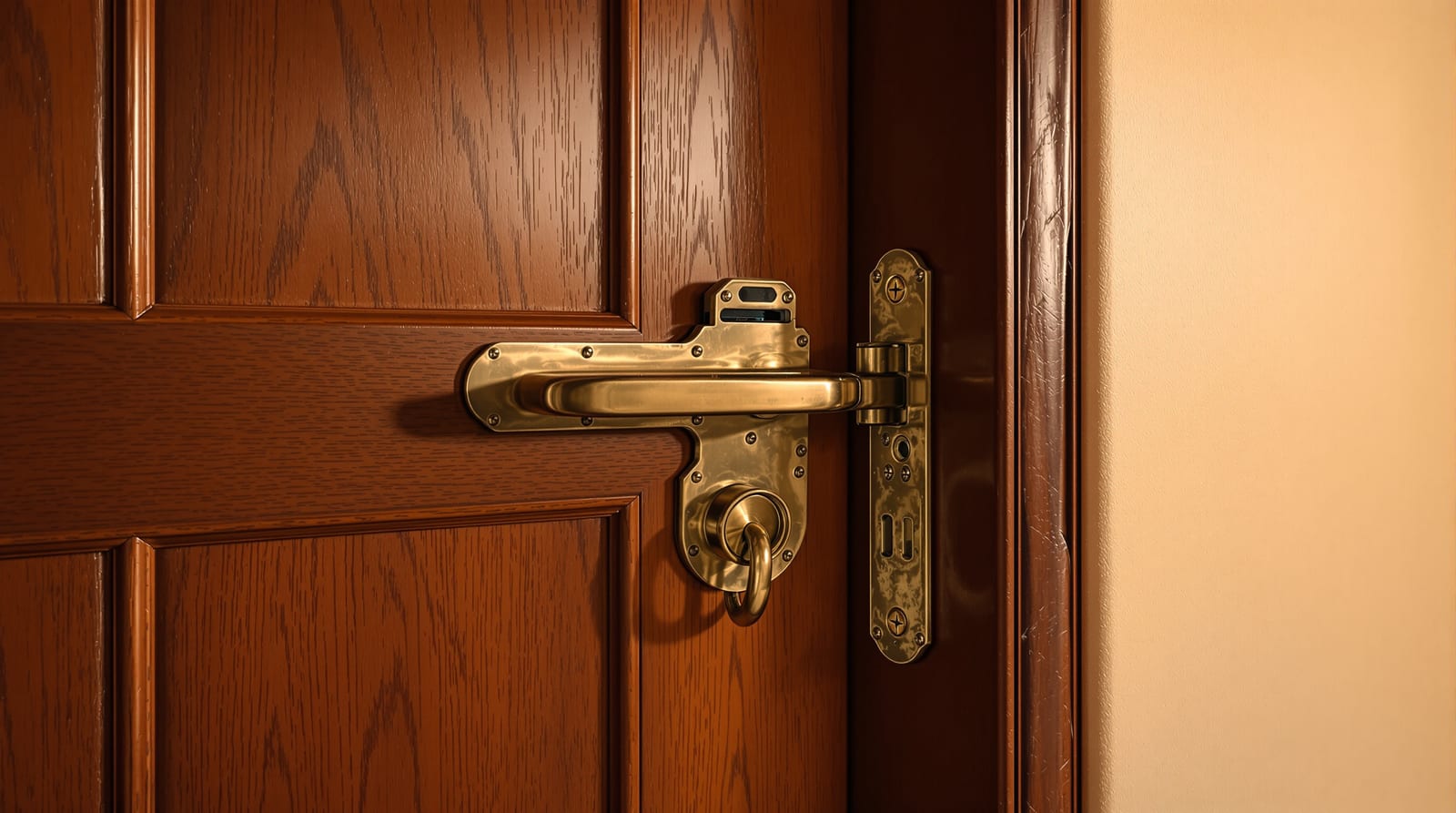
Door Security in India: How to Make Your Main Door Burglar-Resistant (2026 Guide)
A door is only as strong as its weakest part. This guide treats the front door as one security system — leaf, frame, hinges, lock, strike plate and viewer — and shows which upgrades actually stop a burglar in an Indian home.
Most burglaries do not start with a picked lock. They start with a shoulder, a crowbar, or a screwdriver levered into the gap between a flimsy door and a frame that was never properly anchored to the wall. A 3,000-rupee branded lock on a hollow shutter screwed to a half-fixed chowkat is theatre, not security. The door that actually keeps people out is a system — leaf, frame, hinges, lock, strike plate and viewer working together — and it is only as strong as its weakest link. This guide walks through every part of that system, in Indian conditions and at Indian prices, so you can spend on the upgrades that matter and skip the ones that only look reassuring.
Think of the door as a system, not a lock
When you ask "how do I make my door secure?" the hardware shop will point you at a fancier lock. But a lock is one of six things that fail under attack, and almost never the first. Real-world forced entries succeed at the joints:
- The frame (chowkat): if it is not anchored deep into masonry with grout and hold-fasts, the whole frame pops out with the door still locked. This is the single most common failure in Indian flats.
- The strike plate: the little metal plate the bolt shoots into. Two short screws into 12 mm of wood means one good kick splits the jamb. This is the cheapest, highest-impact fix on the whole list.
- The hinges: on an outward-opening door the hinge pins are exposed and can be knocked out, lifting the leaf off entirely.
- The leaf itself: a hollow-core flush door punches through. A solid-core, engineered or steel leaf does not.
- The lock and bolt: important, but only as strong as everything it is bolted to.
- The viewer/intercom: the part that prevents you opening the door to the wrong person in the first place — the failure that no lock can fix.
A burglar attacks the easiest of these. So security is about raising the weakest link, not gold-plating the strongest. Below is each part, ranked roughly by how much safety you buy per rupee.
The frame and its anchoring — the part everyone forgets
A door cannot be stronger than what it is screwed to. In a lot of Indian construction the door frame is set during plastering and tied in with two or three iron hold-fasts; if the carpenter skimped, the frame is held mostly by friction and paint. Under a hard kick the bolt holds but the jamb tears away from the wall.
What to insist on, whether new-build or retrofit:
- A frame of seasoned sal, teak or a steel/GI section (IS 4351), not soft local timber that splits.
- At least three hold-fasts per vertical jamb, grouted into the masonry, plus the frame packed solid with cement mortar — no hollow gaps behind the chowkat.
- On the lock-side jamb especially, depth and solidity matter most, because that is where the bolt transfers force.
- For retrofits on a weak frame, a steel frame-reinforcement plate or "door armour" wrap that ties the strike area into longer fixings is cheaper than replacing the whole frame.
If you are choosing the frame material itself, a galvanised steel frame to IS 4351 is dimensionally perfect, rot-proof and very hard to lever — see our steel doors guide for where steel earns its place. A solid teak or sal frame is the traditional strong choice and pairs naturally with a heavy main door.
The strike plate — the cheapest big win
If you do only one thing after reading this, do this. The standard strike plate ships with two 15-20 mm screws that bite only into the trim. Replace it with a reinforced ("security" or "box") strike plate fixed with four screws of at least 65-75 mm, long enough to pass through the frame and bite into the masonry or stud behind it. Cost: a few hundred rupees and twenty minutes. Effect: the difference between a door that splits on the first kick and one that holds. Pair a strong strike with a strong bolt and you have already beaten the most common smash-entry.
Leaf strength — what the burglar actually pushes through
A lock on a hollow door is like a padlock on a paper bag. For any external door, specify a leaf that resists being punched, drilled or split:
- Solid-core flush door (IS 2202 Part 1) — minimum acceptable for a main door; far heavier and tougher than a cellular/hollow-core shutter sold for bedrooms.
- Solid wood or engineered panel door — good mass, good resistance, classic main-door look.
- Pressed-steel security door — a steel skin over a tube frame, often rockwool-filled; the strongest mainstream option and the natural host for a multipoint lock.
- Reinforced/burglar-resistant doors — factory doors that integrate a steel sheet, anti-saw bolts and reinforced edges into one unit.
The European EN 1627 RC (Resistance Class) scale is a useful mental model even though it is not yet common on Indian retail labels: RC2 resists a casual burglar with simple tools for about three minutes; RC3 resists a determined attacker with a crowbar; RC4 and up are for high-risk premises. For a normal Indian home, an RC2-equivalent setup — solid leaf, anchored frame, reinforced strike, a good multipoint or deadbolt — is the sensible target. Do not pay for RC4 theatre on a flat whose neighbour's window is wide open.
Locks — multipoint, deadbolt, night latch and what each is for
Locks are where buyers over-spend and under-understand. The job of a lock is to throw a strong bolt into a strong strike; the fancier the mechanism, the more it matters that everything around it is solid.
| Lock type | How it secures | Best use | Indicative price (2026) | Watch-outs |
|---|---|---|---|---|
| Mortise deadbolt (key both sides or thumb-turn) | Single heavy bolt thrown deep into a reinforced strike | Main door (primary lock) | ₹1,500-6,000 | Bolt throw must be long; needs a security strike |
| Multipoint lock (3-5 point) | Bolts top, middle and bottom engage frame at several points on one turn | Main door, security/steel doors | ₹6,000-20,000+ | Frame must be true and strong for all points to seat |
| Night latch / rim latch (e.g. cylinder rim lock) | Spring bolt latches automatically; deadlocking versions add security | Secondary/backup, older doors | ₹800-3,000 | A plain spring latch can be "loided" with a card — use a deadlocking type |
| Aldrop / tower bolt | Surface bolt and pad | Traditional secondary bolt, gate side | ₹300-1,500 | Only as strong as its screws; supplement, never sole lock |
| Smart lock (PIN/fingerprint/RFID/app) | Electronic control of a motorised mortise/deadbolt | Convenience + audit trail | ₹5,000-30,000 | Choose one with a mechanical key override and a real deadbolt |
The practical recipe for an Indian main door: a mortise deadbolt or multipoint lock as the primary, a deadlocking night latch or a smart lock as the secondary/convenience layer, and a strong strike for whichever bolt does the real work. A deadbolt beats a plain night latch because a spring latch can be slipped; only a deadlocking latch or a thrown deadbolt resists that. For smart locks specifically — fingerprint reliability, battery backup, app security, and the all-important mechanical override — our smart door locks guide goes deep. Whatever you fit, insist on a model with a physical key fallback so a dead battery never locks you out.
Hinges — the side nobody attacks until they do
If your main door opens outward (common for flats so the leaf does not eat into the room, and required on fire-exit doors), the hinge knuckles and pins sit on the outside. A burglar with a punch can drive the pins out and lift the whole door off, lock untouched. Defences:
- Fixed-pin or security hinges whose pins cannot be removed, or hinges with a welded tab.
- Hinge bolts (dog bolts): steel studs on the hinge edge that engage matching holes in the frame, so even with pins out the door cannot be lifted away.
- Plenty of hinges — three minimum on a heavy main door, four on a tall or steel leaf — with long screws into solid frame, not trim.
Inward-opening doors hide the hinges inside and are inherently safer on this point, which is also why Vastu tradition prefers the main door to open inward and clockwise — a belief that happens to align with sound security. We cover the direction question in detail in entrance Vastu.
Grilles, safety doors and the open-for-air problem
Indian homes want airflow and a locked barrier at the same time — hence the classic double main door: a solid leaf plus an outer steel safety-grille door. The grille lets you keep the heavy door open for breeze and light while a locked, see-through steel gate stays between you and the corridor. Specify the grille with:
- A solid steel frame and closely spaced bars or a fine mesh (wide bars let an arm reach the inner lock).
- Its own good lock — a grille is only a barrier if it locks properly; a flimsy aldrop defeats the point.
- Bars or mesh that cannot be reached through to the inner door's lock or latch.
For balconies and rear/utility doors, a fixed or sliding collapsible grille adds a layer without sacrificing the glass door behind it. None of this replaces the main-door system above; it adds depth to it.
The viewer and intercom — stopping the threat at "who is it?"
The strongest door fails the moment you open it to the wrong person. A wide-angle (160-200°) door viewer (peephole) at a height everyone in the house can use is the cheapest social-engineering defence there is. Better still, a digital peephole or video door phone records and lets you screen visitors without standing at the door — particularly valuable for older residents and for anyone home alone. For wired and wireless video-door-phone options, sizing and where they fit into a layered setup, see our video door systems guide. Pair the viewer with a door chain or limiter so you can open a crack to a known face without releasing the full door.
A door-security cross-section
The diagram makes the principle obvious: the bolt is no stronger than the strike, the strike no stronger than the screws, the screws no stronger than the frame, and the frame no stronger than its grip on the wall. Upgrade them as a chain.
Layered security — beyond the door itself
The door is the front line, not the whole defence. A burglar who finds the door hardened looks for the next opening, so think in layers:
- Perimeter: a locked gate, motion-sensor lighting at the entrance, trimmed planting that gives no cover.
- Detection: a video door phone, a doorbell camera, or a simple door/window sensor that pings your phone.
- Other openings: the strongest door is wasted if the kitchen window or balcony grille is weak — match them.
- Habits: lock the deadbolt every time (a thrown deadbolt is what stops the kick; a latched-only door does not), do not hide keys under the mat, and use the chain when opening to strangers.
Smart integration ties these together — a smart lock that logs who came and when, links to the video phone, and lets a joint-family household share access without copied keys. Keep it grounded: choose devices with mechanical/manual fallback so a power cut or dead battery never traps or exposes you.
A security upgrade checklist, ranked by value per rupee
| Upgrade | What it stops | Indicative cost (2026) | Priority |
|---|---|---|---|
| Reinforced strike plate, 65-75 mm screws into masonry | Kick-in / jamb split | ₹300-1,200 | Do first |
| Anchor / regrout a loose frame (or steel frame) | Whole-frame pop-out | ₹1,500-8,000 | Do first |
| Solid-core or steel leaf (if currently hollow) | Punch-through | ₹4,000-25,000 | High |
| Mortise deadbolt or multipoint lock | Lever / slip attacks | ₹1,500-20,000 | High |
| Anti-lift / fixed-pin hinges or dog bolts (outward doors) | Hinge-pin lift-off | ₹500-3,000 | High (outward doors) |
| Steel safety-grille door | Open-for-air security | ₹8,000-25,000 | Medium |
| Wide-angle viewer + door chain | Opening to wrong person | ₹300-2,000 | Medium |
| Video door phone / doorbell camera | Screening + record | ₹4,000-25,000 | Medium |
| Smart lock with key override | Convenience + audit trail | ₹5,000-30,000 | Optional |
Prices are indicative and vary by city, vendor and finish; add roughly 18% GST and ₹800-3,000 fitting per item. To benchmark your own door against these layers, our door security rating tool scores leaf, frame, lock, hinges, strike and viewer together so you can see your weakest link at a glance. For the broader buying picture across materials and types, the door hardware guide and the main door cost guide round out the spend.
Frequently asked questions
Is a deadbolt better than a night latch for security?
Yes, for the primary lock. A plain spring night latch can be slipped open with a card or shim, so it should never be the only thing securing a main door. A mortise deadbolt throws a solid bolt deep into the strike and cannot be slipped. If you want a latch for convenience, choose a deadlocking night latch and pair it with a deadbolt or multipoint lock as the real defence.
What is the single cheapest upgrade that improves door security the most?
A reinforced strike plate fixed with long 65-75 mm screws that reach the frame and masonry behind it. It costs a few hundred rupees and stops the most common forced entry — the kick that splits the jamb. The standard strike's short screws bite only into trim and fail under one good kick.
Do I need a steel security door, or is a wooden door enough?
A solid wood, solid-core or engineered panel door with a properly anchored frame, a deadbolt and a reinforced strike is secure enough for most Indian homes. A pressed-steel security door adds the most resistance and hosts a multipoint lock cleanly, so it makes sense for ground-floor flats, isolated houses or anyone wanting maximum security. The frame anchoring and lock matter more than the leaf material on its own.
How do I stop someone lifting an outward-opening door off its hinges?
Use fixed-pin or security hinges whose pins cannot be punched out, and add hinge bolts (dog bolts) — steel studs on the hinge edge that engage holes in the frame so the leaf cannot be lifted away even if the pins are removed. Inward-opening doors hide the hinges and avoid the problem entirely.
Are smart locks less secure than traditional locks?
Not inherently, if you choose well. The risk is treating the electronics as the whole security; a smart lock should drive a real motorised deadbolt or mortise, keep a mechanical key override, and have battery backup. Bought that way it adds an audit trail and keyless convenience on top of, not instead of, a strong bolt, strike and frame.
Export this guide
Related Guides — Deep-dive reading
Door Frame Security in India (2026): Anchoring the Chowkhat Break-Ins Actually Exploit
A homeowner's guide to the real weak point behind most forced entries: the frame, not the leaf or the lock, and how to anchor, pack and reinforce a chowkhat so a strong door genuinely stays in the wall.
SecurityAnti-Theft Door Guide India: Affordable Ways to Burglar-Proof Your Entry (2026)
A practical, layered checklist of low-cost upgrades — deadbolts, strike-plate reinforcement, hinge bolts, viewers, grill doors and smart alerts — to make any Indian home door far harder to force.
Home Doors & EntrancesReinforced Wooden Doors in India (2026): Making the Timber Main Door Actually Secure
A homeowner's decision guide to choosing or upgrading the wooden main or flat door most Indian homes actually have, so it genuinely resists a break-in, without pretending a hollow flush door is secure.
SecurityRelated Tools — Try Free
Door Security Rating Calculator
Score your main door out of 100 across leaf, frame, lock and hardware — and see the top upgrades.
Security ToolVideo Door Phone Type Selector
Answer a few questions about your building, cabling, budget and internet and get the right video door phone — analog / wired / wireless / IP, single-home or multi-apartment, monitor or app.
Door Phone SelectorCross-Ventilation Analyzer
Estimate airflow and air changes per hour (ACH) from room size, window areas, layout, and local wind — with NBC 2016 Part 8 compliance check.
Ventilation Calculator