
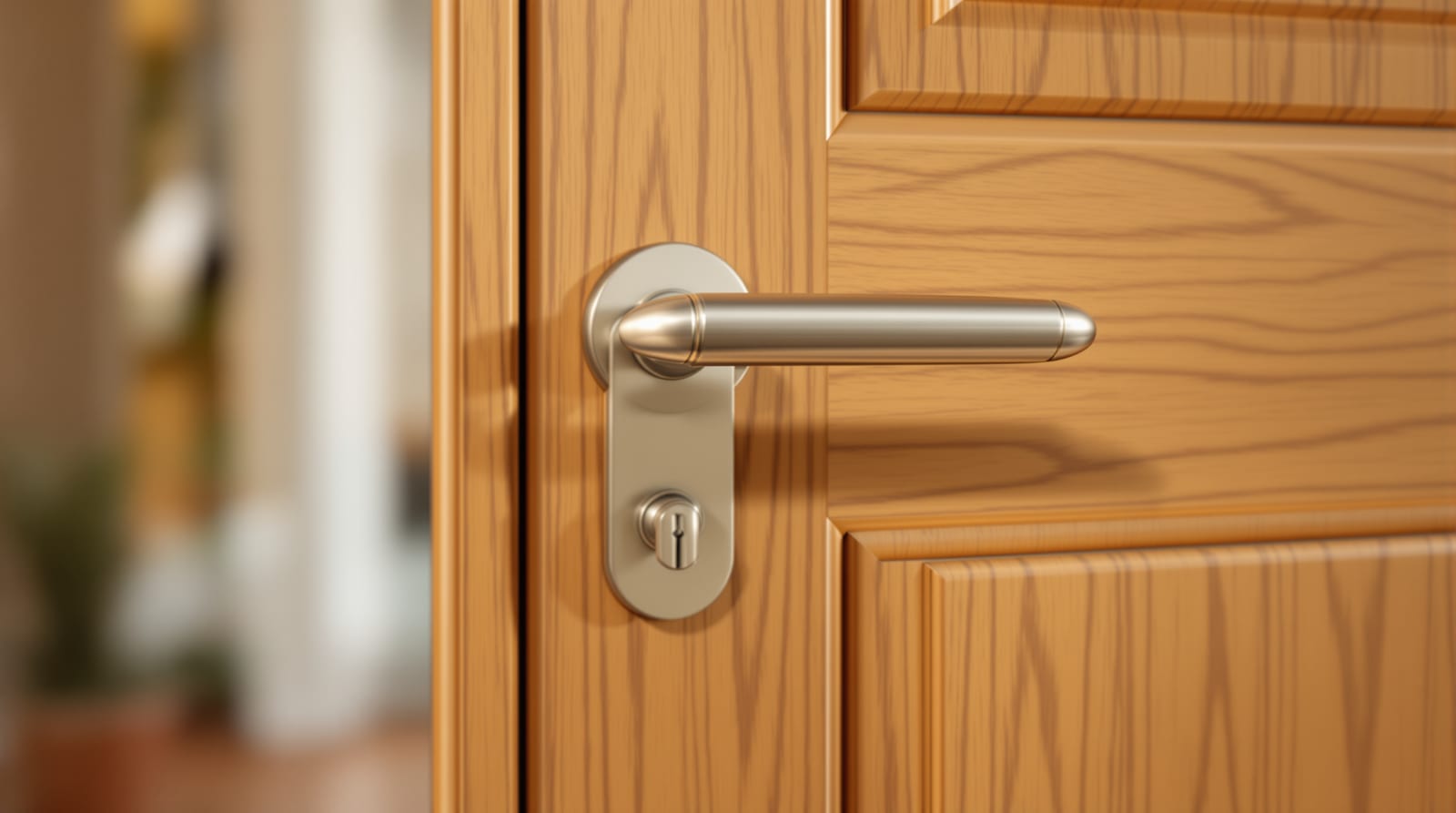
Door Hardware Guide India 2026: Hinges, Handles, Locks, Closers and Every Fitting Explained
What each piece of door hardware actually does, where it belongs, which material (SS304, brass, zinc or iron) survives Indian conditions, the quality signals to check before you pay, and a buyer's checklist with 2026 prices.
A door is only as good as the metal you bolt to it. You can spend ₹40,000 on a carved teak main door and ruin it with a ₹150 hinge that sags inside a year, a lock that any plumber can pick, and a handle that turns green by the second monsoon. Hardware is the part of the door you touch every single day, the part that fails first, and ironically the part most people choose last and cheapest. This guide is the opposite approach: it walks through every fitting on an Indian door — hinges, handles, locks, closers, floor springs, bolts, stoppers, seals, viewers and more — telling you what each does, where it belongs, what it should be made of, how to spot quality, and what it should cost in 2026.
How to think about door hardware
Hardware splits into four jobs, and almost every fitting belongs to one of them:
- Hanging — letting the door swing or slide and return to closed: hinges, pivots, floor springs, door closers.
- Operating — opening, gripping and pulling: handles, levers, knobs, pulls.
- Securing — keeping the door shut and locked: mortise locks, rim locks, latches, tower bolts, aldrops, night latches, smart locks.
- Finishing and protecting — comfort, safety and weather control: stoppers, peepholes, seals and gaskets, door knockers, kick plates, drop seals.
Get the hanging and securing hardware right and the door works for fifteen years. Get them wrong and you will be calling a carpenter every monsoon. The material decision sits on top of all four jobs, so we will settle that first, because in India it is usually the difference between hardware that lasts and hardware that rusts.
The material decision: SS304 vs brass vs zinc vs iron
This single choice quietly decides whether your hardware survives. India is brutal on metal — high humidity, salt-laden coastal air, monsoon condensation and sweaty hands all attack fittings. Here is how the common materials actually behave.
| Material | Corrosion resistance | Strength | Look | Best for | Watch out for |
|---|---|---|---|---|---|
| Stainless steel SS304 | Excellent (true marine-grade is SS316) | High | Bright satin / mirror | Coastal, bathrooms, main doors, anything wet | Cheap "SS" that is actually SS202 (magnet sticks, rusts) |
| Brass (solid) | Very good; develops patina, not red rust | High | Warm gold, classic | Heritage/teak doors, premium locks, handles | Soft if low-grade; lacquer wears and tarnishes |
| Zinc alloy (die-cast / "zamak") | Moderate; needs good plating | Medium | Any plated finish, low cost | Budget handles, locks, decorative trims | Plating flakes; brittle, can crack if dropped |
| Iron / MS (mild steel) | Poor — rusts fast unless galvanised/powder-coated | High | Black/painted, rustic | Tower bolts, aldrops, hinges (galvanised only) | Bare iron streaks rust onto the door |
| Aluminium | Good (oxide layer); not for high security | Low-medium | Matte silver | Sliding-door rollers, light handles | Soft, dents, not pry-resistant |
The coastal rule. If you live within roughly 10-15 km of the sea — Mumbai, Chennai, Kochi, Visakhapatnam, Goa, coastal Gujarat and Odisha — insist on SS304 as the minimum and SS316 for the main door and exposed bolts. Salt air will eat zinc plating and bare iron within a single season; brass survives but tarnishes. A quick field test for fake stainless: a fridge magnet clings firmly to SS202 and mild steel but barely to genuine SS304. Ask for the grade in writing on the invoice — "SS" alone means nothing.
Hinges: the hardware that holds it all up
Every swinging door hangs on hinges, and they are the most under-specified fitting in Indian homes. A heavy solid-wood main door on two flimsy hinges will sag, bind and eventually drop the corner that scrapes the floor.
Common types
- Butt hinges — the standard rectangular pair set into the door edge and frame. Choose ball-bearing butt hinges for heavy doors; plain-bush ones squeak and wear.
- Concealed (European/hydraulic) hinges — hidden inside the door, used on modular wardrobe shutters and some flush doors; allow soft-close.
- Piano (continuous) hinges — a single long hinge along the whole edge, for folding shutters and tall light panels.
- Pivot hinges — top-and-bottom pivots for heavy pivot doors (see floor springs below).
- Flush hinges — sit on the surface, no chiselling, used for light hollow-core doors.
Sizing rule of thumb. Use the door's weight and height, not guesswork. As a practical Indian guide: a standard 32 mm internal flush door (900 mm wide) needs three 100 mm (4-inch) hinges; a heavy 40 mm solid-wood or teak main door needs three or four 125 mm (5-inch) ball-bearing hinges. Two hinges is false economy on anything above bedroom weight. Hinges go roughly 150-200 mm from top and bottom, with the third centred (slightly above centre for sagging doors).
Quality signals: SS304 with visible "304" stamp; smooth, tight, rattle-free swing; ball bearings on heavy doors; matched screws that bite into solid timber (not the frame plaster). Avoid pressed thin-leaf hinges that flex under thumb pressure.
A labelled map of a main door's hardware
Before the fitting-by-fitting detail, it helps to see where everything sits on a typical Indian main door.
Handles, levers, knobs and pulls: what you actually hold
This is the part of the door you touch thousands of times, so feel matters as much as looks.
- Lever handles — the down-press lever, now the default in India. Easy for children, the elderly and anyone with full hands; required thinking for accessible homes (a round knob is hard to grip with arthritis or wet hands). Usually paired with a mortise lock body.
- Knobs — round, twist-to-open. Cleaner look but poor for accessibility and weak grip when wet; fading from Indian homes except on a few interior doors.
- Mortise handle sets — the long backplate handle that houses the lock, standard on main and bedroom doors. Sold as a set with the lock body and cylinder.
- Pull handles — a fixed grab bar with no latch, for sliding doors, glass doors and large pivot doors. Often long stainless tubes.
- Cabinet/flush pulls — recessed pulls for pocket doors and wardrobe shutters that must sit flush.
Choosing right: for the main door, a mortise handle set in SS304 or solid brass; for bedrooms, a lever-on-rose with a privacy lock; for bathrooms, a lever with a thumb-turn inside and emergency release outside; for sliding and glass doors, a stainless pull. Avoid hollow zinc handles with thin chrome plating — the plating bubbles and peels in humidity.
Locks and latches: the security core
Locking hardware deserves the most thought, because it is the difference between a door that closes and a door that protects.
| Lock type | How it works | Typical use | Security | Notes |
|---|---|---|---|---|
| Mortise lock | Lock body buried in the door edge, key + handle | Main & bedroom doors | High | Look for a pin-cylinder + deadbolt; the Indian standard |
| Cylindrical (tubular) lock | Knob/lever with cylinder inside | Interior doors | Medium | Quick to fit, easy to replace |
| Rim lock / night latch | Surface-mounted on the inside face | Older doors, secondary | Medium | The classic "godrej" rim lock + latch |
| Multi-point lock | One turn throws bolts top, middle, bottom | Premium main/security doors | Very high | Common on steel and uPVC security doors |
| Tower bolt / aldrop | Manual sliding bolt / hasp + staple | Extra night security | Low-medium | Backup, not primary security |
| Smart lock | PIN, fingerprint, app, RFID | Main door | Varies | Pair with a mechanical override; see below |
Quality signals on a lock: a brass or hardened-steel deadbolt (not pressed sheet), a cylinder with at least 5-6 pins (anti-pick), a smooth key turn with no grinding, and a reputable name — Godrej, Europa, Dorset, Hettich, Hafele, Yale, Ozone are the dependable mid-to-premium tier. For the main door, a deadbolt that throws at least 14-20 mm into the frame is what actually resists a kick.
If you are weighing electronic options, our companion guide on smart door locks in India covers fingerprint, PIN and app locks, and the broader strategy of layering bolts, viewers and grilles is in door security in India.
Door closers and floor springs: the controlled return
These keep a door from slamming and bring it back to closed on its own — important for main doors, fire doors and any door in a draughty stairwell.
- Overhead door closers — the rack-and-pinion arm at the top of the door. Sized by door weight (EN 1-7); a standard residential door needs roughly an EN 3-4 closer. Hydraulic, with adjustable closing and latching speed. Mandatory on fire doors so they stay shut.
- Concealed / hydraulic closers — hidden in the door for a clean look on premium flush doors.
- Floor springs — buried in the floor under the pivot of a heavy glass or pivot door; they take the full weight and control a smooth swing, with a hold-open detent at 90 degrees. Essential for frameless-glass and large pivot main doors. Choose a load rating matched to the leaf weight; an undersized floor spring fails fast and is miserable to replace once tiled in.
A common Indian mistake is fitting a cheap closer that leaks oil within a year and either slams or refuses to latch. Spend on a branded hydraulic unit here — it is the one fitting whose failure you notice every single day.
Bolts, stoppers, seals and the rest
The smaller fittings finish the door and quietly prevent damage and discomfort.
- Tower bolts — vertical sliding bolts for extra security at night and for holding the inactive leaf of a double door. SS304 outdoors; never bare iron.
- Aldrops (hasp & staple) — the U-shaped latch + padlock fitting on gates, terrace and store doors.
- Door stoppers — wall- or floor-mounted buffers that stop the handle smashing the wall and the door over-swinging. Magnetic and rubber-tipped types; a ₹100 part that saves a ₹5,000 wall repair.
- Door seals and gaskets — perimeter strips and bottom drop seals that block draughts, dust, sound and monsoon water. Critical for energy-efficient doors and soundproofing; a brush or silicone bottom seal also stops the under-door gap that lets in insects and rain spray.
- Peepholes / door viewers — the wide-angle (160-200°) optical viewer in the main door, so you see callers without opening. Digital viewers add a small screen and recording; a basic optical one is ₹150-500.
- Door knockers — decorative-functional, common on traditional and heritage doors, often in brass to match the rest of the entrance hardware.
- Kick plates / push plates — protective metal plates at the base and push area, more common on commercial doors but useful on a busy main door.
The hardware checklist and 2026 prices
This is the centrepiece — print it, take it to the dealer, and tick off every line before you pay. Prices are indicative for 2026 and vary by city, brand and material; add 18% GST and fitting labour.
| Fitting | Where it goes | Recommended material | What good looks like | Indicative price (2026) |
|---|---|---|---|---|
| Butt hinges (per door) | Every swing door | SS304 ball-bearing (heavy doors) | 3-4 hinges, "304" stamp, no rattle | ₹60-250 each |
| Concealed hinges | Wardrobe/flush shutters | Steel, soft-close | Smooth soft-close, no creak | ₹120-400 each |
| Pivot set / floor spring | Pivot & glass doors | Branded hydraulic | Load-rated to leaf weight, 90° hold | ₹2,500-9,000 |
| Mortise lock + handle set | Main & bedroom doors | SS304 or solid brass | 5-6 pin cylinder, 14-20 mm deadbolt | ₹1,200-6,000 |
| Lever handle on rose | Interior/bathroom | SS304 / brass | Spring returns crisply, no wobble | ₹350-2,500 |
| Multi-point lock | Security/main door | Hardened steel | One turn throws 3 bolts | ₹3,500-12,000 |
| Smart lock | Main door | — | Mechanical key override included | ₹5,000-30,000 |
| Pull handle | Sliding/glass/pivot | SS304 tube | Solid mount, no flex | ₹400-3,000 |
| Door closer (overhead) | Main/fire doors | Branded hydraulic | EN 3-4, adjustable, no leak | ₹600-3,000 |
| Tower bolt (pair) | Double doors/terrace | SS304 | Bolt slides freely, locks square | ₹120-600 each |
| Aldrop | Gates/store doors | SS304 / galvanised | Heavy staple, square fit | ₹150-700 |
| Door stopper | Behind every door | SS304 / rubber-tipped | Stops swing fully, buffered | ₹80-400 |
| Bottom drop seal | External & quiet rooms | Aluminium + silicone | Seals gap when closed | ₹300-1,500 |
| Door viewer/peephole | Main door | Brass/SS, wide-angle | 160-200° clear optic | ₹150-1,500 |
| Door knocker | Traditional main door | Solid brass | Heavy, secure backplate | ₹400-3,000 |
Total hardware for a typical main door (hinges + mortise set + closer + viewer + bolts + stopper) usually lands at ₹3,000-12,000, rising to ₹15,000+ if you add a smart lock or premium brass. Bathroom and bedroom doors are far cheaper at ₹600-2,500 each. The brief is simple: budget hardware as a real line item, not an afterthought, and never let a builder "include standard fittings" without naming the brand and grade.
A quick word on fitting and Vastu
Two practical India notes. First, fitting: insist that hinge and lock screws bite into solid timber, not the soft edge of a hollow-core door or the plaster around the frame — most "the lock came loose" complaints are a fitting failure, not a hardware failure. Second, tradition: many families like even-numbered door leaves and a threshold (dehleez) at the main door, and prefer the main door to open inward and clockwise; if you follow Vastu for the entrance, our entrance Vastu guide covers direction and threshold beliefs alongside the practical reasoning, so your hardware choices (handle side, bolt placement, knocker) line up with it.
If you are choosing between a stainless and a brass aesthetic for the whole entrance, treat it as a single design decision — match hinges, handle, viewer, knocker and bolts in one finish family rather than mixing chrome, gold and black, which reads as an afterthought.
Frequently asked questions
Is SS304 or brass better for door hardware in India?
For wet areas, bathrooms and anything within 10-15 km of the coast, SS304 (or SS316 for the most exposed pieces) is the safer choice because it resists salt-driven rust. Solid brass is excellent and classic for heritage and teak main doors — it tarnishes to a patina rather than red-rusting — but low-grade or thinly lacquered brass discolours. Avoid zinc-alloy handles with thin chrome plating in humid climates; the plating peels.
How many hinges does a door need?
A standard internal flush door (900 mm, ~32 mm thick) needs three 100 mm hinges. A heavy solid-wood or teak main door (40 mm) needs three or four 125 mm ball-bearing hinges. Two hinges is acceptable only on the lightest hollow-core or wardrobe shutters; on anything heavier it causes sagging within a year.
What is the difference between a mortise lock and a cylindrical lock?
A mortise lock has its body recessed inside the door edge and combines a latch, a deadbolt and the handle in one robust assembly — it is the standard for Indian main and bedroom doors. A cylindrical (tubular) lock has a simpler mechanism inside a bored hole through the door, is quicker to fit and replace, and suits lower-security interior doors.
Do I need a door closer on a home door?
You do not strictly need one on most interior doors, but a door closer is genuinely useful on the main door (it returns to closed for security), on doors in draughty stairwells that slam, and it is legally required on fire-rated doors so they stay shut. Choose a branded hydraulic EN 3-4 unit and avoid cheap closers that leak oil and slam within a year.
How much should I budget for door hardware?
For a main door expect roughly ₹3,000-12,000 for hinges, a mortise handle-and-lock set, closer, viewer, bolts and a stopper, rising past ₹15,000 with a smart lock or premium brass. Bedroom and bathroom doors are typically ₹600-2,500 each. These are 2026 indicative figures; add 18% GST and fitting labour, and they vary by city and brand.
Export this guide
Related Guides — Deep-dive reading
Types of Door Locks for Indian Homes: Complete Buying Guide (2026)
Mortise, rim, cylindrical, deadbolt, multipoint, aldrop and smart locks — which lock suits your main door, bedroom, bathroom and gate, with security ratings, prices and trusted brands.
Home Doors & EntrancesReinforced Wooden Doors in India (2026): Making the Timber Main Door Actually Secure
A homeowner's decision guide to choosing or upgrading the wooden main or flat door most Indian homes actually have, so it genuinely resists a break-in, without pretending a hollow flush door is secure.
SecurityBathroom Door for Indian Homes (2026): Waterproof Materials, Sizes, Ventilation & Locks
How to pick a toilet door that survives years of splash, steam and monsoon humidity — material ranking, the wet-area threshold detail, ventilation, narrow sizing, privacy locks and anti-rust fittings.
Home Doors & EntrancesRelated Tools — Try Free
Door Security Rating Calculator
Score your main door out of 100 across leaf, frame, lock and hardware — and see the top upgrades.
Security ToolDoor Hardware Cost Estimator
Estimate the all-in hardware cost for a door — hinges, lock, handle, closer, bolts, stopper and fitting — with GST.
Door CalculatorDoor Cost Calculator
Estimate the all-in cost of a door — leaf, frame, hardware, fitting and GST — by type, material and size.
Door Calculator