
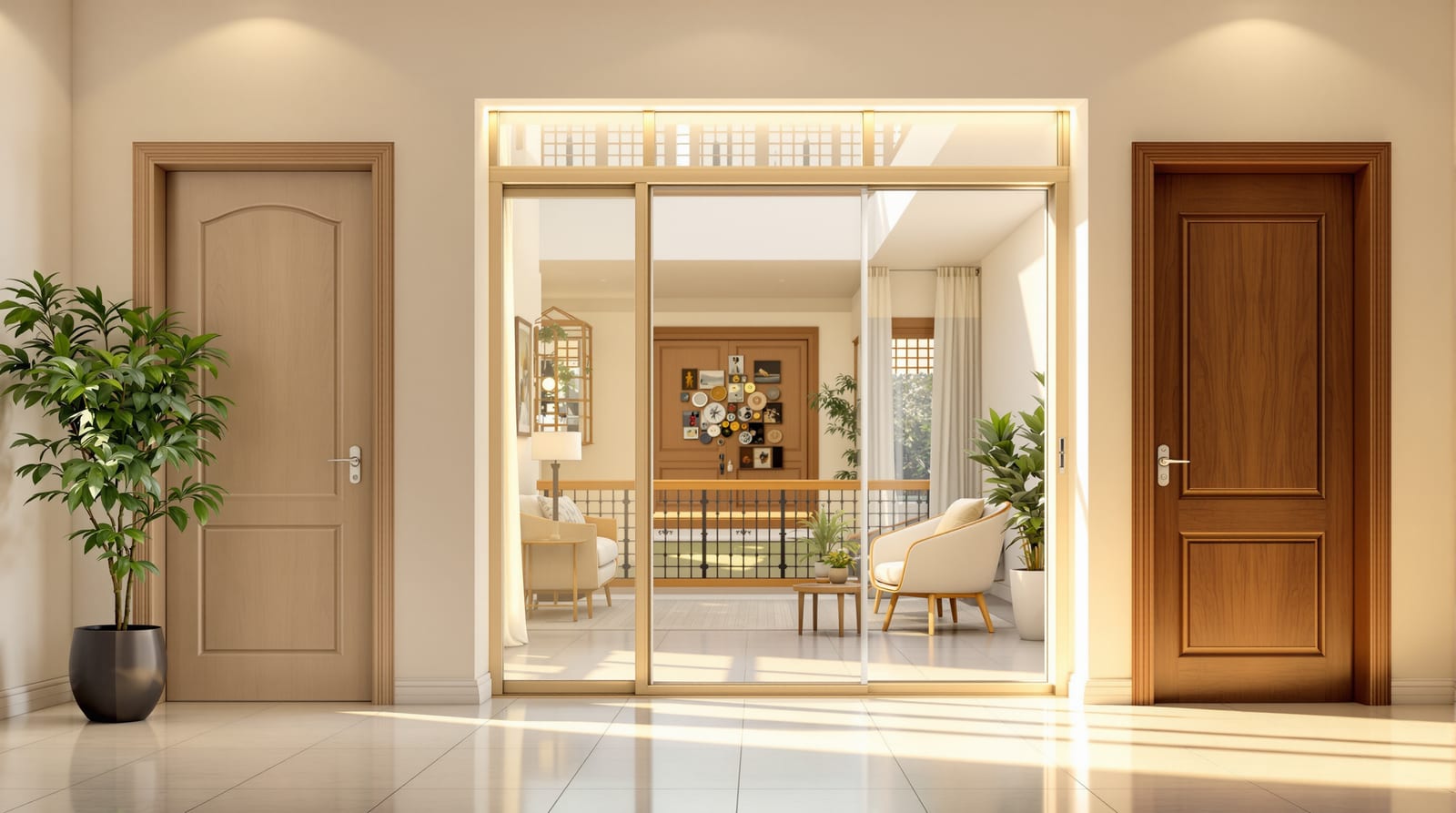
Types of Doors for Indian Homes: The Complete Comparison (Flush to Pivot)
Every common door type compared side by side - cost, security, best use and climate fit - so you can shortlist the right door for each opening in seconds.
A house is a collection of openings, and almost every one of them needs a different door. The flush door that is perfect for a bedroom would look mean on a main entrance; the carved teak that announces your front door would warp and rot in a bathroom; the elegant french doors that open a living room to the garden are a security and dust nightmare on a city main door. Choosing well is mostly a matter of matching the type of door to the job of the opening - and that starts with knowing what each type actually is, what it costs in 2026 rupees, and how it behaves in Indian heat, dust and monsoon.
This guide puts all eleven common door types in one place. Use the master comparison table to shortlist in thirty seconds, then read the short note on each type for the detail - and follow the link to the deep guide when you want to go further on a single type.
The master comparison table
The single most useful view of doors is type against cost, security and best use. Costs below are indicative shutter/leaf prices (material + make), 2026, before frame, hardware, installation and the typical 18% GST - these add roughly ₹3,000-12,000 per door depending on spec. Prices vary by city, timber rate and vendor, so treat every figure as a range.
| Door type | Indicative cost (shutter) | Security | Best use |
|---|---|---|---|
| Flush door | ₹1,200-4,000 (basic); ₹4,000-9,000 veneered | Low-medium (hollow core weak; solid core better) | Bedrooms, internal openings - the default Indian internal door |
| Panel door | ₹4,000-12,000 | Medium-high (solid-wood panel) | Main doors on a budget, character internal doors, pooja rooms |
| Solid wood door | ₹10,000-25,000+ (from ~₹800/sq ft) | High | Main entrance, where mass, sound and longevity matter |
| Teak main door | ₹25,000-1,50,000+ (carved) | High | Premium main entrance; status, durability, termite resistance |
| Glass door | ₹450-1,200 / sq ft (framed) | Low-medium (toughened + good lock helps) | Balcony, garden, study partition, shower; light and views |
| Sliding door | ₹450-1,200 / sq ft | Low-medium | Balcony, wardrobe, terrace, tight rooms where a swing wastes space |
| French door | ₹15,000-60,000 / pair | Low-medium | Living-to-garden, terrace - light and a wide, gracious opening |
| Bi-fold / folding door | ₹700-1,500 / sq ft | Low-medium | Wide openings to balcony/patio that you want to fully open |
| Pocket door | ₹12,000-30,000+ (with cavity frame) | Low-medium | Bathrooms, utility, small rooms - zero swing footprint |
| Pivot door | ₹40,000-2,00,000+ | Medium-high (big leaf, good hardware) | Statement main entrance in modern/luxury homes |
| Barn (sliding-track) door | ₹8,000-25,000 (leaf + track) | Low (gaps, no seal) | Decorative internal sliders - study, walk-in, casual partition |
| Dutch (stable) door | ₹12,000-30,000 | Medium | Kitchen-to-utility, nursery, homes with pets/children |
Bi-fold doors get their own deep guide too. For a like-for-like view of the materials these doors are made from - timber vs WPC vs uPVC vs steel - see the door materials comparison, and for budgeting, the door cost guide for 2026.
How to read the three columns
Cost is the headline number people fixate on, but the shutter is rarely more than half the installed price. A ₹3,000 flush door becomes a ₹7,000-8,000 door once you add a sal/teak frame (chowkat at ₹350-900 per running foot), hinges, a lock, a handle and ₹800-3,000 of fitting labour. Compare installed costs, not shutter prices, when two types are close.
Security depends as much on the lock, frame and fixing as on the leaf. A hollow-core flush door with a good multi-point lock in a steel frame outperforms a solid teak door with a flimsy mortice lock in a loose chowkat. For the main entrance, the type is only the starting point - read the door security guide and consider smart locks.
Best use is where most mistakes happen. The rule of thumb: heavy, solid, lockable types (solid wood, teak, panel, steel, pivot) at the boundary of the home; light, space-saving or view-led types (flush, sliding, glass, pocket, french, bi-fold) inside and at the garden edge.
The eleven types in detail
Flush doors - the Indian default
A flush door is a flat, smooth shutter: a timber frame infilled with a core (hollow/cellular or solid block-board) and faced both sides with plywood, then veneer or laminate. Made to IS 2202 (Part 1), it is the workhorse of Indian homes - cheap, light, paint-or-laminate-ready and quick to hang. The catch is the core: a hollow-core flush door sounds drum-like, dents easily and gives almost no sound or security. Pay the small premium for a solid-core (block-board) flush door on bedrooms and you fix most of that. Best for: every internal door where you do not need character. Full detail in the flush doors guide.
Panel doors - character and strength
A panel door is built the traditional way: vertical stiles and horizontal rails framing one or more recessed panels (timber, ply or glass), to IS 1003 (Part 1). The stepped, shadow-lined face reads as "proper joinery" and the solid-wood versions are genuinely strong, which is why panel doors are the budget-conscious choice for a main door with presence and a favourite for pooja rooms. They cost more than flush and move a little with the seasons. See the panel doors guide.
Solid wood doors - mass where it matters
A solid wood door is exactly that - a slab built up from solid timber (or thick engineered laminations), with real mass, real sound insulation and real security. It is the natural main-door type and the benchmark the others are measured against. The trade-offs are cost (from ~₹800/sq ft, ₹10,000-25,000+ for a full door) and movement: solid timber swells in the monsoon, so it needs seasoned wood, breathing gaps and good finishing. The honest comparison of solid versus the lighter hollow-core alternatives is in solid vs hollow-core doors.
Teak main doors - the status entrance
Teak (Burma or CP/plantation teak) is the prestige timber of Indian doors: dense, oily, naturally termite- and rot-resistant, and beautiful when oiled. A plain teak door starts around ₹800-1,500/sq ft; a carved main door runs ₹25,000 to well over ₹1,50,000. It is the type to specify when the front door must last decades and make a statement. Deep dives: wooden doors, teak doors and teak door cost.
Glass doors - light and view
Glass doors trade privacy and security for daylight and a sense of openness. Always specify toughened (tempered) glass - it is mandatory for safety and shatters into blunt granules - framed in aluminium, uPVC or timber. Use them at the balcony, garden, study partition or shower, not as a main door. Detail in the glass doors guide.
Sliding doors - when a swing wastes space
A sliding door runs on a top or bottom track and overlaps a fixed panel or the wall, so it needs no swing clearance. That makes it ideal for balconies, wardrobes, terraces and small rooms where a hinged leaf would eat the floor. The weaknesses are sealing (drafts, dust, rain ingress at the track), and security (lighter locks). The sliding doors guide covers track types and the monsoon-sealing detail.
French doors - the gracious opening
A french door is a pair of glazed leaves that meet in the middle and open wide, classically onto a garden, balcony or terrace. They flood a room with light and give a generous, symmetrical opening - lovely for a living-to-garden link, less suited to a dusty street-facing main door. See the french doors guide.
Bi-fold / folding doors - open the whole wall
Bi-fold (folding) doors are a run of leaves hinged to each other and to a track, so they concertina to one side and open almost the entire width of the opening. They are the choice when you want a living room or kitchen to truly merge with a balcony or patio. They cost more (₹700-1,500/sq ft), have many seals and hinges to maintain, and offer modest security - best as a secondary, view-led opening. More in the bi-fold doors guide.
Pocket doors - zero footprint
A pocket door slides into a cavity built inside the wall, vanishing completely when open. That makes it the cleanest space-saver in the house - excellent for bathrooms, utility rooms and tight passages where even a sliding overlap is awkward. The catch is that the cavity frame must be built into the wall at construction (hard to retrofit), and the concealed track needs good hardware to glide for years. The pocket doors guide has the cavity-frame detail.
Pivot doors - the statement entrance
A pivot door hangs on a top-and-bottom pivot set rather than side hinges, so a very large, heavy leaf can swing smoothly and centrally. It is the signature modern main door - oversized, often flush teak or veneer or metal-clad, with concealed hardware. It is the most expensive type (₹40,000 to over ₹2,00,000) and needs precise installation and a strong floor fixing, but nothing else reads as "architect-designed entrance" so immediately. See the pivot doors guide.
Barn and dutch doors - the specialists
Two niche types worth knowing. A barn door hangs from an exposed wall-mounted track and slides across the face of the wall - decorative, easy to retrofit, great for a study or walk-in closet, but it does not seal (sound and light leak around the edges) and offers little security or privacy, so keep it off bathrooms and bedrooms. A dutch (stable) door is split horizontally into two leaves that open independently: keep the bottom shut and the top open for a kitchen serving hatch, a nursery, or a home with pets and toddlers. Both are accents, not main-door material.
Anatomy and swing - a quick diagram
The vocabulary above (stile, rail, panel, chowkat, swing) is easier to see than to read. This is a panel door in its frame, with the swing arc you must keep clear:
A hinged door needs roughly its own width of clear floor to swing - which is exactly why sliding, pocket and bi-fold types exist. For the standard leaf sizes (main 1000-1200 mm, bedroom 900 mm, bathroom 700-750 mm, all about 2100 mm tall) and clearances, see the door size standards guide, and for measuring a tight room, how to measure a small room.
Matching type to the Indian climate
The type that suits Delhi is not always the one that suits Kochi or Mumbai. In hot-dry regions, solid timber and panel doors perform well if seasoned. In the monsoon and coastal belt, solid timber swells and sticks, and steel rusts unless galvanised - which is why WPC, uPVC and FRP doors (and laminate-faced flush doors) are increasingly chosen for bathrooms, utility and even external openings; compare them in the door materials guide and WPC doors. Termites add another vote for teak, WPC or treated timber over cheap softwood anywhere in the country.
Type and Vastu for the main door
Vastu Shastra is mostly silent on the type of door and specific about its placement: the main door is traditionally the largest in the house, ideally in the north, east or north-east, opening inward and clockwise, with an even number of panels considered auspicious and a threshold (dehleez) recommended. This is why solid panel and teak doors - which naturally come as substantial, even-panelled leaves - sit so easily with Vastu intent. Treat these as tradition plus practical reasoning (a heavy, well-placed main door is genuinely more secure and welcoming), and cross-reference the dedicated entrance Vastu guide and Vastu main door guide before finalising.
So which type should you pick?
Work opening by opening. Main door: solid wood, teak or pivot for security and presence; panel as the budget hero. Bedrooms: solid-core flush, or panel for character. Bathroom/WC: WPC or laminate flush (water-proof), or a pocket door to save space. Balcony/garden: sliding, french or bi-fold for light and views. Wardrobe/utility: sliding or pocket. Decorative internal: barn; kitchen/nursery: dutch. For a structured walk-through of this decision, use the how to choose doors guide and the interior doors by room guide; the home doors complete guide ties the whole cluster together.
Frequently asked questions
Which type of door is best for the main entrance in India?
A solid wood, teak or panel door is the standard best choice for security, mass and presence; a pivot door is the modern luxury option. Whatever the type, the lock, frame and fixing matter as much as the leaf - pair it with a good multi-point or smart lock.
What is the difference between a flush door and a panel door?
A flush door is flat and smooth with a hidden core (cheap, light, internal use); a panel door has a visible frame of stiles and rails around recessed panels (more character, stronger in solid wood, costs more). See the flush and panel door guides.
Which door type saves the most space?
Pocket doors save the most - they vanish entirely into the wall. Sliding and bi-fold doors also avoid swing clearance. Hinged types (flush, panel, solid, french) need roughly their own width of clear floor to open.
Are glass and sliding doors safe for an Indian home?
They can be, but they are lower-security by nature. Always use toughened glass, fit a good lock, and treat them as balcony, garden or internal openings rather than the main door. Read the door security guide.
How much does a door cost in India in 2026?
Shutters range from about ₹1,200 for a basic flush door to over ₹1,50,000 for a carved teak or large pivot main door. Add frame, hardware, fitting and 18% GST - usually ₹3,000-12,000 more per door. See the door cost guide.
Export this guide
Related Guides — Deep-dive reading
The Complete Home Door Guide for Indian Homes (2026): Types, Materials, Cost, Security & Vastu
Everything an Indian homeowner needs to specify the right door for every opening — from main entrance to bathroom — with real 2026 prices, IS/NBC standards and Vastu sense.
Home Doors & EntrancesDouble Doors in India (2026): Two-Leaf Entrances, Proportions, Hardware & Cost
When a double-leaf door makes sense for Indian main entrances, pooja rooms and master suites, plus active/inactive leaf hardware, the Vastu note on even panels, security at the meeting stile and the rupee premium over a single door.
Home Doors & EntrancesDoor Materials Compared (India): Wood, Engineered, WPC, uPVC, Steel & Glass
A material-by-material comparison of every common door leaf - solid wood, teak, engineered wood, WPC, PVC/uPVC, aluminium, steel and glass - on cost, durability, maintenance, security, moisture resistance and best use for Indian homes.
Home Doors & EntrancesRelated Tools — Try Free
Door Cost Calculator
Estimate the all-in cost of a door — leaf, frame, hardware, fitting and GST — by type, material and size.
Door CalculatorDoor Material Comparison Tool
Compare 2–4 door materials on cost, durability, maintenance, security and moisture resistance.
Comparison ToolMaterial Comparison Sheet
India's interior material cheatsheet — plywood, finishes, hardware, countertops, paints, waterproofing.
Reference Guide