
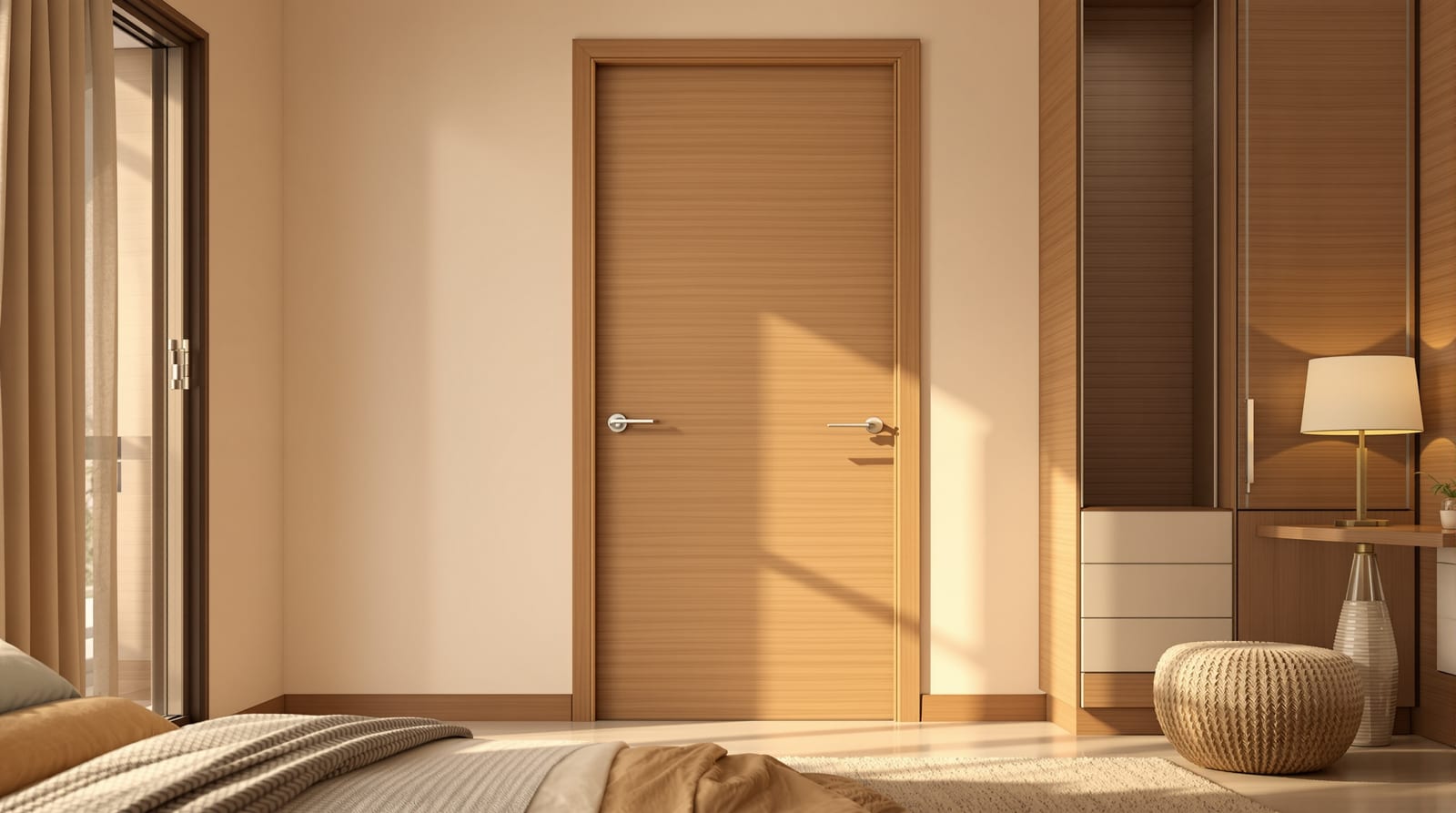
Flush Doors for Indian Homes: Construction, Cost and Buying Guide (IS 2202)
What a flush door actually is, why solid core beats cellular core, how veneer and laminate finishes change the price, and where flush doors belong in an Indian home.
Walk through almost any Indian home built in the last thirty years and you will pass a dozen flush doors without noticing one. That is the point of them. A flush door is the plain, flat, factory-made door - no raised panels, no glazing, just a smooth skin over a hidden core - that has quietly become the default for bedrooms, bathrooms, kitchens and every internal opening that does not need to make a statement. It is cheap, light, quick to fit and easy to paint or finish. But "flush door" hides a huge quality range: the ₹1,200 hollow-core shutter that sounds like a drum and warps in the first monsoon, and the ₹8,000 solid-core veneered door that feels like furniture, are both, technically, flush doors. This guide explains exactly what separates them so you do not pay for one and get the other.
What a flush door actually is
A flush door is a sandwich. Two flat skins (the faces you see and touch) are glued under heat and pressure to a core (the structure inside), all held within a perimeter frame of solid timber battens called stiles (the long vertical edges) and rails (the short top and bottom edges). Because the faces are flat and continuous, the door reads as a single clean plane - the opposite of a panel door, where the surface is broken into raised or recessed panels held in a frame.
The Bureau of Indian Standards governs flush doors under IS 2202 (Part 1) for wooden flush door shutters. The standard recognises two core types - solid core and cellular (hollow) core - and sets out tests for things that matter in our climate: adhesion of plies, end immersion, knife test, slamming and a water-resistance soak. A door stamped "IS 2202 marked" from a known mill is a genuinely meaningful guarantee; an unmarked carpenter-made flush door is a gamble on the glue and the core.
Solid core vs cellular (hollow) core - the decision that matters most
The core is what separates a good flush door from a bad one, and it is invisible once the skins are on. There are two families.
A solid core door fills the inside with a continuous slab - usually block board (timber strips edge-glued together), particle board, or for premium doors a flax/agri-fibre slab. It is heavy, feels solid when you knock it, blocks more sound, holds a lock and hinge screws firmly, and resists warping. This is what you want for any door you actually use daily.
A cellular or hollow core door fills the inside with a thin lattice - a cardboard honeycomb or a widely spaced timber grid - with most of the interior empty. It is light, cheap, and fine for a guest-room cupboard or a rarely-used door, but it sounds hollow, dents easily, holds screws poorly, and a lock fitted into the empty centre has almost nothing to bite into. Builders love them because they are cheap to supply across a whole flat; you will regret them in the bedrooms you live in.
| Solid core flush door | Cellular / hollow core flush door | |
|---|---|---|
| Core | Block board, particle board or fibre slab (filled) | Honeycomb cardboard or open timber grid (mostly empty) |
| Weight | Heavy, "thunk" when knocked | Light, drum-like hollow sound |
| Sound insulation | Good - real privacy between rooms | Poor - voices and TV carry through |
| Holds locks / hinges | Firmly, anywhere on the leaf | Only at the lock block; screws strip out elsewhere |
| Warp / dent resistance | High | Low - dents and bows easily |
| Cost (shutter, basic) | ₹2,500-4,000 | ₹1,200-2,200 |
| Best use | Bedrooms, bathrooms, daily-use internal doors | Cupboard doors, low-traffic / temporary openings |
The single best test in a showroom costs nothing: knock on the middle of the leaf. A solid core gives a dull, dense thud; a hollow core rings like a box. Then ask to see the IS 2202 marking and whether the core is solid block board.
Skins: plywood, MDF and HDF
The skin is the face material glued over the core. It decides how flat the door looks, how well it survives knocks and water, and what finish it can take.
- Plywood skin (commercial or BWR/BWP): the traditional Indian choice. Cross-bonded veneers make it strong and screw-friendly. Insist on BWR (boiling water resistant) or BWP (boiling water proof, marine grade, IS 710) grade for any door near moisture - bathrooms, kitchens, ground floors prone to seepage. Plain "MR / commercial" plywood is fine only for dry internal rooms.
- MDF skin (medium-density fibreboard): very smooth and flat, takes laminate and paint beautifully, and is dimensionally stable - so the door face stays dead flat. Its weakness is water: ordinary MDF swells badly if the edge is exposed and gets wet, which is why MDF-skinned doors are best kept to dry rooms unless they are moisture-resistant (HMR) grade and well sealed.
- HDF skin (high-density fibreboard): denser and harder than MDF, often used as the moulded or pre-finished skin on factory doors and "membrane" / "skin" doors. It gives a hard, smooth, consistent face and resists dents better than MDF, at a slightly higher price.
A common premium build in India is a block-board solid core with BWP plywood skins and a teak or walnut veneer - solid, stable, water-tolerant and beautiful. A common budget build is a hollow core with commercial-ply or MDF skin and a laminate - light and cheap. The skin and core together, not the brochure name, tell you which you are getting.
Veneer vs laminate finish
Once the door is built, the visible surface is created one of two ways, and this is where most of the price and most of the looks live.
Natural veneer is a paper-thin slice of real wood (teak, walnut, oak, rosewood) glued to the skin and then polished. It shows genuine grain, can be matched leaf-to-leaf, and looks like solid timber at a fraction of the cost. It needs polishing, can fade or stain, and a deep scratch shows the wood beneath - but a veneered flush door is the closest a flush door gets to looking like furniture.
Laminate (decorative high-pressure laminate, the "Sunmica" family) is a printed, resin-impregnated sheet pressed onto the skin. It is tougher than veneer - scratch, water and stain resistant, no polishing - and comes in hundreds of wood-look, solid-colour and textured options. It can look slightly "printed" up close and the same pattern repeats, but for bathrooms, children's rooms and rentals its durability wins. A laminated flush door is wipe-clean and forgiving.
| Finish | Look | Durability | Maintenance | Typical cost premium (per shutter) |
|---|---|---|---|---|
| Paint / enamel | Plain, any colour | Medium (chips at edges) | Repaint every few years | Lowest |
| Laminate | Wood-look or colour, slight repeat | High - scratch & water resistant | Wipe clean, none | +₹800-2,500 |
| Natural veneer | Real grain, premium | Medium - scratches show, needs polish | Periodic polish | +₹2,500-5,000 |
| PU / lacquer over veneer | Rich, deep, durable sheen | High | Low | +₹4,000-6,000 |
Where flush doors belong in an Indian home
Flush doors are internal-door specialists. They are the right answer for bedrooms, bathrooms, kitchens, store rooms and utility doors - openings where you want a clean, affordable, easily-finished door and do not need it to impress visitors or stop a burglar. For a quick view of which door suits each opening, see the interior doors by room guide.
They are the wrong answer for your main entrance. A flush door - even solid core - cannot match the mass, security and presence of a solid-wood, teak or panel main door, and it looks underwhelming as the face of a home. For the front door, read the main door design guide and, before you finalise its direction, the entrance Vastu guide - tradition (and good sense) favours a substantial, largest-in-the-house main door, which a thin flush leaf simply is not.
A few placement notes specific to our homes:
- Bathroom doors must have a BWR/BWP plywood core-edge and a laminate or PU finish; an unsealed MDF or commercial-ply flush door near a bathroom is the classic monsoon-swelling failure.
- Pooja room: many families prefer a panel or carved pooja door over a plain flush leaf, often with an even number of leaves per Vastu custom; a veneered flush door is an acceptable modern compromise.
- Standard sizes (NBC 2016 / common practice): bedroom/internal 900 mm x 2100 mm (3' x 7'); bathroom 700-750 mm x 2000-2100 mm; kitchen/utility 800-900 mm wide. Most mills stock flush doors in these and trim to your frame; see door size standards.
Cost: what a flush door really costs in 2026
Costs below are indicative shutter (leaf) prices - material plus make - for 2026, and vary by city, brand and finish. Frame, hardware, fitting and the usual 18% GST are extra and often add ₹3,000-9,000 per door. Treat every figure as a range.
| Flush door build | Indicative shutter price | Notes |
|---|---|---|
| Hollow / cellular core, commercial ply, paint | ₹1,200-2,200 | Cupboards, low-use only |
| Solid block-board core, BWR ply, paint/laminate | ₹2,500-4,000 | The sensible bedroom/bathroom default |
| Solid core, BWP ply skin, natural veneer | ₹4,000-7,000 | Veneered, furniture-like |
| Designer / PU-lacquered veneer, premium brand | ₹7,000-9,000+ | Show-bedroom, master suite |
| WPC flush door (waterproof, termite-proof) | ₹2,000-4,500 (≈₹75-150/sq ft) | Wet areas; see WPC note below |
To budget the whole opening - shutter plus chowkat (frame at ₹350-900 per running foot), hinges, lock, handle and ₹800-3,000 of fitting labour - use the door cost guide for 2026 or the door cost calculator at /utilities/door-cost-calculator. Compare installed costs, not shutter prices.
Moisture and termites: the two Indian killers
Two things end flush doors early in India, and both are avoidable.
Monsoon moisture and swelling. A flush door is only as waterproof as its weakest edge. Cores and skins drink water through unsealed bottom edges and unprotected MDF, then swell, delaminate and bow. Defences: choose BWR/BWP (IS 710 marine) ply, insist the bottom edge is sealed/lipped (not left raw against a wet floor), keep a small gap above the finished floor, and in genuinely wet zones consider a WPC door (wood-plastic composite) - factory-flat, fully waterproof and a direct flush-door substitute for bathrooms and ground floors.
Termites. Block board and ply cores are cellulose - termite food. In termite-prone regions, prefer WPC (immune), specify borate / chemically-treated cores, keep door bottoms off damp floors, and treat the surrounding masonry. A solid-wood panel door in naturally resistant timber like teak is also more termite-tolerant than a cheap flush leaf, which is one more reason flush doors are best kept to dry, well-ventilated internal rooms. The broader trade-offs sit in the door materials comparison and engineered-wood lifecycle costing.
Buying tips: a quick checklist
- Knock the centre - dull thud (solid) good, hollow ring bad, unless you deliberately want a cheap cupboard door.
- Demand the IS 2202 mark and ask whether the core is block board and the ply is BWR/BWP grade.
- Check the lock block - a proper solid timber block where the handle/lock goes; without it the lock loosens within months.
- Look across the face in raking light for flatness; MDF/HDF-skinned doors should be dead flat.
- Confirm edge banding on all four edges (a lipping of matching timber/laminate) - exposed core edges swell and chip.
- Match the finish to the room - laminate or WPC for wet/high-traffic, veneer for show bedrooms.
- Buy slightly oversize if your frame is non-standard; mills trim down far more easily than they add.
- Get it in writing that price includes edge sealing and the IS grade you were promised, then compare the installed quote against a panel door for the same opening.
Frequently asked questions
Are flush doors good for Indian homes?
Yes, for internal openings. A solid-core, BWR/BWP-skinned, IS 2202 flush door is an excellent, affordable, clean-looking choice for bedrooms, kitchens and (when sealed and laminated or WPC) bathrooms. They are not suitable for main entrances, where mass, security and presence call for a solid-wood, teak or panel door.
What is the difference between a solid core and a hollow core flush door?
A solid core is filled with block board or a fibre slab - heavy, sound-blocking, holds locks and hinges firmly, resists warping. A hollow (cellular) core is mostly empty honeycomb - light, cheap, drum-like, and a poor holder of screws. For any door you use daily, choose solid core; reserve hollow core for cupboards and low-traffic openings.
Veneer or laminate finish - which is better?
Laminate is tougher (scratch, water and stain resistant, no polishing) and cheaper, so it wins for bathrooms, children's rooms and rentals. Natural veneer shows real wood grain and looks premium, but it scratches more easily and needs occasional polishing. For show bedrooms choose veneer; for hard-working rooms choose laminate.
How much does a flush door cost in India in 2026?
Indicatively, ₹1,200-2,200 for a hollow-core basic shutter, ₹2,500-4,000 for a sensible solid-core BWR-ply door, and ₹4,000-9,000+ for veneered or designer doors - shutter only. Add frame, hardware, fitting and 18% GST (often ₹3,000-9,000 more) for the installed price. Figures are indicative and vary by city and vendor.
Do flush doors survive the monsoon and termites?
Only the right build does. Use BWR/BWP (IS 710 marine) ply, insist the bottom edge is sealed, keep the door off a wet floor, and for genuinely wet or termite-prone areas switch to a WPC flush door, which is waterproof and termite-immune. An unsealed commercial-ply or MDF flush door near water is the most common early failure in Indian homes.
Export this guide
Related Guides — Deep-dive reading
The Complete Home Door Guide for Indian Homes (2026): Types, Materials, Cost, Security & Vastu
Everything an Indian homeowner needs to specify the right door for every opening — from main entrance to bathroom — with real 2026 prices, IS/NBC standards and Vastu sense.
Home Doors & EntrancesDoor Repair Guide India: Fix Holes, Dents, Swelling, Hinges & Locks (2026)
A fix-it reference for Indian homes: every common door problem with a quick fix, a proper repair, a replace verdict, the materials needed, and indicative rupee costs.
Home Doors & EntrancesVeneer Doors in India (2026): Natural Wood Looks, Finishing, Cost & Care
Why a thin slice of real wood over a flush door gives the warmest premium internal-door look in Indian homes — and what it takes to keep it that way.
Home Doors & EntrancesRelated Tools — Try Free
Door Cost Calculator
Estimate the all-in cost of a door — leaf, frame, hardware, fitting and GST — by type, material and size.
Door CalculatorMaterial Comparison Sheet
India's interior material cheatsheet — plywood, finishes, hardware, countertops, paints, waterproofing.
Reference GuideDoor Material Comparison Tool
Compare 2–4 door materials on cost, durability, maintenance, security and moisture resistance.
Comparison Tool