
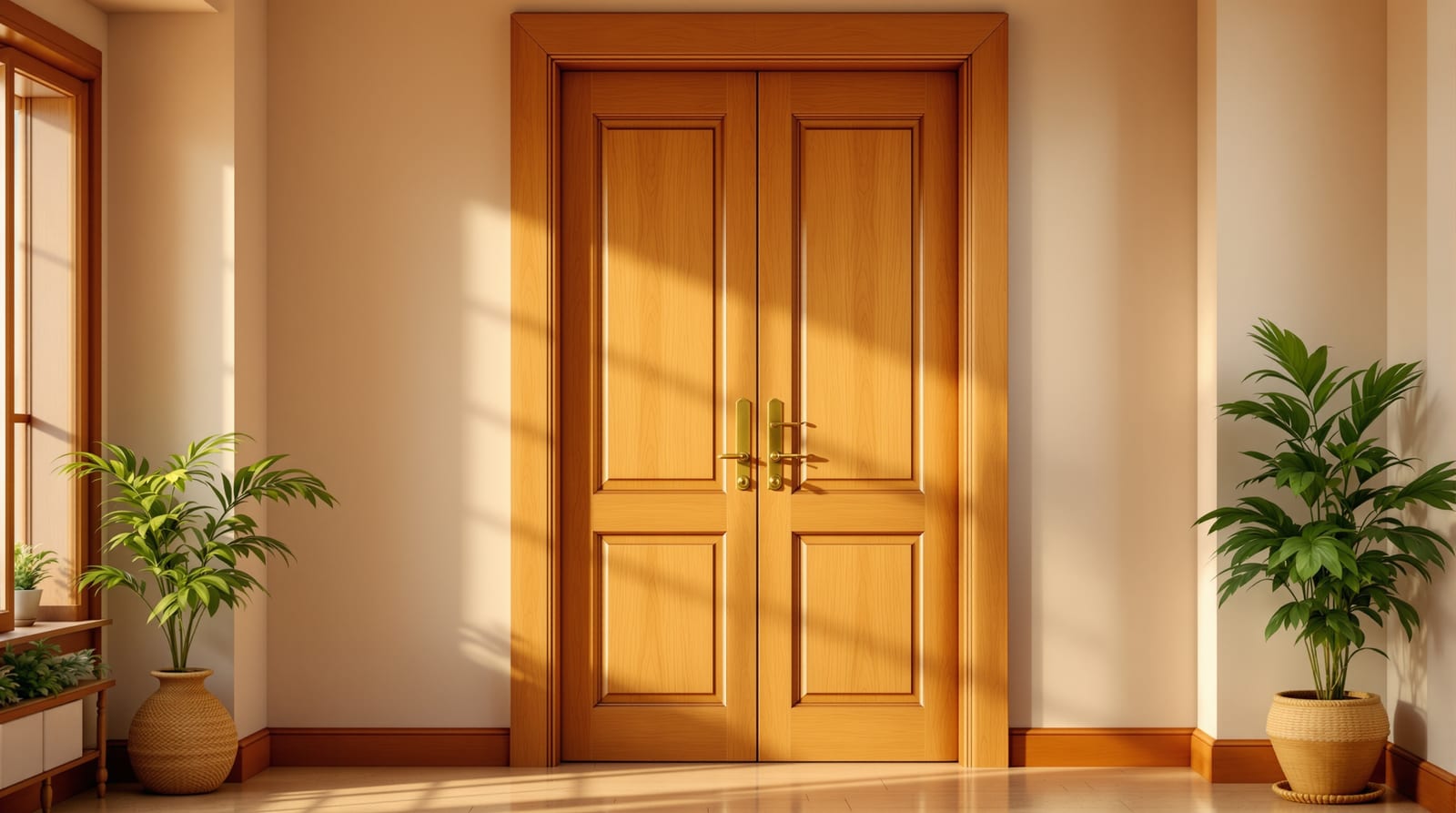
Wooden Doors for Indian Homes: Best Woods, Cost, Finishes & Care (2026)
A homeowner's guide to choosing real timber doors - teak, sal, sheesham, mango, rubberwood, pine and deodar - with seasoning, termite and monsoon facts, solid vs engineered, finishes (polish, melamine, PU) and ₹ costs by wood.
There is a reason a real wooden door still says "this is a home" in a way that no flush panel or moulded shutter quite manages. Timber is warm to the touch, it ages instead of just wearing out, and a well-seasoned hardwood door can outlast the person who installed it. But "wooden door" covers everything from a ₹6,000 rubberwood panel to a ₹1.5 lakh carved Burma teak main door, and the gap between them is mostly invisible at the showroom: it lives in the species, the seasoning, the joinery and the finish. This guide walks through the seven woods you will actually be offered in India, what each is good and bad at, what it should cost in 2026, and how to keep it from swelling shut in the first monsoon.
What "solid wooden door" really means
A genuine wooden door is made from natural sawn timber - planks cut from a tree, planed, jointed and assembled - not from boards reconstituted out of fibre or particles. In Indian homes it almost always takes one of two forms. A panelled door has a frame of vertical stiles and horizontal rails holding floating panels (governed by IS 1003 Part 1 for timber panelled and glazed shutters); the floating panels let the wood expand and shrink with the seasons without cracking. A plank or batten door is built from solid boards held by ledges, common for traditional and rustic looks.
This is different from a flush door, which is a hollow or block-board sandwich with a thin skin, and different again from an engineered wood door, where a stable manufactured core is wrapped in a real-wood veneer. Solid timber is the most beautiful and repairable of the three, and also the most demanding: it moves with humidity, it costs the most per square foot, and a badly seasoned piece will warp no matter how good the carpenter is. For a full leaf-by-leaf view across all materials, see the door materials comparison.
The seven woods you will actually be offered
India's door timber falls into a clear hierarchy, from premium hardwoods down to soft and budget woods. Here is the honest version of each.
Teak (sagwan) is the benchmark. It is dense, dimensionally stable, naturally oil-rich (which makes it resist water, termites and decay better than almost anything), and it takes a finish beautifully. Burma teak is the gold standard; Central Province (CP) and African/plantation teak are more affordable. It is also the most expensive and the most faked - "teak" at a suspiciously low price is usually a cheaper wood stained to imitate it. Worth its own deep dive: teak wood doors.
Sal (sakhua) is the workhorse hardwood of north and east India. It is extremely hard, heavy and strong, and it is the default timber for door frames (chowkat) across much of the country because it holds screws and resists rot. As a door leaf it is tough and good value, though heavier and less refined-looking than teak, and harder to carve.
Sheesham (Indian rosewood) is a dense, beautifully grained hardwood, naturally fairly durable and termite-resistant, widely used in north India for doors and furniture. It looks rich and dark, but it must be very well seasoned - poorly dried sheesham can warp and check - and good stock has become pricier as supply tightens.
Mango wood (aam) is a mid-density hardwood, sustainable and cheap because mango orchards are replanted, with an attractive grain. It is fine for interior doors and panels, but it is only moderately durable, prone to fungal staining and borer if not treated, and not a great choice for an external door in a wet climate.
Rubberwood is plantation timber from spent rubber trees - eco-friendly, even-grained and inexpensive. It machines well and is common in factory-made doors and engineered components, but in its raw state it is highly prone to fungus, borer and decay, so it must be chemically treated (kiln-dried and boron/preservative treated) to be usable. Good for budget interior doors, never for an untreated exterior door.
Pine (chir/cheel) is a soft, light, low-cost softwood, easy to work and to paint, often imported. It is fine for a budget interior or a painted cottage-style door, but it dents easily, is not naturally durable, and absorbs moisture - poor for bathrooms, kitchens and external use unless very well sealed.
Deodar (Himalayan cedar) is a lovely aromatic softwood from the hills, naturally insect- and decay-resistant thanks to its oils, and historically prized in north Indian and Himalayan architecture. It is lighter and softer than the hardwoods, dimensionally stable, and good for doors and frames, but supply is restricted and it is pricier than other softwoods.
Wood comparison table
Costs below are indicative for the door leaf only (material plus making), per square foot of shutter, and vary widely by city, grade and vendor; frame, hardware, finish and 18% GST are extra.
| Wood | Type / hardness | Natural durability | Termite / borer resistance | Moisture stability | Indicative leaf cost (₹/sq ft) | Best used for |
|---|---|---|---|---|---|---|
| Teak (Burma/CP) | Hardwood, hard | Excellent | Excellent (oily) | Excellent | 800 - 1,500+ | Main door, premium internal, wet zones |
| Sal | Hardwood, very hard | Very good | Good | Good (heavy) | 350 - 700 | Frames (chowkat), tough internal/external |
| Sheesham | Hardwood, hard | Good | Good | Good if well seasoned | 500 - 1,000 | Decorative internal, carved doors |
| Mango | Hardwood, medium | Moderate | Low (needs treatment) | Moderate | 250 - 500 | Budget internal doors, panels |
| Rubberwood | Hardwood, medium | Low (raw) | Low - must be treated | Good once kiln-dried | 200 - 450 | Budget interior, engineered cores |
| Pine | Softwood, soft | Low | Low | Poor (absorbs water) | 150 - 350 | Painted/budget interior, cottage style |
| Deodar | Softwood, medium | Good (aromatic oils) | Good | Good | 400 - 800 | Hill-region doors and frames |
A quick rule of thumb: for a main entrance that faces weather and matters for security and looks, teak (or well-treated sal) earns its premium. For everyday internal doors, sheesham, mango or treated rubberwood give real-wood character at sensible cost. Avoid raw pine and untreated mango/rubberwood anywhere that gets wet.
Seasoning, moisture and termites - the three things that ruin wooden doors
Most "the door warped / swelled / cracked" complaints trace back to one of three failures, and all are avoidable.
Seasoning (drying) is the single biggest factor. Freshly cut timber holds a lot of water; as it dries it shrinks and can twist, cup and crack. Properly kiln-seasoned timber is dried to roughly 8-12% moisture content - stable enough to hold its shape through the seasons. Air-seasoned timber takes far longer and is less consistent. The cheapest doors are often made from under-seasoned wood, which is precisely why they warp in their first year. Ask the vendor whether the timber is kiln-seasoned, and be wary of a "solid wood" door priced like a flush door.
Moisture and the monsoon. Even seasoned wood breathes - it absorbs humidity in the rains and gives it back in dry months, which is why a wooden door can stick or swell in July and ease off by November. You manage this, not eliminate it: leave a small expansion gap at fitting, seal all six faces of the leaf (including the top and bottom edges, which carpenters routinely forget), and keep a quality finish intact so water cannot soak into the end grain. In coastal and high-rain regions, naturally oily woods like teak and deodar cope far better than pine or mango.
Termites and borer are an Indian constant. Naturally resistant woods (teak, deodar, sal, sheesham) carry their own defence; vulnerable woods (rubberwood, mango, pine, sapwood of any species) must be boron/preservative treated at the mill and ideally protected by treating the frame and the wall junction. A termite-proof finish on the surface does nothing if the inside of the door is untreated edible wood.
Solid wood vs engineered wood - which to buy
You do not always need full solid timber. Engineered wood doors wrap a stable manufactured core (block board, MDF, HDF or finger-jointed timber) in a real-wood veneer. The advantage is dimensional stability - they barely warp because the core does not move like a single slab - plus lower cost and a consistent grain. The trade-off is repairability and feel: you cannot deeply sand or re-carve a veneer, and a soaked MDF core swells permanently.
As a rough split: choose solid wood where you want longevity, carving, a heavy reassuring main door, or a leaf you can plane and re-finish for decades. Choose engineered where you want a stable, value-for-money internal door with a real-wood look and minimal warping. Many Indian homes mix the two - solid teak main door, engineered veneered internal doors. The economics over a door's life are covered in the engineered-wood lifecycle costing guide.
Finishes - polish, melamine and PU
The finish is not decoration; on a wooden door it is the waterproofing and the wear layer. Three dominate Indian work.
Traditional polish (French/PU polish, or lacquer) is the classic hand-applied finish, often shellac-based for that warm, deep, slightly matte glow. It looks gorgeous on teak and sheesham and is easily re-coated, but it is the least water- and scratch-resistant, so it suits dry interior and decorative doors more than a weather-facing entrance.
Melamine is a popular mid-tier finish - a clear coat sprayed and cured that is harder and more moisture-resistant than polish, available in matte to glossy. It is the everyday default for internal wooden doors: durable enough, affordable, and it keeps the natural grain visible.
PU (polyurethane) is the toughest of the three - a thick, chemically cured film that resists water, scratches, abrasion and UV far better, which is why it is the right choice for a main door and any wet-zone door. It costs more and is harder to patch-repair, but it gives the longest protection. For external doors, a PU or marine-grade finish, with the end grain sealed, is what stands up to sun and rain.
Whatever the finish, it only works if the wood under it is sealed on all faces and kept maintained - a peeling finish lets water into the timber and starts the swelling-and-rot cycle.
Where each wooden door belongs in an Indian home
| Opening | Recommended wood / build | Why |
|---|---|---|
| Main entrance | Solid teak (or treated sal); PU/marine finish | Weather, security, longevity, kerb appeal; oily woods resist rain and termite |
| Pooja room | Carved teak or sheesham, even number of panels | Tradition and reverence; see pooja room door guide |
| Bedrooms | Solid sheesham / engineered veneer; melamine finish | Real-wood feel, good sound, stable, value |
| Bathroom / WC | Treated rubberwood or engineered; PU finish - or avoid solid timber for WPC | Wet zone; raw timber swells, needs heavy sealing |
| Kitchen / utility | Treated hardwood or engineered; washable finish | Heat, steam, grease - durable wipeable finish |
| Balcony / external | Teak or deodar; marine/PU finish | Sun and rain exposure; naturally durable woods only |
For door direction and threshold tradition - main door best in the north, east or north-east, opening inward, an even number of leaves, a threshold (dehleez) - follow the dedicated entrance Vastu guide, which sets out the belief and the practical reasoning. Wooden doors also have to work with the windows around them; the windows and doors design relationship covers proportion and light.
What a wooden door actually costs in 2026
For the leaf only, real solid wood starts around ₹800 per square foot and climbs steeply with species and carving. A standard 3' × 7' solid wood internal door works out to roughly ₹10,000-25,000 made up; a teak main door with a carved face and good finish runs ₹25,000 to well over ₹1,00,000 installed. Engineered veneered doors are cheaper and steadier. On top of the leaf you pay for:
- Frame (chowkat): sal or teak roughly ₹350-900 per running foot; a standard frame uses about 17-18 ft.
- Hardware: hinges, handle, lock, stopper - around ₹1,500-8,000 depending on quality.
- Fitting labour: about ₹800-3,000 per door.
- Finish: polish/melamine/PU adds material and labour on top, more for a hand-polished or PU-coated main door.
- GST: typically 18% on factory-made doors and components.
These are indicative and vary by city and vendor; price by the finished installed door, not the showroom sticker. To sanity-check a quote you can use the Studio Matrx door cost calculator and compare species side by side with the door material comparison tool. For the bigger picture across all door types, see the 2026 door cost guide.
Caring for a wooden door so it lasts decades
Wooden doors reward small, regular attention. Re-coat the finish before it wears through - usually every few years for melamine, longer for PU - so water never reaches bare wood. Wipe with a barely-damp cloth, never a soaking one, and dry it. In the monsoon, if a door starts to stick, resist planing it down immediately; much of the swelling reverses as humidity drops, and over-planing leaves a gappy door in winter. If it must be eased, plane the latch edge minimally and re-seal the cut. Treat the frame and wall junction against termites when you treat the door, oil teak occasionally to keep its glow, and keep weep paths and thresholds clear so water drains away rather than sitting against the timber.
Frequently asked questions
Which is the best wood for doors in India?
For a main entrance, teak is the benchmark - dense, naturally oily, termite- and water-resistant, and beautiful. Well-treated sal is a tougher, cheaper alternative for frames and hard-wearing doors. For internal doors, sheesham, treated mango or rubberwood, or an engineered veneer give real-wood character at lower cost. Match the wood to the opening: oily hardwoods for wet and external doors, value hardwoods for dry internal ones.
Why does my wooden door swell and stick in the monsoon?
Wood absorbs humidity and expands, then releases it and shrinks in dry months - so a door can stick in the rains and ease by winter. The cure is prevention: use kiln-seasoned timber, seal all six faces (especially the top and bottom end grain), keep a small expansion gap, and maintain the finish so water cannot soak in. Naturally oily woods like teak and deodar swell far less than pine or mango.
Is a solid wood door better than an engineered or flush door?
It depends on the opening. Solid wood is the most durable, repairable and characterful, and it is the right call for a main door or any door you want to last decades. Engineered wood barely warps and costs less, making it ideal for internal doors. Flush doors are the cheapest and lightest for plain internal use. Many homes sensibly mix a solid teak main door with engineered or flush internal doors.
What finish should a wooden main door have?
PU (polyurethane) for external and wet-zone doors - it is the most water-, scratch- and UV-resistant. Melamine is the durable, affordable default for internal doors and keeps the grain visible. Traditional polish gives the warmest look but the least protection, so reserve it for dry decorative interiors. Whatever you choose, the wood must be sealed on every face for the finish to actually protect it.
How much does a solid wooden door cost in India in 2026?
Indicative and varying by city and species: the leaf alone starts around ₹800 per square foot, so a standard 3' × 7' solid wood internal door is roughly ₹10,000-25,000, while a carved teak main door can run ₹25,000 to over ₹1,00,000 installed. Add the frame (₹350-900 per running foot), hardware (₹1,500-8,000), fitting (₹800-3,000) and 18% GST, and price by the finished installed door rather than the showroom tag.
Export this guide
Related Guides — Deep-dive reading
The Complete Home Door Guide for Indian Homes (2026): Types, Materials, Cost, Security & Vastu
Everything an Indian homeowner needs to specify the right door for every opening — from main entrance to bathroom — with real 2026 prices, IS/NBC standards and Vastu sense.
Home Doors & EntrancesDoor Repair Guide India: Fix Holes, Dents, Swelling, Hinges & Locks (2026)
A fix-it reference for Indian homes: every common door problem with a quick fix, a proper repair, a replace verdict, the materials needed, and indicative rupee costs.
Home Doors & EntrancesWooden Door Frames in India: Species, Cost & Care (India 2026)
How to choose, season and treat a timber chowkhat that survives India's termites, monsoon and heat — and what it costs per running foot.
Home Doors & EntrancesRelated Tools — Try Free
Door Material Comparison Tool
Compare 2–4 door materials on cost, durability, maintenance, security and moisture resistance.
Comparison ToolCross-Ventilation Analyzer
Estimate airflow and air changes per hour (ACH) from room size, window areas, layout, and local wind — with NBC 2016 Part 8 compliance check.
Ventilation CalculatorDoor Cost Calculator
Estimate the all-in cost of a door — leaf, frame, hardware, fitting and GST — by type, material and size.
Door Calculator