
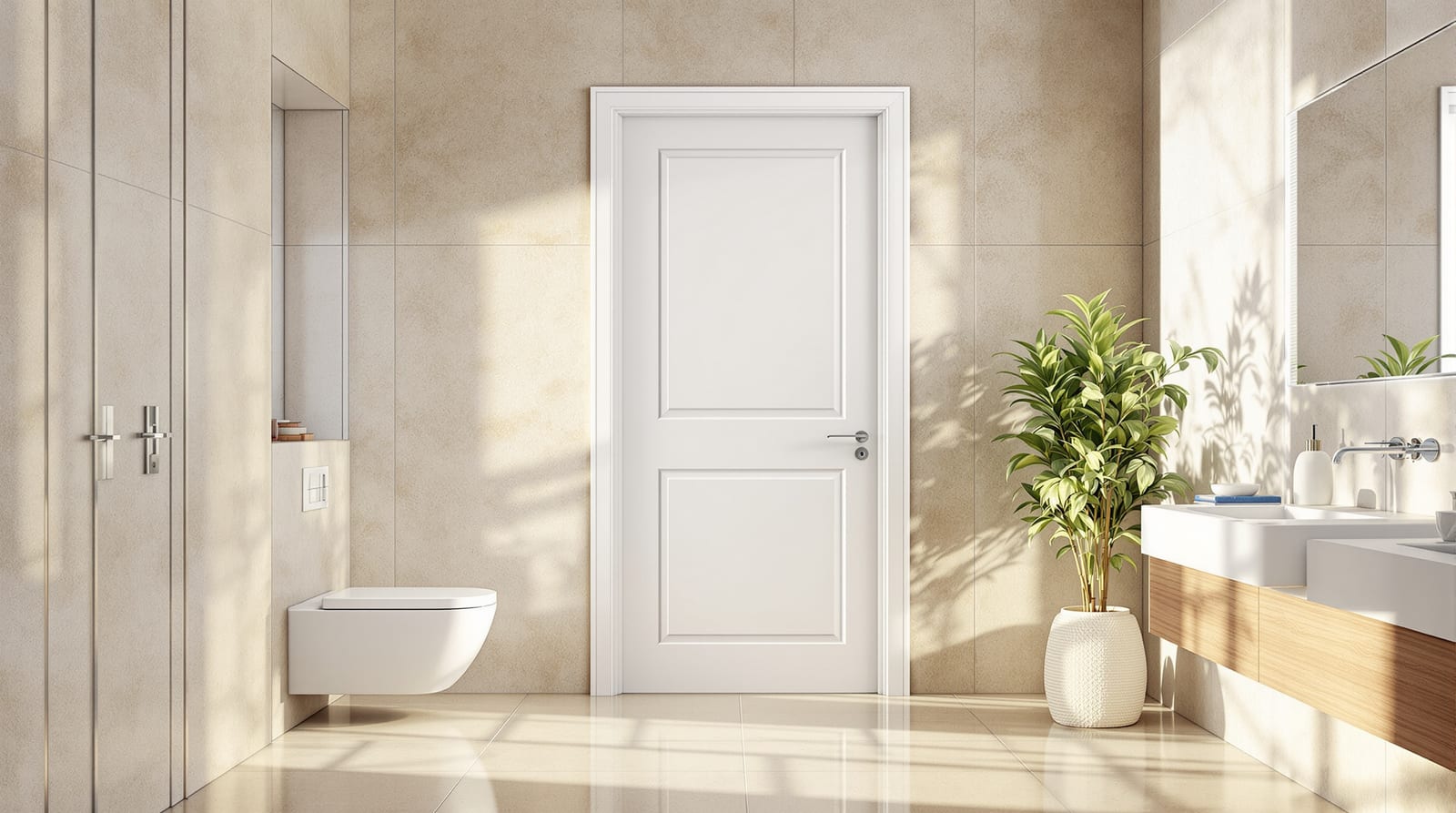
WPC Doors for Indian Homes: 100% Waterproof, Termite-Proof, and Where They Belong
Wood-plastic composite doors and frames promise zero swelling, zero termites and a low price - here is what that really means, where the screw-holding catch bites, and how WPC compares with wood and flush doors in 2026.
Ask any builder in Mumbai, Kochi or Chennai which door goes into the bathroom and the answer comes back in two letters: WPC. Wood-plastic composite has quietly become the default for every wet, humid or termite-prone opening in the Indian home, and it earned that spot honestly - it does not swell in the monsoon, it does not rot, and termites have no interest in it because there is almost no real wood for them to eat. It is also cheap. But "100% waterproof, 100% termite-proof" is a slogan that hides a real catch about how WPC holds a screw, and a wide quality gap between a dense, branded shutter and a foamed-up factory second. This guide walks through what WPC actually is, where it genuinely belongs, the density grades that separate good from bad, and how it stacks up against solid wood and ordinary flush doors.
What WPC actually is
WPC stands for wood-plastic composite. The recipe is a blend of wood flour or fine sawdust (the cheap filler that gives it a wood-like feel and weight), a thermoplastic - usually PVC, sometimes polyethylene - that forms the waterproof matrix, plus calcium carbonate and a handful of additives (foaming agents, stabilisers, UV blockers). The mix is extruded or moulded into a board, then either used as a hollow-or-foamed core under a flat skin (a WPC flush door) or moulded as a complete solid profile (WPC door frames, also called WPC chowkat).
The crucial thing to understand is that WPC is mostly plastic and mineral, with wood present only as a filler. That single fact explains every one of its strengths and its one real weakness. Because the binding matrix is PVC, water cannot get in to swell or delaminate it the way it ruins an ordinary timber or plywood door. Because there is no nutritious cellulose structure for them to colonise, termites and borers ignore it. And because it is foamed plastic, it is lighter, dimensionally stable, and far cheaper than seasoned hardwood - but it also does not grip a screw the way solid timber does.
There is no single dedicated BIS standard that governs WPC doors the way IS 2202 governs wooden flush doors; reputable makers test to the relevant timber-door and FRP-door provisions and quote their own density and water-absorption figures, so brand reputation and a written spec sheet matter more here than a single stamp.
The headline claim, honestly stated
WPC's two big promises are real, with sensible footnotes:
- 100% waterproof. A genuine WPC door will not swell, warp, delaminate or rot from water contact, which is exactly why it owns the bathroom. The board itself does not absorb water. The footnote: the finish and the edges still matter - a poorly sealed laminate edge or a cheap door left standing in a flooded bathroom for days can still look tired, even if it never structurally fails.
- Termite-proof and borer-proof. With no real wood structure to eat, WPC is genuinely immune to termites and powder-post borers - a serious advantage in coastal and high-humidity belts where even teak needs vigilance.
- Fire and chemical behaviour. Good PVC-based WPC is self-extinguishing and resists most household chemicals and salt-laden coastal air. It is not a fire-rated door, though - for a rated fire door you need a tested metallic or non-metallic fire-check door to IS 3614, not a standard WPC shutter.
The one real caveat: screw-holding
This is the single most important sentence in any honest WPC guide: a foamed WPC core does not grip a screw as firmly as solid timber. Over years of slamming, a hinge screwed straight into a low-density WPC stile can loosen, and a heavy mortice lock or a self-closing device can work itself loose if it was fitted carelessly.
This is not a reason to avoid WPC - it is a reason to buy the right grade and fit it properly. Three things solve it:
1. Buy a door with a solid wood or plywood lock-rail and hinge-stiles - better WPC flush doors embed a strip of real timber or HDF exactly where the hinges and lock go, giving the screws something firm to bite. Ask the dealer to confirm this; it is the difference between a door that lasts and one that sags.
2. Use the right fasteners and density. Higher-density doors (see grades below) hold screws far better than foamed budget boards.
3. Fit with care. Pilot-drill, avoid over-torquing power screwdrivers, and use longer screws that reach into a reinforced rail. A good carpenter knows WPC behaves differently from teak and will not just blast screws in.
For the same reason, WPC is the wrong choice for a heavy carved main entrance door that has to carry a big multi-point lock and take decades of forceful use - that is still wood or steel territory. WPC shines on internal and wet-area doors, not the grand front door.
Density and quality grades
Density (measured in kilograms per cubic metre) is the best single proxy for WPC quality - it tracks how much real material is in the board versus how much foam and air. Higher density means a heavier, more solid-feeling door that holds screws better and dents less; lower density means lighter, cheaper and flimsier.
| Grade | Typical density | Feel & use | Screw-holding | Indicative price (shutter) |
|---|---|---|---|---|
| Budget / low-density | ~550-650 kg/m3 | Light, hollow knock; entry-level bathroom doors | Weak - needs reinforced rails | ₹2,000-2,800 |
| Standard / mid | ~700-750 kg/m3 | Solid feel, good for most internal & wet doors | Decent, better with timber lock-rail | ₹2,800-3,800 |
| High-density / premium | ~800-900+ kg/m3 | Heavy, furniture-like; whole-house quality | Good, close to flush-door behaviour | ₹3,800-4,500+ |
Numbers are indicative for a standard single shutter and vary by city, brand and finish. When a dealer cannot tell you the density, treat it as budget grade regardless of the price tag. A genuine high-density WPC door feels noticeably heavier than a cheap one when you lift it - that simple lift test catches most foamed-up fakes.
Finishes: how a plain WPC board becomes a door you like
A raw WPC board is a flat off-white or grey slab; the finish is what you actually see, and it changes both looks and price.
| Finish | What it is | Look | Durability in wet areas | Cost impact |
|---|---|---|---|---|
| Factory paint / PU coat | Sprayed colour or polyurethane | Plain solid colours, smooth | Very good, easy to wipe | Lowest |
| Foil / membrane wrap | Thin printed PVC film vacuum-pressed on | Woodgrain or colour, seamless edges | Good; can peel at edges if cheap | Low-mid |
| Laminate | 0.8-1 mm decorative laminate bonded on | Wide range of woodgrains & solids | Excellent if edges sealed well | Mid |
| Veneer | Real wood veneer (rare on WPC) | Natural timber look | Good, but defeats the maintenance-free point | Highest |
For most Indian homes, a laminate or foil finish in a woodgrain or white is the sweet spot - it gives the maintenance-free, wipe-clean surface that makes WPC worth buying in the first place. Veneer on WPC is unusual: it adds the very upkeep you were trying to escape, so if you want a true wood look choose a wooden door or engineered-wood door instead.
Where WPC genuinely belongs
WPC is not a do-everything door; it is a brilliant fit for specific situations and a poor one for others.
- Bathrooms and WCs - the flagship use. Constant splashing, steam and standing water destroy ordinary flush and panel doors over a few years; WPC simply does not care. This alone justifies WPC in nearly every Indian bathroom.
- Balconies, utility areas and wash spaces. Anywhere semi-open to monsoon rain and sun, WPC outlasts timber. Confirm UV-stabilised grade for sun-exposed faces.
- Coastal homes. In Goa, Kerala, coastal Karnataka, Chennai and the Konkan, salt air and humidity wreck timber and rust steel; WPC's immunity to both moisture and termites makes it a standout choice for whole-house internal doors near the sea.
- Budget whole-house fit-outs and rentals. When you need every internal door fitted reliably for the lowest sensible cost - student housing, rental flats, builder-grade apartments - WPC at standard grade is hard to beat on cost-per-year.
- Door frames (chowkat). A WPC frame never swells, rots or hosts termites at the floor line where timber frames usually fail first. WPC and steel frames are uniform and cheaper than a sal or teak chowkat, which is a strong reason to specify them even behind a wooden shutter in wet areas.
Where WPC does not belong: heavy carved main entrance doors, fire-exit doors that need a rating, and any opening where you want the warmth and gravitas of real timber. For a Vastu-led main door - traditionally the largest in the house, ideally in the north, east or north-east and opening inward - most families still prefer solid wood; see entrance Vastu and our main door design guide before defaulting to WPC at the front.
WPC vs wood vs flush doors
The honest comparison most buyers actually want:
| Factor | WPC door | Solid wood / teak | Plywood flush door |
|---|---|---|---|
| Waterproof | Yes - 100% | No - swells, can rot | No - swells unless marine ply |
| Termite-proof | Yes | No (teak resists, not immune) | No |
| Screw-holding | Weak unless reinforced | Excellent | Good (solid core) |
| Feel / warmth | Plasticky, lighter | Premium, warm, heavy | Neutral, depends on finish |
| Main-door suitability | Poor | Excellent | Fair |
| Wet-area suitability | Excellent | Poor | Poor |
| Price (per shutter) | ₹2,000-4,500 | ₹10,000-25,000+ | ₹1,200-4,000 |
| Maintenance | Wipe clean, none | Periodic polish/oil | Repaint/refinish |
Prices are indicative for 2026 and exclude frame, hardware and ~18% GST. The pattern is clear: WPC wins decisively on water, termites and price; wood wins on feel, screw strength and main-door presence; ordinary flush doors are cheapest for dry internal rooms but fail in wet areas. Many Indian homes now mix them sensibly - teak or a designer flush door for the bedrooms and a veneered main door up front, WPC for every bathroom, balcony and utility door. For the full side-by-side across all materials, see our door materials comparison, and to settle the single best pick for your situation, the best door material guide.
Buying and fitting WPC well
A few practical checks separate a door that lasts twenty years from a regret:
- Ask for the density figure in writing and do the lift test - a heavy door is a good door.
- Confirm a reinforced timber or HDF lock-rail and hinge-stiles so screws have something to bite.
- Specify a sealed-edge laminate or factory PU finish, not a cheap foil that peels at the bathroom-side edge.
- Pair it with a WPC or steel frame in wet areas so the whole assembly is waterproof, not just the shutter.
- Use a carpenter who has fitted WPC before - pilot-drilling and correct screws matter more here than with timber.
- Standard sizes apply: bathroom doors are typically 700-750 mm x 2000-2100 mm and bedroom doors 900 mm x 2100 mm under NBC 2016 practice; you can plan exact openings with our door size standards guide.
Budget the full job, not just the shutter: a standard WPC bathroom door installed - shutter ₹2,500-3,500, WPC frame, hinges, lock and ₹800-1,500 fitting labour - usually lands around ₹5,000-8,000 all-in, indicative and varying by city and vendor.
Frequently asked questions
Are WPC doors really 100% waterproof?
Yes - the composite board itself does not absorb water, swell, warp or rot, which is why WPC is the standard bathroom door across India. The only weak points are a poorly sealed laminate edge or hardware, so buy a sealed-edge finish and a matching WPC or steel frame for a fully waterproof assembly.
Why do people say WPC doesn't hold screws?
A foamed WPC core grips screws less firmly than solid timber, so hinges and locks can loosen over years if fitted carelessly. The fix is to buy a door with a reinforced timber or HDF lock-rail and hinge-stiles, choose a higher-density grade, and have it pilot-drilled and fitted properly. Done right, screw-holding is a non-issue.
Can I use a WPC door as my main entrance door?
It is not the ideal choice. WPC is light, has weaker screw-holding for heavy multi-point locks, and lacks the warmth and presence most families want at the front - especially given Vastu traditions that the main door be the largest and most substantial. WPC excels at bathrooms, balconies, utilities and coastal internal doors; for the main door, prefer solid wood, teak or steel.
Is WPC cheaper than wood?
Much cheaper. A WPC shutter runs about ₹2,000-4,500 versus ₹10,000-25,000-plus for a solid wood or teak door, and WPC needs almost no maintenance. For wet areas and budget whole-house fit-outs the cost-per-year is excellent; for a statement main door, wood still justifies its premium.
How long does a WPC door last in a coastal home?
Very well - WPC's immunity to both moisture and termites makes it one of the best choices for Goa, Kerala, coastal Karnataka and the Konkan, where salt air destroys timber and rusts steel. Choose a UV-stabilised grade for any sun-exposed face and a sealed laminate finish, and a quality high-density WPC door comfortably lasts well over a decade with only wipe-clean care.
Export this guide
Related Guides — Deep-dive reading
The Complete Home Door Guide for Indian Homes (2026): Types, Materials, Cost, Security & Vastu
Everything an Indian homeowner needs to specify the right door for every opening — from main entrance to bathroom — with real 2026 prices, IS/NBC standards and Vastu sense.
Home Doors & EntrancesFlush Doors for Indian Homes: Construction, Cost and Buying Guide (IS 2202)
What a flush door actually is, why solid core beats cellular core, how veneer and laminate finishes change the price, and where flush doors belong in an Indian home.
Home Doors & EntrancesCoastal Region Door Buying in India 2026: Salt-Air Guide
Why cheap flush and MDF doors fail near the sea, and which water-resistant materials and corrosion-proof hardware actually last.
Home Doors & EntrancesRelated Tools — Try Free
Door Cost Calculator
Estimate the all-in cost of a door — leaf, frame, hardware, fitting and GST — by type, material and size.
Door CalculatorDoor Material Comparison Tool
Compare 2–4 door materials on cost, durability, maintenance, security and moisture resistance.
Comparison ToolMaterial Comparison Sheet
India's interior material cheatsheet — plywood, finishes, hardware, countertops, paints, waterproofing.
Reference Guide