
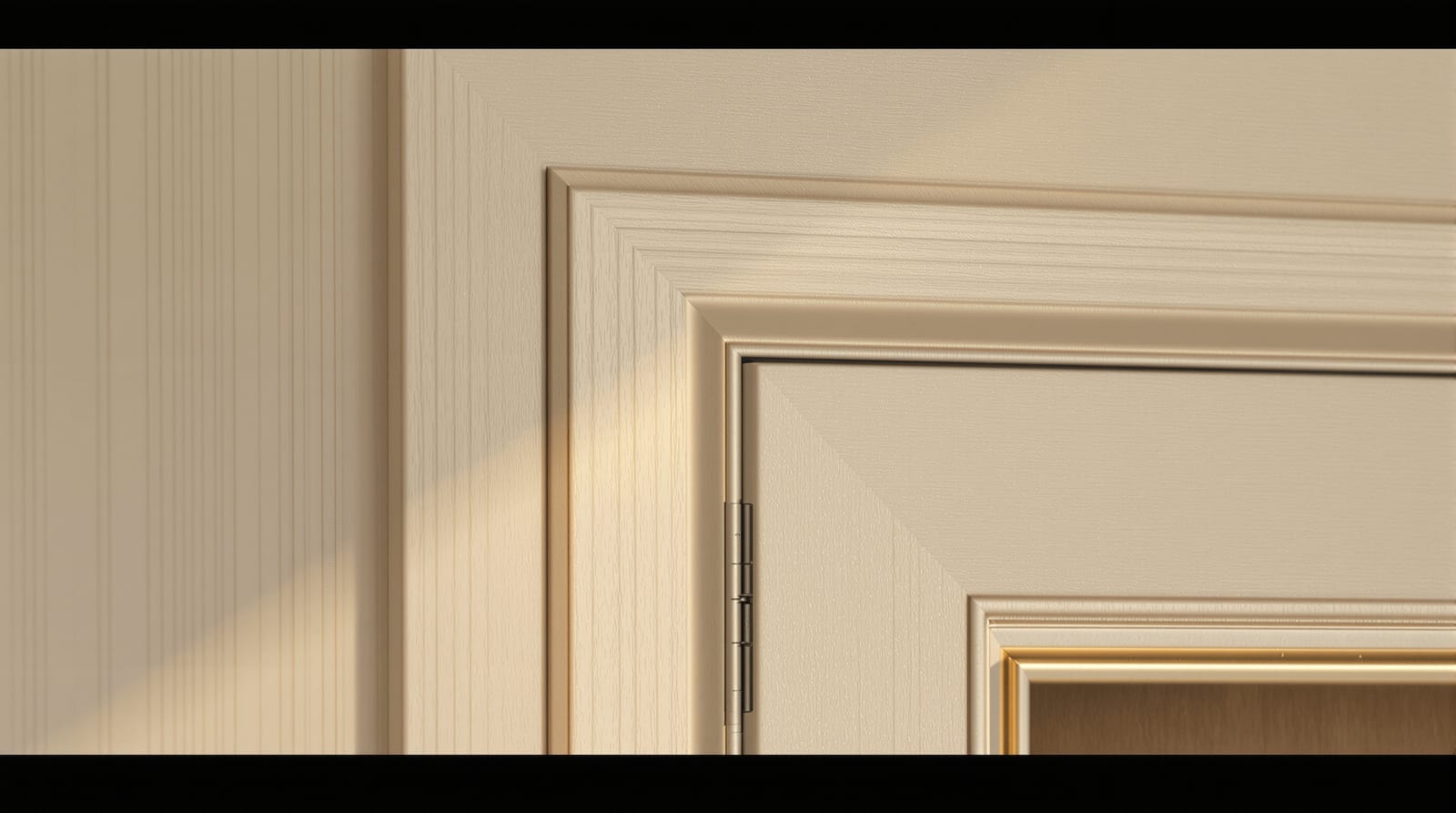
The Architect's Guide to Residential Doors (India): Specification, Schedules & Standards
How to specify residential doors that survive procurement, the monsoon and site: door schedules, leaf-frame-hardware specs, IS codes, fire and egress, accessibility, handing and tolerances.
A door is the most-touched moving assembly in a house, and the one most often under-specified on Indian residential drawings. A single line saying "35 mm flush door" pushes a hundred decisions down to a carpenter who will resolve them in the cheapest way that closes. This guide is the working manual we use to specify residential doors so the design survives procurement, the monsoon and the site: how to build a door schedule and an ironmongery schedule, how to call out leaf, frame and hardware, which IS and NBC clauses actually govern, and the small things — handing, tolerances, undercuts — that decide whether a door swings true in year three.
Start with the door schedule, not the door
Every residential project should carry a door schedule as a tabulated drawing, keyed to door marks (D1, D2, D3…) that appear on the plans. The schedule is the contract. If a property is worth specifying, the schedule should resolve type, size, leaf, frame, finish, fire/acoustic rating, vision panel, threshold, hardware set and handing — one row per door type, with a quantity column.
The reason is procurement reality. In India, doors are bought from three different supply chains at once — a factory-made flush/WPC/uPVC supplier, a local carpenter for site-built joinery, and a separate ironmonger or e-commerce order for locks and hinges. Without a schedule these three never align: the frame rebate doesn't suit the leaf, the lock case won't fit the stile, the handing is mirrored. The schedule is what forces coordination across those three chains.
| Column | What it fixes | Common omission that bites later |
|---|---|---|
| Door mark / qty | Cross-reference to plan; count | Schedule lists a type but not how many |
| Nominal size (W × H) | Structural opening, frame order | Confusing leaf size with opening size |
| Type / leaf | Flush, panel, glazed, sliding, fire | "Wooden door" with no core spec |
| Frame (chowkat) | Section, species, profile | Frame omitted, left to carpenter |
| Finish | Veneer/laminate/paint/PU; both faces | One face specified, other ignored |
| Rating | Fire (min), acoustic (Rw), water | Bathroom door with no moisture spec |
| Hardware set | Reference to ironmongery schedule | Lockset chosen on site, mismatched |
| Handing | LH / RH, in/out swing | Mirrored leaves, lock on wrong side |
For the leaf and material choices that fill these rows, the homeowner-facing companions are useful background — door materials comparison, flush doors, solid vs hollow-core doors and the broader home doors complete guide.
Specifying the leaf: core, thickness, IS reference
Specify the core, not just the appearance. "Flush door" tells a supplier nothing about whether it is a hollow cellular core (light, cheap, hollow-sounding) or a solid block-board / particle-board core (heavy, holds hardware). The relevant standard is IS 2202 (Part 1) for wooden flush door shutters, which distinguishes solid-core and cellular-core types and sets adhesive grades (BWP/BWR). Call out the grade explicitly: BWP (boiling-water-proof, phenol-formaldehyde) for any door exposed to bathrooms, kitchens or external air; BWR is the minimum elsewhere.
For panelled and glazed timber shutters the standard is IS 1003 (Part 1) (shutters) with IS 1003 (Part 2) covering door frames; for the timber frame sections themselves, IS 4021 governs frame profiles and sizes. Where the door is FRP/glass-fibre (common for bathrooms and as a teak substitute), specify to IS 14856. Steel frames are IS 4351, and steel pressed/security door sets follow manufacturer test data plus IS 4351 for the frame.
A defensible residential leaf spec reads like a sentence, not a word:
D2 — 35 mm thick solid-core flush door shutter to IS 2202 (Pt 1), BWR grade, both faces 4 mm commercial ply lipped on all four edges with 25 mm hardwood (matching), finish: 0.5 mm teak veneer both faces with PU clear, factory-made.
Standard leaf thicknesses: 30 mm for light internal, 35 mm as the residential workhorse, 40 mm for main doors and where heavy mortice locks or hinges need bite. Anything carrying a fire rating or a heavy multi-point lock should be 40 mm minimum. Lipping (solid hardwood edging) matters more than buyers realise: it is what lets you trim the door to fit, takes the hinge and lock screws, and stops the veneer chipping. Specify lipping on all four edges; for the hinge edge specify it wide enough (≥ 25 mm) to hold a mortice hinge without splitting.
Frames, rebates and the chowkat
The frame (chowkat) is where Indian door failures concentrate, because it is the part most often value-engineered to nothing. Specify frame section in millimetres (e.g. 100 × 65 mm), species or material, the rebate depth (the step the leaf closes against — 12–15 mm typical), and whether it carries a weather seal. For external and bathroom frames, anti-rot detailing is the spec: hardwood (sal/teak) or WPC/uPVC/steel, never softwood; the bottom 150 mm bedded above floor finish, not buried in wet screed; and a damp-proof separation from masonry.
Material choice for frames tracks the leaf logic — the same trade-offs covered in door materials comparison and WPC doors apply. WPC and steel frames have the advantage of dimensional uniformity (they don't move with humidity) and termite/water immunity, which is why they have largely replaced site-built timber chowkats in bathrooms and external openings across coastal and high-rainfall India. Where you specify teak (teak wood doors) for the main door, specify the frame in the same species or it will move differently from the leaf.
Hardware: the ironmongery schedule
Hardware deserves its own tabulated ironmongery (hardware) schedule, with hardware sets keyed by reference (HW-1, HW-2…) to door marks. Specifying lock-by-lock per door is a recipe for inconsistency; specifying sets lets you control quality and quantity, get accurate procurement, and standardise keying. A hardware set bundles everything a door needs.
| Set | Door | Hinges | Lock / latch | Other | Indicative ₹ / door* |
|---|---|---|---|---|---|
| HW-1 | Main / external | 4 × SS ball-bearing butt | Multi-point or mortice deadlock + cylinder; optional smart lock | Door viewer, stopper, weather seal, threshold | 4,000–12,000 |
| HW-2 | Bedroom | 3 × SS butt | Mortice latch + privacy bolt/lock | Lever handle on rose, stopper | 1,800–5,000 |
| HW-3 | Bathroom | 3 × SS butt (anti-rust) | Tubular latch + privacy snib, emergency release | Indicator bolt, stopper | 1,200–3,500 |
| HW-4 | Kitchen / utility | 3 × SS butt | Tubular latch | Lever handle, stopper | 1,200–3,000 |
| HW-5 | Sliding / pocket | Top-hung track + bottom guide | Hook/mortice lock for sliding | Flush pull, soft-close | 2,500–8,000 |
*Indicative, varies by city, vendor and brand (Godrej, Yale, Hafele, Hettich, Dorset, etc.); add ~18% GST. Smart locks add ₹5,000–30,000 — see smart door locks and the door hardware guide; main-door security strategy is covered in door security.
Three specification disciplines pay for themselves. Hinge sizing and count: three hinges minimum for any door over 2000 mm tall; four for heavy main doors and fire doors. Use ball-bearing hinges for high-traffic and heavy leaves. Backset and lock case: confirm the lock case backset fits the stile width — narrow-stile glazed doors need a narrow-backset lock, and this is the single most common on-site mismatch. Keying: decide master-keying / keyed-alike strategy at spec stage, not after locks arrive.
Fire and egress
Most Indian residential doors are not fire-rated, but the architect must know when they must be. NBC 2016 Part 4 (Fire & Life Safety) governs: exit doors typically minimum 1000 mm clear width, opening in the direction of egress, on the escape route — relevant in apartments, the stair-lobby door, and the flat entrance in high-rise. Fire doors are specified to IS 3614 (Part 1) (metallic) and IS 3614 (Part 2) (non-metallic) fire-check doors, with ratings of 30 / 60 / 90 / 120 minutes, tested to IS/EN 1634 or BS 476 Part 22.
A fire-door spec is a system, not a leaf — leaf, frame, intumescent seal, smoke seal, certified closer, and fire-rated hardware must all carry the rating, and the whole assembly must match the test evidence. Never mix a rated leaf with un-rated hinges or an ordinary lockset; the certificate is for the tested combination. On the escape route, fire doors are self-closing, must not be held open except on approved hold-open devices, and require lever furniture (not knobs) and panic/emergency hardware where occupancy demands. For NBC door widths and the rest of the size logic, see door size standards.
Accessibility
If a residence is to be barrier-free — increasingly a client brief, and mandated in some shared/affordable contexts — the governing reference is the RPwD Harmonised Guidelines (2021). The headline numbers: a clear opening of at least 800–900 mm (a 900 mm leaf gives roughly 810–850 mm clear once you subtract the stop and door thickness, so default to a 900 mm leaf for any accessible door); a threshold no higher than 12 mm, chamfered; lever handles (not knobs) at ~900–1000 mm; and adequate manoeuvring clearance beside the latch (≥ 300 mm on the pull side) so a wheelchair user can reach the handle. Avoid heavy self-closers on accessible doors, or specify low closing force / power operation.
This connects to the wider barrier-free brief in accessible doors and the accessible home design guide; door swing and turning space is the same geometry students learn in how to measure a small room.
Handing, tolerances and the things that decide quality
Handing must be on the schedule and on the plan. Indian sites work inconsistently here, so be explicit: state the swing direction and the hinge side. The common convention — stand on the side from which the door opens away from you (the push side / outside); if the hinges are on your left it is left-hand (LH), on your right right-hand (RH); add "reverse" if it opens towards you. Get handing wrong and the lock lands on the wrong stile, the door swings into a switchboard, or it blocks the corridor. The swing arc also has to be drawn — a door must not foul another door, a wardrobe, or reduce a corridor below code. Tools like a door swing planner help, but the swing belongs on the GA drawing.
Tolerances and clearances are what separate a specified door from a fitted one:
- Frame to leaf gap: ~3 mm at head and sides (2–4 mm), consistent — a tapering gap reads as a defect.
- Bottom clearance: 6–10 mm above finished floor; for bathrooms and rooms needing ventilation, a 12–18 mm undercut (also helps return air to ACs).
- Threshold/sill: ≤ 12 mm for step-free/accessible; weather bar + drip on external doors.
- Squareness and plumb: frame plumb within ~2 mm over height; out-of-plumb frames are why doors swing open or shut on their own.
- Moisture allowance: in monsoon and coastal India, leave the spec note that timber doors are seal-finished on all six faces (including top and bottom edges) before hanging — unsealed edges drink moisture, swell and bind. This single note prevents the most common monsoon callback.
Coordination: where the spec meets the rest of the design
Doors fail at the interfaces, so specify the coordination, not just the door. Three flashpoints in Indian residential work:
1. Flooring level. The leaf bottom clearance is set against finished floor, including the threshold transition between two materials (vitrified to wood, dry to wet). If the schedule references slab level, every door fouls the new floor or swings over a hump. Fix the datum to finished floor and note the undercut against it.
2. MEP and switchboards. Coordinate the handing so the open leaf does not bury a switchboard, AC indoor unit, or geyser isolator. Draw the swing on the services-coordinated plan.
3. Acoustics and the gap you just specified. A bedroom or home-theatre door's acoustic rating (Rw) is destroyed by the undercut and the perimeter gap — if you spec a soundproof door, you must also spec perimeter seals and an automatic drop seal, and reconcile that with the ventilation undercut you wanted elsewhere.
The relationship between door and window openings (light, ventilation, weather) is its own topic — see windows & doors design. And on the most important door of an Indian home, design intent and tradition meet: the main door is the largest, faces N/E/NE where possible, opens inward, and many clients expect an even number of leaves and a threshold (dehleez). Treat Vastu as the client's tradition with a practical rationale and resolve it at concept; the canon is in entrance Vastu and the main door design guide, with planning logic in the residential door planning handbook.
A specification checklist you can copy
- Door schedule keyed to plan marks, with quantities.
- Leaf: core type + IS reference + adhesive grade + thickness + lipping + finish (both faces).
- Frame: section, species/material, rebate, anti-rot detailing, DPC separation.
- Hardware sets in an ironmongery schedule; hinge count/type, lock backset, keying strategy.
- Ratings where required: fire (IS 3614, NBC Part 4), acoustic (Rw), water (BWP).
- Accessibility where briefed: ≥ 800–900 mm clear, ≤ 12 mm threshold, lever handles, clearances (RPwD 2021).
- Handing (LH/RH, in/out) on schedule and plan; swing arc drawn and coordinated.
- Tolerances: perimeter 2–4 mm, bottom 6–10 mm, frame plumb ≤ 2 mm, all-six-faces sealing note.
- Coordination notes: finished-floor datum, MEP/switchboard clash, seal-vs-ventilation reconciliation.
Frequently asked questions
What is the difference between nominal size and opening size on a door schedule?
Nominal (or leaf) size is the door panel; the structural opening is larger to take the frame, packing and tolerance. A 900 × 2100 mm leaf typically needs a masonry opening of roughly 1000–1050 × 2175–2200 mm depending on frame section. Always state which one your schedule dimension refers to, and ideally give both — the supplier orders the leaf, the mason builds the opening.
Which IS code do I cite for an ordinary residential flush door?
IS 2202 (Part 1) for wooden flush door shutters — call out solid-core vs cellular-core and the adhesive grade (BWP for wet areas/external, BWR elsewhere). For panelled/glazed timber shutters use IS 1003 (Part 1), with IS 4021 for the timber frame sections.
How do I describe handing so the site gets it right?
State it twice: in words on the schedule (e.g. "RH, opens inward") and graphically as a swing arc on the plan. The common convention is to stand on the side the door opens away from you; hinges on the left is left-hand, on the right is right-hand, with "reverse" if it swings towards you. Because conventions vary, the drawn arc is the tie-breaker.
When does a residential door legally need a fire rating?
On escape routes governed by NBC 2016 Part 4 — typically the flat entrance door, stair-lobby and exit doors in apartments and high-rise. Those require a fire-rated assembly to IS 3614 (30/60/90/120 min), opening in the direction of egress with a minimum ~1000 mm clear width, self-closing, with rated hardware. A standalone independent house usually has no statutory fire-door requirement, but the same logic is good practice at the kitchen.
What clear width should an accessible door have?
Aim for 800–900 mm clear. A 900 mm leaf gives roughly 810–850 mm clear after deducting the stop and leaf thickness, so default to a 900 mm leaf for any wheelchair-accessible door, keep the threshold ≤ 12 mm and chamfered, use lever handles, and leave manoeuvring clearance beside the latch per the RPwD Harmonised Guidelines 2021.
Export this guide
Related Guides — Deep-dive reading
Door Standards India: IS Codes, NBC 2016, Fire & Accessibility Rules for Residential Doors
The consolidated map of every standard that governs a residential door in India — IS material/construction codes, NBC 2016 widths and egress, fire-door ratings, and RPwD accessibility — and which one applies where.
Home Doors & EntrancesDesigning Adaptable & Universal-Design Homes
Accessibility, Aging-in-Place, and the Multi-Stage Family — Code, Anthropometrics, and Plan-Stage Discipline for Indian Residential Architects
Room PlanningThe Complete Home Door Guide for Indian Homes (2026): Types, Materials, Cost, Security & Vastu
Everything an Indian homeowner needs to specify the right door for every opening — from main entrance to bathroom — with real 2026 prices, IS/NBC standards and Vastu sense.
Home Doors & EntrancesRelated Tools — Try Free
Door Material Comparison Tool
Compare 2–4 door materials on cost, durability, maintenance, security and moisture resistance.
Comparison ToolAccessible Door Checker
Check a door against wheelchair-accessibility guidance — clear width, threshold, handle and closer force per RPwD 2021.
Compliance ToolWindow Material Comparison Tool
Compare uPVC, aluminium, wood, steel and composite windows on cost, life, upkeep and insulation.
Compare