
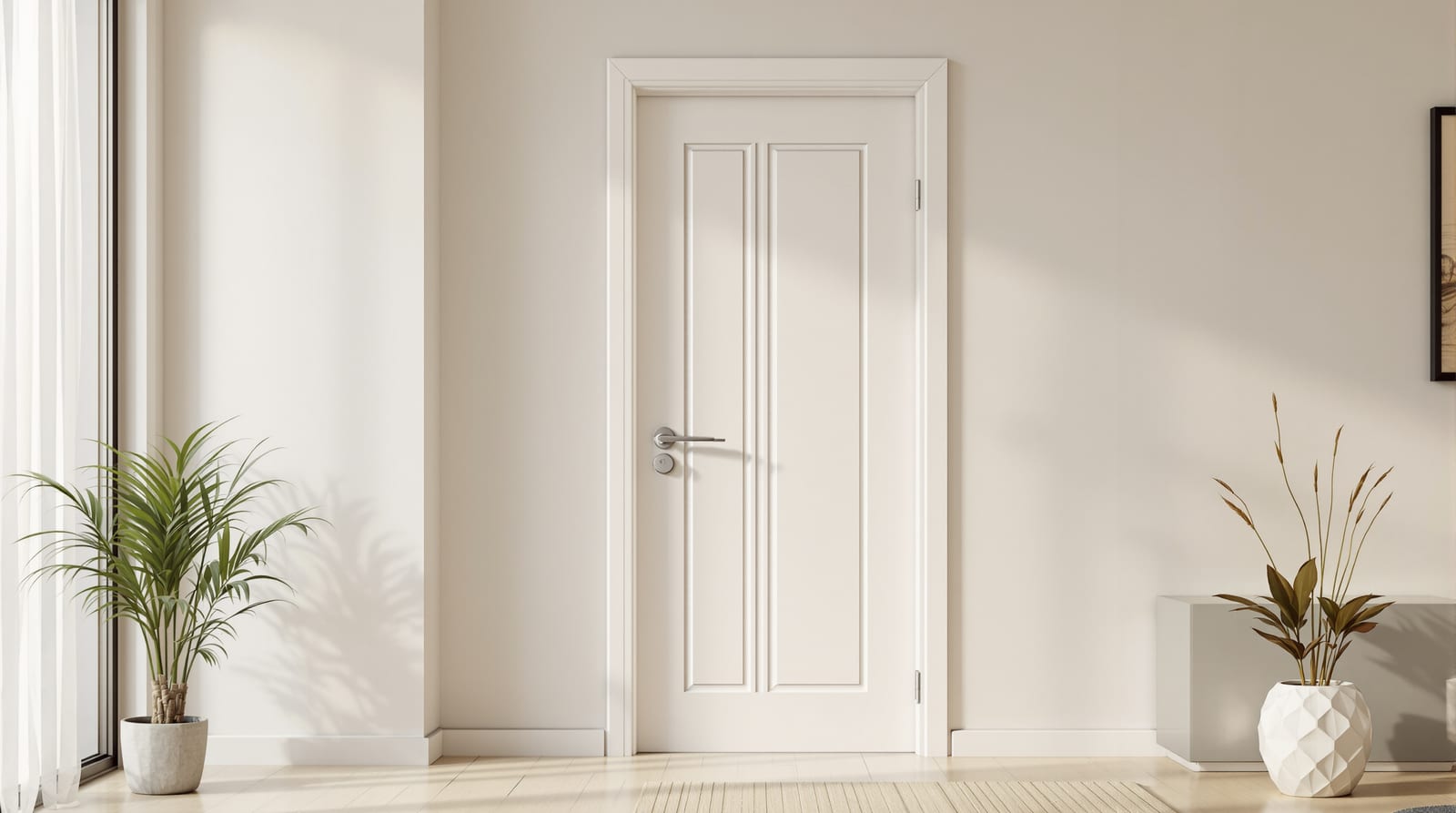
Modern Door Design for Indian Homes: 9 Contemporary Looks That Still Work in the Monsoon
Minimalist flush-and-groove leaves, vertical and horizontal slats, flush-with-frame reveals, handle-less pulls, glass accents and statement pivots - the contemporary door styles that look right in a 2026 Indian home, and what each one costs and demands.
Walk into a 2026 apartment in Bengaluru, Pune or Gurugram and the doors give the game away faster than the sofa. The carved teak panel door that signalled "good home" to our parents now reads as dated; the look that says "designed" today is the opposite - flat, calm, almost invisible, with a single confident line or a slim full-height handle doing all the talking. That is what "modern door design" means in practice: not a style you bolt on, but a set of decisions about flatness, proportion, finish and hardware that, done right, make a door look intentional and make a room feel larger.
This guide walks through the nine contemporary door looks that actually work in Indian homes - minimalist flush, groove and reveal lines, vertical and horizontal slats, flush-with-frame, handle-less and long-pull hardware, glass accents, and the statement pivot - with the finishes (matte laminate, veneer, PU, membrane) and palettes that make each one sing, and the monsoon, dust and budget realities that decide whether they still look good in year five.
What makes a door read as "modern"
Strip away the marketing and a modern door is doing four things at once.
- It is flat. A flush face, or panels so subtly recessed they read as lines, not relief. No raised mouldings, no carving, no "Roman" arch glass.
- It is proportioned to the wall, not to tradition. Modern leaves run taller - often floor-to-ceiling or up to 2400 mm internal where the slab allows - and frames get slimmer or disappear, so the door reads as a clean rectangle.
- Its lines are deliberate. A single groove, a rhythm of vertical slats, a horizontal reveal at handle height - one geometric idea, repeated. Restraint is the whole point.
- Its finish and hardware are quiet. Matte over gloss, wood-grain or solid neutrals over high-shine, and slim handle-less pulls or full-height bars instead of fussy lever sets.
Notice that none of this is about a particular material. You can build a modern door in WPC, an engineered-wood flush leaf, a laminated MDF shutter, a veneered solid-core or solid teak. The "modern" lives in the face design, the finish and the edge detailing - which is exactly why a ₹3,500 laminated flush shutter and a ₹90,000 teak pivot can both be unmistakably contemporary.
The nine modern looks, at a glance
| Look | What it is | Best for | Indicative cost (shutter only)* | Watch-outs |
|---|---|---|---|---|
| Minimalist flush | Dead-flat face, one neutral finish, no lines | Bedrooms, any interior | ₹3,000-9,000 | Bland if finish/handle are cheap |
| Groove / channel lines | Routed vertical or horizontal grooves, often dark-filled | Living, main door, wardrobes | ₹4,000-12,000 | Grooves trap dust; need PU/laminate seal |
| Vertical slat (louvre look) | Repeated raised or routed vertical battens | Main door, study, partition | ₹6,000-20,000 | Gaps catch dust; not for bathrooms |
| Horizontal slat / reveal | Long horizontal lines, low-wide proportion | Main door, TV-wall doors | ₹6,000-18,000 | Lines must align across adjacent doors |
| Flush-with-frame (shadow gap) | Leaf sits flush in wall, slim reveal, concealed hinge | Designer interiors | ₹12,000-30,000+ | Carpentry-critical; warp = visible gap |
| Handle-less / push | No visible handle; push or recessed grip | Wardrobes, pantry, study | Add ₹0-2,000 | Hard for elderly; needs soft-close |
| Long-pull bar | Slim full-height tubular handle | Main door, statement interiors | Add ₹2,000-15,000 | Cheap pulls bend/discolour |
| Glass-accent | Frosted/fluted glass strip or panel in a flush leaf | Pooja, study, balcony, foyer | ₹6,000-25,000 | Toughened glass + privacy choice |
| Statement pivot | Oversized leaf on a floor-spring pivot | Front entrance, villas | ₹40,000-1,50,000+ | Weather + floor-fixing critical |
*Shutter only; frame (chowkat), hardware, lock and fitting are extra, and +18% GST is typical. Treat every number as indicative and varying by city, vendor and finish.
1. Minimalist flush - the modern default
A flush door is just a frame of timber battens with a hollow or solid core, faced both sides with ply, MDF or HDF and finished. It is the cheapest way to be modern, and for interiors it is now the default. The trick is that "minimal" exposes everything: with no carving to hide behind, the finish, the edge banding and the handle have to be right. A matte laminate in a warm grey or oak, a clean 2 mm edge band that matches the face, and a slim handle - and a ₹4,000 shutter looks like a ₹15,000 one. Specify a solid-core (not hollow) leaf for the master bedroom and main rooms so it feels and sounds substantial; hollow-core is fine for low-traffic stores. Make sure factory leaves conform to IS 2202 (Part 1) for flush-door shutters.
2. Groove and channel lines
The single most popular "modern" upgrade in India right now: take a flush leaf and rout one, two or three slim vertical grooves (or one horizontal reveal at handle height). The grooves are often filled with a contrasting dark laminate or simply left as shadow lines. It is subtle, it scales from bedroom to main door, and it photographs beautifully. The catch is maintenance - open grooves collect dust and, in humid coastal homes, moisture - so seal them with the same PU or laminate as the face and wipe them down. Keep the groove pattern consistent across all doors in a sightline; mismatched groove counts look accidental.
3. Vertical slats (the louvre look)
Repeated vertical battens - either raised fins or routed lines - give a door a tactile, architectural rhythm that works especially well on a main door or a study. They make a leaf read as taller and add the texture a flat finish lacks. Use them where you want presence: entrance, home-office, or as a sliding partition. Avoid them in bathrooms and dusty utility areas, because the reveals between slats are dust- and grime-traps that are tedious to clean. A teak or walnut-veneer slat door at the entrance is a restrained, very 2026 alternative to a carved teak panel.
4. Horizontal slats and reveals
The horizontal cousin - long lines running across the leaf - reads calmer and wider, and pairs naturally with the low-slung furniture of contemporary interiors. It is a favourite for "disappearing" doors set into a panelled TV or feature wall, where the door lines simply continue the wall lines. The discipline here is alignment: the horizontal reveals must line up with adjacent doors, skirting or wall panels, or the eye instantly catches the error. This is a detail to fix on a drawing before the carpenter starts, not on site.
5. Flush-with-frame (the shadow-gap door)
The most architectural modern detail: the leaf sits flush within the wall plane, hung on concealed hinges, with a slim, even "shadow gap" reveal all around and no visible frame face. Done well, the door reads as a panel of the wall that happens to open. It demands a concealed (3D-adjustable) hinge, a precise frame, and a stable leaf - which is exactly why it is unforgiving in India: a leaf that swells or warps in the monsoon turns the crisp even reveal into an obvious wedge-shaped gap. Specify a dimensionally stable core (engineered-wood or WPC, not green solid timber), insist on factory-made leaves and frames, and budget for skilled fitting. This is the one modern look most likely to disappoint with a local fabricator.
6 and 7. Handle-less and long-pull hardware
Hardware is where modern doors are won or lost. Two contemporary directions:
- Handle-less / push - no visible handle at all. The door has a recessed finger-pull, a J-groove edge, or a touch-latch / push-to-open mechanism. Beautiful and very minimal, but think about who uses it: push-latches and recessed grips are awkward for the elderly and for anyone carrying a child or a tray, so reserve them for wardrobes, pantries and study doors, not the main bedroom of a joint family.
- Long-pull bars - a slim, full-height (or three-quarter-height) tubular handle in matte black, brushed steel, brass or champagne gold. This is the signature of the modern Indian main door and tall internal doors. Spend here: cheap pulls bend, the coating chips, and brass-look finishes discolour in coastal air. A solid stainless or genuinely PVD-coated pull is worth the premium.
A note on the lever sets you do keep: choose flat, square or thin-round modern levers in a matte finish, mounted on the slimmest possible rose, and match the metal across the whole home (one metal, repeated). For the main door, pair the look with a proper multi-point lock or smart lock - modern looks should never mean weaker security.
8. Glass accents
A strip of frosted, fluted (reeded) or tinted glass set into an otherwise flush leaf borrows daylight and adds a soft modern detail without sacrificing privacy. Fluted glass is having a real moment in Indian homes - it diffuses light, hides fingerprints and looks expensive. Use a vertical glass strip beside the handle on a study or foyer door, or a wider panel on a balcony or pooja door (frosted for privacy, etched motif if you want a quiet traditional nod). Always specify toughened (tempered) glass for safety, mind IS 3548 workmanship for glazing, and remember a glazed leaf offers less sound and security than a solid one - so keep full-glass looks for internal and semi-private positions, not the front door.
9. The statement pivot
For a villa or independent-house entrance, nothing reads as "architect-designed" faster than an oversized leaf swinging on a floor-spring pivot - a tall veneered or metal-clad slab with a full-height pull. It is the ultimate modern main door, but it is a hardware and weather project, not a finish choice: the floor spring must be set into the slab correctly, the leaf must be a stable engineered build, and the weather seal and security have to be solved because the leaf is large and the reveals are slim. If a pivot is on your list, read our dedicated walkthrough of pivot doors in India before you commit, because the failure modes (sagging, scraping, monsoon ingress) are specific and avoidable. For a more conventional grand front door, see our guide to modern main-door design for Indian homes.
Finishes: where modern is actually decided
Two doors with the same groove pattern can look ₹40,000 apart, and the difference is the finish. The contemporary palette:
| Finish | Look | Durability / monsoon | Maintenance | Indicative add over base |
|---|---|---|---|---|
| Matte laminate (1 mm) | Flat, even colour or wood-grain; the modern workhorse | Good; water-resistant face, but edges/grooves must be sealed | Wipe clean; can't refinish | ₹150-450 / sq ft |
| Acrylic / high-gloss laminate | Mirror-flat, reflective | Good but shows every smudge, scratch, dust speck | High - constant wiping | ₹300-700 / sq ft |
| Natural veneer + PU/melamine | Real wood grain, warm, premium | Good if sealed; needs re-coat every few years | Medium; can be refinished | ₹350-900 / sq ft |
| PU paint (solid colour) | Smooth automotive-like matte or satin colour | Very good; seals the whole leaf | Low; can re-spray | ₹250-600 / sq ft |
| Membrane / PVC foil | Seamless wrap over routed (CNC) shapes | Moderate; edges can peel in heat/humidity | Low but not repairable | ₹200-500 / sq ft |
| Duco / matte spray | Dead-flat solid colour, very designer | Good with proper primer | Medium | ₹300-650 / sq ft |
The reliable, low-drama modern recipe for most Indian homes: a matte laminate or PU-finished engineered-wood or WPC leaf, with grooves and edges properly sealed against monsoon humidity. Matte hides the dust and fingerprints that high-gloss broadcasts. Save real veneer or solid teak for the doors you actually want to feel - the main door, the master bedroom - and run cheaper-but-matching laminate elsewhere.
For the colour itself, modern Indian interiors lean to a tight neutral palette: warm greys, greige, soft white, oak and walnut wood-tones, charcoal, and the occasional deep accent (forest green, terracotta, midnight blue) on a single feature door. The hardware metal is then matched to the palette - matte black or brushed steel for cool/grey schemes, brass or champagne gold for warm/wood schemes - and repeated through the home.
The flush-with-frame detail, drawn
The crisp even shadow-gap is the make-or-break detail of a high-end modern door. Here is what sits at the leaf edge:
The reveal has to stay even all the way around. That is only possible if the leaf does not move with the seasons - so the modern-detail doors are the ones to build from stable engineered cores, factory-made, and to fit with adjustable concealed hinges that let you correct small drift.
Designing modern doors for Indian conditions
Looks aside, a modern door in India has to survive things a magazine never mentions.
- Monsoon swelling and warp. Flat, slim, flush leaves show movement more cruelly than chunky carved ones - a warped flush door reveals an ugly gap; a swollen one binds. Favour dimensionally stable cores (engineered-wood, WPC, marine-grade ply) over green solid timber for any flush or shadow-gap door, and seal all six faces and every groove.
- Coastal and humid homes. In Mumbai, Chennai, Kochi or Goa, choose WPC or uPVC for bathroom and balcony doors (they don't swell, rot or feed termites), and keep solid wood for dry internal positions.
- Termites. A modern look in solid timber still needs termite-treated wood and frames; WPC and uPVC sidestep the problem entirely.
- Dust. India is dusty, and every groove, slat reveal and recessed pull is a dust trap. Matte finishes and simpler line patterns age far better than high-gloss or deeply slatted faces in a real home.
- Sizes and standards. Keep to NBC 2016 practice: main door 1000-1200 mm x 2100 mm, bedrooms ~900 mm x 2100 mm, bathrooms 700-750 mm wide, with a low (<=12 mm) threshold for accessibility. Going taller for a modern look is fine; going narrower is not - don't let a designer pinch a door below ~800 mm clear where wheelchair access matters (RPwD Harmonised Guidelines 2021). See our note on door size standards for the full chart.
- Vastu, the modern way. A clean contemporary main door can still respect tradition: orient it to the favourable North, East or North-East where the plan allows, keep it the largest door in the home, hang it to open inward and clockwise, and many families keep a slim threshold (dehleez). Treat these as belief plus practical reasoning, and read our entrance Vastu guide for the canon before you finalise the front-door position.
A quick budgeting reality check
For a typical 2-3 BHK going fully modern, the sensible spend pattern is: one statement at the entrance (a veneered or teak vertical-slat / long-pull leaf, or a pivot if it is a villa), matte laminated flush leaves with a single groove for the bedrooms and common doors, and WPC for the bathrooms - all in one palette and one hardware metal. The visual coherence of "one finish family, one metal, one line idea, repeated" is what actually makes a home look designed, far more than any single expensive door. Use a door cost calculator to price the mix before you commit to a carpenter or factory order, and remember installation, frame and hardware can add 30-60% on top of the shutter price.
Frequently asked questions
What is the most modern door design for an Indian home right now?
The dominant 2026 look is a tall, flat flush leaf - in matte laminate, veneer or PU - carried by one quiet idea: a single vertical groove, a rhythm of vertical slats, or a flush-with-frame shadow gap, paired with a slim full-height long-pull handle in matte black or brushed steel. For a villa entrance, an oversized pivot leaf is the statement version. The common thread is restraint: one geometric idea, one neutral palette, one hardware metal, repeated.
Are modern flush doors good for the Indian monsoon?
They can be, if you choose the core and finish correctly. The risk with flat, slim leaves is that any swelling or warp shows clearly. Specify a dimensionally stable core - engineered-wood, WPC or marine-grade ply rather than green solid timber - get factory-made leaves to IS 2202, and seal all six faces and every groove. For bathrooms and balconies in humid or coastal cities, WPC or uPVC leaves are the safe modern choice because they don't swell, rot or attract termites.
Laminate, veneer or PU - which finish for a modern door?
Matte laminate is the reliable workhorse: water-resistant, low-maintenance, and available in convincing wood-grains and solid neutrals, ideal for most doors. Natural veneer with a PU or melamine seal gives real wood warmth and can be refinished - worth it for the main door and master bedroom. PU paint gives a smooth, durable solid-colour finish and seals the whole leaf well. Avoid high-gloss and acrylic in dusty Indian homes unless you are happy to wipe them constantly.
Are handle-less doors practical in India?
For wardrobes, pantries and low-traffic study doors, yes - push-latch and recessed-grip handle-less doors look superb and minimal. But they are awkward for the elderly and for anyone with full hands, and push mechanisms wear, so avoid them on the main bedroom or any door used constantly by a joint family. A better all-round modern choice for important doors is a slim full-height long-pull bar, which keeps the clean look while staying easy to grab.
How much does a modern main door cost in India?
A modern flush or vertical-slat main door in veneer or laminate typically runs ₹15,000-40,000 for a designer leaf, plus frame, a good lock or smart lock, and a full-height pull. A solid-teak modern leaf or an oversized pivot entrance climbs to ₹40,000-1,50,000+ installed. Interior modern doors are far cheaper - matte laminated flush leaves with a groove are commonly ₹4,000-12,000 per shutter. All figures are indicative for 2026 and vary by city, vendor and finish; add ~18% GST and 30-60% for frame, hardware and fitting.
Export this guide
Related Guides — Deep-dive reading
Minimalist Door Designs in India (2026): Flush, Frameless & Concealed-Frame Doors
The clean-line, no-architrave, hidden-hardware door language behind modern Indian apartments and designer interiors — flush-to-wall doors, concealed hinges, recessed pulls, tall leaves and what the look really costs.
Home Doors & EntrancesPivot Doors in India: The Luxury Statement Entrance (Mechanism, Cost and Pitfalls)
How a pivot door works, why it lets you hang an oversized leaf, what teak or metal-clad statement entrances actually cost in 2026, and the weather and security details Indian homes must get right.
Home Doors & EntrancesGuest Room Door in India: Privacy, Quiet and Smart Picks Without Overspending (2026)
How to choose a guest bedroom door for an Indian home - privacy and acoustics so visitors feel comfortable, but budget-sensible for a room used only now and then: solid-core flush for quiet, panel or laminate for looks, the right privacy lock, simple soundproofing, and a finish that matches the rest of your doors - with picks ranked and indicative rupee costs.
Home Doors & EntrancesRelated Tools — Try Free
Door Cost Calculator
Estimate the all-in cost of a door — leaf, frame, hardware, fitting and GST — by type, material and size.
Door CalculatorApartment Furniture Size Chart
Standard furniture dimensions for Indian apartments — sofas, beds, tables, dining, storage.
Reference ChartDoor Material Comparison Tool
Compare 2–4 door materials on cost, durability, maintenance, security and moisture resistance.
Comparison Tool