
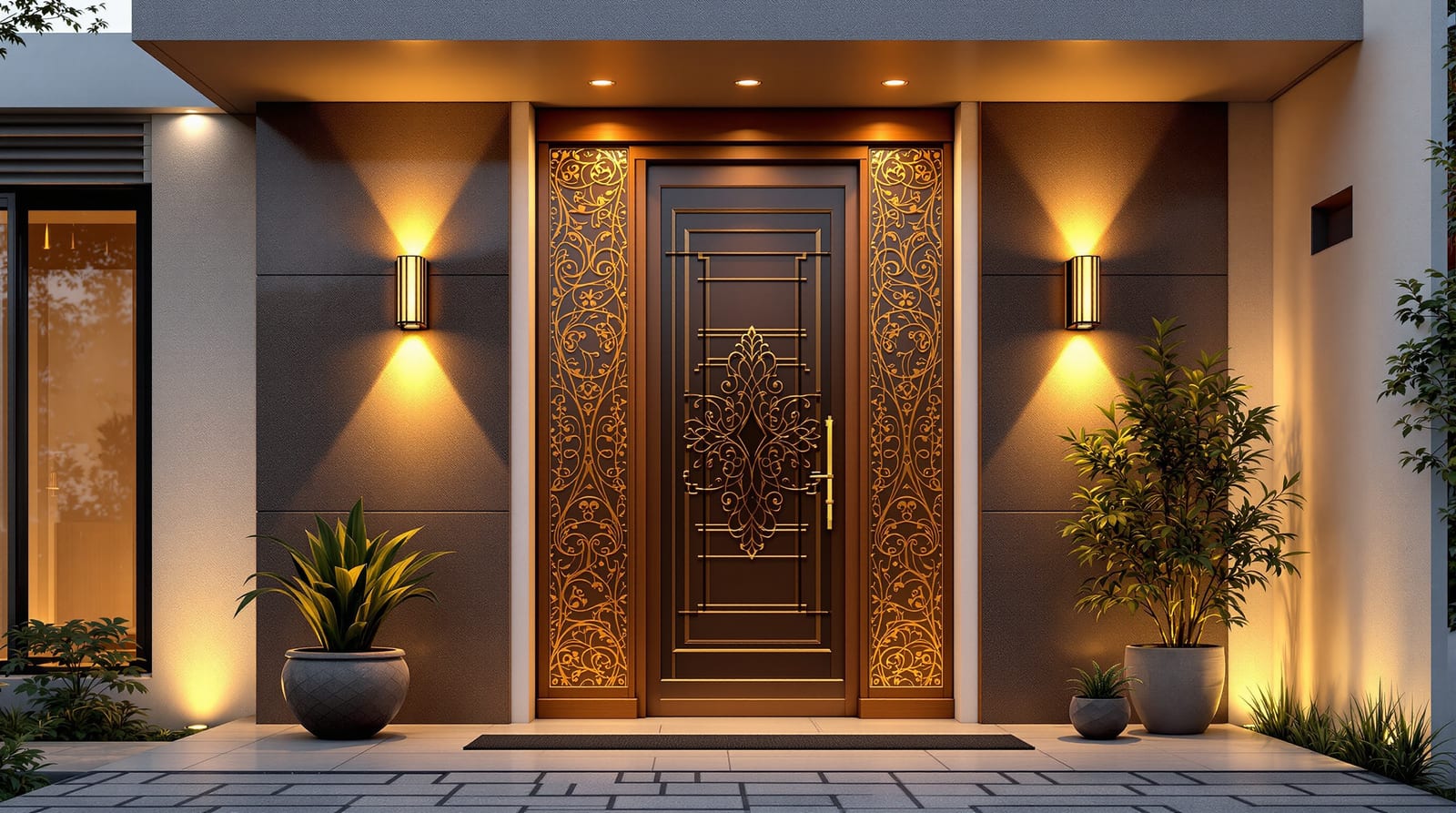
Main Door Design Ideas for Indian Homes 2026: Styles, Proportions, Materials and Vastu
From traditional carved teak to modern minimalist and pivot statement entrances - how to design a main door that reads as grand, ages well in the Indian climate, and respects Vastu, with real 2026 costs.
The main door is the one piece of your home that every guest, every neighbour and - if you believe the tradition - every blessing has to pass through. It is the first thing seen and the last thing touched, and in an Indian home it carries a weight no internal door does: it is the mukhya dwar, the face of the house, the threshold that the new bride steps over and the door the family garlands at Diwali. Get it right and the whole entrance reads as considered and generous, even on a modest budget. Get it wrong - too small, too thin, too fussy, or fighting the wall around it - and no amount of marble flooring inside will recover the first impression.
This guide is about the design of the main door specifically: the styles that work for Indian homes in 2026, how to make a door feel grand through proportion rather than expense, the materials and finishes that survive our monsoon and termites, how to treat hardware and lighting as jewellery, and the Vastu touchpoints that matter to most Indian families. For pure numbers, pair this with our main door cost guide; for the Vastu canon, lean on entrance Vastu and the main-door Vastu guide.
Start with proportion, not pattern
The single biggest design lever is also the cheapest: size. Vastu and good design agree on one point - the main door should be the largest, most prominent door in the house, and it should look it. A common mistake in Indian homes is buying a standard 3 ft x 7 ft leaf for the entrance, the same size as the bedrooms, so the front door has no hierarchy at all.
For a main entrance, design upward and outward:
- Single leaf: aim for 1000-1200 mm wide x 2100 mm tall (about 3.5-4 ft x 7 ft) as a minimum. The extra few inches of width read as generosity and ease a sofa or fridge through on moving day.
- Taller leaves: if the porch ceiling allows, a 2400 mm (8 ft) or taller leaf - with a fixed glazed or louvred panel above the door (a fanlight or transom) - instantly reads as architect-designed rather than builder-standard.
- Double doors: two leaves (a 1.5-leaf pair, where a slim secondary leaf is bolted shut day-to-day) suit bungalows and large villas, and an even number of leaves is considered auspicious in Vastu.
Grandeur is mostly the ratio of door to wall. A tall, slim, plain door in a generous plain wall looks far more expensive than a heavily carved door crammed under a low lintel. Before you choose a single carving, fix the opening size, the height, and how much blank wall frames it.
The main design styles, compared
There is no single "best" main door - the right style follows your facade. Here is how the popular 2026 styles stack up.
| Style | Looks like | Best facade | Typical material | Indicative cost, installed* | Watch-outs |
|---|---|---|---|---|---|
| Traditional carved | Deep relief carving, beadings, jharokha/temple motifs, often double-leaf | Heritage, courtyard, classic bungalow | Solid teak / sal / sheesham | ₹35,000-1,50,000+ | Carving traps dust; needs covered porch; heavy upkeep |
| Modern minimalist | Single flush plane, slim full-height handle, no beading | Contemporary villa, flat-fronted homes | Veneered flush, pivot, metal-clad | ₹25,000-1,20,000 | Reveals must be perfect; shows every dent |
| Contemporary mixed | Wood + metal grooves, fluted timber, asymmetric handle line | Modern Indian, "warm modern" | Engineered wood + veneer, teak strips | ₹30,000-90,000 | Joints between materials are weak points in monsoon |
| Panelled / semi-classic | Raised or recessed rectangular panels, restrained moulding | Mid-size independent homes, duplexes | Solid wood or engineered panel | ₹8,000-40,000 | Panel joints can shrink/crack; pick stable timber |
| Pivot / statement | Oversized single leaf swinging on a pivot | Double-height lobby, premium villa | Teak, veneer or metal-clad | ₹60,000-2,50,000+ | Floor-spring and weather-sealing are critical |
| Glass-accent | Solid leaf with frosted/textured glass strips or sidelights | Modern, light-starved foyers | Wood/uPVC frame + toughened glass | ₹20,000-80,000 | Use toughened/laminated glass; security grille behind |
*Installed figures include frame and basic hardware; carving, premium locks and oversized leaves push the top end higher. Costs are indicative and vary by city, timber grade and vendor. Run your own numbers with the main door cost guide and our door cost calculator.
A quick way to choose: if your facade is busy (stone cladding, jaali, colour), keep the door calm and modern; if your facade is plain, the door can carry the drama - carving, a bold colour, or fluted timber.
Traditional carved
The classic Indian main door: a solid teak or sheesham double leaf with deep relief carving - kalash (pot), lotus, peacock, temple gopuram or jharokha motifs - often paired with a brass kadi (ring handle) and a stepped threshold. It belongs under a covered porch, both for drama and because rain and harsh sun ruin carved timber fast. It is the most maintenance-hungry style, but nothing else carries the cultural weight, and a well-made carved teak door is genuinely heirloom furniture. See traditional Indian doors for the regional vocabularies (Chettinad, Rajasthani, Kerala nalukettu) and how to source carving honestly.
Modern minimalist
A single clean plane - flush veneer, fluted timber, or a metal-clad pivot leaf - with concealed hinges and a slim full-height handle. The luxury is in restraint: perfect reveals, a single unbroken grain or colour, and no visible hardware. This style is unforgiving (every ding shows) but reads as the most expensive even when it is not. Pair it with a hidden or pivot mechanism for a true statement entrance - see modern door designs and pivot doors.
Panelled and contemporary-mixed
The pragmatic middle. A panelled door - raised or recessed rectangles framed by restrained moulding - suits most independent homes and duplexes, and is far cheaper than carving while still adding depth and shadow. The contemporary-mixed look layers a strip of metal, a band of fluted wood, or a glass sliver onto an otherwise plain leaf, giving character without heritage upkeep. Stable engineered timber behind a veneer (rather than wide solid panels that shrink) keeps these doors flat through monsoon swings.
Materials: what survives the Indian main door's hard life
The main door faces the most punishment of any door in the house - direct sun, wind-driven rain, dust, and the constant slam of a busy household. Material choice is design and durability.
| Material | Look and feel | Climate behaviour | Maintenance | Indicative material cost |
|---|---|---|---|---|
| Burma / CP teak | Warm honey grain, premium, takes carving | Excellent - oils resist termite, water, warping | Re-oil/polish every 2-3 yrs | ₹800-1,500+ / sq ft |
| Sal / sheesham (other hardwood) | Strong, traditional | Good with seasoning; can warp if green | Periodic polish | ₹400-900 / sq ft |
| Engineered wood + veneer | Looks like solid wood, perfectly flat | Stable - resists warping; vulnerable if edges unsealed | Low; reseal edges | ₹4,000-9,000 / leaf |
| WPC (wood-plastic composite) | Modern matte, paintable | Waterproof, termite-proof - great for coastal/wet | Very low | ₹75-150 / sq ft |
| Metal-clad (steel/brass/CorTen) | Industrial-luxury, slim | Durable but conducts heat; can dent | Wipe; watch corrosion at coast | Varies, premium |
For most Indian homes, a solid teak main door remains the aspiration - it carves, it ages beautifully, and it shrugs off termites and monsoon if oiled. Where budget or a wet coastal climate rules that out, an engineered-wood leaf with a teak veneer gives the look with far better dimensional stability (see engineered-wood doors and the engineered-wood lifecycle costing), and WPC is the quietly sensible choice for an unsheltered or coastal entrance. Whatever the leaf, insist the carpenter seals all four edges and both faces - an unsealed bottom edge wicking monsoon water is the number-one cause of a swollen, sticking main door. Compare options in depth in our door materials comparison and the material comparison tool.
Colours and finishes
Finish is where a modest door starts looking designed.
- Natural wood, oiled or melamine: the safe classic. Lets teak grain speak; warm, timeless, suits carved and panelled doors.
- Deep stains (walnut, mahogany, ebony): add gravitas to engineered or lesser timbers; ebony or charcoal reads ultra-modern.
- Bold paint: a saturated front-door colour - deep indigo, forest green, oxblood, mustard, teal - is the cheapest way to make a plain door memorable, and is having a real moment on Indian facades. Use exterior-grade PU or enamel that handles UV.
- Two-tone and fluted: a wood leaf with a black metal handle band, or a fluted timber face in a natural-plus-dark scheme, anchors the warm-modern look.
- Duco / PU lacquer: factory-grade sprayed finishes give a flawless, durable surface - worth it on a flush modern leaf where brush marks would betray it.
Tie the door colour to one other element at the entrance - the railing, the window frames, a planter - so it looks intentional rather than random. South- and west-facing doors take brutal afternoon sun, so favour UV-stable finishes and re-coat them sooner.
Hardware as jewellery
On a main door, the handle, lock and accents are the jewellery - small in area, huge in impact. A beautiful leaf with cheap chrome hardware looks unfinished; a plain leaf with one gorgeous full-height handle looks designed.
Design choices that punch above their cost:
- One statement handle. A full-height brass, matte-black or stainless pull turns a plain leaf into a design object. Match its finish to the wall lights and nameplate for a coordinated entrance.
- A traditional kadi or knocker on a carved door keeps the cultural language honest - brass that develops a patina ages better than shiny chrome.
- A quality lock, sized right. Set the lock at a comfortable ~1000 mm, and on the main door spend on a proper multi-point mortise or a smart lock - the entrance is the one place security and convenience both pay off. See door hardware, smart door locks and the smart-lock cost calculator.
- Hinges that carry the weight. A heavy main leaf needs three or four good hinges (or a pivot/floor spring on oversized leaves) - undersized hinges sag and the door starts scraping within a year.
Lighting, nameplate and the entrance frame
A main door is never seen alone - it is seen lit, with a nameplate, against the wall around it. Design the whole vignette:
- Flanking wall lights at roughly door-handle to head height, one each side, make the entrance read as warm and welcoming after dark and double as security lighting. Warm white (2700-3000 K) flatters wood; choose IP-rated fittings for an open porch.
- A nameplate in a finish that matches the hardware - brass on teak, matte black on a modern leaf - is the final piece of jewellery. Keep it legible and modest.
- A grille or jaali behind a glass-accent door, or a secondary security grille door, lets families keep the main door open for air and light (and the breeze that joint-family kitchens love) while staying secure - very common and very practical in Indian homes. A "main door design with grill" is a genuine style, not a compromise.
- The threshold (dehleez). A modest step or marble threshold is both practical (keeps water and dust out) and culturally meaningful - the place for the rangoli, the toran over the frame, the lakshmi feet. Keep it shallow enough to be safe to step over; for an accessible entrance, a near-flush threshold under ~12 mm matters - see accessible doors.
Vastu touchpoints for the main door
For a large share of Indian families, the main door's Vastu is non-negotiable, and most of it aligns with good design anyway. Treat these as tradition plus practical reasoning, and read the full canon in entrance Vastu and Vastu main door; plan directions with the door Vastu planner.
- Direction. The main door is considered most auspicious facing north, east or north-east; a south-west main door is the classic default to avoid. In practice, plot orientation often decides this, and Vastu offers remedies rather than absolutes.
- Largest and prominent. The main door should be the biggest, most welcoming door - which is exactly what good design wants too.
- Opens inward, clockwise. Tradition favours a main door that swings inward and clockwise, into a clear, unobstructed entrance - no door behind it, no clutter, no facing staircase.
- Even leaves and a threshold. An even number of leaves and the presence of a dehleez (threshold) are both considered auspicious.
- Clean, well-lit, decorated. A clean, well-lit, garlanded entrance - the toran, the nameplate, the wall lights - is held to invite positive energy. The design and the belief point the same way.
The honest takeaway: design your main door to be large, prominent, inward-opening and beautifully lit, and you will satisfy both an architect and the family elder.
A short design checklist
Before you sign off on the main door drawing, confirm:
1. The leaf is bigger than every other door in the house (at least 3.5 ft x 7 ft; taller if the porch allows).
2. There is generous plain wall framing it, and the style suits the facade (busy facade, calm door).
3. The material survives your climate - teak/engineered for sheltered porches, WPC for coastal or unsheltered.
4. All edges and faces are sealed; finish is UV-stable on south/west doors.
5. One statement handle, a quality lock at ~1000 mm, hardware finishes coordinated across handle, nameplate and lights.
6. Wall lights both sides, a nameplate, and a threshold designed in - not added later.
7. Vastu direction and inward swing checked with the family, with remedies noted if the plot forces a compromise.
For the full library of door types and the buying process around all this, start from the home doors complete guide, and design your specific leaf with the main-door design selector.
Frequently asked questions
What is the best size for a main door in an Indian home?
A main entrance leaf should be larger than the internal doors: aim for 1000-1200 mm wide x 2100 mm tall (about 3.5-4 ft x 7 ft) at minimum, and go taller (2400 mm-plus with a transom above) where the porch ceiling allows. Bungalows often use double leaves. Bigger reads as grand, eases furniture in, and aligns with Vastu's preference for the main door being the largest in the house. See door size standards.
Which material is best for a main door - teak or engineered wood?
Solid Burma or CP teak is the heirloom choice: it carves, ages beautifully and resists termites and monsoon when oiled, but it is the most expensive and needs upkeep. An engineered-wood leaf with a teak veneer gives nearly the same look with far better dimensional stability and lower cost, and WPC is the smart pick for unsheltered or coastal entrances. Match the material to how sheltered the door is. Compare them in our door materials comparison.
How much does a designer main door cost in India in 2026?
As a rough guide, a good installed main door (leaf, frame and basic hardware) runs about ₹25,000 to ₹1,50,000-plus, depending on timber grade, size, carving and lock. A plain engineered or panelled main door can be ₹20,000-40,000; a carved teak or oversized pivot statement door climbs well past ₹1,00,000. These are indicative and vary by city and vendor - see the main door cost guide.
Can I keep my main door modern and still follow Vastu?
Yes. Most Vastu guidance - main door facing north/east/north-east, being the largest and most prominent, opening inward, well-lit, with a threshold - is about direction, size and welcome, not carving or ornament. A clean modern or pivot leaf can satisfy all of it. Read entrance Vastu and treat the rules as tradition plus practical reasoning.
What hardware makes the biggest difference to a main door?
One statement handle (a full-height brass, matte-black or steel pull) plus a quality lock do the most visible work. On the main door, invest in a proper multi-point mortise lock or a smart lock for security and convenience, set at about 1000 mm, and use enough hinges (or a pivot/floor spring on oversized leaves) to carry the weight. Coordinate handle, nameplate and wall-light finishes - see door hardware.
Export this guide
Related Guides — Deep-dive reading
Minimalist Door Designs in India (2026): Flush, Frameless & Concealed-Frame Doors
The clean-line, no-architrave, hidden-hardware door language behind modern Indian apartments and designer interiors — flush-to-wall doors, concealed hinges, recessed pulls, tall leaves and what the look really costs.
Home Doors & EntrancesWooden Door Designs for Indian Homes (2026): Styles, Patterns, Finishes & Costs
A design gallery of wooden door styles for Indian homes — traditional carved and panelled, classic 4/6-panel, modern flush wood, vertical-plank and slat, fluted, framed-glass, grooved CNC and minimalist — with grain-showing finishes, proportion tips and rough cost bands.
Home Doors & EntrancesModern Door Design for Indian Homes: 9 Contemporary Looks That Still Work in the Monsoon
Minimalist flush-and-groove leaves, vertical and horizontal slats, flush-with-frame reveals, handle-less pulls, glass accents and statement pivots - the contemporary door styles that look right in a 2026 Indian home, and what each one costs and demands.
Home Doors & EntrancesRelated Tools — Try Free
Door Material Comparison Tool
Compare 2–4 door materials on cost, durability, maintenance, security and moisture resistance.
Comparison ToolCross-Ventilation Analyzer
Estimate airflow and air changes per hour (ACH) from room size, window areas, layout, and local wind — with NBC 2016 Part 8 compliance check.
Ventilation CalculatorWindow Hardware Cost Calculator
Estimate window hardware cost — hinges, handles, locks, rollers and multipoint gears.
Window Calculator