
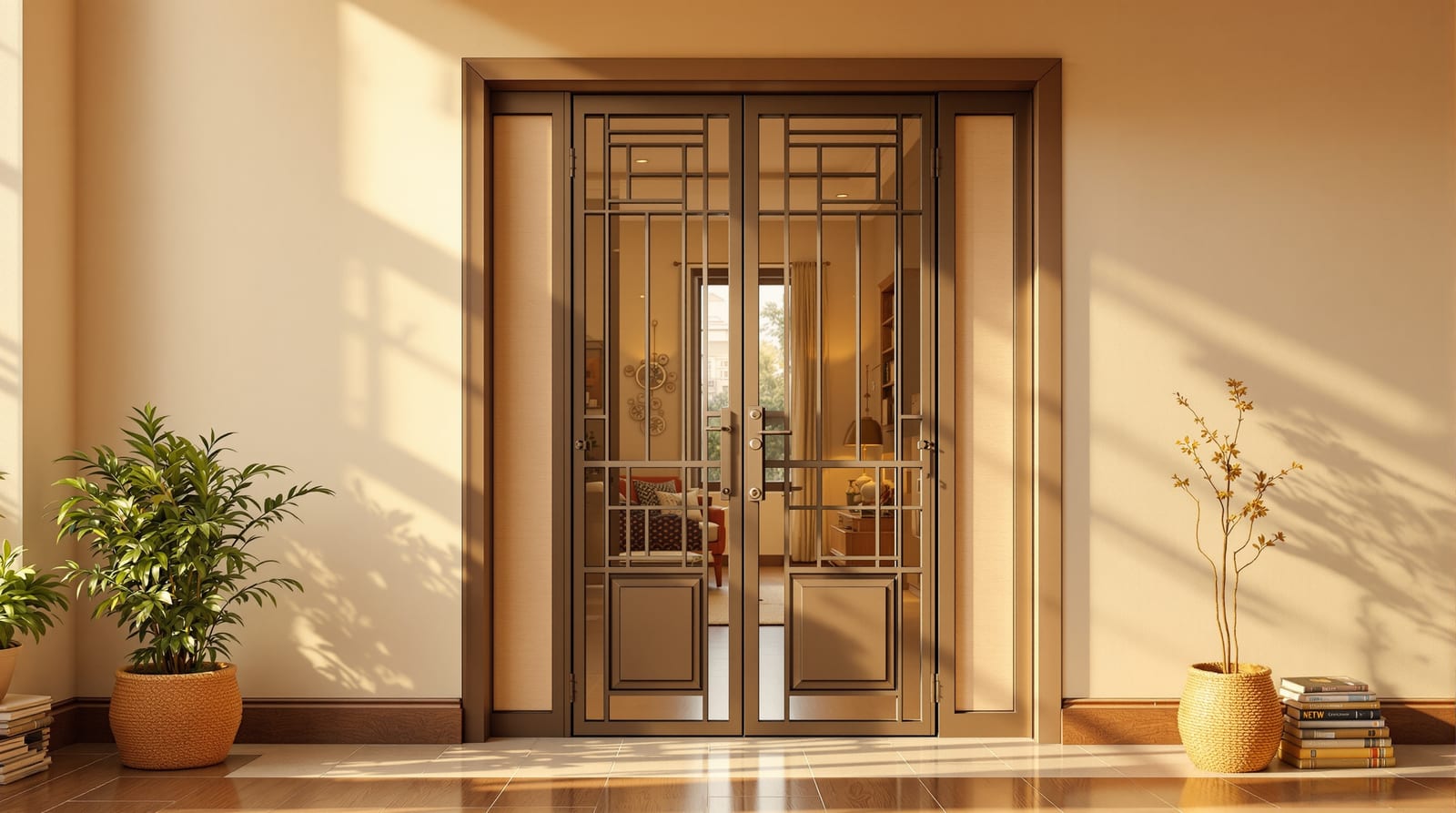
Steel Doors in India: Security Doors, Galvanised Frames and Fire-Rated Steel Doors Explained
Where pressed-steel security doors, GI frames (IS 4351) and fire-rated steel doors (IS 3614) actually belong in an Indian home, the finishes that hide the metal, how to stop coastal rust and what a set costs in 2026.
Most Indian homes still think of "steel" as the ugly grey gate at the back of a government office. That picture is two decades out of date. Today a pressed-steel security door can carry a convincing teak-grain finish, swallow a multi-point lock, shrug off a monsoon that would warp a wooden shutter, and in its fire-rated form hold back flames for ninety minutes while you get out. The trick is knowing which steel door belongs where: a security door at the main entrance does a very different job from a galvanised frame on a damp bathroom or a fire-check door on a stairwell. This guide walks through all three, the codes that govern them, the finishes that make them liveable, and what each costs in 2026.
Why steel, and why now
Wood swells, twists and feeds termites. uPVC and WPC solve moisture and termites but are easy to lever open and offer no fire resistance. Steel is the one material that answers security, fire and moisture at the same time — which is exactly why builders quietly switched to galvanised steel frames for wet areas years ago, and why security-conscious families now specify a steel main door behind a decorative wooden one, or instead of it.
Three distinct products hide under the single word "steel door":
- Pressed-steel security doors — a skin of galvanised or cold-rolled steel sheet (usually 0.8-1.2 mm) pressed over a steel-tube internal frame, often filled with rockwool or honeycomb board for sound and insulation. This is the "safety door" your hardware dealer sells.
- Galvanised (GI) steel door frames — the chowkat alone, in pressed steel to IS 4351, used with any shutter (wood, WPC, even another steel leaf). Cheap, dimensionally perfect, rot-proof.
- Fire-rated steel doors — purpose-built metallic fire-check doors to IS 3614, tested to hold for 30, 60, 90 or 120 minutes. Mandatory on certain stairwells, lobbies and service shafts under NBC 2016.
Each has its own code, its own price band and its own right place in the home. Mixing them up — say, buying a decorative "safety door" and assuming it is fire-rated — is the single most common and most dangerous mistake buyers make.
Where steel doors actually belong in an Indian home
A steel door is rarely the right choice for a bedroom. It earns its keep at the thresholds where security, weather or fire matter most.
| Location | Door type | Why steel here | Typical spec |
|---|---|---|---|
| Main entrance (security) | Pressed-steel security door | Pry-resistant, multi-lock, fits a fingerprint/smart lock cleanly | 1000-1100 mm wide, multi-point lock, wood-finish skin |
| Behind a wooden main door | Steel security door (mesh + solid) | Lets you keep the door open for air with a locked steel grille leaf | Double-leaf: mesh grille + solid steel |
| Terrace / roof access | Galvanised steel door | Fully exposed to sun and monsoon; wood rots, steel does not | GI shutter + GI frame, powder-coated |
| Bathroom / WC frame | GI frame (IS 4351) | Frame stays dry-proof; pair with WPC or PVC shutter | 0.8-1.0 mm GI pressed frame |
| Services duct / electrical shaft | Steel door, often fire-rated | Code may require fire separation of shafts | 60-min fire door in many apartments |
| Common stairwell / fire exit | Fire-rated steel door (IS 3614) | Legally required; opens in egress direction | 1000 mm min clear, 60-120 min, panic bar |
| Store / utility / pump room | Plain steel door | Tough, cheap, no aesthetic demand | Powder-coated GI |
Note the pattern: solid security at the front, galvanised frames where it is wet, and fire-rated steel only where the building code or a sensible fire strategy demands it. In a typical 2-3 BHK flat the resident usually controls only the flat's own main door; the stairwell and lift-lobby fire doors are the builder's or society's responsibility, but it is worth knowing whether they were ever actually fire-rated, because "looks like steel" and "tested to IS 3614" are not the same thing.
The three steel doors, compared
| Feature | Pressed-steel security door | Galvanised (GI) frame + shutter | Fire-rated steel door (IS 3614) |
|---|---|---|---|
| Primary job | Burglary resistance | Rot-proof, dimension-stable opening | Contain fire and smoke for a rated time |
| Governing code | No single IS; quality varies | IS 4351 (frames) | IS 3614 Pt 1/2; tested to BS 476 Pt 22 / IS-EN 1634 |
| Steel gauge | 0.8-1.2 mm skin + tube frame | 0.8-1.6 mm pressed | Heavy-gauge skin + mineral core |
| Core / fill | Rockwool, honeycomb or hollow | Hollow (frame only) | Rockwool / vermiculite board, intumescent seals |
| Rating you can ask for | Number/strength of lock bolts | Galvanising coating weight | 30 / 60 / 90 / 120 minutes |
| Finish options | Powder-coat, PVC laminate, wood-grain | Powder-coat, primer + paint | Powder-coat (must not be flammable) |
| Indicative cost (set) | ₹8,000-25,000 | Frame ₹150-400/ft run; shutter extra | ₹12,000-40,000+ per leaf |
| Where it shines | Flat main door, behind wood door | Wet areas, terrace, all frames | Stairwells, shafts, fire exits |
Treat "security door" and "fire door" as separate purchases. A decorative steel safety door from a hardware shop almost never carries a fire rating. If you need fire performance, you must buy a door that comes with a test certificate to IS 3614 from a recognised lab — ask to see it.
Galvanised frames: the quiet workhorse
The steel product most Indian homes already own without noticing is the pressed-steel door frame to IS 4351. Builders adopted GI frames because a wooden chowkat in a bathroom wall absorbs water from the wet plaster and the daily splash, then rots and lets the shutter sag within a few years. A galvanised frame is rolled from zinc-coated sheet, is dimensionally identical door to door, takes hinges that are spot-welded (not screwed into softening timber), and simply does not rot.
The thing to check is the zinc coating weight and the gauge. A thin, lightly-galvanised frame in a coastal flat will still bleed orange rust at the welds within a year or two. For wet areas and coastal homes, specify a heavier gauge (1.0-1.6 mm) and a powder-coat over the galvanising for a second barrier. Pair a GI frame with a WPC or PVC shutter in bathrooms and you have an opening that ignores the monsoon entirely — a combination we recommend in our companion reading on choosing between door materials and on residential door standards.
Fire-rated steel doors and the code
A fire door is an engineered assembly — leaf, frame, intumescent seals, hinges, closer and lock — tested as a whole to a fire-resistance time. IS 3614 (Part 1 metallic, Part 2 non-metallic) governs metallic fire-check doors in India; the leaf is tested to BS 476 Part 22 or IS-EN 1634 and certified for 30, 60, 90 or 120 minutes. NBC 2016 Part 4 (Fire & Life Safety) sets where they are required and how they must behave: a fire/exit door must give at least 1000 mm clear width, must open in the direction of escape, must be self-closing, and must not be propped or locked against escape.
For a homeowner the practical points are:
- The rating is for the complete assembly, not just the leaf. A 90-minute leaf hung on an ordinary frame with a flammable seal is not a 90-minute door.
- It must have a self-closing device and intumescent strips that swell with heat to seal the gap and block smoke.
- A fire door is only as good as its closer and hardware; wedging it open with a brick (a national habit in stairwells) defeats the entire system.
- Ask for the test certificate and the rating stamp. "Fire door" stickers without a lab certificate mean nothing.
If you are renovating a villa, a duplex with an internal stair, or a top-floor flat with a single escape route, a fire-rated steel door on the stair or service shaft is a genuinely life-saving upgrade and not an extravagance.
How a pressed-steel security door is built
A good security door is more than a sheet of metal. Two skins of galvanised steel are pressed over an internal steel-tube frame, and the cavity is filled with rockwool (for fire delay and sound) or paper-honeycomb (for stiffness and weight). The hardware is where security is won or lost: look for a multi-point lock that throws bolts into the head and sill as well as the side, anti-saw hinge pins, and a frame anchored deep into the masonry, not just screwed to the plaster. A ₹40,000 lock on a flimsy frame is wasted money — the burglar levers the frame, not the lock.
Finishes: making steel look like a home, not a warehouse
The reason families resisted steel for so long was the grey, institutional look. That objection is gone:
- Powder-coating — an electrostatically applied, oven-baked polyester coat. Tough, available in any RAL colour, and the standard for modern steel doors. Re-coatable after years of wear.
- PVC / vinyl laminate skins — wood-grain films pressed onto the steel face. Convincing teak, walnut and oak looks at a fraction of real-wood cost.
- Wood-finish (heat-transfer) coatings — sublimation printing that bakes a wood pattern into the powder coat; the most durable wood-look option, common on imported security doors.
- Membrane / moulded panel pressing — the steel is pressed into raised panels that mimic a traditional six-panel timber door, then finished — so it reads as a classic door from across the room.
For a main door, a wood-finish steel leaf gives you the warmth families expect at the entrance (and keeps the Vastu instinct for a "solid, welcoming" main door satisfied) with the security of metal underneath. See our entrance Vastu guide for direction and threshold conventions — those apply to a steel door exactly as they do to a wooden one.
Rust and coastal care — the one real weakness
Steel's enemy is corrosion, and India has plenty of it: Mumbai, Chennai, Kochi, Goa, Visakhapatnam and the whole coastal belt carry salt-laden air that finds every scratch and weld. The good news is that rust is entirely manageable with the right spec and a little routine.
- Specify galvanised, not bare, steel — the zinc layer is the first line of defence. Coastal homes should also insist on a powder-coat over the galvanising as a second barrier.
- Watch the welds and cut edges — galvanising is thin or absent where the door was cut or welded on site. These are the first spots to bleed rust; touch them up with a zinc-rich primer before final painting.
- Annual wipe-down — clean the door with mild soapy water, dry it, and check the bottom rail and threshold where water pools.
- Touch up chips immediately — a coin of exposed steel under a chipped powder-coat will undercut the surrounding coating if left. Sand, prime with zinc primer, and re-coat.
- Drainage matters — a door that sits in a puddle after every monsoon shower will rust at the foot regardless of coating. Make sure the threshold sheds water outward.
A galvanised, powder-coated steel door that gets a yearly clean will outlast a wooden door several times over even on the coast. Neglected bare steel will rust through in a few damp seasons. The difference is entirely in the spec and the upkeep.
Costs in 2026 (indicative, varies by city and vendor)
| Item | Indicative cost | Notes |
|---|---|---|
| Pressed-steel security door (set) | ₹8,000-25,000 | Leaf + frame; higher for multi-point lock + wood finish |
| Imported / premium security door | ₹25,000-60,000+ | Heavy gauge, smart-lock ready, designer finish |
| Galvanised steel frame (chowkat) | ₹150-400 / ft run | Cheaper and more uniform than teak/sal frame |
| Fire-rated steel door (per leaf) | ₹12,000-40,000+ | Rises with rating: 30 < 60 < 90 < 120 min |
| Powder-coating (refinish) | ₹1,500-4,000 / door | If re-coating an old steel door |
| Installation / fitting labour | ₹800-3,000 / door | Masonry anchoring extra for security doors |
| Hardware upgrade (multi-point lock, smart lock) | ₹3,000-30,000 | A smart lock fits a steel door cleanly |
Add 18% GST on the supply, as on most door products. Note that a basic steel door overlaps in price with a good flush or panel door — you are paying for security and weather resistance, not luxury. A fire-rated door costs more because you are paying for a tested assembly, not just metal. Run your own numbers with our door cost calculator before you commit, and compare against wood, WPC and uPVC on the door material comparison tool.
Should you choose steel? A quick verdict
- Main door security: Yes, especially in ground-floor flats, independent houses and homes left empty during the day — ideally a wood-finish steel security door with a multi-point lock.
- Behind a decorative wooden door: A steel grille + solid double-leaf safety door is one of the best value security upgrades in India.
- Terrace, services, wet-area frames: Galvanised steel is the obvious, almost default, choice.
- Fire exits and shafts: Only IS 3614-certified fire doors will do — never a look-alike.
- Bedrooms and living spaces: Skip it. Steel adds nothing here and a good wooden or engineered-wood door looks and feels better.
For the bigger picture on locks, sensors and reinforcement, read our companion guide on door security; for the codes and sizes that govern every door in the house, see residential door standards.
Frequently asked questions
Are steel security doors actually safe against burglars?
A well-built pressed-steel door with a multi-point lock, anti-saw hinges and a frame properly anchored into masonry is far harder to force than a wooden door. The weak link is usually the frame anchoring and the lock quality, not the leaf — so spend on those, and insist the frame is grouted into the wall, not just screwed to the plaster.
Do steel doors rust, especially near the coast?
Bare steel rusts quickly in salt air. Galvanised steel with a powder-coat on top resists corrosion well; the only vulnerable points are scratches, cut edges and welds. With a yearly clean and prompt touch-up of chips using zinc primer, a galvanised steel door lasts for decades even in coastal cities.
Is a "safety door" the same as a fire door?
No. A decorative steel safety door sold for security is almost never fire-rated. A fire door is a tested assembly certified to IS 3614 for a specific time (30/60/90/120 minutes) and must be self-closing with intumescent seals. If you need fire performance, ask to see the lab test certificate — looks alone mean nothing.
Can a steel door look like wood?
Yes. Heat-transfer wood-finish coatings, PVC wood-grain laminates and pressed moulded panels give steel doors a convincing teak, walnut or six-panel timber appearance, so the entrance still feels warm and traditional while the security is metal underneath.
What does a steel door cost in India in 2026?
A pressed-steel security door set runs roughly ₹8,000-25,000, premium and imported models ₹25,000-60,000+, and fire-rated steel doors ₹12,000-40,000+ per leaf depending on the rating. Galvanised frames cost about ₹150-400 per running foot. Add 18% GST and ₹800-3,000 fitting per door. Figures are indicative and vary by city and vendor.
Export this guide
Related Guides — Deep-dive reading
Reinforced Wooden Doors in India (2026): Making the Timber Main Door Actually Secure
A homeowner's decision guide to choosing or upgrading the wooden main or flat door most Indian homes actually have, so it genuinely resists a break-in, without pretending a hollow flush door is secure.
SecurityDoor Frame Security in India (2026): Anchoring the Chowkhat Break-Ins Actually Exploit
A homeowner's guide to the real weak point behind most forced entries: the frame, not the leaf or the lock, and how to anchor, pack and reinforce a chowkhat so a strong door genuinely stays in the wall.
SecurityThe Complete Home Door Guide for Indian Homes (2026): Types, Materials, Cost, Security & Vastu
Everything an Indian homeowner needs to specify the right door for every opening — from main entrance to bathroom — with real 2026 prices, IS/NBC standards and Vastu sense.
Home Doors & EntrancesRelated Tools — Try Free
Door Material Comparison Tool
Compare 2–4 door materials on cost, durability, maintenance, security and moisture resistance.
Comparison ToolWindow Hardware Cost Calculator
Estimate window hardware cost — hinges, handles, locks, rollers and multipoint gears.
Window CalculatorDoor Security Rating Calculator
Score your main door out of 100 across leaf, frame, lock and hardware — and see the top upgrades.
Security Tool