
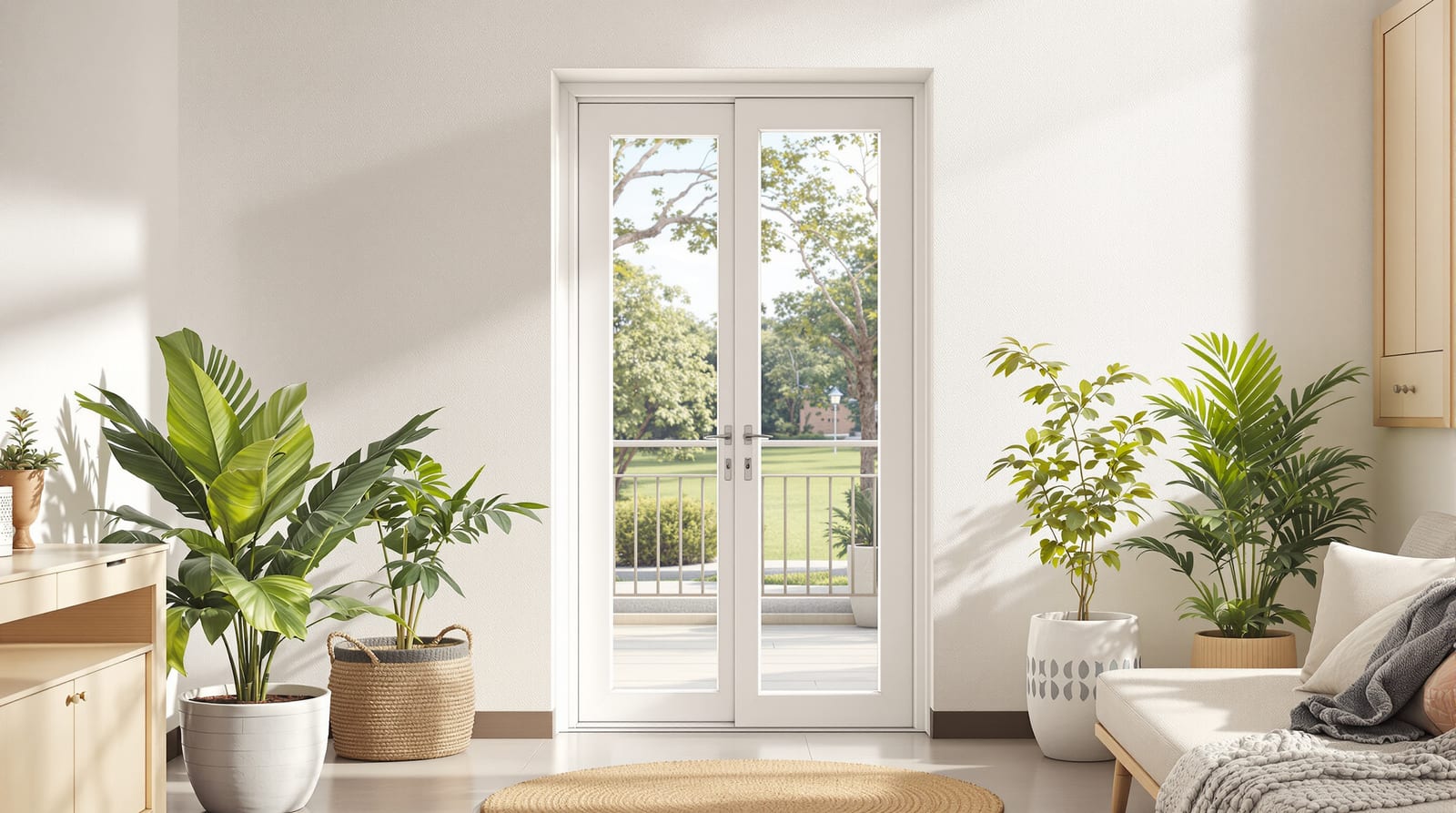
uPVC Doors for Indian Homes: Profiles, Cost, Bathrooms & Buying Guide
Why uPVC wins in bathrooms, utilities, balconies and coastal homes - profiles and steel reinforcement, waterproof and termite-proof performance, multipoint locks, glazing options and 2026 ₹ costs, plus how it compares with WPC and aluminium.
There is one room in every Indian home where a beautiful teak door will quietly rot itself to death: the bathroom. Steam, splash, a perpetually damp threshold and a floor that gets mopped twice a day are exactly the conditions wood was never built to survive. This is where uPVC earns its keep. Made from rigid unplasticised polyvinyl chloride extruded into hollow multi-chamber profiles - the same family of material as your overhead water tank and the better class of pipe - a uPVC door simply does not care about water, will not swell in the monsoon, and offers nothing for a termite to eat.
But uPVC is not a magic material, and it is widely mis-sold. A cheap, un-reinforced uPVC door sags, rattles and yellows; a properly specified one with steel inside the frame, a multipoint lock and good glazing will outlast the building's first coat of paint several times over. This guide covers what is actually inside a uPVC door, where in the home it belongs (and where it does not), how it handles water, salt air and termites, the hardware and glazing that matter, real 2026 rupee costs, and an honest comparison against WPC and aluminium.
What a uPVC door actually is: profile and reinforcement
A uPVC door is not a slab. It is a frame and a shutter, each built from extruded profiles - long hollow sections divided internally into two, three or more air chambers. Those chambers do three jobs at once: they stiffen the section like the flutes in cardboard, they trap still air for thermal and acoustic insulation, and they create a drainage path so any water that gets in finds its way back out.
The catch is that plastic, on its own, flexes. A door leaf a metre wide and over two metres tall, opened and slammed thousands of times, needs a spine. That spine is galvanised steel reinforcement - a U- or box-section steel insert slid down the main chamber of the frame and the shutter stiles and screwed in place. This is the single most important thing to verify before you buy.
- Reinforced (steel inside the load-bearing chambers): stays square, carries the hinges, holds a multipoint lock, does not sag over years. This is what you want for any full door.
- Un-reinforced (hollow plastic only): fine for a tiny lightweight bathroom shutter, but on anything larger it droops at the latch corner within a year or two, the lock stops aligning, and the leaf starts to bow in the sun.
Profile quality also shows in wall thickness and lead-free formulation. Reputable systems quote a class for the visible wall thickness (broadly, Class A is the thickest and most rigid, Class B thinner). Insist on a lead-free, UV-stabilised compound - the UV package is what stops white profiles going chalky-yellow in Indian sun. Ask whether the corners are heat-welded (the profiles are mitred and fusion-welded into a single sealed frame) rather than merely screwed or glued; welded corners are stronger and watertight, and are the mark of a real fabricator rather than a cut-and-assemble shop.
Where uPVC doors belong in an Indian home
uPVC is a specialist, not a generalist. It is outstanding in wet, exposed and low-prestige openings, and a poor choice where you want warmth, grandeur or a hand-crafted look.
| Location | uPVC suitability | Why |
|---|---|---|
| Bathroom / WC | Excellent | Totally waterproof, no swelling, mould-resistant, wipe-clean; the default modern choice |
| Utility / wash area | Excellent | Survives constant damp, splashes and detergent |
| Balcony / terrace door | Very good | Casement or sliding uPVC seals against rain and dust; UV-stable white frame |
| Back / service entrance | Good | Lockable, secure with steel reinforcement and multipoint lock |
| Coastal / seafront home | Excellent | Will not corrode like aluminium or steel; ignores salt air |
| Bedroom / study (internal) | Acceptable | Works, but flush or panel doors look warmer and cost similar |
| Main entrance | Avoid (usually) | Lacks the gravitas, mass and craftsmanship expected; teak/solid or steel-cored doors suit better |
| Pooja room | Avoid | Tradition favours wood; see entrance and pooja-door practice |
The honest summary: put uPVC where water and weather attack, and where nobody is judging the door's status. For the front door and pooja room, Indian convention - and frankly the look - still wants solid timber. If you are weighing the main door separately, the broader trade-offs sit in our door-materials-comparison-india overview, and the Vastu side of the main door is covered in entrance-vastu.
Weather, water and termites: the real performance case
This is the whole reason uPVC exists in your door schedule.
Water and humidity. uPVC does not absorb water. A wooden door gains and loses moisture with the season - that is why it sticks in July and rattles in January. uPVC does neither: no swelling, no warping, no de-lamination, no rot. The welded frame and the EPDM rubber gaskets running around the shutter form a continuous seal, and the chambered profile drains any incidental water back outside through weep slots. For a bathroom this is transformative - the bottom rail of a flush door is usually the first thing to fail in an Indian bathroom, and uPVC removes that failure mode entirely.
Coastal and salt air. Aluminium pits and steel rusts in seafront air unless heavily coated and maintained. uPVC is chemically inert to salt - this is why it is the smart frame material for homes in Mumbai's coastal belt, Goa, Chennai, Kochi and Vizag.
Termites and borers. uPVC offers a termite literally nothing to eat. In termite-prone regions - much of peninsular and central India - this is a genuine, money-saving advantage over timber and even some engineered-wood doors for damp, ground-floor and external openings.
Fire and heat. Be clear-eyed here. uPVC is not a fire door; it softens and will not give you a fire rating. For staircase, lobby or kitchen-egress doors that need a rating, you need a tested fire-check door (steel or treated timber to IS 3614), not uPVC. And in direct, relentless sun a dark-coloured profile can heat and very slightly bow - which is exactly why quality uPVC is sold UV-stabilised and most commonly in white.
Hardware: hinges, gaskets and the multipoint lock
A uPVC door's security and seal live in its hardware, and this is where budget products cut corners.
- Multipoint lock (MPL): the headline feature. One turn of the key throws several bolts - typically a central latch plus hooks or rollers top and bottom - that pull the leaf tight into the frame at multiple points. This both secures the door against levering and compresses the gasket evenly for a weather-tight seal. For any external or balcony uPVC door, specify a multipoint lock; a single cylinder latch is a weak point. The economics of upgrading locks are covered in our door-security-india guide.
- Hinges: external door leaves are heavy once steel-reinforced, so they need three sturdy, adjustable hinges (rising/falling and lateral adjustment lets you re-square the door later). Cheap two-hinge fittings are a sag waiting to happen.
- EPDM gaskets: the rubber seals must be continuous and supple. They are the part that keeps driving monsoon rain and fine summer dust out; ask whether they are replaceable.
- Handles and cylinder: a key-lockable lever handle on the outside, with a Euro-profile cylinder you can later swap for a smart cylinder. For bathrooms, a simple thumb-turn with an emergency release outside is standard.
- Friction stays (for casement leaves): stainless friction hinges hold a balcony casement open at any angle against wind.
Glazing and panel options
A uPVC door is really a frame with an infill, and the infill defines its look and function.
- Frosted / obscure glass: the standard for bathrooms - light in, privacy kept. Toughened obscure glass is best for safety.
- Clear single or double glazing: for balcony and garden doors where you want the view and, with double glazing, real heat and noise reduction.
- Solid uPVC panel: an opaque insulated panel where no light or vision is wanted (service doors, lower half of a half-glazed door).
- Louvred / ventilator infill: for utility and bathroom doors that need air movement; fixed louvres in the lower panel are common.
- Toughened safety glass: for any large or low glazed pane, insist on toughened (tempered) glass per good glazing practice (IS 3548 covers workmanship). For acoustic comfort against a noisy street, double glazing in a uPVC frame is a meaningful upgrade - see energy-efficient-doors-india and soundproof-doors-india for how the layers add up.
2026 cost in India
uPVC doors are priced per square foot of the opening (frame plus shutter), not per shutter, because the frame is integral and welded to size. Figures below are indicative and vary by city, profile brand, reinforcement and glazing; add 18% GST and installation.
| Item | Indicative 2026 cost | Notes |
|---|---|---|
| uPVC door (supply, basic profile) | ₹400-700 / sq ft of opening | Higher for premium imported profiles and double glazing |
| Standard bathroom door (≈ 2'6" x 7", ~17.5 sq ft) | ₹7,000-13,000 supplied | Frosted glass or louvred panel, single MPL or thumb-turn |
| Balcony / external casement door | ₹12,000-25,000+ | Larger opening, toughened/double glazing, multipoint lock |
| Multipoint lock (upgrade) | ₹2,500-7,000 | Brand and number of locking points dependent |
| Toughened glass infill | ₹120-300 / sq ft of glass | Frosted/obscure costs a little more |
| Installation / fitting labour | ₹800-3,000 per door | Welded frames usually fitted by the fabricator's crew |
Two cost notes worth remembering. First, "uPVC" prices in the market range wildly because the cheapest products are thin, un-reinforced and lead-bearing - if a quote looks too good, it is missing the steel. Second, uPVC's low maintenance is part of its value: a wooden bathroom door you replace twice a decade is the true comparison, and on a lifecycle basis uPVC usually wins in wet rooms. For a structured budget across the whole door schedule, see door-cost-india-2026.
Maintenance: close to none
This is uPVC's quietest selling point. There is no polishing, no melamine re-coat, no termite treatment, no painting. Maintenance is:
- Wipe the profile with a damp cloth and mild soap; a soft brush for textured surfaces. Avoid abrasive scourers and solvents that can dull the finish.
- Twice a year, clear and lightly lubricate the hinges, the multipoint lock mechanism and the drainage weep slots.
- Inspect the EPDM gaskets for hardening or gaps every couple of years and replace if needed - this keeps the seal and the lifespan intact.
- Check the steel-reinforced leaf still closes square; quality hinges let you re-adjust without removing the door.
A well-made uPVC door in a bathroom can comfortably last 20-25 years with this minimal care, which is far beyond a timber bathroom door in the same conditions.
uPVC vs WPC vs aluminium
These three are the genuine alternatives for wet and exposed openings, and they win on different things.
| uPVC | WPC | Aluminium | |
|---|---|---|---|
| Core material | Steel-reinforced multi-chamber plastic profile | Wood-plastic composite board (flush slab) | Extruded aluminium frame + glass/panel |
| Water / monsoon | Excellent - waterproof, welded seal | Excellent - waterproof, no swell | Excellent (glass), but frame can seep if seals poor |
| Termite-proof | Yes | Yes | Yes |
| Coastal / salt air | Best - inert | Very good | Corrodes/pits unless well coated |
| Insulation (heat/noise) | Best (air chambers + double glazing) | Moderate | Poor unless thermally broken |
| Look | Frame-and-glass, modern, mostly white | Can mimic a flush wooden door, paintable | Sleek, industrial, slim sightlines |
| Strength / security | High with steel + multipoint lock | Good, screw-holding fine | High, rigid frame |
| Typical use | Bathroom, balcony, coastal, utility | Bathroom, utility, internal wet-area | Balcony sliders, large glazed openings |
| Indicative cost | ₹400-700 / sq ft | ₹75-150 / sq ft of shutter | ₹450-1,200 / sq ft (glazed) |
Quick rule of thumb: for a bathroom or utility flush door that should look like a normal painted door, WPC is cheaper and reads better - see wpc-doors-india. For a balcony, external or coastal door where you want a sealed, insulated, glazed opening with a real lock, uPVC is the stronger pick. For a large wall-of-glass slider, aluminium has slimmer sightlines, though uPVC seals and insulates better. The uPVC frame story overlaps heavily with windows, since the same profiles are used - our windows-doors-design-india guide covers the uPVC frame system as it spans both, and is worth reading if you are doing a whole-flat fenestration package.
Frequently asked questions
Are uPVC doors strong enough to be secure?
Yes - if they are steel-reinforced and fitted with a multipoint lock. The galvanised steel insert inside the frame and stiles gives the leaf its rigidity and lets the hinges and lock bite into something solid; the multipoint lock then pulls the door tight at several points, making it very hard to lever. An un-reinforced, single-latch uPVC door is genuinely weak, so always confirm both before buying.
Will a uPVC door turn yellow in the Indian sun?
A cheap, non-UV-stabilised profile can chalk and yellow over years of direct sun. A reputable lead-free, UV-stabilised profile - which is what you should specify - holds its white colour for well over a decade. White and light shades are most stable; very dark profiles absorb more heat and are best avoided on fully sun-exposed openings.
Can I use uPVC for my main entrance door?
You can, but most Indian homes should not. uPVC lacks the mass, warmth and craftsmanship expected of a front door, and convention (and resale appeal) still favours solid timber, teak or a steel-cored security door for the main entrance. Reserve uPVC for bathrooms, utilities, balconies, service doors and coastal exposures where its waterproofing genuinely pays off.
Is uPVC or WPC better for a bathroom?
Both are waterproof and termite-proof, so it comes down to look and budget. WPC flush doors are cheaper and look like a normal painted timber door, which most people prefer for an internal bathroom. uPVC suits the bathroom when you want a glazed or louvred panel, a sealed external bathroom on a balcony, or a coastal setting where its insulation and inertness matter more.
How long does a uPVC door last and what maintenance does it need?
A quality steel-reinforced uPVC door lasts roughly 20-25 years in a wet room with almost no maintenance - just an occasional wipe-down, twice-yearly lubrication of the lock and hinges, clearing the drainage slots, and replacing the rubber gaskets if they harden. There is no painting, polishing or termite treatment, which is a large part of why it outlasts a timber bathroom door so comfortably.
Export this guide
Related Guides — Deep-dive reading
Reinforced Wooden Doors in India (2026): Making the Timber Main Door Actually Secure
A homeowner's decision guide to choosing or upgrading the wooden main or flat door most Indian homes actually have, so it genuinely resists a break-in, without pretending a hollow flush door is secure.
SecurityAluminium Doors in India: Profiles, Glazing, Cost & uPVC vs Steel (2026)
Framed glazed aluminium doors — sliding, openable and French-style — for balconies, utility and modern facades: powder-coat vs anodised vs wood-finish profiles, IS 733/1285 sections, thermal-break options and ₹/sq ft costs.
Home Doors & EntrancesSoundproof Doors in India: How Doors Leak Sound, STC Ratings, Seals & Real Costs
A door is the weakest acoustic link in any wall - and it usually leaks through the gaps, not the panel - so here is how to actually quieten a bedroom, home theatre or street-facing room, from a 1,500-rupee seal kit to a proper acoustic door.
Home Doors & EntrancesRelated Tools — Try Free
Window Material Comparison Tool
Compare uPVC, aluminium, wood, steel and composite windows on cost, life, upkeep and insulation.
CompareDoor Material Comparison Tool
Compare 2–4 door materials on cost, durability, maintenance, security and moisture resistance.
Comparison ToolWindow Hardware Cost Calculator
Estimate window hardware cost — hinges, handles, locks, rollers and multipoint gears.
Window Calculator