
 Lesson 0.3
Lesson 0.3 · Foundations
How to Read Your Own Space
You can see the waste now. But a feeling isn't a plan. This lesson turns your trained eye into a measured map — the foundation every design decision stands on.
Architects don't trust their eyes. They measure twice, draw it flat, and let the numbers argue back. A small home rewards that discipline more than any mansion ever could.
In the last two lessons you learned to see — the three levers, the four lenses, the wasted space hiding in plain sight. This lesson is where seeing becomes knowing.
Because here's the trap: when space is tight, a few centimetres decide whether a plan works. Will the wardrobe door clear the bed? Does the fridge fit beside the counter with room to open? Can two people pass in the kitchen? You cannot answer these by eye. You measure. And measuring a small home well is a real skill — with real mistakes that cost you the very space you're trying to save.
The measuring toolkit (you already own most of it)
You don't need professional gear. A reliable read of your home takes four humble things and an hour of care.
A tape measure — A 5m steel tape, or a phone laser measure. Metric — the whole world of design works in mm and metres.
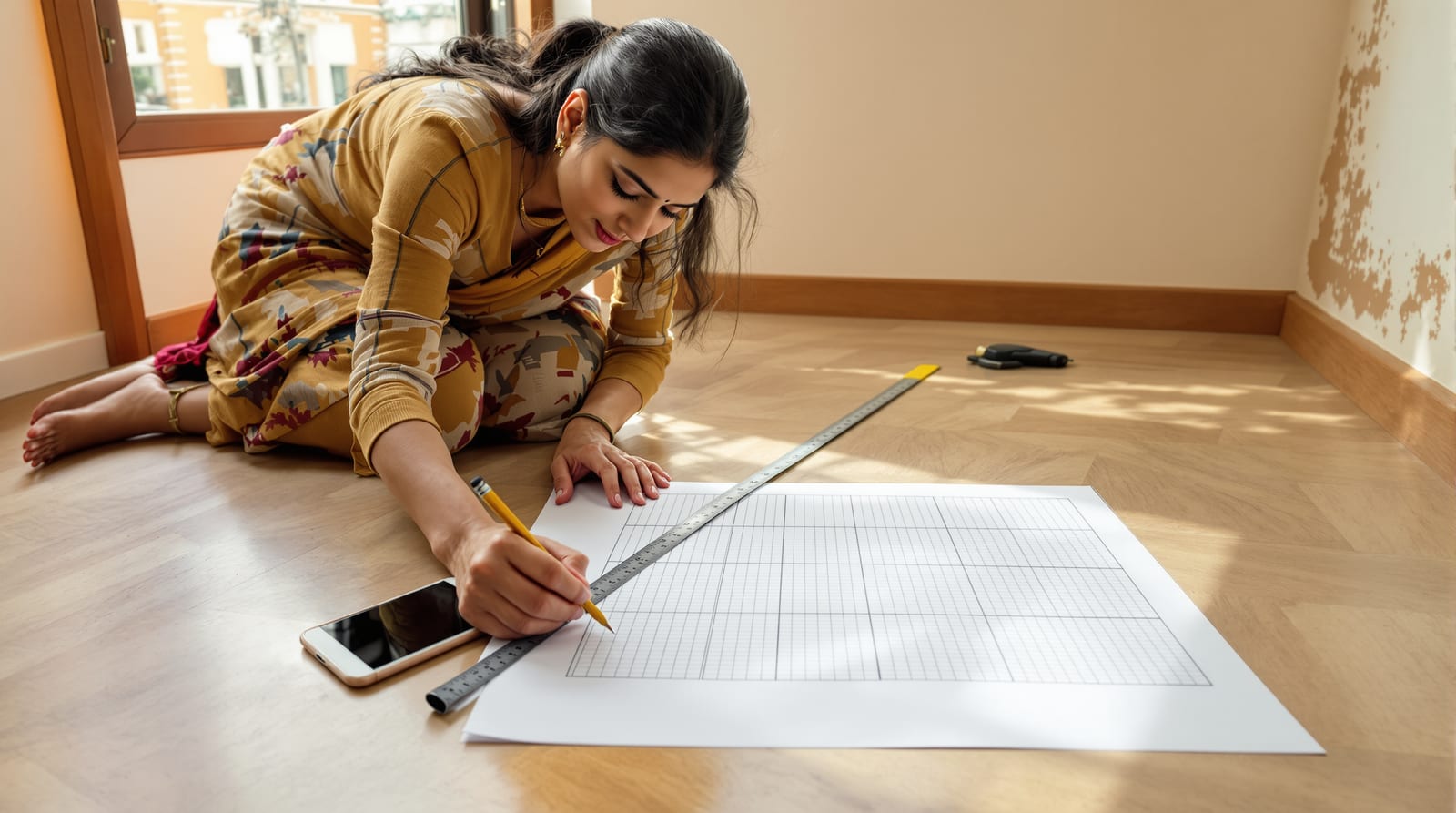
Graph paper — Or the gridded sheet from your worksheet. One square = a fixed real distance. The grid keeps you honest.
A pencil, not a pen — You will be wrong, repeatedly, and that's the process. Sketch loosely first, correct freely.
Your phone camera — Photograph each wall before you measure it. Memory lies; photos don't. Note fittings, sockets, the direction doors swing.
That's it. The skill isn't in the tools — it's in what you measure and the mistakes you avoid. Which is exactly what the next part lets you practise.
Walls first, then everything that interrupts them
A good measure-up follows a sequence, so nothing is forgotten. Work one room at a time, and within each room, in this order:
1 · The shell — Each wall, corner to corner, at skirting height. Then the diagonal across the room — if the diagonals don't match what your wall lengths predict, the room isn't a true rectangle (few Indian rooms are), and that matters when furniture has to fit a corner.
2 · The interruptions — Every door and window: its width, and crucially its position along the wall, plus the way each door swings. A door's swing is dead floor you cannot furnish — yet it's the single most forgotten measurement, and the cause of countless “the bed won't fit” surprises.
3 · The fixed things — What you can't easily move: the kitchen platform, the bathroom door, electrical points, the water inlet, the position of the pooja niche if built in. These anchor everything else.
4 · The third dimension — Floor to ceiling. And floor to the top of any window or door. This is the measurement Western guides skip and Indian homes live by — it tells you whether there's loft volume to claim, whether a mezzanine is even possible, how tall a wardrobe can go.
You are measuring carpet, not built-up
The deepest measuring mistake isn't a slip of the tape — it's measuring the wrong thing entirely. When you draw your plan, you draw the space inside the walls: the carpet area, the floor you can actually use. Builders' drawings often show built-up area, including wall thickness. Mix the two and every piece of furniture you plan will be slightly too big for the room that actually exists.
| What you measure | What it gives you |
|---|---|
| Inside face to inside face | Carpet area — real usable floor. Always use for design. |
| From a builder's drawing | Often built-up — includes walls. Too big for design. |
| The brochure number | Super built-up — includes lobby. Never use for design. |
Go deeper — clearances, the numbers that make a plan livable
Measuring the room is half the job; knowing the clearances furniture needs is the other half. A few worth committing to memory for Indian compact plans:
600mm — minimum to walk past comfortably (a person's shoulder width plus a little). Below this, a passage feels like a squeeze. 750–900mm — to pull out a dining chair and sit, or to open a wardrobe and stand in front of it. 1050mm — for two people to pass in a kitchen, the Indian reality of a joint family cooking together. 700mm — clear in front of a WC; 550mm in front of a basin.
These turn a measured plan into a livable one. A bedroom that measures fine on paper fails the moment the wardrobe door can't open without hitting the bed — and only the clearance numbers catch that before the carpenter does.
Measure a room without leaving your chair
Here's a real ~120 sq ft bedroom. Four measuring decisions come up in every room you'll ever survey — and each has a common, costly mistake. Make the call, then see why it matters. Practise here so you don't pay for it at home.
Fig 0.3 — The four decisions recur in every room of every survey you will ever do.
You've measured a bedroom's walls perfectly and the wardrobe fits against the wall on paper. What's the most likely reason it still won't work in real life?
Run the method yourself
Don't do the whole house yet. Pick your hardest room — the one that feels most cramped — and measure it properly, using everything above. Bring your 0.1 and 0.2 worksheets; this is where their findings get pinned to real numbers.
- 1Photograph every wall first. Four photos, before the tape comes out. Note doors, windows, sockets, the water inlet.
- 2Measure in order: shell (each wall + one diagonal), then interruptions (doors, windows, and every door's swing), then the fixed things, then floor-to-ceiling.
- 3Draw it to scale on the gridded sheet — inside face to inside face. Mark the door swings as dead floor. Write the ceiling height in a circle in the centre.
- 4Overlay your waste. From your Four-Lens Walk, mark on this measured plan exactly where each wasted pocket sits. Now your opportunities have coordinates, not just feelings.
- You need four humble tools: a metric tape, gridded paper, a pencil, and your camera. The skill is in what you measure, not the gear.
- Measure in order: shell → interruptions → fixed things → ceiling height. The third dimension is the one Indian homes live by.
- A door's swing is dead floor — the single most forgotten measurement, and the cause of most “it won't fit” surprises.
- Always measure inside face to inside face — carpet area, the only number that's real. Mix in built-up and every plan runs too tight.
- Overlay your measured plan with your waste findings, and your opportunities now have coordinates.
You have a measured plan and a map of its waste. So what does it actually look like to pull all three levers across one real home at once?
The author
Amogh N P
Architect, interior designer, and creative polymath. Studio Matrx began in his notebooks — his vision of design made honest, useful, and open to everyone. Its Academy is written and taught in his memory, and free, forever.
More about Amogh →