
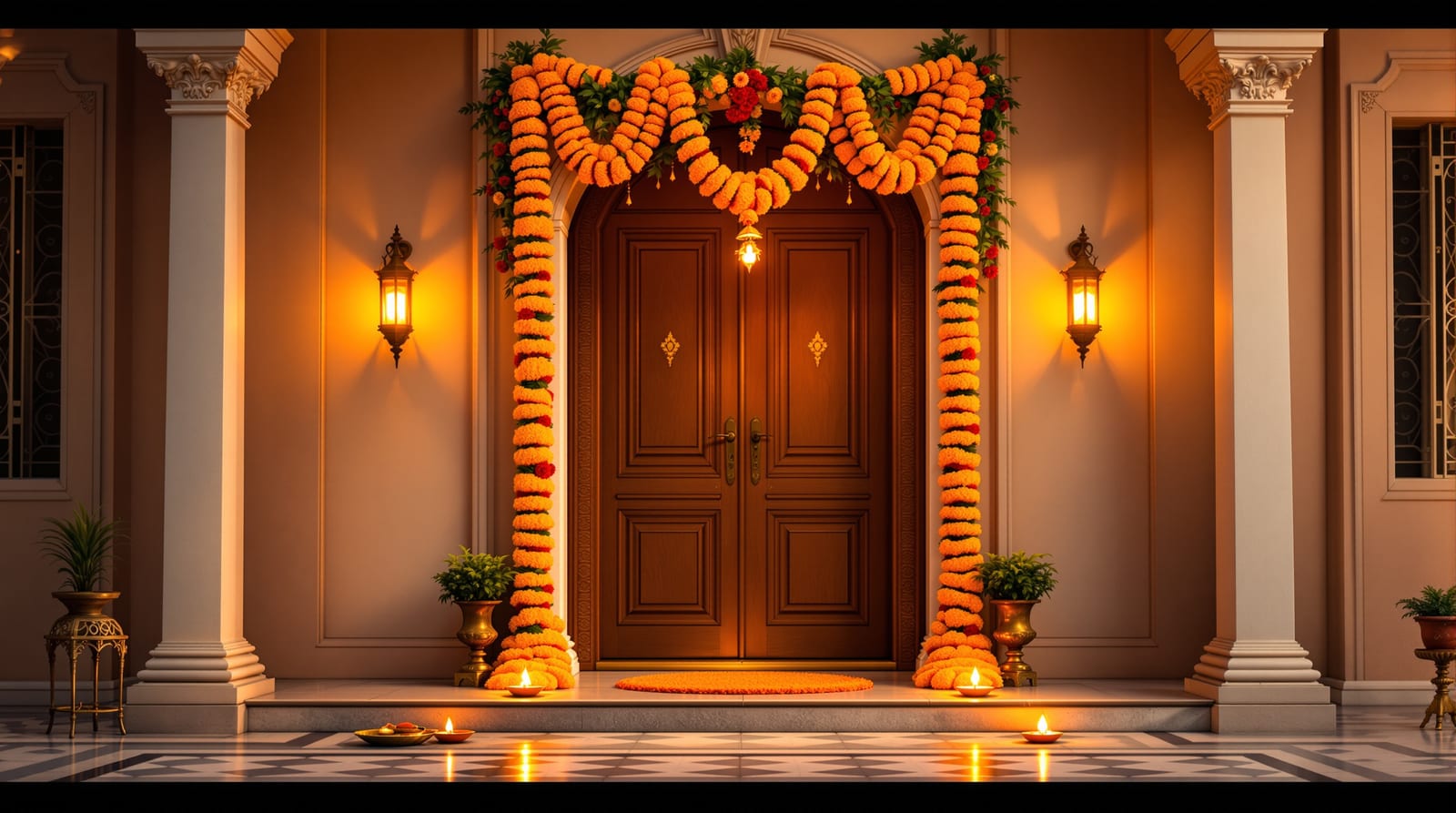
Vastu for Main Door in India: Direction, Size, Panels, Threshold & Colour
A door-specific Vastu reference for the Indian home - best direction quick-table, the right size and proportion, why an even number of panels, the dehleez/threshold, auspicious colours and materials by direction, what to avoid, and remedies when an apartment door is builder-fixed.
In Vastu Shastra the main door is the mukha, the mouth of the home, the single point through which prana (life energy), guests, prosperity and the day's mood all enter. That is why elders fuss over it more than any other element of the house. This guide is deliberately door-specific: which direction the door should face, how big it should be, why an even number of panels, what to do about the threshold, which colours and materials suit each direction, and what to quietly avoid. For the full directional treatment of the entrance zone, the eight padas, foyer rules and the rituals around it, read our companion Entrance Vastu - we will not repeat that here.
A useful way to hold all of this: Vastu is a centuries-old design tradition, and a surprising amount of it lines up with plain building sense - light, ventilation, approach, weather and the psychology of arrival. Where a rule is purely belief we will say so; where it has a practical reason we will point it out.
Main door direction - the quick reference
Direction is the first thing every family asks about. The short version: the north-east quadrant (North, East, North-East) is the most prized, because in the northern hemisphere these orientations catch the gentle morning sun and avoid the harsh afternoon west sun - good practical sense, dressed in tradition. The table below is a door-owner's quick reference; the deeper pada-by-pada ranking lives in Entrance Vastu.
| Door direction | Vastu rank | Presiding idea | Practical reason | If you have it |
|---|---|---|---|---|
| North | Excellent | Kubera (wealth) | Soft, even daylight; no heat gain | Keep it bright, clutter-free |
| East | Excellent | Surya (sun) | Morning sun, healthy start | Let in the morning light |
| North-East | Best | Ishanya (divine) | Coolest, most balanced corner | Treat as the sacred entry |
| North-West | Good | Vayu (air) | Good airflow | Fine; keep tidy |
| West | Acceptable | Varuna/Shani | Evening light; afternoon heat | Use a shade/canopy, remedies |
| South-East | Acceptable with care | Agni (fire) | Hot exposure | Lighten with colour, plants |
| South | Use remedies | Yama | Harsh sun, heat | Threshold, symbols, screening |
| South-West | Avoid as default | Nairutya | Heaviest, hottest corner | Strong remedies; keep heavy/closed |
A small but important nuance many homeowners miss: Vastu reads direction by where you stand inside facing out. Stand just inside your main door looking outward; the way you face is your door's direction. Confirm it with a compass (or our Door Vastu Planner) rather than guessing, because being one octant off changes every recommendation below.
Size and proportion - the door should be the largest
Vastu holds that the main door should be the biggest and most prominent door in the house - taller and wider than every internal door, so the home's "mouth" is generous and welcoming. This is one rule where tradition and modern practice agree completely. In practice:
- A standard main/external door in India is 1000-1200 mm wide x 2100 mm tall (roughly 3.5' x 7'), against 900 mm (3') for bedrooms and 700-750 mm for bathrooms - so it is naturally the largest.
- Vastu favours a door taller than it is wide, in a clean upright proportion (often described as roughly twice as tall as wide), which also reads as elegant and lets in a tall column of light.
- The doorhead (top of frame) should ideally be the highest of any door, reinforcing prominence.
- Avoid an oversized, disproportionate door that dwarfs the facade, and avoid a cramped low door - both are considered inauspicious and both feel wrong in person.
Keep the door size honest to NBC 2016 practice and your wall opening; you do not need an exotic dimension to be "Vastu-correct". For the full standards, see Door Size Standards, and to size yours quickly use the Door Size Calculator.
Number of panels and leaves - prefer even
Tradition prefers an even number of door leaves and panels for the main door. The most auspicious classic main door is the two-leaf (double-shutter) door, opening from the centre - grand, symmetrical and welcoming. Within each leaf, an even number of decorative panels (2, 4, 6) is preferred over odd counts. The folk reasoning is balance and symmetry; the practical reasoning is that a wide main door split into two leaves is easier to operate and frames the entry beautifully.
| Feature | Vastu preference | Notes |
|---|---|---|
| Number of leaves | Even - two-leaf ideal | Single leaf is acceptable for narrow openings |
| Panels per leaf | Even (2/4/6) | Avoid an odd, asymmetric panel layout |
| Number of steps to door | Odd is often favoured | Local belief; keep approach clean above all |
| Door opens | Inward, clockwise | See "what to avoid" below |
If your opening only fits a single leaf, do not panic - a single well-proportioned main door is fine. The even-number rule is a preference, not a hard requirement.
The threshold (dehleez / chaukhat sill)
Vastu strongly recommends a threshold - the dehleez or raised sill - at the main door. Symbolically it marks the boundary between the outer world and the protected inner home, "holds" prosperity inside and stops negative energy at the edge. Practically, a small raised sill keeps rain splash, dust and insects out (very real in the Indian monsoon) and is where families place the kumkum, rangoli/kolam and toran that signal a cared-for home.
Two cautions that matter:
- Keep the raised threshold low - 12 mm or less where you want barrier-free movement, so it does not become a trip hazard or block a wheelchair. Accessibility guidance (RPwD Harmonised Guidelines 2021) caps thresholds at about 12 mm for exactly this reason. See Accessible Doors.
- Never let the threshold be cracked, broken or worn - a damaged dehleez is considered inauspicious and simply looks neglected.
A stone (kota, granite, marble) threshold is the common Indian choice - durable, easy to keep clean and ritually appropriate.
Door colour by direction
Vastu links each direction to an element and a colour family. The point is to harmonise the door's colour with its direction; these are guidance, not rigid law, and a tasteful natural wood finish is universally safe.
| Direction | Element | Favoured colours | Avoid |
|---|---|---|---|
| North | Water | Blue, green, white, wood tones | Heavy red/black |
| East | Air/Sun | White, light blue, wood, pastel | Dark heavy shades |
| North-East | Water/divine | White, cream, light yellow, wood | Black, dark red |
| West | Water/Varuna | White, grey, blue, metallic | - |
| South-East | Fire | Silver, white, light green | Avoid intense dark |
| South | Fire | Red, orange, pink (warm) | Blue (clashes with fire) |
| South-West | Earth | Yellow, brown, beige, wood | Blue, black |
| North-West | Air | White, cream, grey, light tones | Dark/heavy |
Across all directions, Vastu generally discourages all-black main doors (seen as absorbing and heavy) and favours warm wood, white and earthy tones. Saffron/maroon accents, an Om or swastika motif and a brass toran above the door are classic auspicious touches.
Materials - what Vastu (and the weather) prefer
Vastu favours a solid wooden main door, ideally a good hardwood such as teak (sagwan), for its weight, warmth and longevity - a substantial door befits the home's mouth. This aligns neatly with Indian climate practice: solid teak resists termites and monsoon swelling far better than hollow or cheap timber. Avoid a flimsy, hollow-core or visibly low-grade main door.
| Material | Vastu view | Practical India note | Indicative cost |
|---|---|---|---|
| Solid teak (Burma/CP) | Most auspicious | Termite/water resistant, lasts decades | Rs 800-1,500+/sq ft; carved Rs 25,000-1,50,000+ |
| Other solid hardwood (sal) | Good | Sturdy, heavier maintenance | From ~Rs 800/sq ft |
| Engineered wood / veneered | Acceptable | Stable, value option | Rs 4,000-9,000 per shutter |
| WPC / uPVC | Neutral | Waterproof, good for coastal/wet zones | WPC ~Rs 75-150/sq ft; uPVC ~Rs 400-700/sq ft |
| Steel/metal as main door | Generally avoided for the front | Fine as a security gate behind a wood door | Rs 8,000-25,000 per set |
Costs are indicative and vary by city and vendor; add ~18% GST plus frame, hardware and installation (fitting Rs 800-3,000 per door). For the deeper material picture see Best Door Material and Teak Wood Doors; for design direction see Main Door Design.
What to avoid (door-specific)
These are the door-level "don'ts" that come up most often:
- Door opening outward or anticlockwise. The main door should open inward and clockwise, symbolically drawing energy and guests in. It is also safer and tidier in a tight Indian lobby.
- A creaking or sticking door. A noisy, hard-to-open door is considered to repel good energy - and signals swollen, poorly hung or unmaintained joinery. Plane it, oil the hinges, fix it.
- Two doors directly facing each other (main door aligned dead-opposite the back door or a large window) - energy is believed to rush straight through. Stagger, screen or curtain.
- Main door under a beam, staircase, or with a sharp corner / pillar edge pointing at it (sha chi). Box in or soften the edge.
- Shoe racks, dustbins, broken items or a cluttered, dark entry right at the door - keep it clean, lit and inviting.
- A door damaged, cracked or with peeling paint - repair promptly; a tired main door is the single most-cited inauspicious sign.
- All-black colour or a door smaller than internal doors (covered above).
Apartment fixed-door remedies
In most flats the builder has already fixed the main door's direction, size and often the leaf - and you cannot move a load-bearing opening. This is the most common real-world situation, and Vastu has a calm answer: remedies, not demolition. You influence the energy and the experience without touching structure.
- Wrong direction (e.g. south/south-west): add a threshold strip, place a brass Ganesha/Lakshmi and a Vastu pyramid or copper strip; keep the zone exceptionally bright (a warm 2700K light is mandatory) and clean.
- Single leaf where you wanted two: you cannot add a leaf, so compensate with symmetry around the door - matched plants or lamps on both sides, a centred toran and nameplate.
- No threshold: add a low (<=12 mm) stone or brass threshold strip - this is the easiest, highest-impact fix.
- Plain builder door colour: repaint in a direction-appropriate auspicious colour, or add a wood-veneer/laminate skin and a brass kada handle.
- Door faces another door/lift: hang a curtain, add a console or plant to break the straight line, place a small mirror per Entrance Vastu guidance.
- Cramped, dark lobby: light, a kolam decal, a fresh nameplate and removing the shoe rack transform it.
For the complete set of fixed-door remedies, the eight foyer rules, mirror placement and the decorations checklist, go to Entrance Vastu - it covers the entrance zone in full. You can self-check your door against these rules with the Door Vastu Planner.
Frequently asked questions
Which is the best direction for the main door as per Vastu?
North, East and especially North-East are considered the best, because they catch gentle morning light and avoid harsh afternoon sun. South-West is the direction to avoid as a default. If your door faces a less ideal direction you use remedies rather than rebuilding - see the table above and Entrance Vastu.
Is a south-facing main door always bad?
No. A south or south-west door is considered less ideal, not "cursed". Many homes have them and thrive. Standard remedies are a raised threshold, auspicious symbols (Ganesha/Lakshmi, swastika), a Vastu pyramid or copper strip, strong warm lighting and keeping the entry spotless and well-proportioned.
How many panels should a main door have as per Vastu?
An even number is preferred. The classic auspicious main door is a two-leaf (double-shutter) door, with an even number of panels (2, 4 or 6) in each leaf. A single well-proportioned leaf is acceptable when the opening is narrow.
What colour should the main door be?
Match the colour to the door's direction (see the colour table) - warm wood, white, cream and earthy tones are broadly safe. Vastu generally discourages an all-black main door. A natural teak finish suits almost any direction.
Can I fix Vastu for a builder-fixed apartment door?
Yes. You cannot move the opening, but you can add a threshold, repaint in an auspicious colour, place Ganesha/Lakshmi, light the zone warmly, add symmetry with plants and lamps, and keep it clean and clutter-free. These remedies are exactly what Entrance Vastu prescribes for apartments.
Export this guide
Related Guides — Deep-dive reading
Door Repair Guide India: Fix Holes, Dents, Swelling, Hinges & Locks (2026)
A fix-it reference for Indian homes: every common door problem with a quick fix, a proper repair, a replace verdict, the materials needed, and indicative rupee costs.
Home Doors & EntrancesThe Complete Home Door Guide for Indian Homes (2026): Types, Materials, Cost, Security & Vastu
Everything an Indian homeowner needs to specify the right door for every opening — from main entrance to bathroom — with real 2026 prices, IS/NBC standards and Vastu sense.
Home Doors & EntrancesVastu for Home Lifts (India): Direction, Colour, Materials and Remedies
The complete vastu picture for a home lift — favoured and avoided directions, the honest north-east nuance, cabin colour and material, the door, light and cleanliness, the stair relationship, and remedies when an existing lift cannot be moved — always reconciled with structure, safety and accessibility.
Home Lifts & AccessibilityRelated Tools — Try Free
Cross-Ventilation Analyzer
Estimate airflow and air changes per hour (ACH) from room size, window areas, layout, and local wind — with NBC 2016 Part 8 compliance check.
Ventilation CalculatorDoor Material Comparison Tool
Compare 2–4 door materials on cost, durability, maintenance, security and moisture resistance.
Comparison ToolVastu Window Planner
Vastu guidance for window placement and size by wall direction and room — rating and remedies.
Vastu