
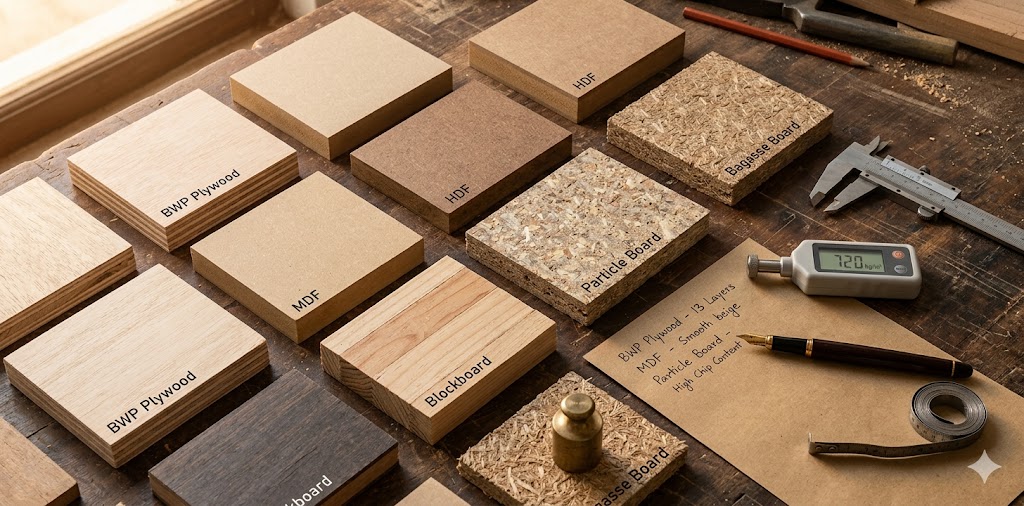
Engineered Wood Panels & Lifecycle Costing in India
Specifier's Reference for Plywood, MDF, HDF, Particle Board — and 20-Year Cost Math
Engineered wood panels are the invisible material of contemporary Indian residential interiors. They form the kitchen carcass, the wardrobe shell, the false ceiling substrate, the dry-wall partition core, the bed-headboard backing, and the cabinetry shutter substrate. The client never sees them after handover. The architect specifies them once and forgets them. The contractor procures them based on the lowest acceptable price.
This is also the material category most quietly responsible for residential interior failure. A wrong-grade plywood in a kitchen results in a swollen carcass at year 3. A high-formaldehyde MDF bed-back in a child's room emits VOCs for years. A particle-board wardrobe in a coastal home delaminates by year 5. Each failure is preventable at Stage 4 with one careful specification.
This guide is the architect's working reference for engineered wood panel selection. It covers the grade structure under IS 710 and IS 303, the emission classes that affect indoor air quality, the density and screw-holding properties that determine how the panel performs over decades, the termite-treatment options, and a 20-year lifecycle cost framework that converts a Stage 4 specification into client-facing economic argument.
"In interior architecture, the material the client cannot see costs more in the long run than the one they can." — Aphorism in Indian residential interior practice
1. The Material Family — What's What
The engineered-wood family is a continuum of substrates from highest-density (plywood) to lowest (particle board), each with distinct manufacturing, properties, and use cases.
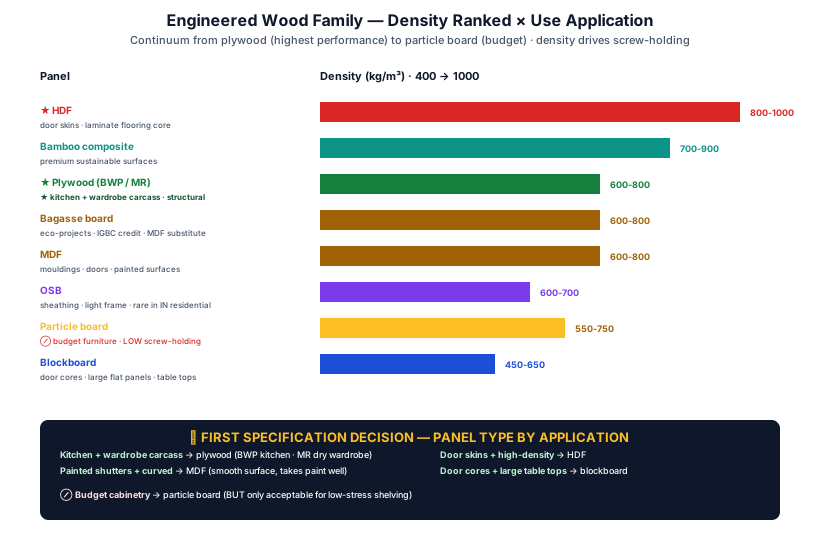
The Engineered Wood Family
| Panel | What It Is | Density (kg/m³) | Typical Use |
|---|---|---|---|
| Plywood | Cross-laminated wood veneers, glued under heat and pressure | 600–800 | Kitchen carcass, wardrobe carcass, structural |
| Blockboard | Solid wood batten core sandwiched between veneers | 450–650 | Door cores, large flat panels, table tops |
| MDF (Medium Density Fibreboard) | Wood fibres + resin, pressed | 600–800 | Mouldings, doors, painted surfaces, low-stress shelving |
| HDF (High Density Fibreboard) | Higher-density MDF | 800–1000 | Door skins, laminate flooring core |
| Particle Board | Wood chips + resin, pressed | 550–750 | Budget furniture, low-load shelving |
| OSB (Oriented Strand Board) | Larger oriented wood strands + resin | 600–700 | Sheathing, light frame; rare in Indian residential interiors |
| Bagasse Board | Sugarcane fibre + resin (sustainable alt to MDF) | 600–800 | Eco-projects, IGBC credit material |
| Bamboo Composite | Compressed bamboo fibre | 700–900 | Premium sustainable surfaces |
Source: Synthesised from BIS standards (IS 710, IS 303, IS 12823), manufacturer datasheets, and IGBC material credit reference.
The architect's first specification decision: panel type by application.
- Kitchen carcass and wardrobe carcass — plywood (BWP grade for kitchen, MR grade for dry wardrobes)
- Painted shutters and curved surfaces — MDF (smooth surface, takes paint well)
- Door skins and high-density panels — HDF
- Budget cabinetry, low-stress shelving — particle board (with caveats)
- Door cores, large table tops — blockboard
"The plywood specification is the architect's quietest contribution to the project's longevity." — Practitioner observation
2. IS 710 vs IS 303 — The Two Grade Standards
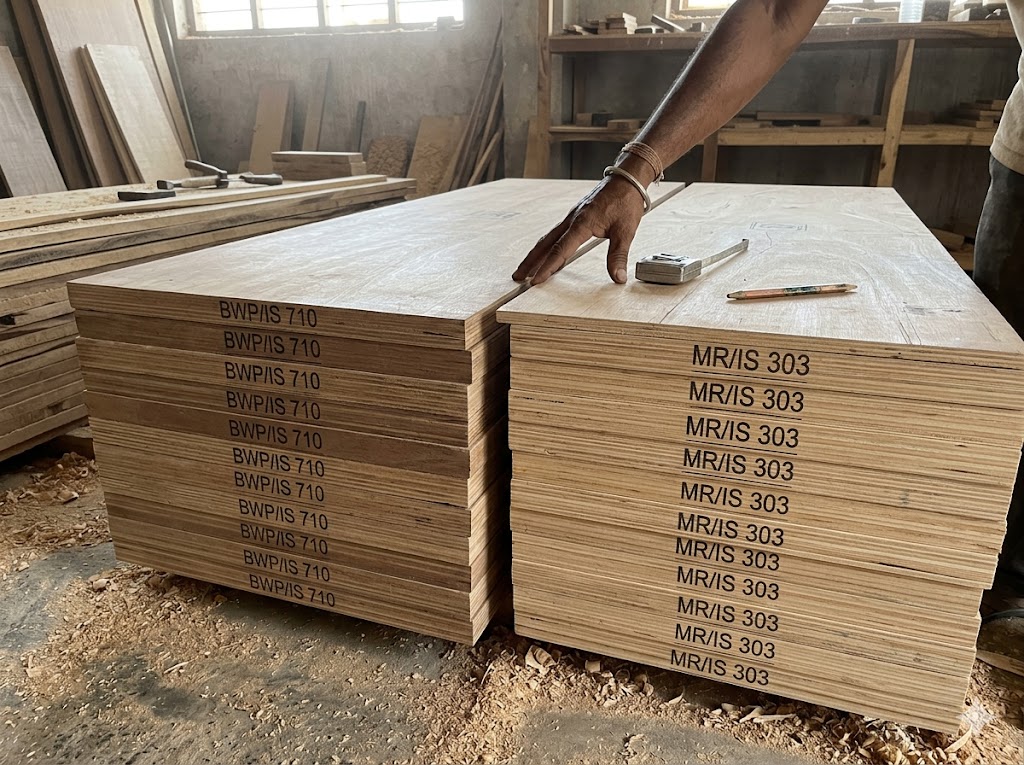
For plywood, the dominant Indian Standard is IS 710 (marine grade) and IS 303 (commercial / MR / BWR). These are not synonyms — they describe substantially different products.
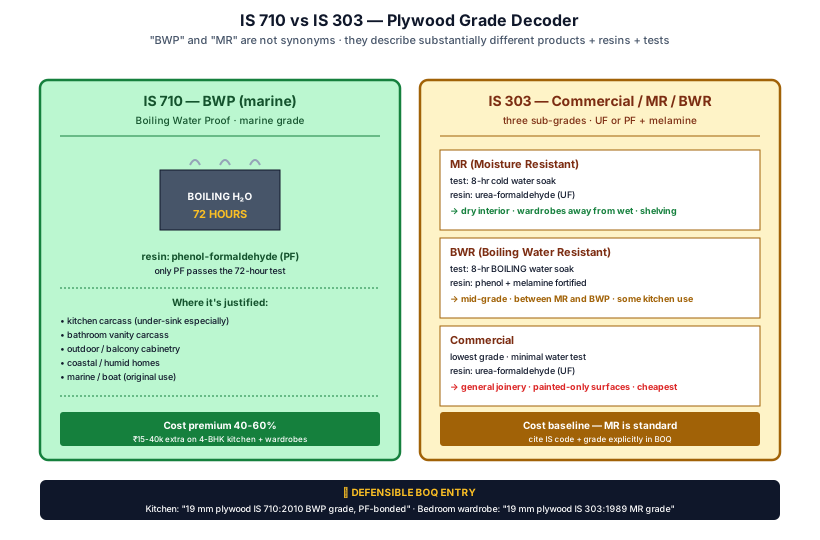
IS 710 — Marine / BWP Plywood
IS 710 specifies Boiling Water Proof (BWP) plywood. The defining test: the panel survives 72 hours of boiling water immersion without delamination. Only phenol-formaldehyde (PF) resin can pass this test.
Where IS 710 BWP plywood is justified:
- Kitchen carcass (especially below the sink — water exposure)
- Bathroom vanity carcass
- Outdoor or balcony cabinetry
- Boat building, marine applications (the original use)
- Coastal or high-humidity homes
Cost premium: BWP plywood costs 40–60% more than commercial-grade. For a 4-BHK home with a substantial kitchen and three wardrobes, the cost difference is typically ₹15,000–₹40,000 — a meaningful but defensible amount.
IS 303 — Commercial / MR / BWR
IS 303 specifies plywood in three grades:
| IS 303 Grade | Test | Resin | Where Used |
|---|---|---|---|
| MR (Moisture Resistant) | 8-hour cold water soak | Urea-formaldehyde (UF) | Dry interior — wardrobes (away from wet areas), shelving, false ceilings |
| BWR (Boiling Water Resistant) | 8-hour boiling water soak | Phenol + melamine fortified | Mid-grade — between MR and BWP; some kitchen use |
| Commercial | Lowest grade | UF | General joinery, painted-only surfaces |
The architect's specification — and BOQ entry — should explicitly cite the IS standard and grade:
- Kitchen, bathroom: "19 mm plywood conforming to IS 710:2010 BWP grade, PF-bonded"
- Living-area wardrobes: "19 mm plywood conforming to IS 303:1989 MR grade"
- Painted joinery (TV unit shell): "18 mm MDF conforming to IS 12406, E1 emission class"
Without this clarity, the contractor procures whatever-is-cheapest and the architect carries the warranty risk.
"The most expensive plywood is the one that fails the kitchen-sink soak test in year 3." — Aphorism widely heard in Indian site reviews
3. Formaldehyde Emission — Indoor Air Quality
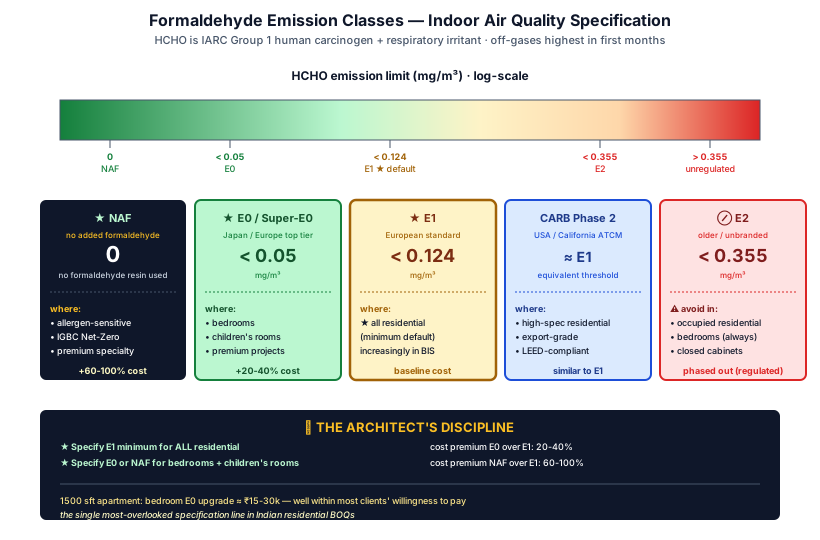
Engineered wood panels emit formaldehyde from the resin binder. Formaldehyde is a known human carcinogen (IARC Group 1) and an established irritant of eyes, nose, and respiratory system. The off-gassing rate is highest in the first months after manufacture and decays over years.
Emission Classes — International Standards
| Emission Class | HCHO Emission Limit | Typical Origin | Where to Specify |
|---|---|---|---|
| E0 / Super-E0 | <0.05 mg/m³ (≤0.3 mg/L perforator) | Japan / Europe high-end | Bedrooms, children's rooms, premium projects |
| E1 | <0.124 mg/m³ (≤8.0 mg/100g perforator) | European standard, increasingly adopted in India | All residential — minimum default |
| E2 | <0.355 mg/m³ (≤30 mg/100g perforator) | Older / unbranded — being phased out in regulated markets | Avoid in occupied residential |
| CARB Phase 2 (USA) | Equivalent to E1, similar threshold | California Air Resources Board | High-spec residential, export |
| NAF (No Added Formaldehyde) | No formaldehyde-based resin used at all | Premium / specialty | Allergen-sensitive clients, IGBC Net-Zero |
Source: European Standard EN 13986 / EN 13146; California Air Resources Board (2008) Composite Wood Atmospheric Toxic Control Measure — CARB ATCM Phase 2; Bureau of Indian Standards is moving toward E1-equivalent in BIS revisions.
The architect's discipline: specify E1 minimum for all residential; specify E0 or NAF for bedrooms and children's rooms in projects where the client values indoor air quality. The cost premium for E0 over E1 is typically 20–40%; for NAF, 60–100%. For a 1500-sqft apartment, the total premium for upgrading bedroom carcass to E0 is typically ₹15,000–₹30,000 — well within most clients' willingness-to-pay if they understand the trade-off.
The single most-overlooked specification line in Indian residential is emission class. Architects who add it to BOQ entries are operationalising indoor air quality at no additional design effort.
4. Density and Screw-Holding
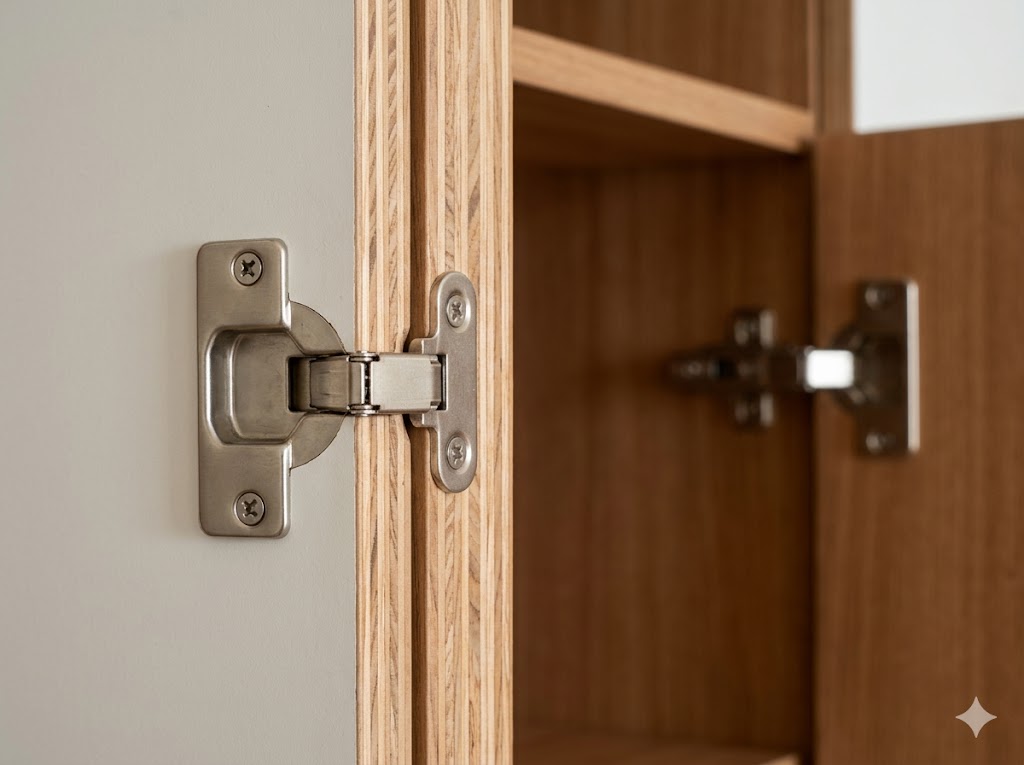
A panel's density determines how reliably it holds screws over time — a property that matters most where hardware loads cycle, like wardrobe hinges, drawer slides, and shelf supports.
Screw-Holding Performance
| Panel | Density (kg/m³) | Face Screw-Holding (N) | Edge Screw-Holding (N) |
|---|---|---|---|
| BWP Plywood (PF-bonded, 19 mm) | 700–800 | 2200–3000 | 1500–2200 |
| MR Plywood (UF-bonded, 19 mm) | 600–700 | 1800–2500 | 1200–1800 |
| Blockboard (19 mm) | 450–550 | 1500–2000 (face) | 800–1200 (poor on batten edge) |
| HDF (19 mm) | 800–1000 | 1800–2500 | 1500–2000 |
| MDF (19 mm) | 700–800 | 1500–2000 | 800–1200 |
| Particle Board (19 mm) | 550–700 | 800–1400 | 500–900 |
Source: Indicative values from IS 1734 (test method for screw holding), supplemented with manufacturer technical bulletins.
The structural decision-rule: for hinge-bearing edges and high-cycle hardware applications, plywood is the only safe choice. Particle board's edge screw-holding falls dramatically after 2–3 hardware reinstallations — which is why budget particle-board wardrobes look fine for 18 months and develop sagging doors in year 3.
For shelves carrying heavy loads (books, kitchen appliances), the architect should specify plywood with intermediate vertical supports at 750–900 mm rather than relying on edge screws of MDF or particle board.
5. Termite and Borer Treatment — IS 401
Engineered wood is vulnerable to termites and wood-borers in Indian conditions. Treatment under IS 401 (Code of Practice for Preservation of Timber) uses chemical impregnation.
| Treatment Type | What It Does | Typical Premium |
|---|---|---|
| Pressure treatment | CCA (chrome-copper-arsenate) or boron-based; deep penetration | 8–15% of plywood cost |
| Boron-based wash | Surface treatment; less penetration | 3–6% premium |
| Anti-termite paint coating | Applied to face during finishing | Negligible |
| No treatment | Default if not specified | — (high failure risk in non-coastal but humid contexts) |
The architect's specification: all engineered wood used in contact with masonry, floor, or wall — termite-treated (back of wardrobes, pantry units, kitchen carcass). Untreated panels develop borer activity within 2–3 years in most Indian climates.
"The architect's two unanimously-overlooked panel specifications are emission class and termite treatment. Both cost less than 5% to add and prevent 50% of long-term complaints." — Practitioner observation
6. Surface Finish Options
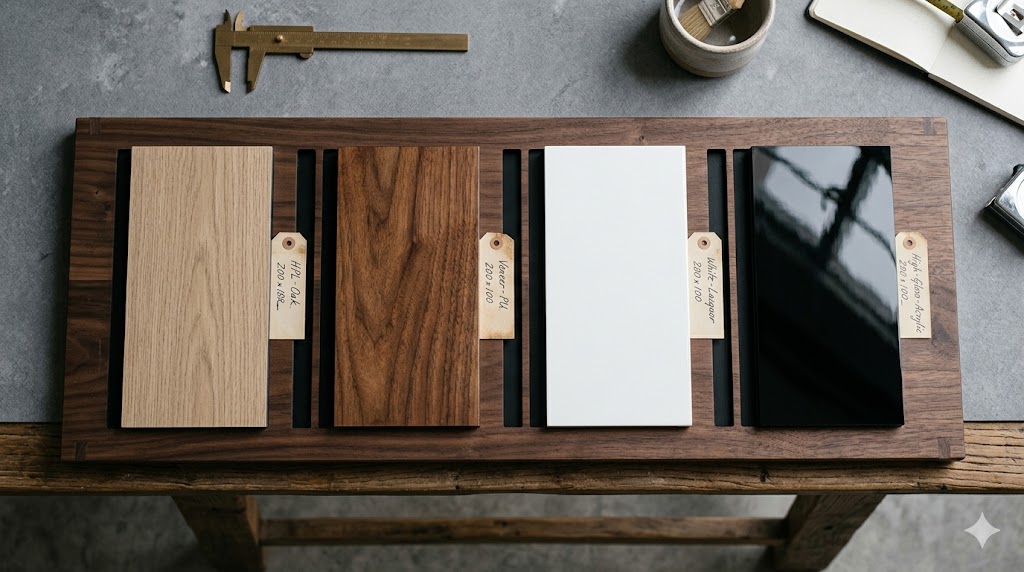
Engineered wood panels are rarely used unfinished. The surface treatment determines aesthetics, durability, and cost:
| Finish | Application | Lifetime | Cost (₹/sqft applied) |
|---|---|---|---|
| Laminate (HPL) | Glued/pressed onto panel | 15–25 years | 80–250 |
| Veneer + polish | Real wood layer + clear coat | 10–20 years (refinishable) | 200–800 |
| Lacquer / PU | Spray-applied liquid finish | 10–15 years | 150–400 |
| Melamine / pre-laminated panel | Factory-bonded melamine sheet | 8–15 years | 70–180 |
| Acrylic / glass / membrane | Premium surface treatments | 10–25 years | 250–600 |
The architect's specification ties surface finish to substrate:
- Laminate or melamine → plywood, MDF, or particle board (all work)
- Veneer + polish → plywood (best), blockboard (acceptable), MDF (some patterns); not suitable for particle board
- Lacquer/PU → MDF (best for smooth paint finish), HDF; less common on plywood
- Acrylic / membrane → MDF substrate (smooth profile required)
7. Lifecycle Cost Framework — 20-Year Math
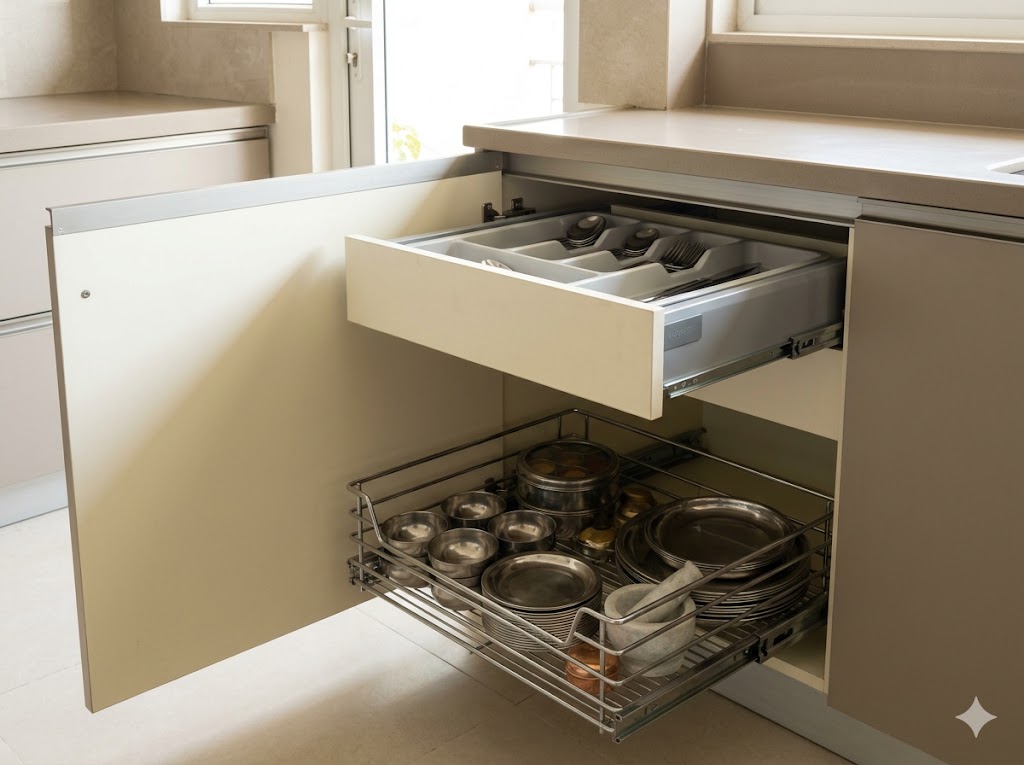
The headline price per sheet of plywood/MDF tells only the capex story. The economic story is 20-year cost of ownership, which includes replacement, rework, hardware re-fitment, and disposal.
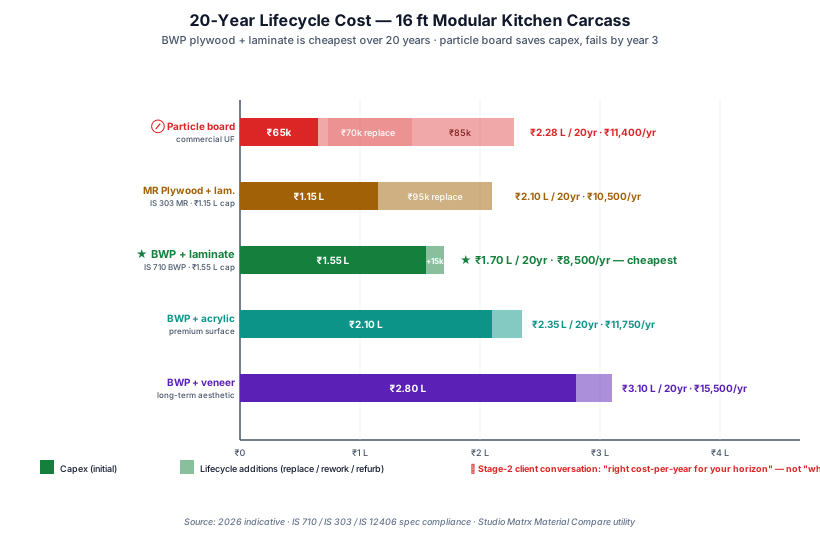
20-Year Lifecycle Cost — Kitchen Carcass (Indicative)
For a typical 16-foot Indian modular kitchen with full carcass, doors, and drawers — comparing five specifications:
| Specification | Capex (₹) | Year-3 Rework | Year-10 Replace | Year-15 Replace | 20-Yr Total | Annual Cost |
|---|---|---|---|---|---|---|
| Particle board (commercial) | 65,000 | ₹8,000 | ₹70,000 | ₹85,000 | 2,28,000 | 11,400/yr |
| MR Plywood + laminate | 1,15,000 | nil | ₹95,000 | nil | 2,10,000 | 10,500/yr |
| BWP Plywood + laminate | 1,55,000 | nil | minor refurb ₹15,000 | nil | 1,70,000 | 8,500/yr |
| BWP Plywood + acrylic | 2,10,000 | nil | refurb ₹25,000 | nil | 2,35,000 | 11,750/yr |
| BWP Plywood + veneer | 2,80,000 | nil | refinish ₹30,000 | nil | 3,10,000 | 15,500/yr |
Indicative figures including labour and hardware; updated to 2026 prices.
The pattern this table reveals: BWP plywood with laminate is cheapest over 20 years. The particle-board option saves at capex but requires multiple replacements; the high-end veneer option is permanently more expensive but defensible if the client is buying long-term aesthetic value rather than economy.
The architect's client conversation: present this table at Stage 2. It changes the question from "which is cheapest?" to "which is the right cost-per-year for your horizon?" — and the answer is rarely the cheapest at capex.
8. Sustainable Alternatives
Three engineered-wood alternatives have IGBC / GRIHA credit value and are increasingly mainstream:
| Alternative | What It Is | Performance | Cost vs Plywood |
|---|---|---|---|
| Bagasse board | Sugarcane bagasse + UF resin (replaces wood fibre) | Comparable to MDF | Similar to MDF, sometimes slightly less |
| Bamboo composite (engineered bamboo) | Compressed bamboo fibre | Higher density and strength than plywood | 30–80% premium |
| FSC-certified plywood | Forest Stewardship Council chain-of-custody timber | Same as standard plywood | 10–25% premium |
| Reclaimed / salvaged wood | Reused timber from demolition | Variable | Project-dependent |
| Cork composite | Cork particles + resin | Lower density; specialty surfaces | Premium |
For projects pursuing IGBC Green Homes or GRIHA certification, specifying at least 30–50% of engineered-wood content from bagasse, FSC-certified, or bamboo sources earns material-credit points and represents a meaningful design claim.
9. Specification Cheat-Sheet by Application
A consolidated reference the architect can keep at their desk:
Application × Specification Matrix
| Application | Substrate | Grade | Emission | Surface | Termite |
|---|---|---|---|---|---|
| Kitchen carcass (under sink) | Plywood | IS 710 BWP | E1 | Laminate | Treated |
| Kitchen carcass (general) | Plywood | IS 710 BWP | E1 | Laminate / acrylic | Treated |
| Wardrobe carcass — bedroom | Plywood | IS 303 MR | E1 (E0 if children) | Laminate / membrane | Treated |
| Wardrobe carcass — bathroom | Plywood | IS 710 BWP | E1 | Laminate / acrylic | Treated |
| TV unit / wall console | MDF (substrate) + plywood (carcass) | IS 12406 (MDF) + IS 303 MR (ply) | E1 | Lacquer / PU | Treated |
| Bed back / headboard | MDF | IS 12406 | E0 (sleeping zone) | Lacquer / fabric | Treated |
| False ceiling substrate | Particle board or MDF | IS 3087 / IS 12406 | E1 | Paint | NA (above ceiling) |
| Door core (flush door) | Blockboard or particle board | IS 1659 / IS 3087 | E1 | Veneer / laminate | Treated |
| Drawer bottom / back panel | Plywood thin grade or HDF | IS 303 MR | E1 | Plain | Treated |
| Painted shutter (mouldings) | MDF | IS 12406 | E1 | PU / lacquer | Treated |
The architect's BOQ should reference each cell of this matrix. The contractor receives a specification with grade and emission class, not just "plywood, 19 mm".
10. The Architect's Closing Note
Engineered wood specification is the architect's discipline most invisible to the client. The work is in the BOQ entry, the IS-code citation, the emission-class line, the termite-treatment note. The result is a residence that performs across decades — kitchen carcasses that don't swell, wardrobe doors that don't sag, children's bedrooms that don't off-gas formaldehyde for years.
The professional position: specify by application matrix, cite IS code in BOQ, state emission class, require termite treatment, present lifecycle cost at Stage 2. None of these four moves cost the architect significant time. All four prevent specific types of project failure that would otherwise damage the practice's reputation in the years after handover.
Plywood is the architect's quietest material. The architects who treat it carefully build practices whose projects look the same at year 10 as they did on Day 1.
Cross-References Within Studio Matrx
- Top Wardrobe Finish Ideas — surface-finish counterpart to substrate selection
- Modular Kitchen Design Guide — carcass and shutter specification in kitchen context
- Construction Material Quality Standards — broader IS-code reference
- Flooring & Finishes Specification for Indian Architects — flooring counterpart to interior-substrate spec
- The Architect's Scope of Services in India — Stage 4 BOQ that captures the spec
- Use the Material Comparison Tool to compare panel + finish combinations
- Use the Material Quality Checklist to verify on-site against spec
References
1. Bureau of Indian Standards (2010) IS 710 — Marine Plywood — Specification. New Delhi: BIS.
2. Bureau of Indian Standards (1989) IS 303 — Plywood for General Purposes — Specification. New Delhi: BIS.
3. Bureau of Indian Standards (2003) IS 12823 — Pre-Laminated Particle Boards. New Delhi: BIS.
4. Bureau of Indian Standards (2003) IS 12406 — Medium Density Fibreboards (MDF) for General Purposes. New Delhi: BIS.
5. Bureau of Indian Standards (1990) IS 401 — Code of Practice for Preservation of Timber. New Delhi: BIS.
6. Bureau of Indian Standards IS 1734 — Methods of Test for Plywood — including Screw Holding. New Delhi: BIS.
7. Bureau of Indian Standards IS 1659 — Block Boards — Specification. New Delhi: BIS.
8. Bureau of Indian Standards IS 3087 — Particle Boards of Wood and Other Lignocellulosic Materials. New Delhi: BIS.
9. International Agency for Research on Cancer (2006) IARC Monographs Vol. 88 — Formaldehyde, 2-Butoxyethanol, and 1-tert-Butoxypropan-2-ol. Lyon: IARC.
10. California Air Resources Board (2008, with updates) Composite Wood Atmospheric Toxic Control Measure — CARB ATCM Phase 2. Sacramento: CARB.
11. European Committee for Standardization (2013) EN 13986 — Wood-Based Panels for Use in Construction. Brussels: CEN.
12. Indian Green Building Council (2024) IGBC Green Homes Rating System v3.0 — Materials and Resources Credit. Hyderabad: IGBC.
Author's Note: Engineered wood is one of those domains where small specification details cumulate into substantial residential-quality differences. The architect who works through the application × specification matrix on every project — even on "simple" residential — is the architect whose 10-year-old projects still photograph well. This guide is a desk reference intended to make that workflow standard rather than exceptional.
Disclaimer: This article is for informational and educational purposes only. It does not constitute professional materials-engineering advice. Grade, emission, and treatment values cited are indicative of current Indian practice but vary by manufacturer and may shift with BIS revisions. Architects must verify against current IS standards, manufacturer datasheets, and lab test reports before final specification. Studio Matrx, its authors, and contributors accept no liability for decisions based on this guide.
Export this guide
Related Guides — Deep-dive reading
The Design Decisions With the Biggest Cost Consequences
A cost-leverage map of Indian home interiors — the handful of decisions that swing your total budget the most, so you spend your attention where a single choice has an outsized rupee impact.
Cost & MoneyMarine Ply vs HDHMR vs MDF
When each engineered-wood substrate is the right answer for an Indian interior
Materials & FinishesThe Truth About Cost Per Square Foot
Why a ₹/sqft interior quote is the most misleading number in Indian home costing — and how to convert it into a real BOQ
Cost & MoneyRelated Tools — Try Free
Full-Room BOQ — Living, Bedroom, Kitchen, Bath
Room-wise BOQ across living, bedrooms, kitchen, utility, and bathrooms with line-item pricing.
Full-Room BOQMaterial Comparison Sheet
India's interior material cheatsheet — plywood, finishes, hardware, countertops, paints, waterproofing.
Reference GuideInterior Contract Clause Checklist
16 sections and 98 checkboxes covering scope, BOQ, milestones, penalties, warranty, and disputes.
Contract Checklist