
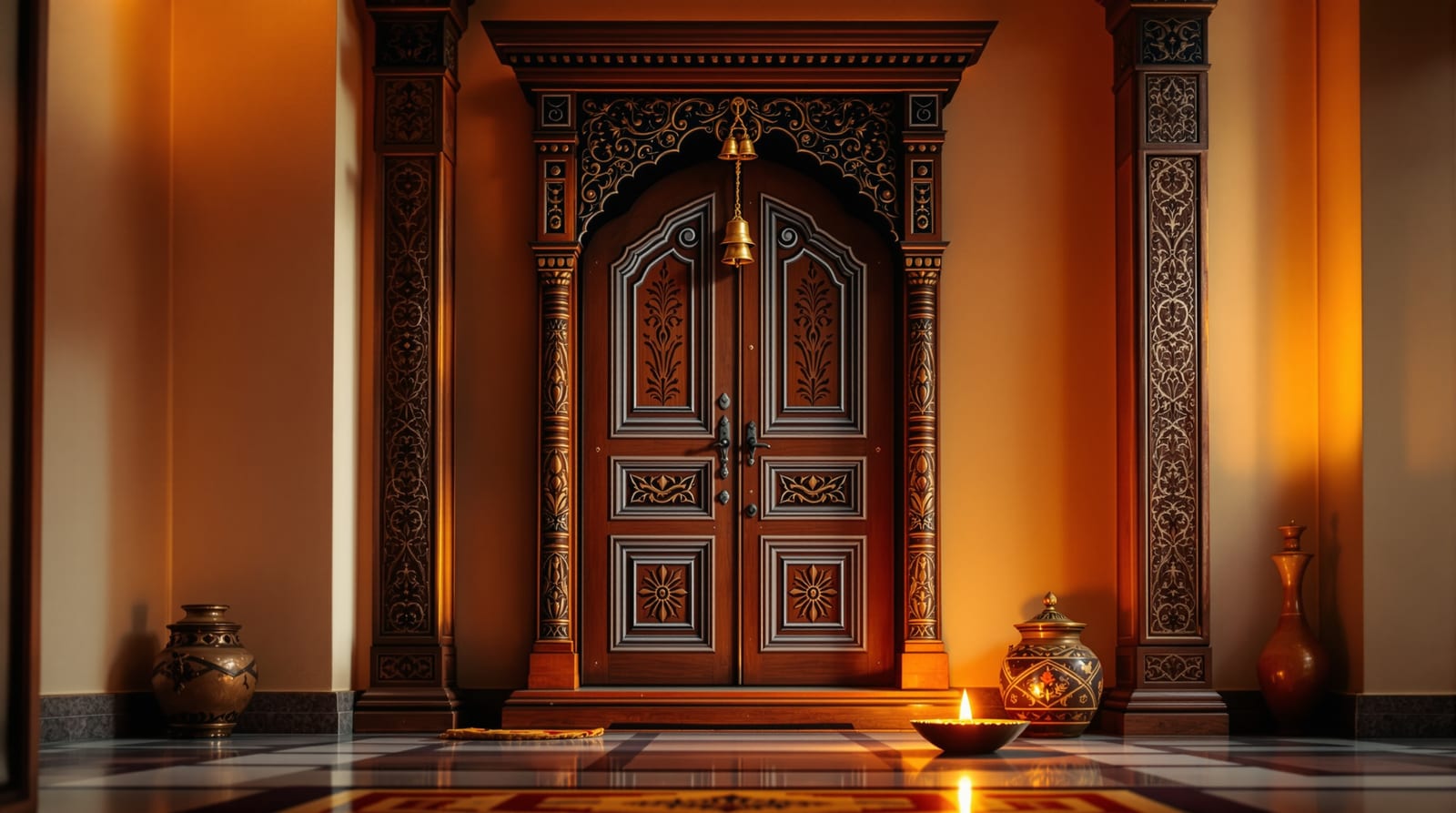
Pooja Room Door Designs in India: Materials, Vastu, Bells & 2026 Cost
A complete guide to designing the mandir door - carved teak, jaali, glass with mantra etching and brass-clad styles, the doors-vs-no-doors debate, bells and thresholds, plus the Vastu rules for pooja door direction, size and placement.
The pooja room door is the one door in an Indian home that carries spiritual weight. It is not just an opening; it is the threshold to the most sacred corner of the house, and almost every family puts more thought, money and emotion into it than any internal door except the main entrance. This guide walks you through the real choices - materials, carved and jaali styles, the surprisingly heated "doors or no doors" debate, bells and thresholds, the Vastu rules that govern direction and placement, plus honest 2026 costs in rupees.
Why the pooja door is treated differently
In most Indian households the mandir is the spiritual heart of the home, and the door to it functions as a small dwar (gateway) to the divine. Tradition holds that this threshold should be honoured: people pause, fold their hands or remove footwear before crossing it. Practically, the door also does ordinary work - it contains the smoke and fragrance of incense and the lamp flame, keeps oil and kumkum off the rest of the house, protects the deities from dust and pets, and offers privacy for prayer in a joint family where the living room is always busy.
So a pooja door has to satisfy two masters at once: it must feel devotional and beautiful, and it must function as a real door in a humid, monsoon-prone, often termite-prone climate. The best ones do both.
Materials for a pooja room door
The same material logic that governs any Indian door applies here, but aesthetics and longevity carry extra weight because this door is rarely replaced. For a deeper material-by-material breakdown see our companion guide on wooden doors and the wider door materials comparison.
| Material / style | Look & feel | Durability in Indian climate | Indicative 2026 cost (door + make, fitting extra) | Best for |
|---|---|---|---|---|
| Solid teak (Burma/CP), carved | Warmest, most premium, ages beautifully | Excellent - termite & moisture resistant; lasts generations | Rs 25,000 - 1,50,000+ (carved); plain teak from ~Rs 800-1,500/sq ft | Heirloom mandir, larger pooja rooms |
| Solid wood (sal, sheesham, mango), carved | Rich traditional look, slightly less stable than teak | Good with proper seasoning & polish | Rs 12,000 - 40,000 | Traditional homes on a tighter budget |
| Engineered wood / veneered panel | Clean, modern, consistent finish | Good indoors if kept dry; see engineered-wood doors | Rs 6,000 - 18,000 | Apartments, contemporary mandirs |
| Toughened glass (etched/frosted, mantra or deity motif) | Light, airy, lets the lamp glow through | Excellent; unaffected by humidity; needs frequent wiping | Rs 12,000 - 35,000 (8-12 mm toughened, framed/frameless) | Modern flats, small or dark pooja niches |
| Brass-clad / brass-inlay on wood | Ornate, temple-like, catches diya light | Brass needs periodic polishing; wood core as above | Rs 20,000 - 80,000+ | Statement devotional doors |
| Jaali (carved lattice in wood or CNC MDF) | Ventilated, lets incense smoke escape, casts patterns | Wood jaali good; MDF jaali only if kept dry | Rs 10,000 - 45,000 | Where airflow for the lamp matters |
Costs are indicative and vary widely by city, vendor, carving depth and whether the work is by a local carpenter or a factory. Add roughly 18% GST, plus Rs 800-3,000 fitting and Rs 1,500-8,000 for hardware (handle, hinges, latch, bells). Carving is priced by labour and intricacy more than by the timber, so two teak doors of the same size can differ by a factor of five.
A quick word on glass: pooja glass doors are almost always toughened (8-12 mm) and decorated with frosting, sandblasting or laser-etching of a deity, an Om, a Ganesha, Lakshmi feet (charan), a kalash or a Sanskrit mantra such as the Gayatri. Etched glass is hugely popular in flats because it lets the lamp's glow read through the door while still screening the shrine, and because glass simply does not swell, warp or attract termites in the monsoon.
Popular pooja room door styles
- Carved wooden door: the classic - panels with floral, kalash, lotus, bell, elephant, peacock or temple-gopuram motifs, often with carved deities at the top. Best in teak or seasoned hardwood.
- Jaali / lattice door: a carved openwork screen that ventilates the room and throws beautiful shadow patterns when the lamp is lit. Solid wood jaali is durable; CNC-cut MDF jaali is cheaper but must stay dry.
- Bell-detail door: rows of small brass ghungroo or temple bells fixed to the leaf or frame so the door announces every entry - a very traditional, sensory touch.
- Glass door with etching: frameless or slim-framed toughened glass with a frosted deity, Om, charan or mantra. The most popular modern choice in apartments.
- Brass-clad / inlay door: sheet brass or brass repousse panels over a wood core, sometimes with embossed deities; reads as a temple door.
- Sliding or pocket door: where floor space is tight, a sliding glass or wooden shutter saves the swing arc. See sliding doors and pocket doors.
- Double-leaf (two-shutter) door: two equal leaves opening outward - considered especially auspicious because an even number of leaves is preferred in Vastu, and it makes a grand temple-gate gesture.
With doors or without? The honest debate
This is the single most-asked pooja design question in India, and there is no one right answer - only trade-offs.
Arguments for a door (or at least shutters/curtains): Some traditions and Vastu practitioners hold that the deities should be "put to rest" and the shrine closed at night, just as a temple sanctum (garbhagriha) is closed after the last aarti; a door provides this. It also keeps out dust, insects, lizards and curious toddlers, contains incense smoke, and gives privacy. For a pooja room that doubles as a store or sits near the kitchen, a door is practical.
Arguments against a door / for an open mandir: Others believe divine energy should flow freely and the shrine should be openly visible and always accessible, so they prefer an open niche, an arch, or only a light curtain (toran or cloth) and a half-height threshold. Open mandirs suit small flats where a full door eats space and light.
A common middle path: Many Indian homes use glass doors or jaali shutters - the shrine stays visible and the lamp's glow is shared with the room, but the space can still be closed for dust and at night. Curtains and toran (door hangings of mango leaves, marigold or beads) are also used alone or with a door. If you do fit a door, the widely-followed guidance is that the pooja door should open outward and the leaves should be even in number (two shutters rather than one wherever the width allows).
Bells, thresholds and the sensory details
Two small details turn an ordinary door into a devotional one:
- Bells (ghanti / ghungroo): small brass temple bells or strings of ghungroo are fixed to the leaf, the frame or hung in the doorway so that every entry rings them. The sound is meant to focus the mind and announce one's presence to the deity; acoustically it is also a gentle daily ritual cue. Plan the bells at the design stage so the carpenter leaves fixing points.
- Threshold (dehleez / chowkat sill): a raised threshold at the pooja door is strongly favoured in tradition - it marks the boundary of the sacred space, traditionally kept the floor of the inner room cleaner, and is where many families paint kumkum or place a small rangoli. Keep it low (about 10-20 mm) so it is a symbolic step, not a trip hazard; for accessibility never exceed about 12 mm if anyone in the home uses a walker or wheelchair.
- Toran / door hanging: a string of mango leaves, marigold, beads or bells across the top of the frame is the simplest, cheapest way to mark the threshold as sacred, with or without a door.
A simple pooja door motif (carving & jaali)
The diagram below shows a common layout: a carved kalash-and-lotus top panel, a central jaali band for airflow, and a row of bells along the lower rail. Use it as a brief to your carpenter or CNC vendor.
Vastu for the pooja door: direction, placement and size
Vastu is a traditional belief system, not building law - treat the guidance below as cultural convention plus common sense, and adapt it to your actual flat. It pairs closely with the rules for the main entrance, so read this alongside our entrance Vastu guide and the focused Vastu main door guide; the pooja door rules complement, not duplicate, those.
Where the pooja room (and its door) should sit: The most auspicious zone for a mandir is the north-east (Ishanya) corner of the home, with east and north as strong alternatives. The idol/deity is ideally placed so the worshipper faces east or north while praying, which usually means the deities face west or south and the door opens on the east or north side of the room. Avoid placing the pooja room (or its door) in the south or south-west as the default, and avoid it under a staircase, against a toilet wall, or in the bedroom if it can be helped.
Door direction and orientation:
| Vastu pointer | What it means in practice |
|---|---|
| Best zone for mandir | North-east; else east or north |
| Worshipper faces | East or north while praying |
| Door opens | Toward east or north preferred; opening outward is commonly advised |
| Number of leaves | Even (two shutters) considered auspicious over a single leaf |
| Threshold (dehleez) | Recommended - marks the sacred boundary |
| Avoid | South / south-west pooja door, door under stairs, sharing a toilet wall, door directly facing a bathroom |
Size and proportion: A pooja door is an internal door, so the practical sizes follow ordinary Indian norms - roughly 750-900 mm wide x 2100 mm (7 ft) high, scaled to the room and the door opening. It should never be larger than the main entrance door, which Vastu holds must remain the largest and most important door of the house. For very small niche mandirs a pair of slim shutters of 450-600 mm each works well. Keep the leaf size honest to the structural opening: measure the opening, then subtract the frame thickness, exactly as covered in our how to measure a small room note.
A grounding note: none of this is mandatory. A north-east mandir with an east-facing two-leaf threshold door is the "textbook" arrangement, but a thoughtfully placed, clean, well-lit shrine in any orientation is what most families and most priests will tell you matters most. Where Vastu and your floor plan conflict, prioritise a layout you will actually use daily.
Lighting the pooja door and shrine
Light makes or breaks a pooja room, and the door is part of the lighting scheme. Plan for:
- A warm, dimmable downlight or a small chandelier-style fixture over the deities (warm white, ~2700-3000K) so the shrine glows rather than glares.
- Backlighting or LED strips behind a jaali or etched-glass door, which makes the carving or the etched mantra read beautifully and shares a gentle glow with the adjoining room.
- A niche light for the diya/lamp so the natural flame is supported, never overpowered.
- Keep switches outside the room within easy reach, and never run wiring where lamp soot or oil can reach it.
If your pooja room shares a wall with a window or balcony, treat the daylight and the door glazing together - our companion on the windows and doors design relationship covers how to balance the two so the shrine gets soft morning (east) light without glare on the deities.
Buying and building tips
- For carved work, see the carpenter's previous mandir doors in person; carving quality varies enormously and photos flatter.
- Insist on seasoned timber (kiln or air-dried) for any solid-wood pooja door - green wood warps and cracks within a monsoon or two.
- For glass, specify toughened glass and a tested fixing; etching should be sandblasted or laser, not a printed film that peels.
- If you want bells, brass inlay or a specific deity motif, brief it at the start so it is built in, not bolted on.
- Polish or lacquer wood doors before installation and re-polish every few years; clean brass with a mild brass cleaner; wipe glass daily as it shows kumkum, oil and lamp soot quickly.
- Budget for the whole assembly - leaf, frame (chowkat), hinges, latch/handle, bells and threshold - not just the carved leaf.
For the wider picture of choosing internal doors room by room, see our interior doors by room guide and the traditional Indian doors overview, which covers the carving, jaali and brasswork vocabulary in more depth.
Frequently asked questions
Should a pooja room have a door or be left open?
Both are valid. A door (especially glass or jaali) keeps out dust and insects, contains incense smoke, gives privacy, and lets you "close" the shrine at night as a temple sanctum is closed. An open niche or a simple curtain/toran suits small flats and the belief that divine energy should flow freely. Glass or jaali shutters are the popular middle path - the shrine stays visible but can still be closed.
Which direction should the pooja room door face as per Vastu?
Vastu favours a mandir in the north-east, with the door opening toward the east or north so that the worshipper faces east or north while praying. Avoid a south or south-west pooja door, a door under a staircase, or one sharing a wall with a toilet. Treat this as tradition plus common sense, and cross-check it against your overall layout and the entrance Vastu rules.
What is the ideal size for a pooja room door?
As an internal door it follows normal Indian sizes - about 750-900 mm wide by 2100 mm (7 ft) high, scaled to the room. For small niche mandirs a pair of slim shutters of 450-600 mm each works well. It should never be larger than the main entrance door, which Vastu holds must remain the largest door of the house.
Are glass doors good for a pooja room?
Yes - toughened glass (8-12 mm), usually frosted or etched with a deity, Om, charan or mantra, is one of the most popular choices in Indian apartments. Glass does not swell, warp or attract termites in the monsoon, it lets the lamp's glow read through, and it screens the shrine while keeping it visible. It just needs frequent wiping as oil, kumkum and soot show quickly.
How much does a good pooja room door cost in India in 2026?
Indicative ranges (door plus make; fitting, frame and hardware extra, plus about 18% GST, varying by city and vendor): engineered/veneered panel about Rs 6,000-18,000; etched toughened glass about Rs 12,000-35,000; carved solid wood about Rs 12,000-40,000; and a carved teak or brass-clad statement door from about Rs 25,000 up to Rs 1,50,000+ depending on carving intricacy.
Export this guide
Related Guides — Deep-dive reading
Temple Doors in India: Carved Devotional Doors for Pooja Rooms, Mandirs and Main Entrances
Temple-style carved teak and rosewood doors with deities, bells, kalash and lotus motifs — meanings, regional styles, brass cladding, sizes for a home mandir, costs and care.
Home Doors & EntrancesMain Door Design Ideas for Indian Homes 2026: Styles, Proportions, Materials and Vastu
From traditional carved teak to modern minimalist and pivot statement entrances - how to design a main door that reads as grand, ages well in the Indian climate, and respects Vastu, with real 2026 costs.
Home Doors & EntrancesDouble Doors in India (2026): Two-Leaf Entrances, Proportions, Hardware & Cost
When a double-leaf door makes sense for Indian main entrances, pooja rooms and master suites, plus active/inactive leaf hardware, the Vastu note on even panels, security at the meeting stile and the rupee premium over a single door.
Home Doors & EntrancesRelated Tools — Try Free
Cross-Ventilation Analyzer
Estimate airflow and air changes per hour (ACH) from room size, window areas, layout, and local wind — with NBC 2016 Part 8 compliance check.
Ventilation CalculatorVastu Window Planner
Vastu guidance for window placement and size by wall direction and room — rating and remedies.
VastuWindow Orientation Planner
Pick the best window type, glass and shading by wall direction — north, east, south and west.
Window Tool