
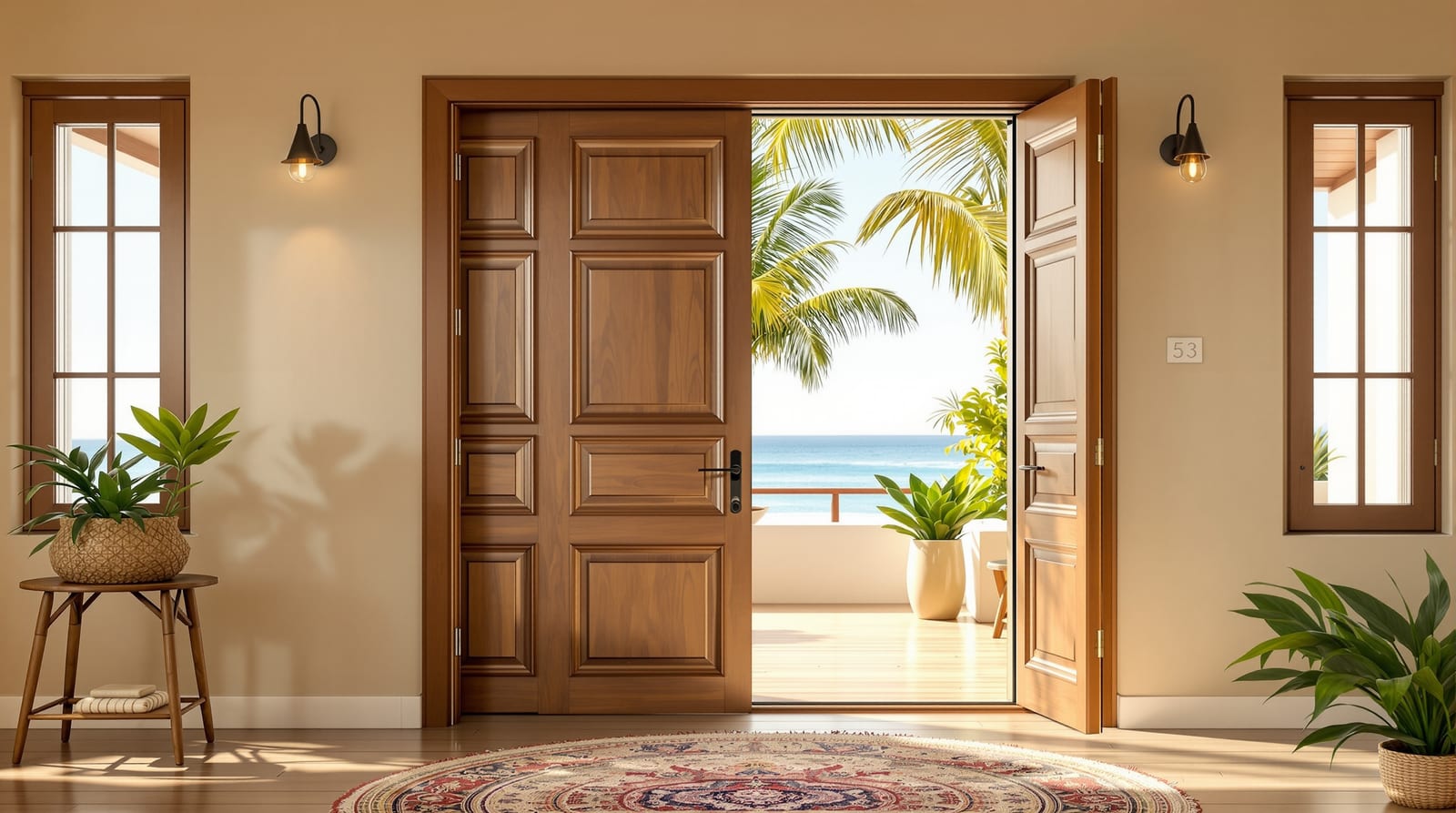
Best Door Material in India (2026): The Right Choice for Every Room & Climate
A situation-by-situation verdict on the best door material for Indian homes - teak or steel for the main entrance, WPC or uPVC for bathrooms and coasts, engineered flush for bedrooms - with a by-location decision table and budget-vs-premium picks.
Ask any carpenter, showroom salesman or relative "what is the best door material?" and you will get a confident, different answer from each of them - teak, WPC, steel, "branded flush door". They are all partly right and all partly wrong, because there is no single best door material. The honest answer is that the best material is whichever one is matched to that specific opening - its exposure to water, its security job, and your budget for it. The teak that is perfect for your main entrance would be an expensive mistake on your bathroom; the WPC that is perfect for the bathroom would look cheap and feel insecure as a main door.
This guide gives you a clear verdict for every situation in an Indian home - main entrance, bedrooms, bathrooms, kitchen and utility, balconies, plus the climate cases that override everything: coastal salt air, monsoon moisture, and termites. The centrepiece is a by-location decision table you can use as a buying checklist. For a neutral, feature-by-feature face-off of every material, read the companion door materials comparison for India; this guide is the opinionated "just tell me what to buy" verdict.
The one rule that decides everything
Before any table, internalise the rule that prevents 90% of door regrets in India:
Pick the material for the opening, not the house. A single home is correctly built from three or four different door materials.
Water and termites destroy more Indian doors than burglars or wear ever do. So the decision order is almost always:
1. Is the opening wet or exposed? (bathroom, utility, balcony, coastal wall) - waterproofing wins; choose WPC or uPVC.
2. Does it need real security? (main entrance, service door) - strength wins; choose solid wood/teak or steel.
3. Is it a dry internal door? (bedroom, study, store) - value and stability win; choose an engineered flush door.
Everything below is an application of those three questions.
The by-location decision table (the centrepiece)
This is the table to take to the showroom. All costs are indicative for 2026, leaf-only (material + make) - frame, hardware and fitting are extra, plus ~18% GST - and vary by city, grade and vendor.
| Location / opening | Best material | Budget pick | Premium pick | Indicative leaf cost | Why this wins here |
|---|---|---|---|---|---|
| Main entrance | Solid teak / hardwood | Solid-core engineered flush or steel | Carved Burma teak + steel frame | ₹10,000-25,000+ (teak much higher) | Security, weight, repairability, Vastu "face of the home" |
| Bedrooms / internal | Engineered flush (IS 2202) | Hollow-core flush, laminate | Veneered solid-core flush | ₹1,200-9,000/shutter | Cheap, flat, stable, paint/veneer choice; no wet exposure |
| Bathroom / WC | WPC | PVC | WPC + WPC frame, laminate finish | ~₹75-150/sq ft (₹2,000-4,500) | Waterproof, termite-proof, zero polishing, no swelling |
| Kitchen / utility | WPC or uPVC | WPC | uPVC framed | ₹2,000-4,500 (WPC) | Splashes, steam, frequent use; easy to wipe clean |
| Balcony / terrace | uPVC or aluminium + glass | Aluminium sliding | Thermally broken aluminium / premium uPVC | ₹450-1,200/sq ft (system) | Rain seal, daylight, large openings, weather resistance |
| Pooja room | Solid wood / teak | Engineered panel | Carved teak / brass-clad | ₹4,000-25,000+ | Tradition, even panels, statement; see entrance Vastu |
| Service / back door | Steel (galvanised) | Steel | Galvanised steel, anti-rust | ₹8,000-25,000/set | Strongest leaf per rupee; theft-prone secondary entry |
| Internal partition / cabin | Glass (toughened, framed) | Aluminium-framed glass | Frameless toughened + patch fittings | ₹450-1,200/sq ft (system) | Daylight, open feel; never the sole secure barrier |
Use this as a shortlist. The sections below explain the reasoning so you can defend the choice against a pushy vendor.
The main entrance: teak, solid wood or steel
The main door is the one opening where it is worth spending. It carries security, first impression, and - for most Indian families - real cultural and Vastu weight as the "mouth" of the home.
- Best overall: solid teak or seasoned hardwood. Heavy, repairable, re-polishable for decades, and the traditional ideal. Burma and old CP teak are the gold standard; plantation/"CP teak", sal, sheesham and mango cost less but vary in stability. Insist on kiln-seasoned timber and a finish on all six faces (the hidden top and bottom edges are where monsoon water enters). See the deep dives on teak wood doors and wooden doors in India.
- Best value: solid-core engineered flush, or a steel security door. A BWP solid-core veneered flush door (IS 2202) at ₹6,000-9,000 with a good multi-lock looks and performs close to solid wood for far less. A galvanised steel door is the strongest leaf per rupee and resists kick-in, drilling and fire - many homes fit an outer steel security door behind an inner decorative wooden one.
- Avoid for the main door: WPC, PVC and bare glass - they are not secure enough on their own and read as "back door" materials at the front.
For full cost ranges see main door cost in India and teak door cost in India, and the design angle in main door design in India.
Bedrooms and internal doors: engineered flush
For dry internal openings - bedrooms, study, store, dressing - the practical default across India is the engineered-wood flush door to IS 2202. Factory-made flush doors are flatter, more dimensionally stable and cheaper than a carpenter building a solid door on site, and you can finish them in laminate, veneer or paint to match the room.
Spend up to the solid-core grade if the budget allows: a hollow-core door at ₹1,200 sounds drum-hollow and dents easily, while a solid-core door at ₹4,000-9,000 feels reassuringly solid and blocks more sound. Just keep engineered cores out of wet areas - ordinary MR-grade cores delaminate if water sits at the base. The fuller economics are in engineered wood doors in India and flush doors in India, and the core question itself in solid vs hollow core doors.
Bathrooms and wet areas: WPC (PVC only on a tight budget)
The bathroom door is where the most expensive mistakes happen, because people fit a wooden or engineered door and watch it swell, rot and grow black at the base within a couple of monsoons. The fix is WPC (wood-plastic composite): it is waterproof, termite-proof, does not swell, needs no polishing, takes screws and laminate like wood, and costs only ~₹75-150/sq ft. WPC is now the default for bathroom, WC, utility and balcony leaves, ideally hung on a WPC frame so the chowkat is waterproof too.
PVC doors are the budget cousin - fully waterproof and very cheap (₹1,200-3,000) but flimsy, prone to discolouring and easy to break. Use PVC only for low-stakes bathroom or servant-area openings where cost is the only criterion. The detailed split is in WPC doors in India.
Coastal homes: anti-corrosion comes first
Within ~5-10 km of the sea, salt-laden air is the dominant enemy. It rusts non-galvanised steel, corrodes cheap hinges and locks, and accelerates rot in unsealed timber. Re-order your priorities around corrosion resistance:
- Best all-rounder: uPVC. It does not rot, rust, swell or feed termites, seals tightly against driving coastal rain, and suits balcony, utility and secondary entries beautifully. See uPVC doors in India.
- Wet and utility: WPC - immune to salt and water, ideal for bathrooms and service areas in coastal homes.
- Security with care: galvanised steel only (never bare/painted mild steel at the coast), with stainless-steel (SS 304/316) hardware throughout.
- Main door: well-finished hardwood/teak is fine if every face is sealed and re-oiled on schedule; teak's natural oils help it cope better than most timbers.
- Glazing: aluminium or uPVC framed with marine-grade fittings for sliders and French doors.
The single biggest coastal lever is hardware metallurgy - even a great door fails when its hinges and lock seize with rust, so insist on stainless or properly coated fittings.
Monsoon and moisture-prone homes
In high-rainfall belts (Western Ghats, Northeast, Kerala, coastal Maharashtra) and any ground-floor or basement opening that gets damp, moisture is a year-round, not seasonal, problem:
- Use WPC or uPVC for all wet and exposed leaves and frames.
- For wooden doors, demand kiln-seasoned timber, a finish on all six faces, and a small floor gap so the door does not drag and trap water at the sill.
- Keep engineered/MR-grade cores away from floors that flood or stay damp; use BWP-grade only where some moisture is unavoidable.
- Choose WPC or steel (IS 4351) frames over timber chowkats in rooms that get wet, since the frame is what meets standing water at floor level.
Termites: which materials are simply immune
Termites turn unprotected timber and engineered cores to powder, often invisibly from inside. Four materials are fully immune: WPC, uPVC, steel and glass. All timber and engineered-wood cores - including the frame - need chemical treatment and a treated chowkat. In termite-heavy regions, the safe pattern is WPC/steel for wet and service openings and well-treated, sealed hardwood reserved for the main and pooja doors where its look is worth the upkeep.
Budget vs premium: the same opening, two ways
You rarely need to "upgrade everything". Spend where it shows and protects, save where it is hidden and dry.
| Opening | Smart budget build | Worth-the-money premium build |
|---|---|---|
| Main entrance | Solid-core engineered flush + good multi-lock (~₹8,000-12,000 installed) | Teak leaf on steel frame, branded smart lock (₹40,000-1,50,000+) |
| Bedrooms | Hollow-core laminate flush (~₹1,500-2,500/shutter) | Solid-core veneered flush, designer handles (₹6,000-9,000) |
| Bathroom | PVC or basic WPC (~₹2,000) | WPC leaf + WPC frame + laminate, SS fittings (₹4,000-6,000) |
| Balcony | Aluminium 2-track slider (₹450-700/sq ft) | Thermally broken aluminium / premium uPVC + toughened glass (₹900-1,200/sq ft) |
The rupees are best spent on the main door + its lock and on getting wet-area material right the first time; the cheapest honest saving is hollow-core flush doors on dry bedrooms. Plug your own openings into the door cost calculator and weigh leaves side by side with the door material comparison tool.
The decision flow
Three questions, asked in order, decide almost every door material in an Indian home.
Don't forget the frame
The best leaf fails on a bad frame, because the chowkat is what anchors the lock strikes and hinges and meets water and termites at floor level. Match the frame to the opening's exposure, not to the leaf: WPC frames for wet areas, galvanised steel frames (IS 4351) for security and fire doors, and seasoned, treated timber only for dry interior openings. Mixing is normal and smart - a WPC frame under an engineered bathroom leaf, or a steel frame under a teak main door. The trade-offs mirror window framing; see windows and doors design for India.
How to verify quality at the showroom
The best material badly made is worse than the right material well made. Quick checks:
- Wood/teak: ask for the species in writing, tap for a dense (not papery) sound, check for kiln-seasoning and a finish on all six edges. Substituting cheaper species for "teak" is common.
- Flush doors: look for the IS 2202 mark, tap for solid-core vs hollow-core, and confirm BWP grade for any value main door.
- WPC/uPVC: check leaf thickness and density (cheap WPC sags), and confirm a matching waterproof frame.
- Steel: confirm it is galvanised (not just painted mild steel), especially for coastal or external use.
- Glass: specify toughened or laminated glass and a visible manifestation band so nobody walks into it.
Frequently asked questions
What is the best door material for an Indian home?
There is no single best - it depends on the opening. Use teak or solid wood (or steel) for the main entrance, engineered flush doors for bedrooms, WPC for bathrooms and utility, and uPVC for balconies and coastal homes. Match the material to that opening's exposure, security need and budget rather than buying one material for the whole house.
Which is the best waterproof, termite-proof door material?
WPC is the best all-round choice for wet Indian openings - it is waterproof, termite-proof, needs no polishing and is affordable. uPVC, steel and glass are also fully immune to water and termites. Plain timber and engineered-wood cores are neither, and must be sealed and termite-treated to survive.
What is the best door material for a coastal home?
Prioritise corrosion resistance. uPVC is the best all-rounder, WPC for wet and utility areas, and only galvanised steel (never bare mild steel) where you need security - all with stainless-steel hardware. A well-sealed teak main door can still work if you re-oil it on schedule.
Teak or WPC - which is better?
They are not competitors; they suit different doors. Teak is best for the main and pooja doors where security, weight and looks matter and you accept some maintenance. WPC is best for bathrooms, utility and wet areas where waterproofing and zero upkeep matter. A typical home uses both. See the full door materials comparison.
What is the best budget door material?
For dry bedrooms, a hollow-core engineered flush door (IS 2202) is the cheapest sensible choice. For wet areas on a tight budget, basic WPC (or PVC at the lowest end) is best because it avoids the swelling and rot that ruin a cheap wooden bathroom door. Spend your saved rupees on the main door and its lock.
Export this guide
Related Guides — Deep-dive reading
The Complete Home Door Guide for Indian Homes (2026): Types, Materials, Cost, Security & Vastu
Everything an Indian homeowner needs to specify the right door for every opening — from main entrance to bathroom — with real 2026 prices, IS/NBC standards and Vastu sense.
Home Doors & EntrancesDoor Materials Compared (India): Wood, Engineered, WPC, uPVC, Steel & Glass
A material-by-material comparison of every common door leaf - solid wood, teak, engineered wood, WPC, PVC/uPVC, aluminium, steel and glass - on cost, durability, maintenance, security, moisture resistance and best use for Indian homes.
Home Doors & EntrancesAluminium Door Cost in India 2026: ₹/Sq Ft by Profile Grade, Finish, Glazing & Hardware
A focused 2026 cost guide for aluminium doors in India — ₹ per sq ft of opening by profile grade (economy domal vs branded system sections vs thermal-break), powder-coat vs anodised vs wood-finish surcharge, glazing, rollers/locks/handles, sliding vs openable, fitting and GST, with a worked balcony/utility example.
Home Doors & EntrancesRelated Tools — Try Free
Door Material Comparison Tool
Compare 2–4 door materials on cost, durability, maintenance, security and moisture resistance.
Comparison ToolDoor Cost Calculator
Estimate the all-in cost of a door — leaf, frame, hardware, fitting and GST — by type, material and size.
Door CalculatorWindow Hardware Cost Calculator
Estimate window hardware cost — hinges, handles, locks, rollers and multipoint gears.
Window Calculator