
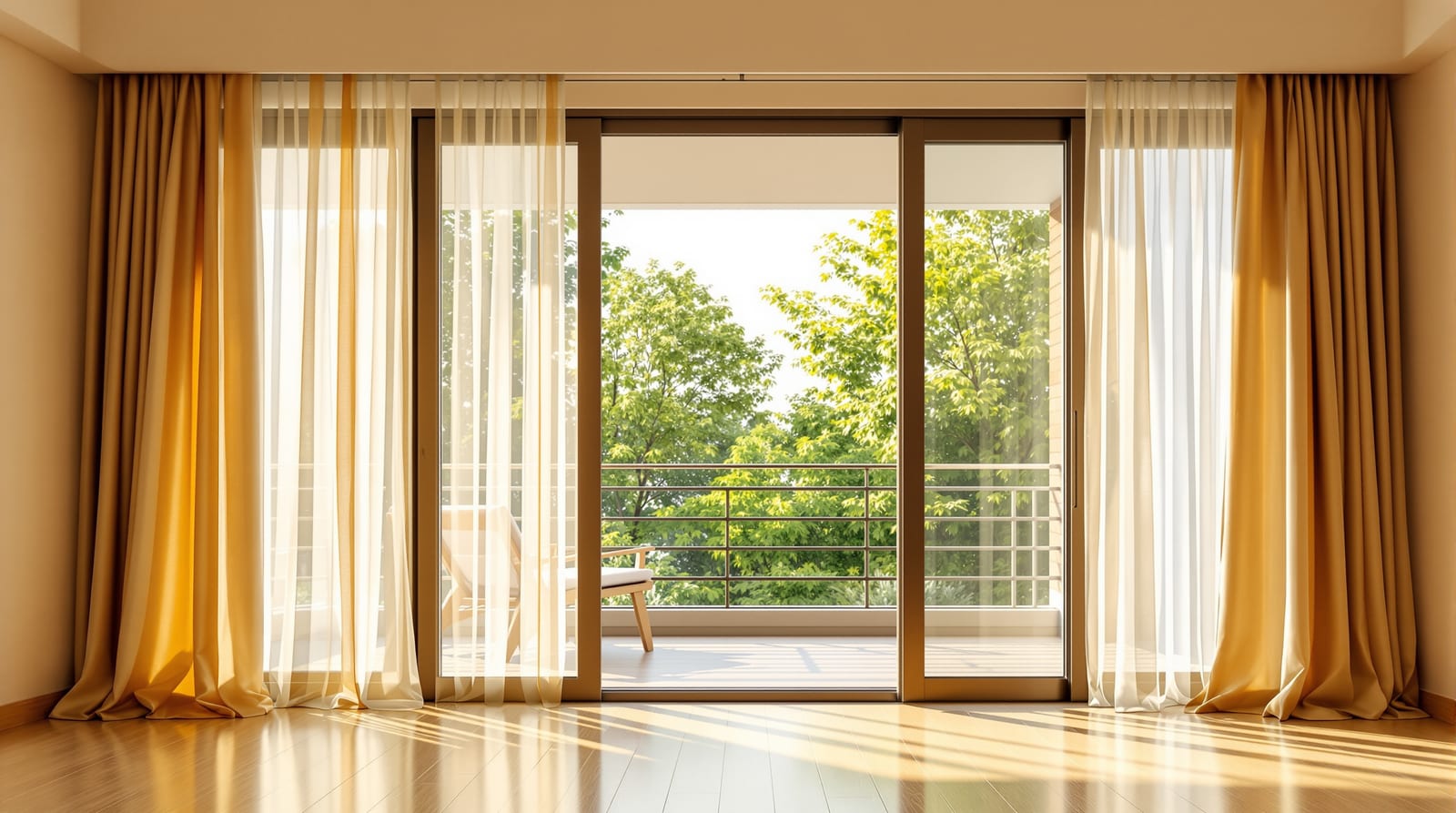
Sliding Doors for Indian Homes: Types, Cost, Tracks & Buying Guide
Top-hung vs bottom-roller, telescopic and wardrobe sliders compared - frames, tracks, hardware, 2026 ₹ costs, security and monsoon-proofing for Indian balconies, patios and small rooms.
The sliding door earns its place in Indian homes by doing one thing brilliantly: it opens an opening without ever stealing the floor. Where a hinged door needs a clear arc roughly the width of the leaf - close to a square metre of dead space - a slider needs nothing, because the shutter simply glides sideways across the wall or into a parallel panel. In a 2BHK where every square foot is paid for, that is the difference between a usable balcony threshold and a cramped one, between a wardrobe you can stand in front of and one whose doors clash with the bed.
But "sliding door" covers a wide family - balcony glass walls, telescopic patio openings, mirror-fronted wardrobe shutters, slim aluminium room dividers - and they behave very differently in heat, dust and a Mumbai monsoon. This guide walks through the types, the all-important track and hardware, where each one belongs, real 2026 rupee costs, and how to keep a slider secure, weather-tight and rolling smoothly for years.
The two ways a slider hangs: top-hung vs bottom-roller
Almost every choice you make starts here, because it decides how the door carries its own weight and how it ages.
A bottom-roller (bottom-rolling) door sits on small wheels that run in a track set into or onto the floor. The floor track takes the full weight of the shutter. This is the classic, lower-cost arrangement for most Indian aluminium and uPVC balcony sliders. It is simple and strong, but the floor track is a dirt trap: dust, hair and grit collect in the channel, the rollers grind, and over a few monsoons the door starts to drag. A bottom track also breaks the floor line - a small trip lip and a channel to sweep.
A top-hung door hangs from a strong header track fixed above the opening; the rollers are at the top and the floor carries little or no weight (just a guide pin keeps the bottom from swinging). This gives a clean, near-flush floor - excellent for accessibility and for that flush "wall of glass" look - and the track stays cleaner because gravity pulls dirt down, away from the wheels. The trade-off is that top-hung needs a properly engineered, well-fixed lintel/header and costs more; a heavy glass leaf hanging from a weak header is a real failure risk. Premium room dividers, slim-profile systems and most quality wardrobe sliders are top-hung.
| Bottom-roller | Top-hung | |
|---|---|---|
| Weight carried by | Floor track | Header / lintel above |
| Floor finish | Track + small lip (trip risk) | Clean, near-flush (better for accessibility) |
| Dust / monsoon behaviour | Track clogs, rollers wear faster | Stays cleaner, smoother for longer |
| Typical use | Most aluminium/uPVC balcony sliders, budget | Slim systems, room dividers, quality wardrobes |
| Cost | Lower | Higher (needs strong header) |
| Common faults | Dragging, jumped roller, gritty channel | Header sag if under-built, guide-pin rub |
The track and hardware: where a slider lives or dies
A sliding door is only as good as the part you cannot see. Two doors with identical glass and identical frames will feel completely different depending on the rollers, the track and the locks. Spend here.
- Rollers (wheels): nylon rollers are cheap and quiet but wear; stainless-steel or sealed twin-wheel bearing rollers cost more and roll smoothly for a decade. Insist on adjustable rollers so the door can be levelled later when the building settles.
- Track section: anodised aluminium or stainless tracks resist the pitting that plain steel suffers in coastal and humid air. A deeper, broader track section spreads load and is far easier to keep clear.
- Brush / pile weatherstripping: the fuzzy strip along the meeting stiles and frame is what keeps dust, draught and driving rain out. Cheap sliders skip it; good ones have continuous pile seals and an interlock where the two leaves meet.
- Anti-lift / anti-derail blocks: small clips that stop the leaf being levered out of the track - both a security and a safety feature on glass.
- Locks: a basic sliders' "touch lock" or hook-bolt is weak. Specify a multi-point lock (two or three hook bolts engaging the frame), a key-lockable handle, and ideally a separate top-and-bottom bolt for balcony doors.
A look inside the track (cross-section)
The cross-section shows the everyday two-leaf, bottom-roller layout: each leaf carries rollers in its own channel, and where the two stiles overlap at the centre, a brush seal plus interlock keeps weather and dust out. A top-hung version moves the load-bearing rollers up to the header and leaves only a shallow guide at the floor.
Frame materials: aluminium vs uPVC vs framed glass vs wood
The frame decides looks, longevity and cost more than the glass does.
| Frame | Indicative cost | Strengths | Watch-outs | Best for |
|---|---|---|---|---|
| Aluminium (slim/system) | ₹450-1,200 / sq ft | Thin sightlines, big glass, strong, low maintenance | Conducts heat; cheap sections flex; coastal pitting if not anodised | Balcony, patio, room dividers, the default modern slider |
| uPVC | ₹400-700 / sq ft | Best seal, quiet, no rust, good for AC rooms | Bulkier frame, fewer designs, quality varies wildly | Bedrooms, AC living rooms, noisy or dusty city sites |
| Framed glass (toughened) | ₹450-1,200 / sq ft | Light, views; toughened is safe-shatter | Needs good lock; privacy via frosting | Balcony, study partition, shower |
| Wood / engineered-wood | ₹700-1,500+ / sq ft | Warm, traditional, heavy | Swells in monsoon if not sealed; heavier track load | Period homes, internal sliders, wardrobes |
Costs are per square foot of opening (material plus make), 2026, before track, hardware, the typical 18% GST and ₹800-3,000 fitting labour - treat them as indicative and city-dependent. For a full like-for-like on the materials themselves, see the door materials comparison for India; for budgeting across all door types, the door cost guide for 2026; and for how sliders relate to your windows, the windows and doors design relationship.
Telescopic and multi-track sliders
Standard sliders are two- or three-track (two or three overlapping leaves). A telescopic slider links two leaves on the same side so they move together and stack - giving you a much wider clear opening from a shallower stack of glass. It is the answer for a wide patio or living-to-deck opening where you want to walk through generously without a three-leaf system eating frame depth. It costs more (more rollers, synchroniser hardware) and demands precise installation, but it is dramatic. For openings you want to throw fully open, also weigh up bi-fold doors, which concertina aside to leave almost no frame at all, and pocket doors, where an internal slider vanishes into the wall cavity for a zero-footprint finish.
Where sliders belong (and where they do not)
- Balcony / patio / terrace: the classic job. Big glass, light, views, no swing into a small room. Specify good seals and locks - this is your weak point for weather and security.
- Wardrobes: sliding shutters (often top-hung, mirror or laminate) save the swing space a hinged wardrobe needs in a tight bedroom. No clash with the bed.
- Room dividers / study partitions: slim aluminium or glass sliders to split a large living room or screen a home office, with light still passing through.
- Small bathrooms and utility: a slider removes the door swing in a cramped WC - though for a fully concealed finish a pocket door is neater.
- Where they struggle: as a main entrance (low security, weather exposure - a solid or teak door is the right call there), and on a wall where you need to hang things or place furniture flat against the wall the door slides across.
On the front door, sliders are simply the wrong tool; if security and ceremony matter, read the entrance Vastu guidance and choose a substantial hinged or pivot leaf instead. Vastu tradition also favours the main door opening inward and being the largest in the home, which a sideways slider cannot honour.
Cost: what a sliding door really runs to
A common mistake is pricing the glass and forgetting that the track, rollers, locks and fitting are half the job - and that they are exactly the parts worth not cheaping out on.
| Item | Indicative 2026 cost | Note |
|---|---|---|
| Aluminium/uPVC framed glass slider | ₹450-1,200 / sq ft of opening | Frame + glass + make |
| Telescopic / premium system | ₹900-2,000+ / sq ft | Synchroniser hardware, precision fit |
| Sliding wardrobe shutters | ₹600-1,500 / sq ft of shutter | Mirror/laminate; top-hung dearer |
| Quality roller + track set | ₹1,500-6,000 per opening | Stainless/sealed-bearing rollers worth it |
| Multi-point / hook-bolt lock | ₹1,500-6,000 | The single best security upgrade |
| Fitting / installation labour | ₹800-3,000 per door | Level header and track critical |
| GST | +18% typical | On material and often labour |
As a rough all-in: a standard 7 ft x 7 ft (≈ 49 sq ft) aluminium balcony slider lands around ₹25,000-55,000 installed with decent hardware; a premium slim-profile or telescopic system can run well past ₹80,000-1,50,000. A sliding wardrobe front is usually ₹15,000-40,000 depending on size and finish. Always compare installed prices, not glass-only quotes.
Security and weatherproofing - the two real weaknesses
Sliders are loved for light and space and distrusted for exactly two reasons. Both are solvable.
Security. A sliding leaf can be levered out of its track or its weak centre catch forced. Fix it with: anti-lift blocks at the top of the track; a multi-point hook-bolt lock rather than a single touch latch; a key-lockable handle; and a simple top-and-bottom bolt or a charley bar / patio dowel laid in the floor channel so the door cannot slide even if the latch is defeated. Toughened (or laminated, for ground floors) glass resists smash-through. For a layered approach across the whole home, our broader door-security guidance and the planned door security rating tool help you benchmark each opening.
Weatherproofing. India's monsoon drives rain horizontally; a poorly sealed slider weeps water along the bottom track and lets dust in everywhere. Specify continuous pile/brush seals on every stile, an interlock at the meeting leaves, and a track with proper drainage weep holes so any water that gets in drains out rather than pooling. On exposed coastal or high-floor balconies, ask for double-walled sections and a small upstand at the sill. uPVC frames seal best and are quietest; well-made aluminium with good gaskets is close behind.
Maintenance: keeping it gliding
A slider that drags is almost never broken - it is dirty or out of level. A few minutes a season keeps it smooth.
1. Vacuum and wipe the track monthly; lift out grit, hair and dust from the channel. This is the number-one cause of hard-sliding doors.
2. Lubricate the track with a dry silicone spray (not oil, which attracts dust) two or three times a year.
3. Adjust the rollers with the screw at the leaf base if the door has dropped or scrapes - it should glide with one finger.
4. Check the seals before and after monsoon; replace flattened brush pile.
5. Clear the weep holes so the track drains.
6. Oil the lock mechanism occasionally and check the anti-lift blocks are still in place.
Bottom-roller doors need this attention more often than top-hung; if a slider in a dusty location is becoming a chore, a top-hung system at the next replacement will pay you back in less fuss.
Frequently asked questions
Are sliding doors safe for an Indian main entrance?
Generally no. A sliding leaf offers lower security than a solid hinged door and is exposed to weather and dust at the front of the house. Use sliders for balconies, patios, wardrobes and internal dividers, and choose a substantial hinged or pivot door - sited per entrance Vastu - for the main entrance.
Top-hung or bottom-roller - which should I choose?
Bottom-roller is cheaper and fine for most balcony sliders, but the floor track clogs and wears in dusty, monsoon-prone India. Top-hung costs more and needs a strong header, but gives a clean near-flush floor, stays cleaner and rolls smoothly far longer - the better long-term choice if the lintel can take the load.
How much does a sliding glass door cost in India in 2026?
Framed aluminium or uPVC glass sliders run roughly ₹450-1,200 per square foot of opening for the leaf, plus track, rollers, locks and ₹800-3,000 fitting, and 18% GST. A standard 7 ft x 7 ft balcony slider is commonly ₹25,000-55,000 installed; premium slim-profile or telescopic systems cost considerably more. Figures are indicative and vary by city and vendor.
Why is my sliding door hard to open?
Almost always a dirty or unlevel track. Vacuum the channel, clear grit and hair, spray dry silicone (not oil) and adjust the roller screws at the base of the leaf so it glides with one finger. If it still drags, a roller has worn and should be replaced.
How do I make a sliding door more secure?
Add anti-lift blocks at the top of the track, fit a multi-point hook-bolt lock and a key-lockable handle, lay a charley bar or dowel in the floor channel to physically block sliding, and use toughened (or laminated on the ground floor) glass.
Sliding, bi-fold or pocket - which space-saver is right?
A slider is the simplest and cheapest and suits balconies, wardrobes and dividers. A bi-fold folds fully aside to open a whole wall to a patio. A pocket door disappears into the wall cavity for a true zero-footprint internal opening - neatest for small bathrooms and utility rooms.
Export this guide
Related Guides — Deep-dive reading
Double Doors in India (2026): Two-Leaf Entrances, Proportions, Hardware & Cost
When a double-leaf door makes sense for Indian main entrances, pooja rooms and master suites, plus active/inactive leaf hardware, the Vastu note on even panels, security at the meeting stile and the rupee premium over a single door.
Home Doors & EntrancesStacking Sliding Doors for Indian Homes: Multi-Panel Open-Wall Guide (2026)
How 3-6 panel stacking sliders create a near-full open wall to your balcony or garden, the multi-track aluminium systems, weight and glass limits, weather seals, costs, and how they compare to bi-folds.
Home Doors & EntrancesThe Complete Home Door Guide for Indian Homes (2026): Types, Materials, Cost, Security & Vastu
Everything an Indian homeowner needs to specify the right door for every opening — from main entrance to bathroom — with real 2026 prices, IS/NBC standards and Vastu sense.
Home Doors & EntrancesRelated Tools — Try Free
Window Material Comparison Tool
Compare uPVC, aluminium, wood, steel and composite windows on cost, life, upkeep and insulation.
CompareDoor Material Comparison Tool
Compare 2–4 door materials on cost, durability, maintenance, security and moisture resistance.
Comparison ToolWindow Maintenance Cost Calculator
Estimate annual window upkeep by frame material — yearly, per-window and 5-year cost.
Window Calculator