
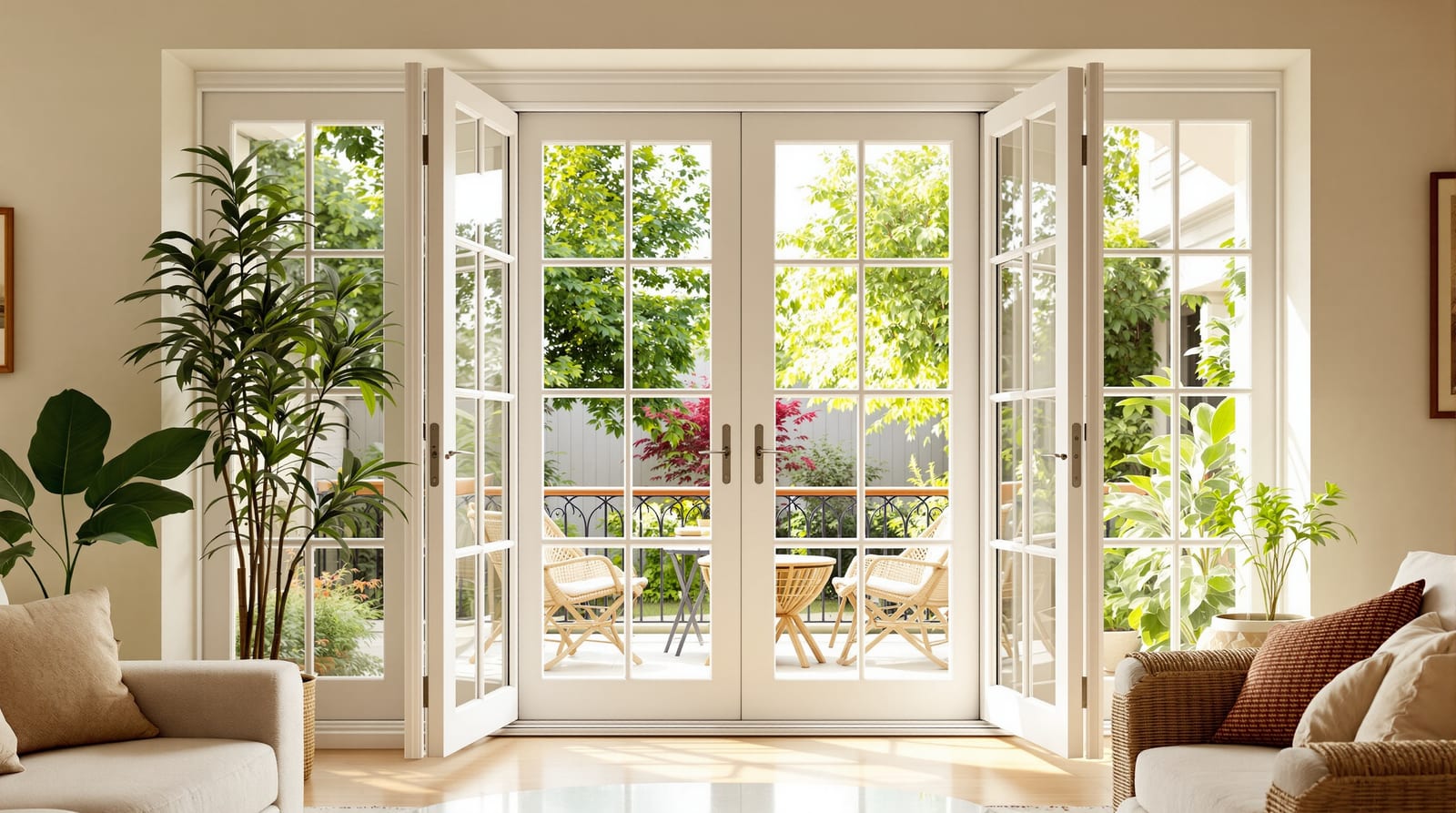
French Doors for Indian Homes: Glazing, Security, Cost & Monsoon Sealing
The double-leaf glazed door that opens a living room to a balcony or garden - where it works, how to specify the glass, frame and seals, what it costs, and how it stacks up against sliding and bi-fold.
There is a particular moment a french door is made for: the end of the day, the monsoon light gone soft, and a living room that suddenly belongs to the garden because two glazed leaves have swung wide open. No single sheet of glass and no track-bound slider gives you that full, gracious, walk-straight-through opening. But french doors also ask more of you than any other glazed door - more wall, more sealing, more thought about security and dust - and in an Indian climate that punishes glazing with heat, driving rain and grime, a badly specified pair will sweat, leak and creak its way to regret. This guide is the careful version: where french doors earn their place, exactly how to specify the frame, glass and seals, what the whole thing costs in 2026 rupees, and when a slider or bi-fold is simply the smarter buy.
What a french door actually is
A french door is a pair of side-hung glazed leaves that meet in the middle, with no fixed mullion between them - so when both are open you get one clear opening the full width of the frame. Each leaf is mostly glass, held in a slim timber, uPVC or aluminium frame, sometimes divided into smaller panes by glazing bars (the classic "georgian" or colonial look). The leaves swing on hinges, exactly like ordinary doors, which is the whole point and the whole problem: the swing is what gives you the wide, unobstructed opening, and the swing is what eats floor space and lets in dust and rain if the seals are poor.
Do not confuse french doors with three near-cousins. A sliding door runs glazed panels on a track and never swings, so it saves space but only ever opens half the width. A bi-fold folds a run of leaves concertina-style against one jamb, opening almost the full width but with more hardware and more cost. A french window is the same idea at sill-to-head height but narrower, treated as a window. French doors sit in the sweet spot between a single glass door and a wall of glass: a real, walk-through opening of roughly 1.2 to 1.8 m, framed and human-scaled. For the bigger family of glazed openings, see the glass doors guide and the sliding doors guide; for how french doors sit among all door types, the types of doors overview.
Where french doors work in an Indian home - and where they do not
French doors are an interior-to-exterior transition door, not a security door and almost never a main door. They shine at the soft boundary of the home, where you want light, view and the option of a wide opening:
- Living or dining room to a balcony, deck or sit-out - the classic use. The doors are protected by the balcony slab above, the opening is generous, and the glass pulls daylight deep into the room.
- Living room to a garden or lawn in a ground-floor flat, villa or farmhouse - the indoor-outdoor flow that french doors do better than anything.
- Master bedroom to a private balcony - quieter, more private than the living room, and a lovely way to wake up.
- Study or home office onto a terrace - light and a sense of openness without a full glass wall.
Where french doors are the wrong call: as the main entrance door (almost all glass, hinged outward-vulnerable, a dust and security liability - use a solid or teak door there, see main door design and door security); on a fully exposed west or south facade with no shade, where the glass turns the room into an oven; in bathrooms and pooja rooms (privacy and reverence); and in tight rooms where the double swing simply has nowhere to go - that is a job for a sliding or pocket door. A french door wants a balcony or garden in front of it and a metre of clear floor behind it.
The Vastu note
In traditional Vastu, large glazed openings to balconies and gardens are welcomed on the north and east - the cooler, gentler light - and treated more cautiously on the south-west. French doors, being a secondary opening rather than the main door, are not bound by the strict rules that govern the entrance, but the same logic holds: face them to morning light where you can, keep the threshold (dehleez) clean and unobstructed, and an even number of leaves (a pair) is itself considered auspicious. Frame this as tradition plus the sound practical reason - north and east light is kinder to Indian glazing - and for the main entrance rules read the entrance Vastu canon and Vastu main door guide.
Anatomy of a french door
The detail that decides whether french doors work in India is not the glass - it is the meeting stiles (where the two leaves close against each other), the threshold (where rain wants to come in at the bottom) and the seals all around. A french door has more linear metres of joint than any other glazed door, and every joint is a potential path for dust, water and noise. Get the seals and a multi-point lock right and the doors are tight and secure; skimp on them and you have an expensive draught.
Materials and frames - choosing the system
The frame material drives almost everything else: how the doors weather the monsoon, how much they cost, how they look, and how much maintenance you sign up for.
| Frame material | Indicative cost (per pair, glazed) | Weather / monsoon | Maintenance | Best for |
|---|---|---|---|---|
| Seasoned hardwood (teak, sal) | ₹35,000-90,000+ | Good if seasoned & sealed; can swell/warp if not | High - re-polish every 2-4 yrs | Heritage, villa, character interiors |
| uPVC (multi-chamber) | ₹18,000-45,000 | Excellent - won't rot, swell or corrode; good gaskets | Very low - wipe clean | Coastal, high-rain, value buyers |
| Aluminium (thermal-break system) | ₹30,000-70,000 | Excellent; slim sightlines; needs good gaskets | Low | Modern homes wanting maximum glass |
| Engineered wood / WPC | ₹22,000-50,000 | Good - dimensionally stable, termite-resistant | Low-medium | Warp-prone climates, mid budget |
| Steel (powder-coated) | ₹28,000-60,000 | Good; strongest but heavy; condensation risk | Low | Industrial look, security-led |
Prices are installed pair ranges including glass, frame and hardware, before the typical 18% GST; they vary by city, glass spec and system brand, so treat each as indicative. For a deeper material-by-material view see the door materials comparison; for the timber-specific case, the wooden doors and teak doors guides; and for the plastic-frame case, the uPVC doors guide.
A blunt verdict for most Indian buyers: if the doors face weather and you value low maintenance, uPVC or thermal-break aluminium beat timber on every count except romance. Reserve hardwood french doors for a sheltered, character-led setting where you will actually maintain them - and insist the timber is properly seasoned to IS 1003 standards, or it will swell shut in the first monsoon.
Glazing - the choice that decides comfort and safety
For a door this glassy, the glass spec is not a detail; it is the difference between a comfortable room and a greenhouse, and between safe and dangerous.
- Always toughened (tempered) glass, never plain annealed. A french door is at body height, in a high-traffic spot, often near children - toughened glass is four to five times stronger and crumbles into blunt pebbles rather than blades. This is good practice and aligns with IS 3548 workmanship for glazing.
- Double glazing (DGU / insulated glass unit) - two panes with a sealed air or argon gap - is the single biggest upgrade. It roughly halves heat gain and cuts outside noise noticeably, and it stops the inner pane fogging with condensation in air-conditioned rooms. On a west- or south-facing french door in Delhi, Ahmedabad or Hyderabad, double glazing is close to essential; on a shaded north balcony it is a comfort luxury.
- Low-E (low-emissivity) coating on the glass reflects radiant heat back out while letting light in - worth the premium anywhere the doors get afternoon sun.
- Tint or frosting for privacy or glare on lower-floor or street-facing doors; laminated glass if security or sound is a priority (it holds together when broken).
Single-glazed toughened is the budget floor; double-glazed Low-E toughened is the comfort sweet spot for any sun-exposed french door. For the wider trade-offs see the energy-efficient doors and soundproof doors guides.
Sealing for the Indian monsoon - the make-or-break detail
This is where french doors are won or lost. Because the leaves swing and meet in the middle, water and dust have three favourite paths: under the bottom rail, through the central meeting stiles, and around the hinge edges. Specify against all three.
- A proper threshold or sill with an upstand and a drainage channel, sloped to throw water outward. For accessibility keep the upstand low (a sill no more than ~12 mm helps wheelchairs and trip-safety, per the RPwD Harmonised Guidelines) but never zero on an exposed door, or the monsoon walks straight in. A low sill plus an outward-draining channel is the compromise.
- EPDM or silicone gaskets continuously around both leaves and at the meeting stiles - these are standard on good uPVC and aluminium systems and the first thing to check on a timber one.
- A multi-point locking system (an espagnolette that throws bolts at top, middle and bottom) - this is both your security and your seal: it pulls the leaves tight against the gaskets all along their height. A single central latch leaves the top and bottom corners loose, where rain and dust get in.
- A weather bar / drip on the bottom rail of the active leaf, and a rebated meeting stile so the leaves overlap rather than just butting together.
- A deep overhang or chajja above the doors - the cheapest, most effective monsoon defence is simply keeping driving rain off the glass in the first place. French doors under an open sky, fully exposed to a Mumbai or Kerala monsoon, will leak eventually no matter how good the seals.
Add insect mesh to the plan from the start - a separate mosquito-mesh door or a magnetic/pleated mesh - because a wide-open french door to a garden at dusk is an open invitation to mosquitoes. And factor cleaning: all that glass shows every fingerprint and every dust storm.
What french doors cost in 2026
Budget for the installed pair, not the leaves alone. A french door is a system - frame, two glazed leaves, hinges, multi-point lock, handles, gaskets, threshold and fitting - and the glass and hardware often cost more than the frame.
| Item | Indicative cost (2026) | Notes |
|---|---|---|
| uPVC french doors, single-glazed toughened | ₹18,000-30,000 / pair | Best value, low maintenance |
| uPVC / aluminium, double-glazed Low-E | ₹35,000-60,000 / pair | Comfort spec for sun-exposed openings |
| Aluminium thermal-break, slim sightline | ₹40,000-70,000 / pair | Maximum glass, modern look |
| Seasoned teak / hardwood, glazed | ₹45,000-90,000+ / pair | Character; add re-polishing over life |
| Multi-point lock + good handles | ₹3,000-9,000 | Security and seal; do not skimp |
| Insect-mesh door (pleated/magnetic) | ₹3,000-12,000 | Plan from the start |
| Fitting / installation labour | ₹2,000-6,000 / pair | More than a single door - two leaves to hang true |
| GST | +18% typical | On most factory-made systems |
All figures are indicative and vary by city, glass spec, system brand and timber rate. For a full budgeting walk-through use the door cost guide for 2026, and run your own numbers on the door cost calculator and compare frames on the door material comparison tool.
French doors vs sliding vs bi-fold
The honest comparison most buyers actually need - which glazed opening to choose for a balcony or garden:
| Factor | French doors | Sliding doors | Bi-fold doors |
|---|---|---|---|
| Opening width achieved | Full width of frame (both leaves swing clear) | Only half (one panel slides behind the other) | Almost full width (leaves stack/fold aside) |
| Floor space needed | Swing space inside or out (~0.6-0.9 m) | None - panels slide | Small stacking zone at one jamb |
| Best opening size | ~1.2-1.8 m | 1.5-4 m+ | 2-6 m+ (wide spans) |
| Cost | Medium (₹18,000-90,000 / pair) | Medium (₹450-1,200 / sq ft) | Highest (₹700-1,500 / sq ft) |
| Sealing / monsoon | Hardest (swinging joints) - needs care | Good (overlap + brush seals) | Moderate (many joints, good gaskets) |
| Security | Medium (multi-point lock essential) | Low-medium (lift-out risk; good lock helps) | Low-medium |
| Look / feel | Classic, gracious, indoor-outdoor flow | Clean, space-saving, contemporary | Dramatic full-open wall |
| Best for | Living/bedroom to balcony or garden, 1.2-1.8 m | Balcony, tight rooms, any width on a track | Wide living-to-garden spans you want fully open |
The decision rule: choose french doors for the gracious, classic full-width opening at a moderate width where you have floor space for the swing; choose a sliding door when floor space is tight or the opening is very wide; and choose a bi-fold when you want to throw open an entire wall to the garden and the budget allows. For very wide openings, french doors stop scaling and the slider or bi-fold takes over. For the relationship between glazed doors and the windows around them, see windows and doors design.
A quick buyer's checklist
Before you sign off a french door order, confirm: toughened glass (double-glazed Low-E if sun-exposed); multi-chamber uPVC or thermal-break aluminium frame unless you are committing to maintain timber; continuous EPDM gaskets and a rebated, weather-barred meeting stile; a multi-point lock; a sloped, draining threshold under a chajja or balcony slab; insect mesh planned in; and an installer who will hang both leaves dead true so they meet cleanly for years. Get those right and french doors give you the best indoor-outdoor moment in the house. Skimp on the seals and lock and you have bought a leak with a view.
Frequently asked questions
Are french doors a good idea in the Indian monsoon?
Yes, if specified for it - and a liability if not. The risks are water and dust through the swinging joints, so insist on continuous EPDM gaskets, a multi-point lock that pulls the leaves tight, a sloped draining threshold, and crucially a chajja or balcony slab overhead to keep driving rain off the glass. uPVC or thermal-break aluminium frames handle wet climates far better than timber. Fully exposed to a Mumbai or Kerala downpour with poor seals, any french door will eventually leak.
Are french doors secure enough for a ground-floor home?
French doors are a balcony/garden door, not a main entrance, and should never be your only line of defence at street level. With a proper multi-point lock (bolts top, middle and bottom), laminated or toughened glass and a strong frame, they are reasonably secure, but for a vulnerable ground-floor opening add a grille, an alarm contact or a separate security door. Keep solid, lockable doors at the main entrance - see the door security guide.
French doors or sliding doors for a balcony?
Sliding doors if the opening is wide or floor space is tight - they save space and seal well. French doors if the opening is a moderate 1.2 to 1.8 m and you want the gracious, full-width, walk-straight-through feel that a slider can never give (a slider only ever opens half its width). For a full-wall opening to a garden, consider a bi-fold instead.
Should french doors be single or double glazed?
Double-glazed with a Low-E coating for any door that gets afternoon sun - it roughly halves heat gain, cuts noise and stops the inner pane fogging in air-conditioned rooms, which more than pays for itself in comfort and electricity. Single-glazed toughened is acceptable only on a shaded north or east balcony on a tight budget. Always toughened, never plain glass, at this height and traffic.
What size are french doors in India?
A french door pair typically spans about 1.2 to 1.8 m wide (two leaves of roughly 600-900 mm each) at the standard door height of about 2100 mm, matching NBC 2016 practice. Wider than ~1.8 m and the leaves get heavy and the swing unwieldy - that is where a sliding or bi-fold door takes over. See the door size standards guide for the full size charts.
Export this guide
Related Guides — Deep-dive reading
The Complete Home Door Guide for Indian Homes (2026): Types, Materials, Cost, Security & Vastu
Everything an Indian homeowner needs to specify the right door for every opening — from main entrance to bathroom — with real 2026 prices, IS/NBC standards and Vastu sense.
Home Doors & EntrancesFloor-to-Ceiling Windows (India): Maximum Light, and the Heat Trade-Off
Full-height glazing for Indian homes — how to win the daylight and view without losing the energy code, comfort or safety.
Windows & GlazingDouble Doors in India (2026): Two-Leaf Entrances, Proportions, Hardware & Cost
When a double-leaf door makes sense for Indian main entrances, pooja rooms and master suites, plus active/inactive leaf hardware, the Vastu note on even panels, security at the meeting stile and the rupee premium over a single door.
Home Doors & EntrancesRelated Tools — Try Free
Door Material Comparison Tool
Compare 2–4 door materials on cost, durability, maintenance, security and moisture resistance.
Comparison ToolBrise-Soleil Visualizer
Interactive horizontal-louvre cut-off angle calculator — sun altitude, louvre depth, and spacing inputs with a live shadow preview. Computes θ = arctan(spacing/depth) for façade shading, ECBC envelope compliance, hospital daylight design, and tropical sun-control detailing.
Sun Shading ToolWindow Cost Calculator
Estimate window price plus installation by type, frame material, size, glass and quantity.
Window Calculator