
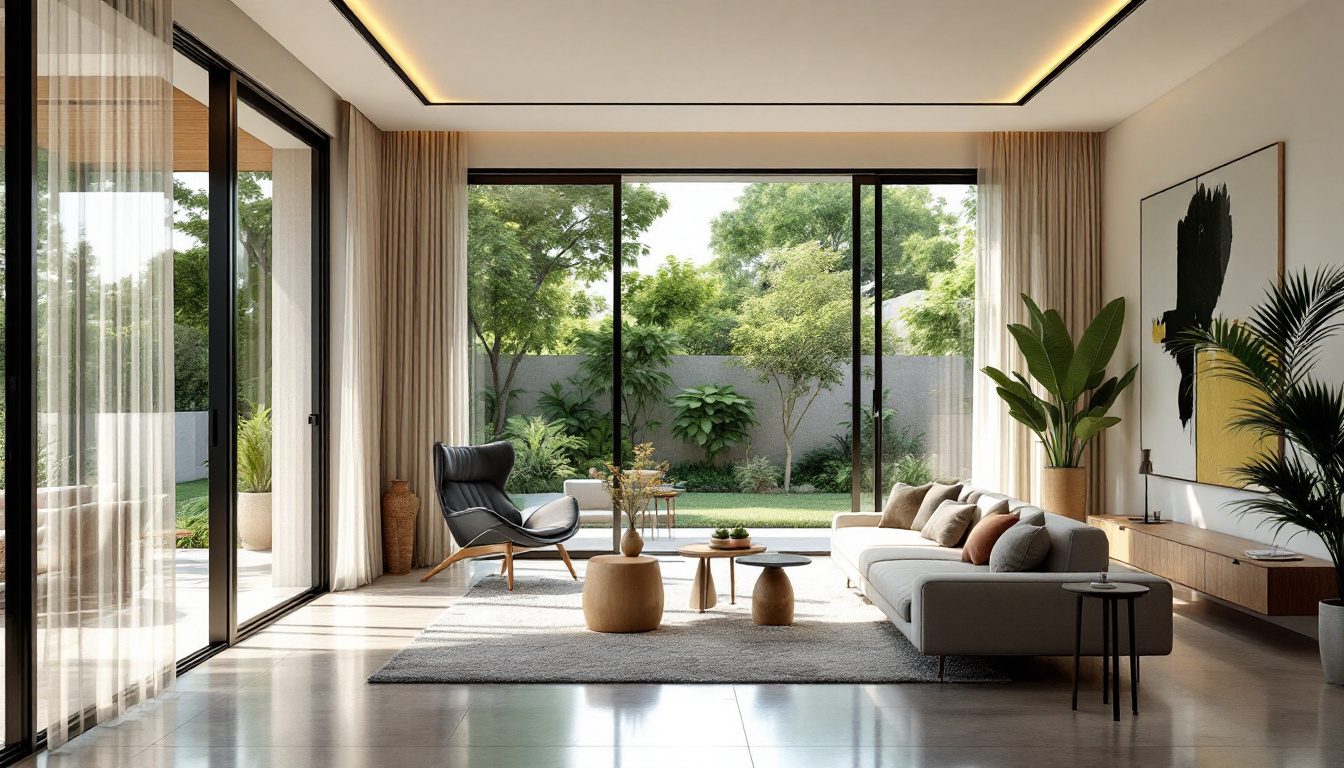
Windows & Doors: The Eyes and Mouth of Your Home
Matching window shape to the view, golden-mean proportion, composing the wall, doors that signal rank, French doors as connectors, and cross-ventilation
If the walls of a home are its body, then the windows are its eyes and the door is its mouth. They are the parts that look out, breathe in, and speak to everyone who approaches. Yet in most Indian homes, openings are decided last and almost by accident, a leftover negotiation between the structural drawing, the contractor's standard sizes, and whatever the carpenter happens to have done before. The result is a room that may be the right area on paper and still feel airless, glary, or strangely blind, staring at a compound wall when it could have been framing a gulmohar tree.
This guide is about treating windows and doors the way a designer does, as decisions with reasons. We will begin where a window should always begin, with the view. Then we will talk about proportion, about composing a whole wall, about doors that announce their rank, and about the very Indian truth that here a window is never only a picture frame. In our climate it is a piece of climate-control machinery, a security device, and a monsoon barrier all at once. Get the openings right and the room sees, breathes, and glows. Get them wrong and no amount of furniture will rescue it.
Start with the View: Match the Window to What It Sees
The single most overlooked principle of window design is also the simplest one. A window is, before anything else, an expression of what lies beyond it. From outside it makes a passerby wonder what is within; from inside it frames a picture, blocking the parts you would rather not see and concentrating attention on the part that deserves it. So the first question is never how big or how many. It is: what is this window looking at, and what shape is that view?
A window is not a hole in a wall to let in light. It is a frame you have chosen to hang around one particular piece of the world.
Once you ask that question, the answer often draws itself. A long, low garden, a distant ridge line, the horizon over a lake, a row of rooftops at dusk, these are horizontal subjects, and they want a broad, horizontal window that lies down with them. A single tree, a temple spire, a tall coconut palm, a sliver of sky pressed between two adjacent buildings, these are vertical subjects, and they ask for a tall, narrow opening that stands up to meet them. The opening should echo the geometry of the picture it carries.
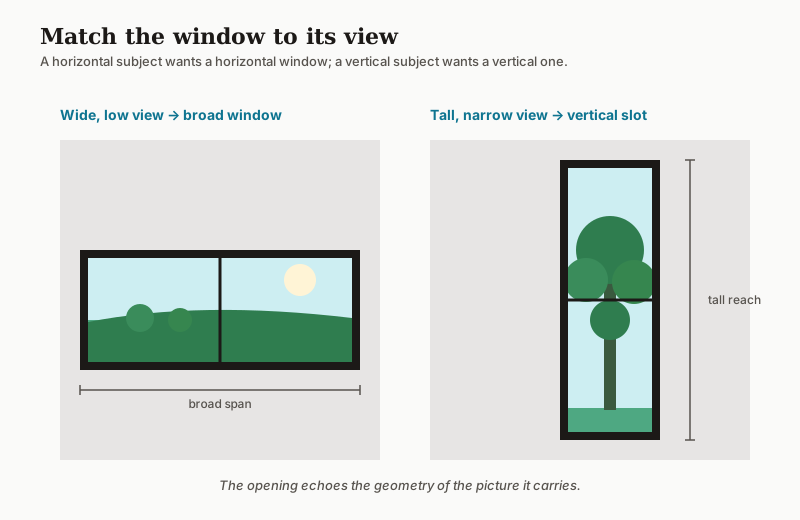
A Shape-to-View Matrix
The same logic scales up and down. Where the view earns it, the window can be broad and expansive; where the surroundings are dull or the privacy concern is real, a small, deliberate opening that isolates one good thing beats a large one that frames a parking lot.
| What lies beyond | View shape | Window response | Typical Indian situation |
|---|---|---|---|
| Garden, lawn, distant horizon | Wide and low | Horizontal band or picture window, low sill | Ground-floor living room onto a plot |
| Single tree, spire, tall plant | Tall and narrow | Vertical slot window, full-height glazing | Stairwell, double-height living room |
| Sliver of sky between buildings | Narrow vertical | High clerestory or slot, head near ceiling | Dense urban plot, side setback |
| Dull or overlooked outlook | None worth framing | Small high window for light only, or jaali | Bathroom, kitchen facing compound wall |
| Sky and treetops above | Horizontal, raised | Clerestory above eye level | Bedroom needing light without exposure |
The lesson is that you size and place a window for its job. A window that lights a room is a different creature from a window that frames a view, which is different again from a window that only ventilates. Many openings do two of these at once, and the best designs decide consciously which job leads.
Proportion and the Human Test
Not every window has a hero view to frame. A great many simply sit in a wall and must look right on their own terms. Here proportion does the work that the view would otherwise have done.
The old reliable is the golden mean, a height-to-width ratio of roughly 1 to 1.618. It is not a law of nature, but it is a remarkably forgiving safety net for a single window, a door panel, or a glazed shutter. A window that is 900 mm wide and about 1,450 mm tall, or 1,200 mm wide and roughly 1,950 mm tall, will rarely look wrong. When in doubt about a stand-alone opening, reach for that ratio before you reach for a rounder, lazier one. Our scale and proportion calculator will work the numbers both ways so you can test a sill-to-head dimension against the wall it sits in.
A good window is one beside which two people could comfortably stand and talk. If it feels right at the size of the human body, it usually is right.
That second test, attributed to the Renaissance architect Alberti, is worth keeping in your pocket. It cuts through ratios entirely. Stand at the wall in your imagination. Could two people pause beside this opening and have a conversation without it feeling cramped or cavernous? Windows that pass the human test tend to be the ones a room loves. To anchor the proportions to real bodies, the anthropometric data in Panero and Zelnik gives the standing eye height of an average Indian adult at roughly 1,500 to 1,600 mm, which is exactly why a window head set at 2,100 mm and a sill at 750 to 900 mm so often feels natural: the view sits right where the eyes already are.
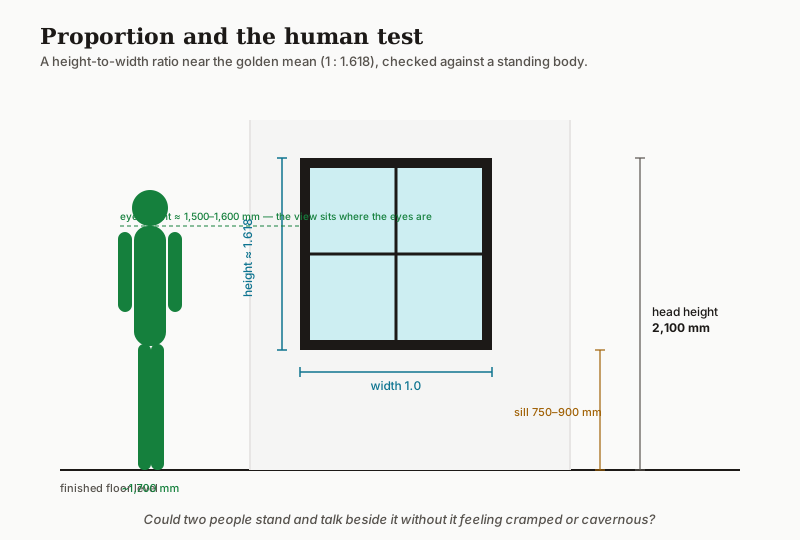
Sill and Head Heights That Work
A few dimensions recur because they fit the body and the furniture. A living-room sill at 600 to 750 mm lets a seated person see out. A bedroom sill at 750 to 900 mm clears the headboard and a side table. A kitchen sill at 1,050 to 1,200 mm sits above the counter and the splashback. A bathroom window goes high, sill around 1,500 mm or more, for privacy. Window heads almost universally align with door heads at about 2,100 mm, which is the quiet trick behind a calm wall, and the reason the next section matters so much.
Composing the Wall: Windows Are Like Hanging Pictures
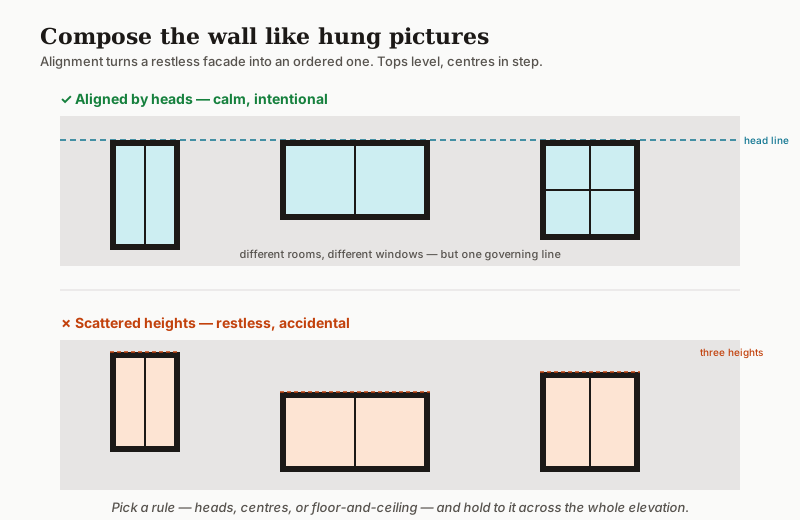
From the outside, arranging windows in a facade is a great deal like hanging pictures on a wall. You are not trying to fill the surface. You are trying to create a cohesive, intentional pattern that the eye reads as ordered rather than scattered. A wall with three windows at three different heights and three different sizes, each placed wherever the room behind happened to want it, looks restless and accidental, the architectural equivalent of pictures nailed up at random.
The cure is alignment. Pick a rule and hold to it. Align the windows by their heads, so the tops form one clean horizontal line, which is the most common and most forgiving discipline. Or align them by their centres, so a vertical axis runs through a cluster. Or align them to the floor and the ceiling so that sills and heads land on shared lines across the whole elevation. The room behind each window does not need the same window, but the wall in front of them all does need a governing order.
Muntins and Shutters: Two Quiet Regulators
Two old devices help tune how a window reads, and both are worth understanding even if you choose to leave them off. Muntins are the slim bars that divide a single sheet of glass into smaller panes. They do something subtle: they bring a large, blank pane down to a human scale, so a tall window reads as a composition of friendly small parts rather than one intimidating slab. A large plate-glass window can feel corporate; the same window with a light grid of muntins feels domestic.
Shutters, even decorative ones that never close, are what designers call a peopling device. They hint at the life inside, at hands that open and close, at a household that lives behind the wall. In the Indian context the working equivalent is the louvred shutter or the timber ventilator panel, which earns its keep by managing light, air, and privacy rather than just suggesting them. Use these regulators to set the character of a wall before you spend a rupee on the view itself.
Doors: Portals That Signal Their Rank
If the windows are the eyes, the door is the mouth, and it speaks the moment anyone arrives. Every door carries a quiet anticipation of what lies beyond it, and good design lets the door express its own importance honestly. The main door should be the grandest thing in the elevation. It is the one that greets a guest, a relative, a courier, the priest before a housewarming, and it commands embellishment: more width, more height, a finer material, a frame that announces it. Internal doors are quieter by design, sized and detailed to match their humbler rank.
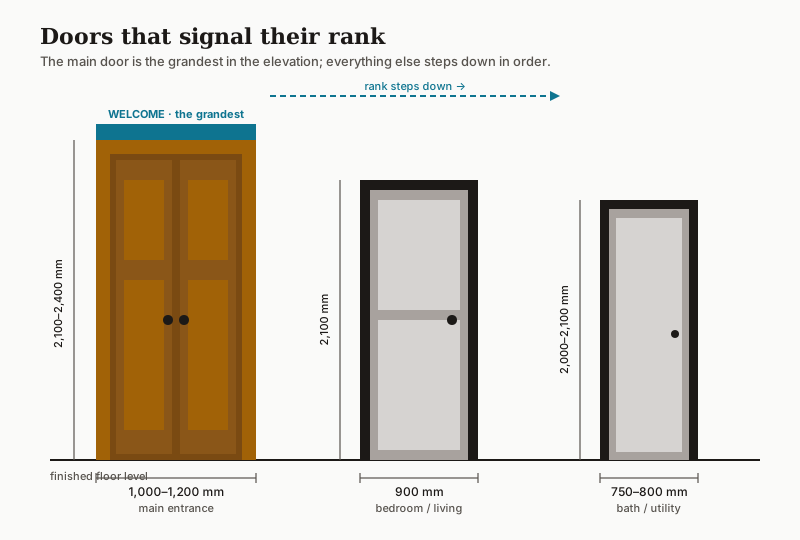
This is not vanity, it is wayfinding and welcome. A visitor who cannot tell the main door from the utility door has been failed by the design. Make the important door clearly the important one, and let everything else step down in a deliberate order. Vastu-minded households often weight the main door further, favouring north, east, or north-east placement and a threshold that feels generous; if that matters to you, our Vastu compass tool can help you read your plot's orientation before you fix the entrance.
Door Sizes and Where They Go
Indian practice has settled on a workable set of standard sizes, and knowing them saves you from a carpenter's guesswork. A main entrance door wants real presence; an internal door should be quiet and efficient.
| Door | Typical width | Height | Where it goes |
|---|---|---|---|
| Main entrance | 1,000 to 1,200 mm | 2,100 mm (up to 2,400) | Front door, the welcome |
| Bedroom or living | 900 mm | 2,100 mm | Primary rooms, furniture must pass |
| Internal or study | 800 to 900 mm | 2,100 mm | Secondary rooms |
| Bathroom or utility | 750 to 800 mm | 2,000 to 2,100 mm | Toilets, stores, small spaces |
| Sliding or French | 1,800 to 2,400 mm | 2,100 mm | To balcony, garden, verandah |
Note that 2,100 mm is the near-universal door height, the same line your window heads should land on. A main door that runs taller, to 2,400 mm, gains gravity without needing to grow wider and awkward. And do remember the practical floor: a 750 mm leaf is the minimum a wheelchair or a large piece of furniture can negotiate, which is why even modest internal doors should resist shrinking below it. When you are setting these out room by room, the room programming worksheet is a useful place to record which door serves which space and how furniture will move through it.
The Chameleon: French and Sliding Doors
French doors, doors filled with panes of glass, are the chameleons of the opening world. Sometimes they behave as doors and let you pass; sometimes they behave as windows and let you look. Their power is partly psychological. Even on the days you never actually step out onto the balcony, the mere fact that you could deepens your sense of connection to the space beyond. The wall has been dissolved, and the room borrows the garden, the sky, the breeze.
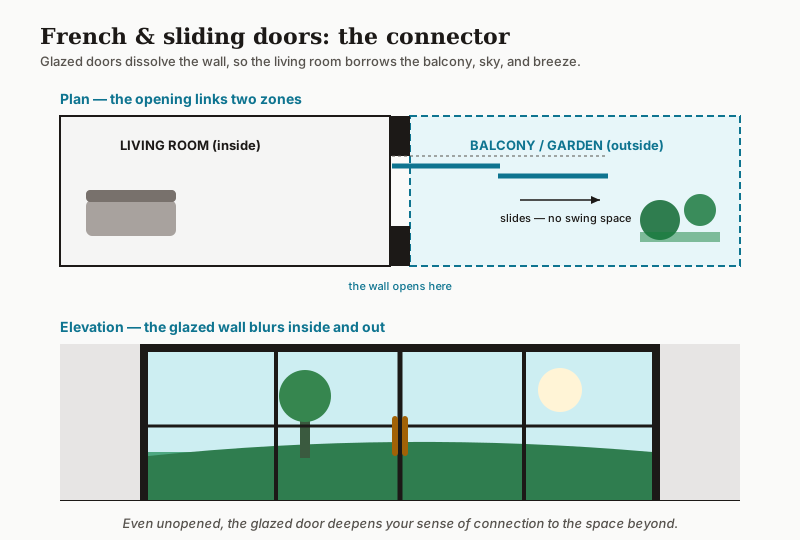
In Indian homes this is where indoor-outdoor living actually happens. A sliding glass door onto a balcony, a French door opening to a verandah or a small garden, a corner that folds away in the cool months, these are the gestures that make an apartment feel larger than its carpet area. The sliding variety saves the swing space that a hinged French door demands, which matters in a compact flat, while the hinged pair gives a more traditional, ceremonial feel. Either way, plan the threshold carefully: a flush or near-flush sill reads beautifully but must be detailed against monsoon water, which we will return to below.
The Window Seat, a Small Joy
Wherever a window turns out generous, consider giving it a seat. A window seat is a built-in away-place, somewhere to sit with a book in the morning light, and it costs almost no floor area because it borrows the depth of the wall and the sill. In a bedroom bay, a living-room corner, or a study nook, it is very often the spot the household comes to love most, the proof that a humble opening, treated with a little affection, can become a destination rather than a hole in the wall.
The Indian Dimension: Windows as Climate Control
Here is the part that no imported design book will tell you with enough urgency. In India, a window is not primarily a view. It is climate-control equipment that happens to also frame a view. It governs how the house breathes, how it stays cool without grid electricity, how it survives four months of driving rain, and how it keeps mosquitoes and intruders out. Treat openings as machinery first and decoration second and the comfort follows.
In our climate, the cleverest air conditioner in the room is often a pair of well-placed windows.
Cross-Ventilation and the Stack Effect
Air does not move through a room with a single window; it merely peeks in and stops. To make a breeze pass through, you need openings on two different walls, ideally opposite or adjacent ones, so that air enters on the windward side and leaves on the leeward side. This cross-ventilation is the most important comfort decision in a hot, humid country, and it is decided at the plan stage, not by any gadget bought later. Place the inlet low and the outlet high and you also harness the stack effect: warm air rises and escapes through the high opening, drawing cooler air in below. A high clerestory or a ventilator over a door is not decoration; it is the chimney of the room.
Shading the Western Sun
A large west-facing sheet of glass looks dramatic in a brochure and bakes the room in reality, because the low evening sun drives heat straight in for the hours you most want to relax. The Indian answer is old and excellent: shade the glass before the heat reaches it. The classic device is the chajja, a projecting horizontal sunshade above the window; deep reveals, vertical louvres, pergolas, and the jaali screen all do related work. A chajja sized to the latitude blocks the high summer sun while welcoming the low winter sun, which is precisely the seasonal behaviour you want.
| Shading device | Best on which face | What it does | Indian note |
|---|---|---|---|
| Chajja (horizontal sunshade) | South, and high east or west sun | Blocks high overhead sun | Standard 450 to 600 mm projection |
| Vertical fins or louvres | East and west low sun | Blocks low-angle morning and evening sun | Adjustable louvres best for west |
| Jaali (perforated screen) | West, south, exposed faces | Diffuses light, cuts glare, keeps privacy | A beautiful, breathable filter |
| Deep reveal | Any | Self-shades the glass within the wall | Free if the wall is thick enough |
| Pergola or planted screen | West, terraces | Softens and cools incoming light | Pairs well with balconies |
How Much Opening: NBC Rules of Thumb
The National Building Code of India 2016 turns ventilation from a feeling into a number. For habitable rooms the broad guidance is that the aggregate openable area, doors and windows that actually open, should be no less than one-tenth of the floor area, and that the glazed area for daylight should be at least one-tenth to one-sixth of the floor area depending on room type. Kitchens and bathrooms carry their own minimums, with a small ventilator demanded even where a window is impractical. Use these as a floor, not a ceiling.
| Room (per NBC 2016, general guidance) | Minimum openable area | Daylight glazing target |
|---|---|---|
| Habitable room (living, bedroom) | About 1/10 of floor area | 1/10 of floor area, more for deep rooms |
| Kitchen | 1/10 of floor area, plus a ventilator | 1/10 of floor area |
| Bathroom or WC | A ventilator of about 0.3 sq m minimum | High small window where possible |
| Deep or single-aspect room | Increase openings, add clerestory | Aim higher, toward 1/6 |
A worked example helps. A 12 square metre bedroom wants at least 1.2 square metres of openable window, which a single 1,200 by 1,200 mm openable shutter very nearly meets, and a second opening on another wall to make the air actually move. Our cost calculator can turn these window and door areas into a realistic line item once you know your frame and glazing choice.
Mesh, Grilles, and Monsoon-Proofing
Three Indian realities must be designed in, not bolted on as afterthoughts. Mosquito mesh, ideally on a separate sliding or openable track so it does not fight the shutter, lets you keep windows open through the evening without the room filling with insects. Security grilles, the M S or stainless steel bars over ground and accessible openings, protect the home, and they are far handsomer when their pattern is considered as part of the elevation rather than welded on later in a clash of styles. And monsoon-proofing means the right frame, a proper drip groove under every chajja, weep holes to drain the track of a sliding door, and a sill detailed to throw water out rather than in. A flush balcony threshold is lovely until the first heavy rain finds the gap, so detail it with a slight upstand or a continuous drainage channel.
Glazing and Frames: What to Choose and What It Costs
The frame and the glass decide how a window performs, ages, and bills. India's three common frame materials each suit a different brief, and the gap between single and double glazing matters more here than most homeowners expect.
| Frame material | Strengths | Weaknesses | Rough cost band | Best for |
|---|---|---|---|---|
| Aluminium | Strong, slim sightlines, low maintenance, large spans | Conducts heat unless thermally broken, plainer look | 600 to 1,200 per sq ft | Sliding doors, large modern windows |
| uPVC | Good insulation, seals tightly, weather and termite proof | Limited spans, fewer finishes, mid to higher cost | 800 to 1,500 per sq ft | Bedrooms, acoustic and dust control, harsh climates |
| Wood (timber) | Warm, traditional, repairable, beautiful detailing | Needs upkeep, warps in damp, costliest | 1,200 to 3,000+ per sq ft | Heritage homes, main doors, feature windows |
Costs vary widely by city, section, and brand, so treat the bands as a starting point and confirm against local quotes. As a rule, aluminium wins on large glazed spans and slim modern frames, uPVC wins on sealing out dust, noise, and heat, and timber wins on warmth and on the ceremonial main door where the extra spend is most visible.
Single Versus Double Glazing
A single pane is one sheet of glass; a double-glazed or insulated glass unit is two panes with a sealed air or argon gap between them. The gap dramatically slows heat and sound. In most of India, where the issue is keeping heat out, double glazing with a low solar heat gain coefficient pays for itself in cooling comfort, especially on west and south faces and on large glazed areas. The Eco Niwas Samhita, India's residential energy code under the ECBC family, sets exactly this kind of envelope guidance, capping the effective window-to-wall ratio and the solar heat gain so that a glazy home does not become an oven. For a small north window with a good view, single glazing is perfectly sensible. For a wall of west-facing glass, double glazing with shading is not a luxury, it is the difference between a room you can use in May and one you cannot.
| Glazing | What it does | Where it fits in India |
|---|---|---|
| Single clear | Cheapest, lets heat and noise through | North windows, small openings, tight budgets |
| Single tinted or low-E | Cuts some heat and glare | West and south where double is out of budget |
| Double (IGU) | Strong heat and sound insulation | Large glazing, west and south, noisy roads, premium |
| Double low-E low-SHGC | Best heat rejection with daylight | Big glazed living rooms, hot cities, energy-conscious builds |
Bring it to life with Studio Matrx
Windows and doors are where your home meets the world: where it sees, breathes, and says its word of welcome. Tell Studio Matrx about your views, your plot's orientation, and your city's climate, and our AI will propose window and door layouts that frame what matters, compose the facade like hung pictures, give the main door its rightful rank, and plan for cross-ventilation, shading, security, and the monsoon, all tuned to NBC norms and a budget you set. Start with the view, and let the rest follow.
References
- Bureau of Indian Standards. National Building Code of India 2016 (SP 7), Part 8 Building Services and Part 3 Development Control Rules and General Building Requirements, ventilation, daylighting, and openable-area provisions for habitable rooms.
- Bureau of Energy Efficiency. Eco Niwas Samhita (Energy Conservation Building Code for Residential Buildings), 2018 and 2021, window-to-wall ratio, thermal transmittance, and solar heat gain coefficient limits for the building envelope.
- Bureau of Energy Efficiency. Energy Conservation Building Code (ECBC), 2017, fenestration and daylighting requirements for the Indian climate zones.
- Bureau of Indian Standards. IS 1948 and IS 1949, Specification for Aluminium and Steel Windows, Ventilators and Doors, and IS 2553, Safety Glass, dimensional and performance standards.
- Ministry of Housing and Urban Affairs, Government of India. Energy Efficiency guidelines and model building bye-laws, shading, orientation, and passive-cooling recommendations.
- Panero, Julius, and Martin Zelnik. Human Dimension and Interior Space. Whitney Library of Design, anthropometric data for sill, head, and door heights at human scale.
- Krishan, Arvind, et al. Climate Responsive Architecture: A Design Handbook for Energy Efficient Buildings, on cross-ventilation, the stack effect, and shading devices in Indian climates.
- Hirsch, William J. Jr. Designing Your Perfect House: Lessons from an Architect. Dalsimer Press. (A general inspiration for this series' approach to designing windows and doors.)
Export this guide
Related Guides — Deep-dive reading
Floor-to-Ceiling Windows (India): Maximum Light, and the Heat Trade-Off
Full-height glazing for Indian homes — how to win the daylight and view without losing the energy code, comfort or safety.
Windows & GlazingWindow Design for Villas (India): Using the Freedom of All Four Sides
With walls free on all four sides, you can tune every window to its sun: north light for studies, east for bedrooms, shaded south for living, minimal west, plus feature windows, dual-aspect rooms and stairwell glazing.
Windows & GlazingEnergy-Efficient Facades in India: How the Building Skin Cuts Your Cooling, Heating & Lighting Bills
How a building facade drives cooling, heating and lighting energy in India, the three levers of solar-heat-gain control, insulation and daylighting, U-value, SHGC, VLT and WWR in plain terms, ECBC and Eco-Niwas expectations, and real Indian green buildings.
Building FacadesRelated Tools — Try Free
Brise-Soleil Visualizer
Interactive horizontal-louvre cut-off angle calculator — sun altitude, louvre depth, and spacing inputs with a live shadow preview. Computes θ = arctan(spacing/depth) for façade shading, ECBC envelope compliance, hospital daylight design, and tropical sun-control detailing.
Sun Shading ToolCross-Ventilation Analyzer
Estimate airflow and air changes per hour (ACH) from room size, window areas, layout, and local wind — with NBC 2016 Part 8 compliance check.
Ventilation CalculatorWindow Orientation Planner
Pick the best window type, glass and shading by wall direction — north, east, south and west.
Window Tool