
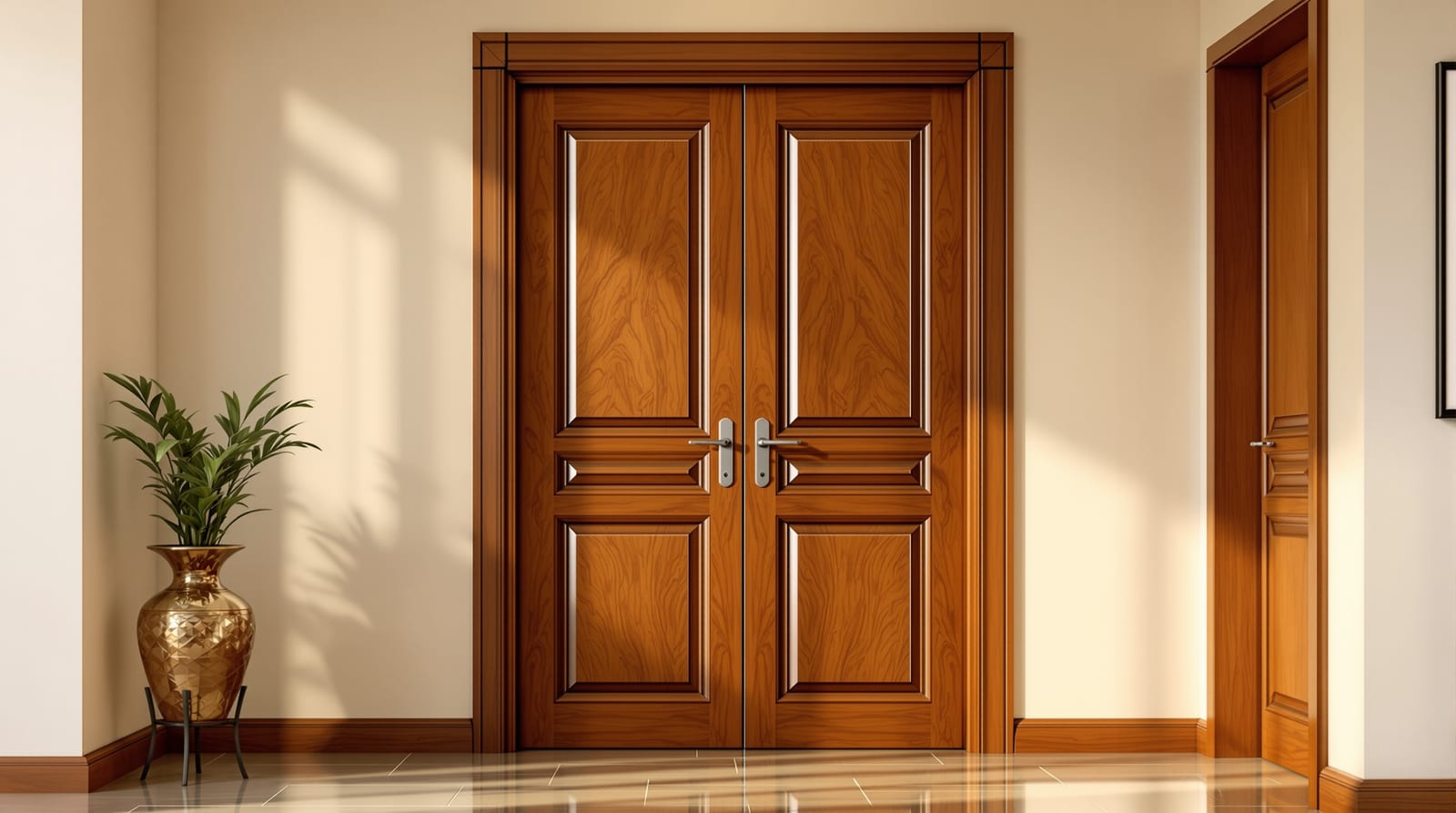
Panel Doors for Indian Homes: Stiles, Rails, Panels & 2026 Costs
How panel doors are built (IS 1003), the 2/4/6-panel styles, solid wood vs engineered vs moulded-skin options, where they work in an Indian home, what they cost and how they compare to flush doors.
Long before the smooth, factory-pressed flush door took over Indian bedrooms, the panel door was the door. Walk into any older bungalow, a heritage home in Chettinad or a 1970s government quarter and you will find them: stout teak or sal shutters with two, four or six recessed panels framed by thick uprights and crosspieces, the stepped shadow lines reading instantly as "real carpentry". Panel doors never went away - they simply moved upmarket. Today they are the budget-conscious way to give a main door genuine presence, the natural choice for a pooja room, and the detail that lifts an internal door from "builder-grade" to "designed". This guide explains exactly how they are built, the styles you can ask for, the three big material families behind them, what they cost in 2026 rupees, and how they really compare to the flush door next to them on the price list.
What a panel door actually is
A panel door is a frame-and-infill construction, and once you can name the parts you can talk to any carpenter or factory with confidence. The outer frame is made of stiles - the two vertical members running the full height of the door - and rails - the horizontal members that span between them (a top rail, a bottom rail, and one or more intermediate or "lock" rails). On larger doors, short vertical members called mullions divide the width as well. The openings created by this grid are filled with panels: thinner boards of timber, plywood, MDF or glass that sit in grooves cut into the inner edges of the stiles and rails.
The clever part is that the panels are not glued solid into the frame. They float loosely in their grooves so that when the timber swells in the monsoon and shrinks in the dry winter, the panel can move without splitting the door or pushing the joints apart. This is the single biggest reason a well-made panel door survives Indian seasonal humidity better than a cheap flush door, where a flat plywood face has nowhere to move and can bow or delaminate.
In India this construction is standardised by IS 1003 (Part 1) for timber panelled and glazed shutters, and IS 1003 (Part 2) plus IS 4021 for the door frames (the chowkat) they hang in. A door made "to IS 1003" has defined minimum stile and rail widths, panel thicknesses, permitted timber species and moisture-content limits - worth specifying in writing, because a roadside carpenter's "panel door" can be made from any offcut he has.
The anatomy, drawn
The deeper the bottom rail and the thicker the stiles, the more solid and "expensive" the door looks - and the more material you are paying for. A common builder economy is to thin everything down; a good door keeps generous stiles (about 100-125 mm) and a deep bottom rail (about 200-250 mm) so the proportions feel right.
The panel styles: 2, 4, 6 and beyond
The number and arrangement of panels is the main thing you choose, and it sets the whole character of the door.
- Two-panel doors have one long panel above a lock rail and one below (or two tall panels side by side). They read as calm and modern, work well in contemporary flats, and use the least joinery - so they are the cheapest panel layout.
- Four-panel doors split into two stacked pairs. This is the workhorse layout for internal doors and a balanced look that suits most Indian homes.
- Six-panel doors (two columns, three rows, divided by a central mullion) are the classic "traditional" door and the one most people picture. The extra rails and mullion make them the strongest and most formal, which is why they are favoured for main doors and pooja rooms.
- Higher counts and mixed layouts exist too - eight- and ten-panel carved doors, doors with a glazed (glass) upper panel for borrowed light, half-louvred panels for bathroom ventilation, or a single carved central panel for a statement entrance.
A Vastu note worth knowing: tradition holds that the number of panels (and the number of leaves) on important doors should be even - two, four, six - and that the main door should be the largest in the house, open inward and clockwise, with a threshold (dehleez). Treat this as belief plus sensible practice rather than rule, and if you are planning the entrance around direction and proportion, read the dedicated entrance Vastu guide and complement it with the practical Vastu main door guide.
Three ways to build a panel door
"Panel door" describes the construction, not the material. The same six-panel look can cost ₹4,000 or ₹40,000 depending on what it is made from. There are three families.
Solid wood panel doors use real timber for both the frame and the panels - sal, mango, rubberwood or meranti for value, teak (Burma or CP/plantation) at the top. They are the strongest, most repairable and longest-lived, with real mass for sound and security. They are also the most expensive, the heaviest to hang, and the most prone to seasonal movement, so they need seasoned wood and good finishing.
Engineered panel doors keep the look but build the frame from finger-jointed or laminated timber and the panels from MDF, HDF or plywood. The engineered core resists warping and twisting far better than a single piece of solid timber and uses less premium wood, so it is more dimensionally stable and cheaper - a sensible middle path. For why engineered timber often wins on lifetime cost, see engineered wood doors and the deeper engineered-wood lifecycle costing guide.
Moulded-skin panel doors are the budget option that imitates a panel door. Two pre-formed HDF "skins", pressed with a six-panel profile, are bonded over a hollow or solid frame - much like a flush door wearing a panel costume. They are light, cheap, factory-uniform and fine for low-traffic internal doors, but the moulded skin can chip, cannot be carved or re-planed much, and tends to swell at the bottom edge if water sits on a bathroom floor. WPC and uPVC versions of the moulded-panel idea also exist for wet areas; see WPC doors and uPVC doors.
| Type | Construction | Indicative shutter cost (2026) | Strength & security | Warp / monsoon behaviour | Best use |
|---|---|---|---|---|---|
| Solid wood panel | Real timber frame + timber panels | ₹8,000-25,000+ (teak higher; carved main doors ₹25,000-1,50,000+) | High - real mass | Moves with seasons; needs seasoned wood, good polish | Main door, pooja room, character internal doors |
| Engineered panel | Finger-jointed frame + MDF/ply panels | ₹4,000-12,000 | Medium-high | Very stable; resists twist | Internal doors, value main doors |
| Moulded-skin panel | HDF skin over frame (panel look pressed in) | ₹2,500-6,000 | Low-medium (often hollow) | Skin can swell at base; keep dry | Low-traffic internal doors, rentals |
Costs are material + make only - they are indicative and vary by city, timber rate and vendor. Add the frame (sal/teak chowkat at ₹350-900 per running foot, or a uniform WPC/steel frame), hardware (hinges, handle, lock, stopper at ₹1,500-8,000), fitting labour (₹800-3,000) and the usual 18% GST before you compare with anything else. To run your own numbers, the door cost calculator and the door material comparison tool are quicker than spreadsheets, and the 2026 door cost guide sets the full benchmarks.
Where panel doors work best in an Indian home
The main door on a sensible budget. A solid-wood six-panel door gives a front entrance real presence and security for a fraction of the cost of a carved teak slab or a pivot door. Add good hardware - a multi-point or mortice lock, heavy hinges, ideally a smart lock - because the leaf is only as secure as what locks it. See door security for the full picture.
The pooja room. Panel doors are the traditional and most popular choice here. A small carved or beaded two- or four-panel teak door, often with a threshold and sometimes bells, reads as appropriately special. Many families specify an even number of panels and an auspicious direction in line with entrance Vastu.
Character internal doors. Where a flush door would look flat - a study, a formal living room, a heritage-style renovation - a four-panel engineered door adds shadow lines and craft at a modest premium.
Where to be careful. Bathrooms and utility areas with standing water are hard on the bottom rail of any timber panel door; here a WPC or uPVC moulded-panel door or a plain flush door is the safer call. Solid teak panel doors on a fully sun-and-rain-exposed external opening still need a deep overhang and annual oiling, or they will check and grey.
Panel doors versus flush doors
This is the comparison most buyers actually want, because the two sit side by side in every shop and the panel door costs noticeably more.
| Factor | Panel door | Flush door |
|---|---|---|
| Look | Stepped panels, shadow lines, "joinery" character | Flat, smooth, minimalist |
| Standard | IS 1003 (Part 1) | IS 2202 (Part 1) |
| Typical cost (shutter) | ₹4,000-12,000 (engineered); solid more | ₹1,200-4,000 basic; ₹4,000-9,000 veneered |
| Strength | High in solid wood; floating panels handle movement | Depends on core - solid-core good, hollow-core weak |
| Repairability | A damaged panel can be replaced; door re-planed | Damage to the face usually means a new door |
| Weight / fitting | Heavier, needs robust frame and hinges | Light, quick to hang |
| Best fit | Main door, pooja, statement internal doors | Default internal door where character is not needed |
The honest summary: choose a flush door as the no-fuss default for bedrooms and ordinary internal openings, and pay up for a panel door where the door is seen, used hard, or carries meaning - the entrance, the pooja room, the doors guests notice. For the full menu of options either way, the types of doors guide and the flush doors guide sit alongside this one, and the door materials comparison covers what each is made of. If you are planning openings room by room, windows and doors design ties the whole envelope together.
Buying and maintaining a panel door
When you order, specify in writing: the species and grade of timber, that it is built to IS 1003 (Part 1), the stile/rail widths and panel thickness, the moisture content of the wood (kiln-seasoned, ideally 10-12%), and the finish (melamine, PU, oil or paint). Insist that panels float in their grooves and are not glued solid. Check that the door is square, the joints are tight mortice-and-tenon (not just glued butt joints), and the bottom rail is deep.
Maintenance is light but real. Re-coat the finish every couple of years on hard-used or exposed doors; oil teak annually if it faces the sun. In the first monsoon a new door may swell and bind slightly - resist planing it down until the dry season, because it will shrink back. Keep water off the bottom rail, treat the chowkat against termites (a constant Indian risk for sal frames at floor level), and tighten hinge screws once a year. A well-made solid-wood panel door, looked after, will outlast the house's flush doors several times over.
Frequently asked questions
Are panel doors better than flush doors?
Not universally - they are different. A solid-wood panel door is stronger, more repairable, handles seasonal movement better and looks far more characterful, which is why it suits main doors and pooja rooms. A flush door is cheaper, lighter and cleaner-looking, which is why it remains the default for bedrooms and ordinary internal openings. Match the door to the job rather than ranking them.
How much does a panel door cost in India?
For the shutter alone in 2026, expect roughly ₹4,000-12,000 for an engineered or value solid-wood panel door, with teak and carved main doors running ₹25,000 to well over ₹1,50,000. Moulded-skin imitation panel doors start around ₹2,500. Add frame, hardware, fitting and 18% GST - these can add ₹5,000-15,000 per door. Figures are indicative and vary by city and timber rate.
What is the difference between a 2-panel, 4-panel and 6-panel door?
It is the number and arrangement of recessed panels set into the frame. Two-panel doors look modern and use the least joinery (cheapest); four-panel is the balanced internal-door standard; six-panel (two columns, three rows) is the classic traditional door, the strongest and most formal, and the usual choice for main and pooja doors.
Do panel doors warp in the monsoon?
Less than you might fear, because the panels float loosely in their grooves and can expand and shrink without splitting the door. Solid timber still moves seasonally, so use kiln-seasoned wood, finish all six faces properly and expect a little swelling in the first wet season. Engineered panel doors (finger-jointed frame, MDF panels) are the most dimensionally stable choice for humid and coastal homes.
Can I use a wooden panel door for a bathroom?
A plain wooden panel door will struggle where water pools, especially at the bottom rail. For bathrooms, prefer a WPC or uPVC moulded-panel door, or a waterproof flush door, and keep any timber door's base sealed and clear of standing water. If you want the panel look in a wet area, the WPC route gives you the profile without the rot risk.
Export this guide
Related Guides — Deep-dive reading
The Complete Home Door Guide for Indian Homes (2026): Types, Materials, Cost, Security & Vastu
Everything an Indian homeowner needs to specify the right door for every opening — from main entrance to bathroom — with real 2026 prices, IS/NBC standards and Vastu sense.
Home Doors & EntrancesModern Door Design for Indian Homes: 9 Contemporary Looks That Still Work in the Monsoon
Minimalist flush-and-groove leaves, vertical and horizontal slats, flush-with-frame reveals, handle-less pulls, glass accents and statement pivots - the contemporary door styles that look right in a 2026 Indian home, and what each one costs and demands.
Home Doors & EntrancesDoor Repair Guide India: Fix Holes, Dents, Swelling, Hinges & Locks (2026)
A fix-it reference for Indian homes: every common door problem with a quick fix, a proper repair, a replace verdict, the materials needed, and indicative rupee costs.
Home Doors & EntrancesRelated Tools — Try Free
Door Material Comparison Tool
Compare 2–4 door materials on cost, durability, maintenance, security and moisture resistance.
Comparison ToolDoor Cost Calculator
Estimate the all-in cost of a door — leaf, frame, hardware, fitting and GST — by type, material and size.
Door CalculatorWindow Hardware Cost Calculator
Estimate window hardware cost — hinges, handles, locks, rollers and multipoint gears.
Window Calculator