
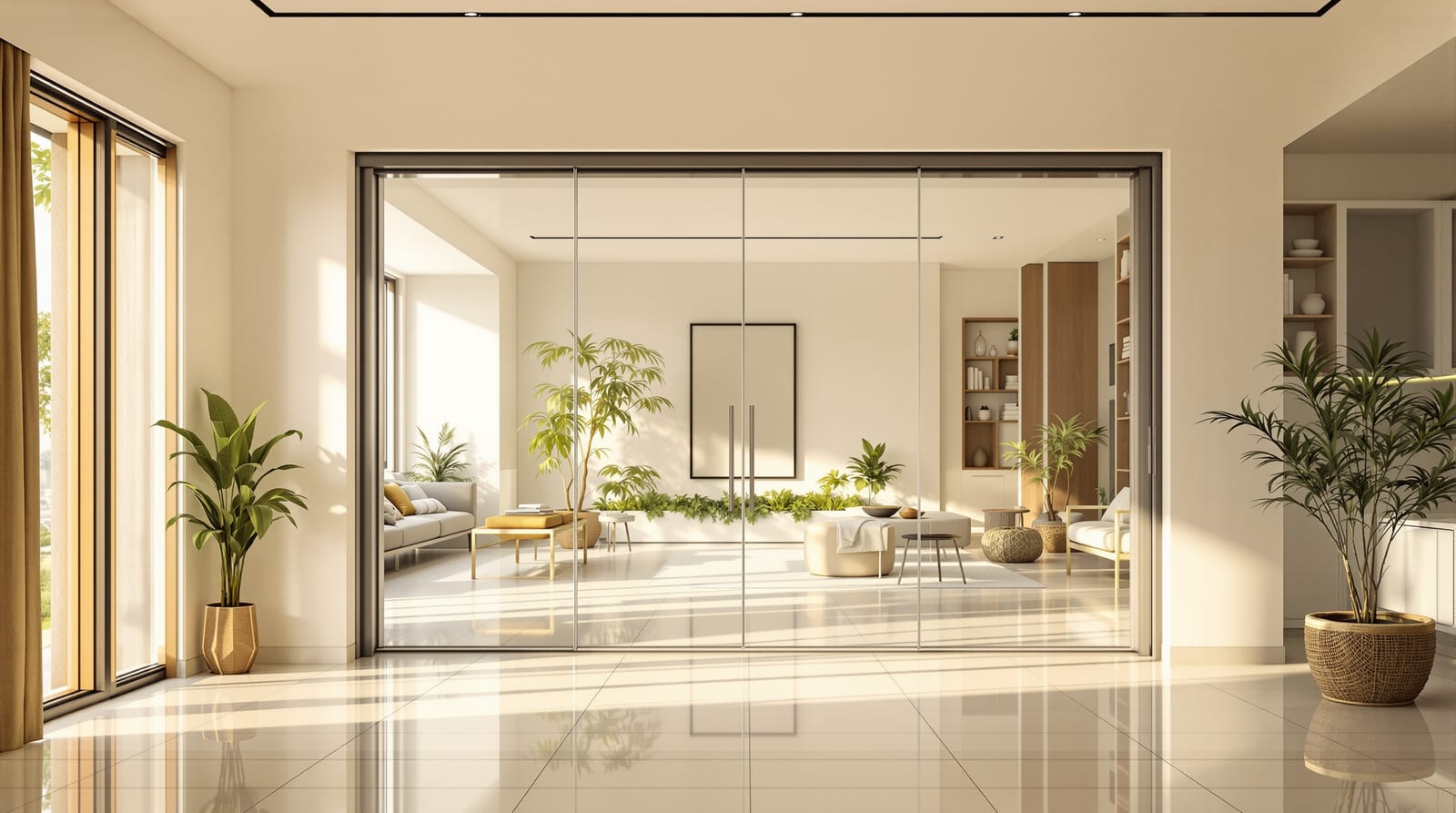
Glass Doors for Indian Homes: Toughened, Laminated, Framed vs Frameless (2026 Guide)
Where glass doors work in Indian homes - balconies, showers, partitions, offices - plus safety glass (IS 2553), privacy options, security, monsoon-proofing and 2026 ₹ costs.
A glass door does something no timber door can: it borrows daylight, makes a small flat feel larger, and visually connects your living room to the balcony or garden. But glass is also the one door material where a wrong choice is genuinely dangerous - ordinary annealed ("window") glass shatters into long dagger-like shards. In an Indian home with children, elderly parents and monsoon-slippery floors, the only correct answer is safety glass to IS 2553, and knowing which type goes where matters as much as the look. This guide covers toughened vs laminated, framed vs frameless, privacy, security, cost and how to keep glass doors working through coastal humidity and heavy rain.
Why (and where) glass doors make sense in Indian homes
Glass doors are not a like-for-like swap for a flush or panel door. You use them deliberately, where transparency, light or a sense of space is the point:
- Balcony / patio / sit-out - sliding or french glass doors connect the living room to outdoor air and light. The single most common residential use.
- Shower enclosures - a toughened-glass shower partition keeps the wet zone contained and the bathroom feeling open; far easier to clean than a shower curtain in our humidity.
- Internal partitions - a glass partition door splits a study, home office or pooja anteroom from the living area without blocking light. Increasingly popular in 2/3 BHK flats where every square foot counts.
- Home offices & cabins - framed or frameless glass doors give acoustic separation while keeping a line of sight (and that "open" feel buyers and clients like).
- Entrance lobbies & shopfronts - frameless "patch fitting" glass doors are standard for clinics, studios and ground-floor offices.
Where glass doors are usually a poor fit: as a main entrance door to a flat or independent house (security and privacy work against it), and in fully exposed positions that take direct driving monsoon rain without an overhang.
The non-negotiable: safety glass (IS 2553)
This is the part most homeowners skip and later regret. IS 2553 (Part 1) is the Indian Standard for safety glass; the National Building Code (NBC 2016) and most municipal norms expect safety glazing in doors and in any glazing near floor level or in wet areas. There are two safe types:
- Toughened (tempered) glass - heat-treated so it is 4-5x stronger than ordinary glass and, when it does break, crumbles into small blunt granules instead of shards. Standard for shower doors, balcony sliders and partitions. It cannot be cut or drilled after toughening - all holes for handles and patch fittings must be made first, so measurements must be final.
- Laminated glass - two (or more) glass panes bonded with a PVB/EVA interlayer; if it breaks, the fragments stick to the interlayer and the door stays in its frame. Better for security and sound, and the type to specify where you want intrusion resistance or acoustic control.
Ordinary annealed float glass is not acceptable in a door. If a supplier offers a cheaper "plain glass" door, walk away. Look for the toughening mark / BIS stamp etched in a corner, and ask for a test certificate on larger jobs.
| Glass type | How it breaks | Typical thickness | Best for | Relative cost |
|---|---|---|---|---|
| Annealed (plain float) | Long sharp shards - unsafe in doors | 4-6 mm | Not for doors | Lowest (avoid) |
| Toughened / tempered | Small blunt granules | 8-12 mm | Showers, balcony sliders, partitions | Moderate |
| Laminated | Cracks but holds together | 6.38-13.52 mm | Security, sound, overhead | Higher |
| Toughened-laminated | Granules held by interlayer | 11.52 mm+ | Premium security + safety | Highest |
Framed vs frameless: the big aesthetic and budget fork
Both are valid; the choice is about looks, budget and the opening.
Framed glass doors sit in an aluminium or uPVC frame (often with a sliding mechanism for balconies). The frame carries the weight, allows thinner glass, improves the weather seal, and costs less. This is the practical, monsoon-friendly default for external openings - balconies, patios, utility - because the frame and gaskets keep water and dust out.
Frameless glass doors use thick (10-12 mm) toughened glass with discreet "patch fittings", pivots or floor springs and no surrounding frame. They look cleaner and more premium and are the standard for shower enclosures, internal partitions and lobby entrances. They cost more, demand precise site measurement, and are less suited to fully weather-exposed external positions.
| Factor | Framed | Frameless |
|---|---|---|
| Look | Defined frame, more "windowy" | Minimal, premium, seamless |
| Typical glass | 5-8 mm in frame | 10-12 mm toughened |
| Weather sealing | Better (gaskets) - good for external | Weaker - best for internal / sheltered |
| Cost | Lower | Higher |
| Best use | Balcony, patio, utility, sliding | Shower, partition, office, lobby |
| Hardware | Frame + rollers/locks | Patch fittings, floor spring, pivots |
For how sliding-glass mechanisms, tracks and rollers actually work, see our deeper sliding doors guide; for the wide double-leaf glazed look onto a garden, see french doors.
Anatomy of a frameless glass door
The fittings do all the work: a frameless door has no frame to screw into, so a top patch and a floor spring (a hydraulic pivot set into the floor) carry the weight and control the swing. The lock patch and handle are pre-cut into the glass at the factory.
Privacy without losing the light
The obvious objection to glass doors in an Indian home - "everyone can see in" - is solvable:
- Frosted / etched glass - acid-etched or sandblasted to a translucent finish; passes light, blocks the view. The default for bathroom and partition doors, and the safest choice for a pooja-room or study door where you want light but seclusion.
- Tinted glass - grey, bronze or blue tints cut glare and afternoon heat on west/south balconies and add daytime privacy.
- Frosted film / decorative film - the budget retrofit; a self-adhesive film converts a clear door to frosted for a few hundred rupees per sq ft.
- Fluted / reeded glass - vertical ridges that blur the view; very popular in 2026 partition designs.
- Smart "switchable" PDLC glass - clear at the flick of a switch, frosted when off. Premium, but a genuine option for a study or guest area.
Pair privacy glass with Vastu-aware placement for internal openings, and remember a frosted glass door still reads as "open" - good for joint-family homes that want connection without full exposure.
Security and monsoon: the two Indian realities
Security. Glass feels vulnerable, and a single sheet of toughened glass can be defeated. For any glass door on the building line (ground-floor balcony, rear utility, office entrance) specify laminated glass - the interlayer resists a break-through far longer and the door stays intact. Add a good multi-point lock or floor-spring lock, and treat a glass main entry as needing a grille or a solid secondary door behind it. See our door security and smart door locks guides for hardware choices.
Monsoon and coast. This is where framed glass doors earn their keep:
- Choose anodised or powder-coated aluminium (or uPVC) frames - mild steel will rust within a season near the coast.
- Insist on EPDM rubber gaskets and a weep-hole drainage detail in sliding-door tracks, or water pools and seeps inside.
- Use stainless steel (SS 304) patch fittings, hinges and handles; cheaper zinc fittings corrode and stain the glass.
- Hard tap water leaves white scale on glass - a balcony door facing rain needs more frequent cleaning than an internal one.
- An overhang or chajja above an external glass door dramatically reduces driving-rain load and leakage.
What glass doors cost in India (2026)
Glass-door pricing is usually quoted per sq ft of the opening, with frame, hardware, toughening and installation bundled or added separately (+18% GST typical). These are indicative ranges and vary by city, brand and glass thickness.
| Glass door type | Indicative cost (2026) | Notes |
|---|---|---|
| Framed sliding glass (aluminium / uPVC) | ₹450-1,200 / sq ft | Balcony / patio default; thicker glass and slim profiles cost more |
| Frameless toughened partition (8-10 mm) | ₹350-700 / sq ft (glass) + fittings | Add patch fittings, floor spring |
| Shower enclosure (toughened, fixed + door) | ₹12,000-40,000+ per enclosure | Depends on size, layout, fittings |
| Frameless office / lobby door (10-12 mm) | ₹700-1,500 / sq ft installed | Floor spring ₹3,000-9,000 each |
| Laminated upgrade | +₹150-400 / sq ft | For security / sound |
| Frosting / etching | +₹60-150 / sq ft | Film is cheaper than factory etch |
| Floor spring (hydraulic) | ₹2,500-9,000 each | Quality matters - cheap ones fail |
| Patch fittings / handles (SS 304) | ₹1,500-8,000 per door | Stainless is the monsoon-safe choice |
A standard 3' x 7' frameless toughened partition door, fully fitted, typically lands around ₹12,000-25,000 including a decent floor spring and handle. A balcony sliding-glass door for a 6' x 7' opening commonly runs ₹20,000-45,000 depending on profile and glass. Estimate your own with our door cost calculator and compare against timber and other materials in the door materials comparison.
Maintenance: keeping glass doors clear and smooth
- Clean with a squeegee and a mild glass cleaner; avoid abrasive scrubbers that scratch. A weekly wipe stops hard-water scale building up.
- Apply a nano / hydrophobic coating on shower and balcony glass - water sheets off and scale forms more slowly.
- Lubricate sliding tracks every few months and clear the weep holes; grit in the track is the number-one cause of stiff sliders.
- Check the floor spring annually - a door that slams or won't self-close usually needs the spring re-adjusted or topped up.
- Re-seal gaskets that have gone hard; perished gaskets are where monsoon leaks start.
- Toughened glass that develops a chip should be replaced - chips can lead to spontaneous breakage. It cannot be ground down or re-cut.
How glass doors fit the rest of your door plan
Glass is one type in a wider toolkit. Most homes use a solid timber or flush main door for security and privacy, then deploy glass selectively for the balcony, bathroom and any internal partition. Browse the full types of doors overview to slot glass into your overall plan, and read how windows and doors work together when a glazed door sits in a larger window wall.
Frequently asked questions
Is toughened glass enough, or do I need laminated?
For showers, internal partitions and most balcony sliders, toughened glass to IS 2553 is the standard and is safe. Choose laminated where security matters (ground-floor or rear doors), where you want better sound insulation, or for any overhead glazing - because laminated holds together when broken.
Are glass doors safe with children and elderly parents at home?
Yes, provided you use safety glass (toughened or laminated, never plain). Add visible markings or a frosted band at eye level so people do not walk into a clear door, keep thresholds low and non-slip, and prefer laminated for full-height clear panels in high-traffic areas.
Do glass doors leak during the monsoon?
A well-detailed framed sliding glass door with EPDM gaskets, working weep-hole drainage and an overhang above it stays dry. Leaks come from missing drainage, perished gaskets or fully exposed positions. Frameless external doors are harder to weatherproof, so they suit sheltered or internal use.
Can I get privacy with a glass door?
Easily - frosted, etched, tinted, fluted or filmed glass blocks the view while keeping the light. For a pooja room, study or bathroom, frosted or fluted glass is the usual choice. Smart switchable glass goes clear-to-frosted on demand if budget allows.
How much does a glass door cost in India in 2026?
Framed sliding glass runs roughly ₹450-1,200 per sq ft of opening; a fitted frameless partition door is around ₹12,000-25,000, and a shower enclosure ₹12,000-40,000+. Add 18% GST, the floor spring and SS hardware. Figures are indicative and vary by city and vendor.
Export this guide
Related Guides — Deep-dive reading
Shower Glass Doors in India: Types, Glass, Sealing & Cost (2026)
Hinged, sliding and walk-in shower enclosures in 8-10 mm toughened glass — how to pick the type for your bathroom, get the water-tightness right, and live with India's hard-water spotting.
Home Doors & EntrancesThe Complete Home Door Guide for Indian Homes (2026): Types, Materials, Cost, Security & Vastu
Everything an Indian homeowner needs to specify the right door for every opening — from main entrance to bathroom — with real 2026 prices, IS/NBC standards and Vastu sense.
Home Doors & EntrancesFrench Doors for Indian Homes: Glazing, Security, Cost & Monsoon Sealing
The double-leaf glazed door that opens a living room to a balcony or garden - where it works, how to specify the glass, frame and seals, what it costs, and how it stacks up against sliding and bi-fold.
Home Doors & EntrancesRelated Tools — Try Free
Window Hardware Cost Calculator
Estimate window hardware cost — hinges, handles, locks, rollers and multipoint gears.
Window CalculatorWindow Cost Calculator
Estimate window price plus installation by type, frame material, size, glass and quantity.
Window CalculatorWindow Grill Design Selector
Pick a window grille style and material by priority — security, looks, budget, view — and estimate cost.
Window Tool