
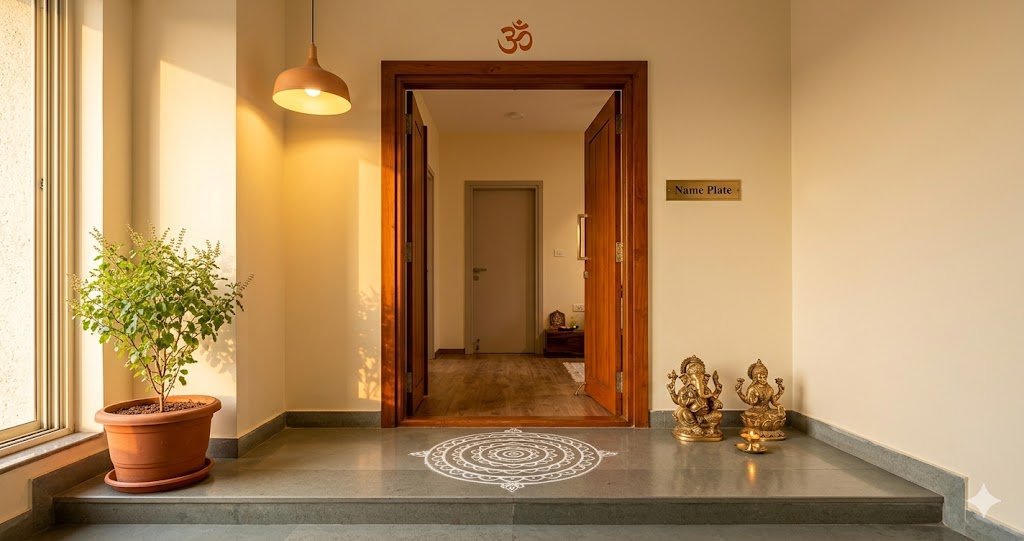
Entrance Vastu — A 2026 Working Reference for Indian Homes
Mukha placement · Eight directions ranked · Apartment-fixed-door remedies
The entrance is the mouth of the home — the Mukha — through which all prana, all fortune, and every guest enters. In the working vocabulary of vastu shastra, no other zone of the apartment carries more weight than the threshold: direction, design, material, light, symbol and daily ritual matter more here than anywhere else inside the four walls. Get the entrance right and everything downstream — kitchen flow, bedroom rest, pooja serenity — settles into place. Get it wrong and the home feels uneasy in ways the occupants struggle to name.
This is a 22-minute working reference for homeowners building, retrofitting or remediating an apartment entrance in 2026 India. It covers the eight cardinal and intercardinal directions ranked for entrance auspiciousness, the eight interior foyer rules that apply regardless of direction, threshold and door specifications, auspicious symbols and decorations, the painful reality of builder-fixed apartment door orientations and what to actually do about them, a three-tier remedy ladder, foyer design for the typical Indian 35-80 sft entry zone, how entrance vastu differs from modern entryway design, when strict adherence stops making sense, and where to go next.
Entrance vastu is the most rescuable vastu issue in the entire apartment. Even a wrongly-placed builder-fixed door — south, west, south-west, the directions vastu traditionally cautions against — can be substantially remedied through interior moves alone: a mirror on the right wall, the right symbol stack at the right height, a colour shift on the door panel, warm pendant light always on after dusk, an auspicious plant at the threshold. You almost never need to break a wall. You almost always need to redesign the foyer.
For complementary depth see Vastu for Modern Homes, Vastu House Plan India, North Facing House Vastu, Vastu for Kitchen, Vastu for Bedroom, Vastu Colors for Home, Staircase Vastu, and Warm Minimal Interiors. Run a full home scan with the Vastu Compliance utility and verify your door direction with the Vastu Compass.
This guide refreshes every 24 months — apartment-vastu interpretation and sourcing leads shift annually. Last verified: May 2026 · Next verify: May 2028.
What Entrance Vastu Is
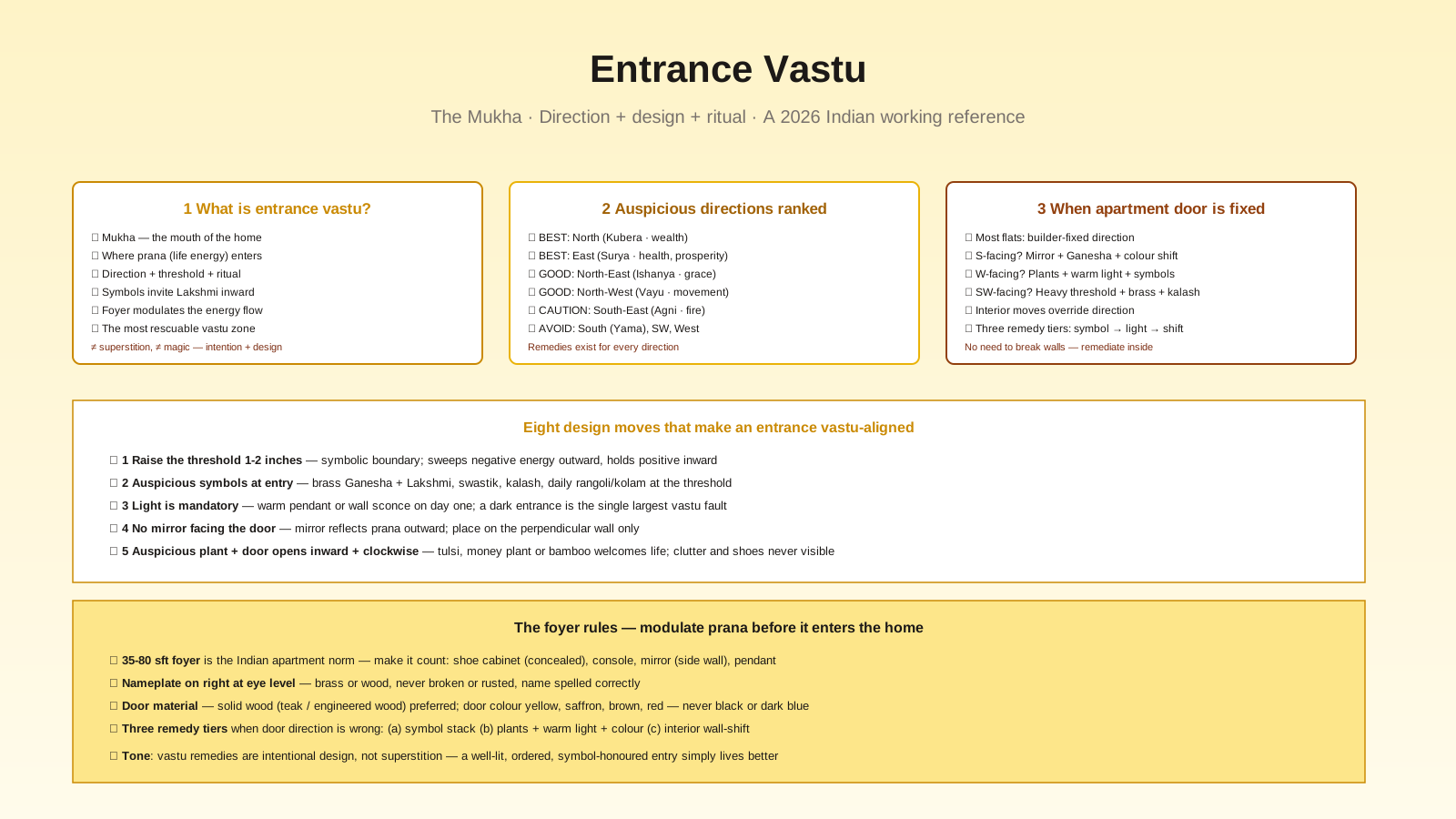
Entrance vastu is the body of guidance in vastu shastra that deals specifically with the main door, the threshold, and the immediate foyer zone of a dwelling. In classical texts — Mayamatam, Mansara Shilpa Shastra, Brihat Samhita, Vishwakarma Vastu Shastra — the entrance is named the Mukha, the mouth, and is treated with the same care a yogic tradition reserves for breath itself: it is where the home inhales the world.
The core idea: the door is a filter and an amplifier. Auspicious energies (prana, Lakshmi, guests, fortune) are invited in; inauspicious energies (kleshas, decay, ill-will) are sent back out. The threshold marks the boundary. The direction the door faces determines which deity presides over what enters. The symbols at the door confirm or deflect what passes. The light, the plant, the cleanliness of the foyer all play their part.
Five things entrance vastu is NOT
1. Not superstition — vastu is a 1,500+ year-old applied environmental philosophy. Many of its rules — light at the entrance, no clutter, raised threshold, no mirror facing the door — turn out to be excellent interior design principles independent of any spiritual frame.
2. Not magic — placing a brass Ganesha will not change your bank balance overnight. Vastu remedies create intentional, ordered, dignified spaces — and intentional spaces support intentional lives. That is the mechanism. The rest is faith.
3. Not optional in an Indian home — even highly secular Indian homeowners observe the threshold rituals (rangoli, namaste at the door, removing shoes outside). The cultural weight is real. Designing against it creates friction.
4. Not a builder's job — most apartment builders treat the entrance as a structural slot. The vastu refinement — the threshold raise, the symbol placement, the foyer console, the light — is the homeowner's responsibility after possession.
5. Not impossible in a flat with a wrong-facing door — the foundational message of this guide. Builder-fixed doors are remediable through interior design.
The Eight Directions Ranked for Entrance Auspiciousness
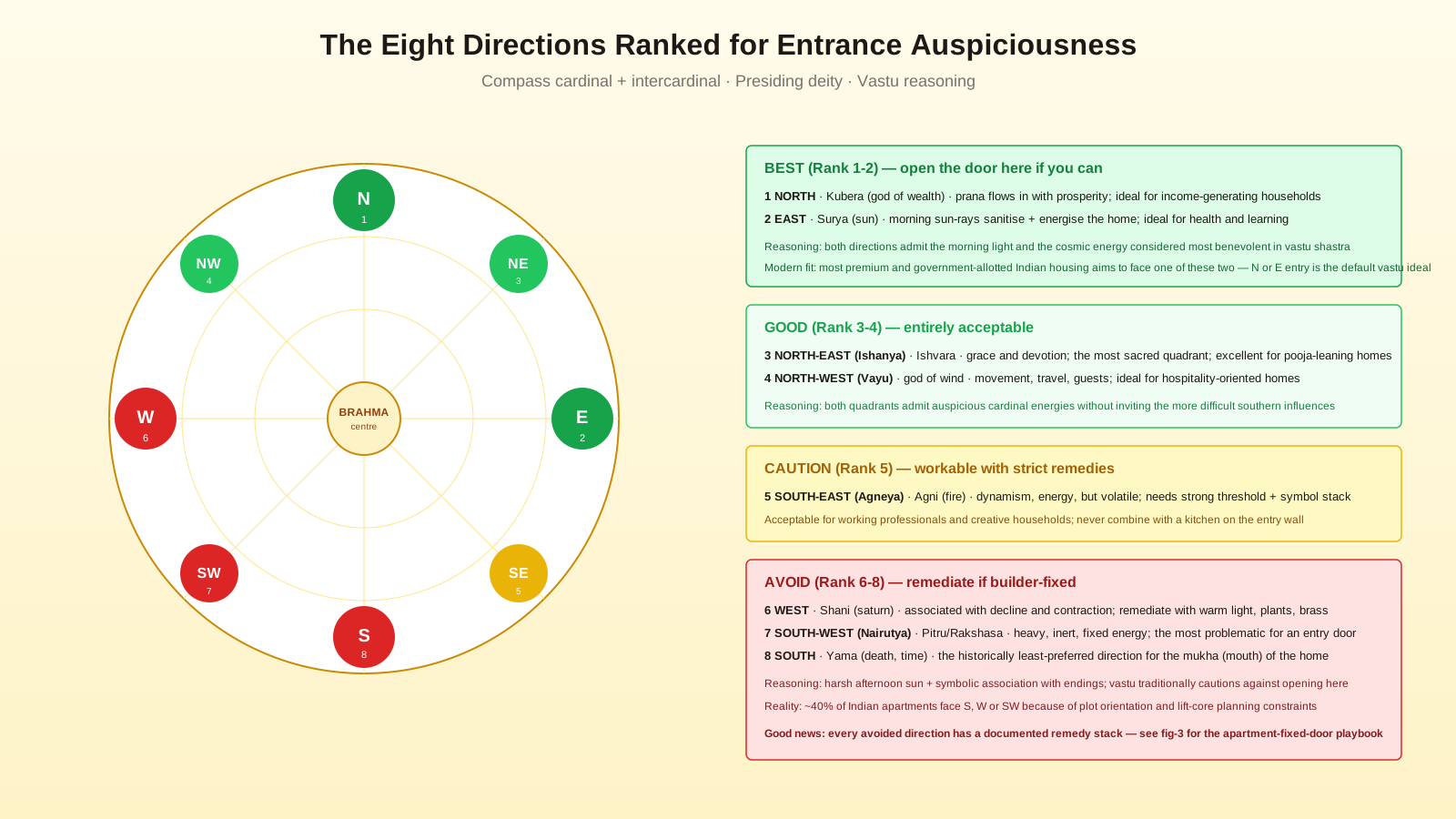
The Indian vastu tradition assigns a presiding deity to each of the eight directions. The entrance door's direction determines which deity presides over what enters the home — and therefore the auspiciousness ranking. The hierarchy below is consistent across Mayamatam, Brihat Samhita and most contemporary practitioner literature (Khushdeep Bansal, Anupama Mohanlal).
The full ranking table
| Rank | Direction | Deity | Element | Verdict | Reasoning |
|---|---|---|---|---|---|
| 1 | North | Kubera | Water | BEST | God of wealth; receives most benevolent cosmic energies; ideal for prosperity |
| 2 | East | Surya | Air | BEST | Morning sun sanitises and energises; ideal for health and learning |
| 3 | North-East | Ishvara | Water | GOOD | Most sacred quadrant; ideal for pooja-leaning, devotional homes |
| 4 | North-West | Vayu | Air | GOOD | God of wind; movement, travel, guests; ideal for hospitality |
| 5 | South-East | Agni | Fire | CAUTION | Dynamic, vital, but volatile; needs strict remedy stack |
| 6 | West | Shani | Earth | AVOID | Saturn-presided; associated with contraction and decline |
| 7 | South-West | Nairutya | Earth | AVOID | Heavy, inert, fixed; most cautioned-against for entry |
| 8 | South | Yama | Fire | AVOID | God of death and time; the historically least-preferred direction |
Why North and East win
The traditional reasoning is partly cosmological — Kubera and Surya are the benevolent givers — but also strikingly practical. North-facing and east-facing apartments receive softer, lower-angle morning sunlight, which has historically been understood (and now confirmed by modern building science) to be antimicrobial, mood-elevating and visually warm without being glare-inducing. The afternoon south and west sun, in the Indian climate, is harsh, hot, and historically associated with energy depletion. The traditional vastu hierarchy is not arbitrary; it is climate-attentive design encoded as religious convention.
Why the South-West is the hardest case
The south-west corner is the Nairutya quadrant, presided over by either the Pitrus (ancestors, in some traditions) or Rakshasa (heavy, fixed energies in others). In classical vastu, this is where the heaviest structural mass of the home should sit — the master bedroom, a storage zone, a heavy wall. Opening a door there is the structural equivalent of leaving the load-bearing wall open: it lets the heaviest energy out and disturbs the home's centre of gravity. This is why a south-west door is the hardest single direction to remediate; the issue is not the deity, it is the structural logic of mass distribution.
The honest reality
About 35-40% of Indian apartments — particularly in older lift-core building plans, narrow plot orientations, and government allotment housing — face south, west, south-west or south-east. Most homeowners cannot select door direction at the time of purchase; the builder, the plot, the lift core, the corridor layout, and the regulatory FSI all over-determine which way the door opens. The right response is not despair; it is interior remediation, which the next sections cover in detail.
The Eight Foyer Interior Rules
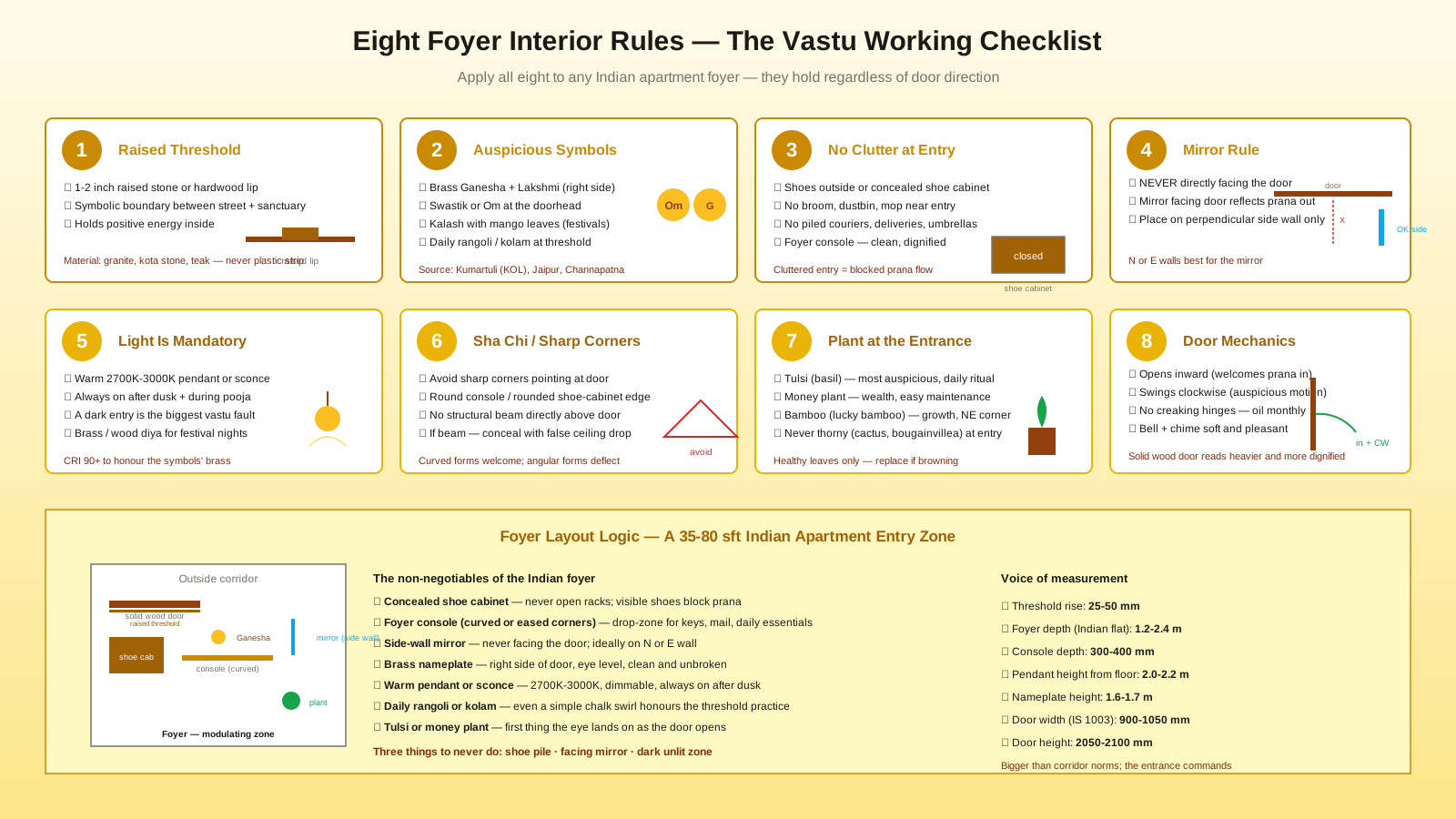
These eight rules apply to every Indian apartment foyer regardless of door direction. They are direction-agnostic vastu hygiene. Apply all eight even if your door already opens to a perfect north or east; ignore them and even a perfect direction will not deliver the calm-and-prosperous home that vastu promises.
The eight rules in full
| # | Rule | Why it matters | Common violation |
|---|---|---|---|
| 1 | Raise the threshold 25-50 mm | Symbolic boundary; sweeps negative energy out, holds positive in | Flush floor between corridor and foyer — pram-friendly but vastu-weak |
| 2 | Place auspicious symbols at entry | Invite Lakshmi inward, deflect ill-will outward | No symbols at all; or broken/chipped Ganesha not refreshed |
| 3 | Never visible clutter at entrance | Blocked prana flow; shoes/shoes/shoes is the single largest fault | Open shoe rack visible from the door; broom and dustbin near entry |
| 4 | Mirror NEVER faces the door | Mirror facing door reflects prana outward; loses fortune | Decorator-style mirror centred on the entrance wall facing the door |
| 5 | Light is mandatory at entrance | A dark entry is the single largest vastu fault per most consultants | Single 5W bulb, off most of the time; or pure daylight reliance |
| 6 | No sharp corners pointing at door | "Sha chi" — angular energy striking the entrance | Square console with sharp-cornered facing the door |
| 7 | Auspicious plant near entrance | Tulsi, money plant, bamboo invite life-energy | Cactus or thorny plant; or dying browning plant left in place |
| 8 | Door opens inward and clockwise | Welcomes prana in; clockwise is the auspicious motion | Door opens outward; or hinges creaking and never oiled |
The discipline test
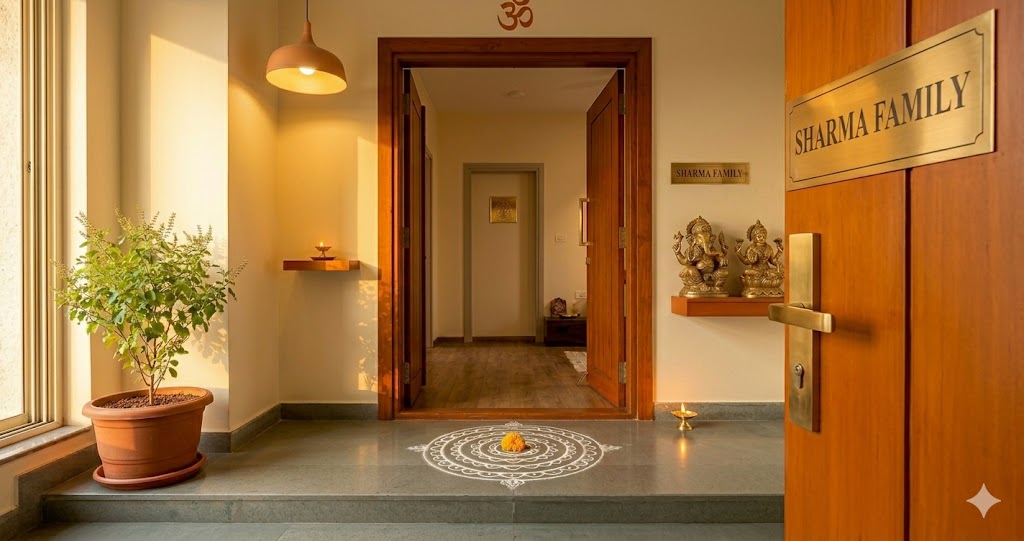
Stand outside your apartment door. Open it slowly. Without entering, look at what is visible in the first three seconds. What do you see? If the answer is shoe pile, dustbin, dim or absent light, broken nameplate, faded paint, cluttered console — you have entrance vastu issues regardless of door direction. If the answer is clean threshold with rangoli, warm pendant casting golden light on a brass Ganesha, a single healthy tulsi plant, an uncluttered console with a folded namaste — you are vastu-aligned regardless of which direction your compass says the door faces.
Threshold and Door Specifications
The threshold (dehali) is treated in vastu shastra as a deity in its own right, often invoked separately during the Griha Pravesh ceremony. The bride entering her marital home traditionally tips a kalash of rice with her right foot across the threshold — this is the dehali ritual. The threshold is not just a structural lip; it is a sacred boundary marker.
Threshold specifications
| Parameter | Spec | Reasoning |
|---|---|---|
| Material | Granite, kota stone, teak hardwood | Solid, dignified, durable; no plastic strip ever |
| Rise above floor | 25-50 mm (1-2 inches) | Symbolic boundary; physical sweep barrier |
| Length | Full door width + 100 mm overlap each side | Visual and ritual completeness |
| Finish | Polished or honed, never rough or unfinished | Speaks of care |
| Care | Wash daily; rangoli or kolam atop | Daily ritual sustains the deity |
Door specifications (per IS 1003 and vastu best practice)
| Parameter | Spec | Reasoning |
|---|---|---|
| Material | Solid teak, engineered wood, sheesham, sal | Mass + dignity + acoustic absorption; never hollow flush |
| Width | 900-1050 mm (per IS 1003) | Generous; the entrance commands more than the corridor |
| Height | 2050-2100 mm | Tall enough to feel ceremonious |
| Opening | Inward, clockwise rotation | Welcomes prana in; auspicious motion |
| Hinges | 3 brass or stainless heavy-duty | No creaking; oiled monthly |
| Lock | Substantial; visible brass or matte black | Speaks of safety; never flimsy |
| Door colour | Yellow, saffron, cream, brown, red, deep wood | Direction-specific; never black or dark blue |
| Doorhead | Toran, Om, swastik, or auspicious motif | Sanctifies the passage |
Why no full-glass main door
A glass-panel main door has become a 2020s design trend (the "showroom apartment" aesthetic), but vastu shastra is unambiguous: the main door is the home's protective shell and must be solid, opaque, materially dignified. A glass main door is visually weak, energetically transparent, and offers no acoustic or symbolic threshold. Use solid wood or engineered wood always; if you want light into the foyer, use a sidelight panel adjacent to the door, not the door itself.
Auspicious Symbols and Decorations
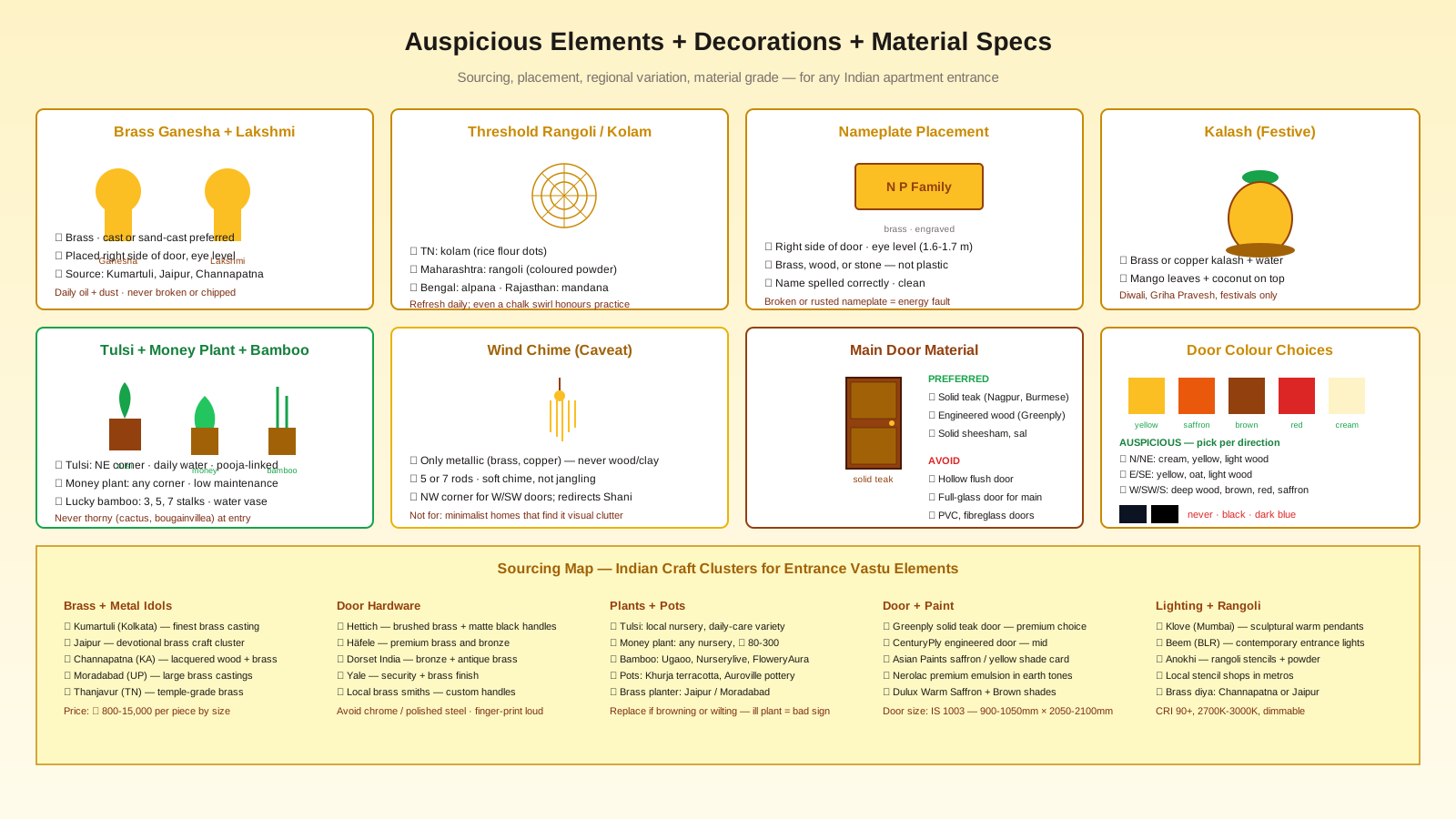
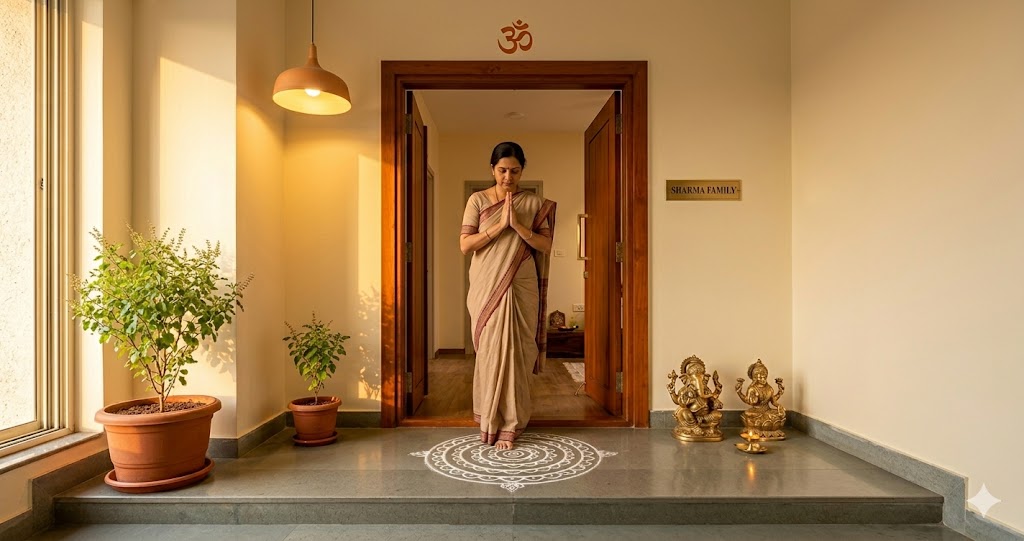
The symbols at the entrance are not decoration — they are the active interface between the home and the world. Each carries a specific meaning, an auspicious placement, and a daily ritual that keeps it alive.
The symbol vocabulary
| Symbol | Meaning | Placement | Care |
|---|---|---|---|
| Brass Ganesha | Remover of obstacles; first invoked | Right side of door, eye level | Daily dust; weekly oil |
| Brass Lakshmi | Goddess of wealth and fortune | Often paired with Ganesha | Daily dust; festival oil |
| Swastik or Om | Sanctifying motif | Doorhead, above the lintel | Repaint annually if faded |
| Kalash with mango leaves + coconut | Festive sanctity (Diwali, Griha Pravesh) | Centre of doorway base | Fresh water + leaves each festival |
| Toran (door garland) | Welcome marker | Across the doorhead | Marigold + mango leaves daily during festivals; brass or fabric toran otherwise |
| Rangoli / kolam | Daily threshold blessing | Outside threshold on floor | Refreshed daily |
| Nameplate | Identity + dignity | Right side of door, 1.6-1.7 m height | Polished monthly; spelled correctly; never broken |
Regional kolam and rangoli variants
| Region | Practice | Material |
|---|---|---|
| Tamil Nadu | Kolam (geometric dots-and-lines) | Rice flour (feeds ants) |
| Andhra | Muggu (similar to kolam) | Rice flour |
| Maharashtra | Rangoli (free-form) | Coloured powder, flowers |
| Bengal | Alpana (curvilinear, ritual) | Rice paste |
| Rajasthan | Mandana (folk geometric) | Chalk, white powder |
| Karnataka | Hasse chitra | Rice flour, chalk |
| Kerala | Pookalam (during Onam) | Flower petals |
A daily kolam or rangoli — even a simple chalk swirl — is one of the most powerful entrance vastu practices, and it costs nothing. It is the embodied practice of the threshold deity.
The plant at the entrance
The auspicious plants are tulsi (holy basil), money plant (Epipremnum aureum), and lucky bamboo (3, 5 or 7 stalks). Each carries specific meaning: tulsi is the most sacred (linked to Vishnu, daily worship), money plant attracts wealth and is forgivingly low-maintenance for apartment conditions, and lucky bamboo represents growth and resilience. Avoid thorny plants (cactus, bougainvillea) at the entrance — thorns symbolically deflect rather than invite. Always replace a wilting or browning plant immediately; an ailing plant at the threshold is read as an inauspicious omen.
The Apartment-Fixed-Door Reality
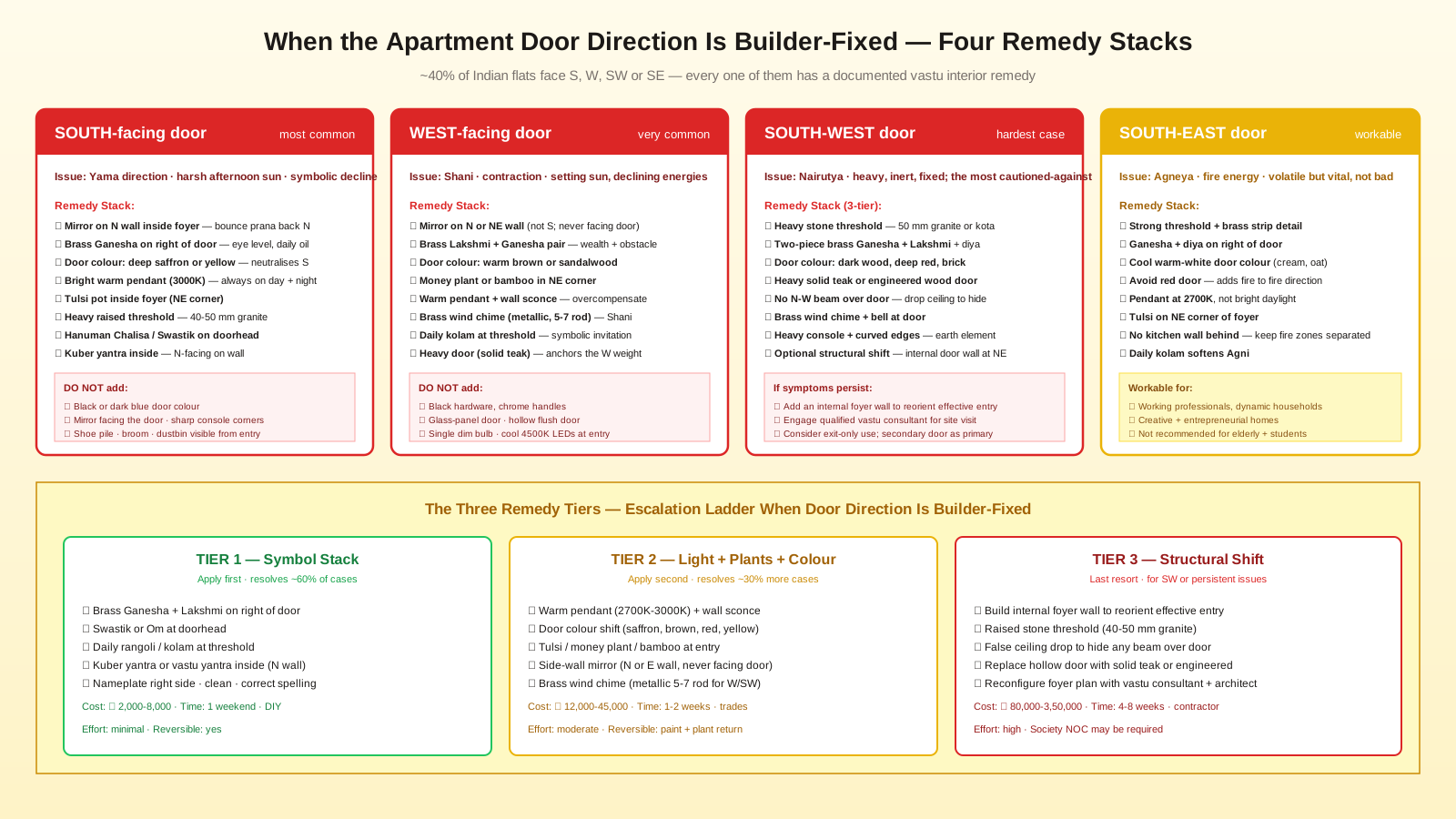
This is the most-asked question we receive on the Vastu Compliance tool: my flat door faces south (or west, or south-west). Should I sell the flat? Should I break the wall? What do I actually do?
The answer in nearly every case is: neither sell nor break. Remediate from inside. Vastu shastra evolved in an era when the homeowner had full control over orientation. Apartment vastu — a 21st-century discipline — must adapt to the reality that the door direction is over-determined by builder, plot, lift core, and regulation. The tradition has responded with a well-developed remedy literature.
Scenario-by-scenario remedies
| Door direction | Issue | Remedy stack (in order) |
|---|---|---|
| South (Yama) | Harsh, declining symbolism | Mirror on N wall · brass Ganesha + Lakshmi · saffron/yellow door · bright warm pendant always on · tulsi in NE foyer corner · 40-50mm granite threshold · Kuber yantra on N wall |
| West (Shani) | Contraction, setting sun | Mirror on N or NE wall · brass Lakshmi + Ganesha · warm brown or sandalwood door · money plant or bamboo in NE · warm pendant + wall sconce · brass wind chime (5-7 rod) · daily kolam · heavy solid teak door |
| South-West (Nairutya) | Heavy, inert, hardest case | All west remedies plus: heavy stone threshold · two-piece brass deities + diya · dark wood door · drop ceiling to hide any beam · brass wind chime + bell · curved console with eased edges · optional internal foyer wall to reorient effective entry |
| South-East (Agneya) | Fire, volatile but vital | Strong threshold + brass strip · Ganesha + diya · cool warm-white door colour (cream, oat) — avoid red · pendant at 2700K not bright daylight · tulsi at NE foyer corner · no kitchen wall behind · daily kolam softens Agni |
What every remediation has in common
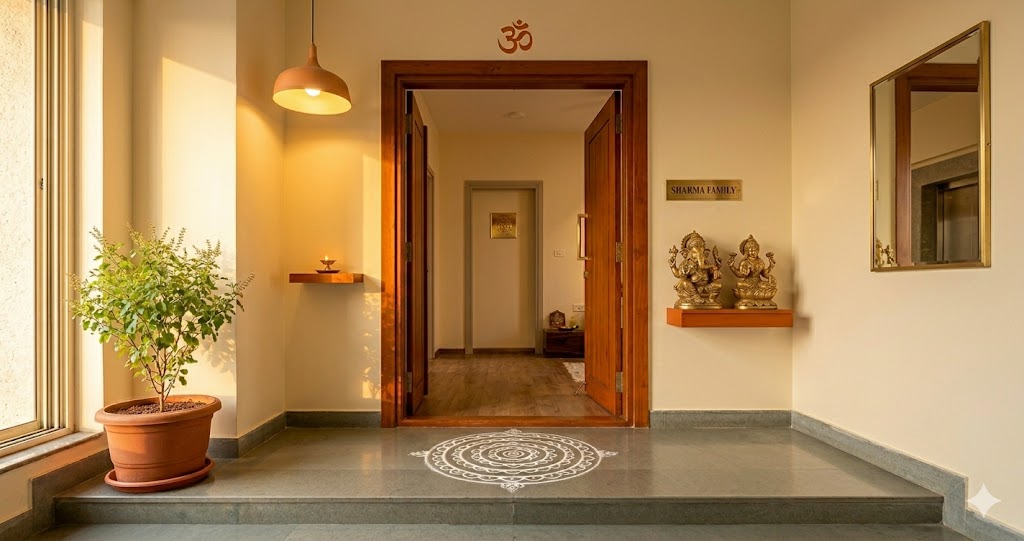
Across every scenario, six remediation moves repeat: (1) a mirror placed on a perpendicular wall (never facing the door, always on a north or east wall when possible); (2) brass symbols on the right side of the door at eye level; (3) a door colour shift to an auspicious direction-appropriate tone; (4) dramatically improved warm-pendant lighting always on after dusk; (5) an auspicious plant at the threshold; (6) a heavier, more dignified threshold and door. These six interior moves resolve the majority of builder-fixed-door cases.
Three Remedy Tiers — The Escalation Ladder
For any apartment with a builder-fixed door in a vastu-cautioned direction, work through the three remedy tiers sequentially. Apply Tier 1 first and observe for 30-90 days; escalate only if symptoms persist.
Tier 1 — Symbol Stack (resolves ~60% of cases)
| Move | Cost | Time | Effort |
|---|---|---|---|
| Brass Ganesha + Lakshmi on right of door | ₹ 1,500-6,000 | Same day | Minimal |
| Swastik or Om at doorhead | ₹ 300-1,500 | Same day | Minimal |
| Daily rangoli or kolam at threshold | ₹ 200/month | 5 min daily | Minimal |
| Kuber yantra on inside N wall | ₹ 500-2,500 | Same day | Minimal |
| Nameplate (brass or wood) on right | ₹ 800-3,500 | One week | Minimal |
| Total Tier 1 | ₹ 2,000-8,000 | One weekend | DIY |
Tier 2 — Light + Plants + Colour (resolves ~30% more cases)
| Move | Cost | Time | Effort |
|---|---|---|---|
| Warm pendant or sconce (2700K-3000K) with dimmer | ₹ 5,000-25,000 | 3-5 days | Electrician |
| Door colour shift (saffron, brown, red, yellow per direction) | ₹ 2,000-6,000 | 1 day | Painter |
| Tulsi / money plant / bamboo at entry | ₹ 500-3,000 | Same day | Minimal |
| Side-wall mirror on N or E wall (never facing door) | ₹ 2,500-8,000 | 1 week | Carpenter |
| Brass wind chime (metallic 5-7 rod, for W/SW) | ₹ 800-3,500 | Same day | Minimal |
| Total Tier 2 | ₹ 12,000-45,000 | 1-2 weeks | Moderate |
Tier 3 — Structural Shift (resolves persistent cases; for SW or severe)
| Move | Cost | Time | Effort |
|---|---|---|---|
| Build internal foyer wall to reorient effective entry | ₹ 35,000-1,50,000 | 3-5 weeks | Contractor |
| Raised granite or kota stone threshold (40-50 mm) | ₹ 8,000-25,000 | 1 week | Mason |
| False ceiling drop to hide beam over door | ₹ 12,000-45,000 | 2 weeks | Carpenter |
| Replace hollow door with solid teak or engineered | ₹ 18,000-90,000 | 2-3 weeks | Carpenter |
| Reconfigure foyer plan (vastu consultant + architect) | ₹ 25,000-1,50,000 fee | 4-8 weeks | Professional |
| Total Tier 3 | ₹ 80,000-3,50,000 | 4-8 weeks | High; society NOC may apply |
The discipline: do not skip tiers. Many homeowners arrive at Studio Matrx asking about Tier 3 structural work when their Tier 1 symbol stack is incomplete or non-existent. Work through the ladder. Most cases resolve at Tier 1 or Tier 2.
The Foyer Design Layer — Indian Apartment 35-80 sft
The Indian apartment foyer is small. Most 2-3 BHKs allocate 35-80 sft to the entrance zone — sometimes a true foyer with three walls, sometimes a notional zone defined only by a rug and a console. Vastu and modern design both demand that this small space carries disproportionate weight.
The foyer working kit
| Element | Spec | Vastu reasoning |
|---|---|---|
| Concealed shoe cabinet | 600 x 300 x 1500 mm, oak or oat laminate | Visible shoes block prana |
| Foyer console (curved or eased edges) | 800-1200 x 300-400 mm | Drop-zone for keys, mail; no sharp corners pointing at door |
| Side-wall mirror | 400-600 mm wide, brass-framed | On N or E wall; never facing door |
| Brass nameplate | 150-250 mm wide, eye-level (1.6-1.7 m) | Dignity and identity |
| Warm pendant or wall sconce | 2700K-3000K, CRI 90+, dimmable | A dark entry is the largest vastu fault |
| Daily kolam zone | 400-500 mm circle outside threshold | Daily ritual sustains threshold deity |
| Tulsi or money plant | 200-300 mm pot, terracotta | Auspicious life-energy at first sight |
The foyer-as-modulator principle
Vastu treats the foyer as a modulation zone — the space where the energy of the world is slowed, filtered, and welcomed before it reaches the inner rooms. A flat with no foyer (direct entry into the living room) is energetically harsh in vastu terms; the prana arrives without preparation. If your apartment has no defined foyer, create one with: (a) a 6-8 ft rug at the entrance defining the zone, (b) a console + shoe cabinet creating a soft visual partition, and (c) a pendant or sconce light defining the volume. The foyer is more a perceptual zone than a structural one.
How Entrance Vastu Differs from Modern Entryway Design
Modern western entryway design — drawn from Scandinavian foyer practice, American mudroom logic, and contemporary minimalism — overlaps with vastu in some moves and diverges sharply in others. Understanding both lets a homeowner blend the two thoughtfully.
| Dimension | Modern entryway design | Entrance vastu | Where they agree |
|---|---|---|---|
| Threshold | Flush, pram-friendly | Raised 25-50 mm | Disagree; vastu prevails |
| Door material | Often glass-panel for light | Solid wood mandatory | Disagree; vastu prevails |
| Door colour | Any contemporary palette | Direction-specific auspicious palette | Some overlap (warm tones) |
| Mirror placement | Often facing door for spatial expansion | Never facing door | Disagree; vastu prevails |
| Lighting | Layered, warm | Always on, warm, mandatory | Strong agreement |
| Shoe storage | Concealed cabinet | Concealed cabinet | Strong agreement |
| Decluttering | Marie Kondo logic | No clutter at entry | Strong agreement |
| Plant at entry | Optional aesthetic move | Auspicious mandate | Modern allows; vastu specifies |
| Symbols / icons | Optional, secular if any | Specific brass deities | Disagree; vastu prevails |
| Nameplate | Often subtle or absent | Brass, eye-level, right side | Disagree; vastu specifies |
The big takeaway: on most non-symbolic moves (lighting, decluttering, shoe storage, console form), vastu and modern design agree. Vastu is more specific and more directive on the symbolic moves (threshold, deity placement, mirror rule, door material, door colour). A homeowner can comfortably blend both — keep the modern minimalist console form, but follow vastu on the threshold height, the deity placement, and the mirror rule.
When Strict Vastu Adherence Doesn't Make Sense
This guide takes vastu seriously as a working framework — but seriously is not the same as uncritically. Strict adherence is unhelpful in several situations:
- When the door direction is non-negotiable and your interior remedies are working. If you have applied Tier 1 + Tier 2 remedies, your home feels good, and the household is thriving — that is the goal. Do not pursue Tier 3 structural shifts on principle alone.
- When ritual practice conflicts with accessibility. A raised threshold of 50 mm can be a falls risk for an elderly parent or a wheelchair user. Vastu was written before universal-design standards; in these cases, a brass strip threshold (5-10 mm rather than 25-50 mm) is the right adaptation. The ritual symbolism is preserved; the trip hazard is removed.
- When the symbol stack feels performative rather than felt. If you do not feel reverence toward brass Ganesha + Lakshmi, the symbols become decoration rather than practice. Pick the practices that resonate (the daily kolam, the warm pendant, the plant at the threshold) and leave the others. Vastu without intention is just clutter.
- When the household is multi-faith. A Muslim, Christian, Sikh, Jain, Parsi or atheist household member may not be comfortable with Hindu deity placement at the entrance. Vastu's structural moves (light, threshold, mirror rule, plant, door material) work without any religious symbol stack. Adapt accordingly.
- When the cost of remediation exceeds the household's means. Vastu is not a tax. If the choice is between a Tier 3 remediation and your child's education or a parent's healthcare, prioritise the latter. The Tier 1 symbol stack costs under ₹ 8,000 and is sufficient for most apartments.
The core message: vastu is a working framework for creating intentional, ordered, dignified spaces. It is not a religious obligation, and it is not a guarantee of fortune. Use it as design discipline, not as superstition. The well-lit, well-ordered, symbol-honoured entrance simply lives better — independent of any spiritual claim.
Where to Go Next
- For the full home-vastu framework — Vastu for Modern Homes
- For plot and floor-plan vastu — Vastu House Plan India
- For the north-facing house specifically — North Facing House Vastu
- For kitchen vastu adjacent to entrance — Vastu for Kitchen
- For bedroom vastu — Vastu for Bedroom
- For door and wall colour palettes — Vastu Colors for Home
- For staircase vastu (duplex apartments) — Staircase Vastu
- For warm-minimal aesthetic at the entrance — Warm Minimal Interiors
- Run a full home compliance scan — Vastu Compliance utility
- Verify your door direction precisely — Vastu Compass utility
References
1. Acharya, P. K. (1934). Architecture of Mansara — Mansara Shilpa Shastra. Oxford University Press. (Classical Sanskrit text on vastu and craft.)
2. Acharya, P. K. (1995). Mayamatam — Treatise of Housing, Architecture and Iconography (2 vols). Indira Gandhi National Centre for the Arts. (Foundational vastu text with entrance and threshold prescriptions.)
3. Varahamihira (6th c. CE, modern trans. Bhat 1981). Brihat Samhita. Motilal Banarsidass. (Classical astrological treatise with vastu chapters; deity-direction system.)
4. Acharya, P. K. (1979). Vishwakarma Vastu Shastra. Oriental Books Reprint. (Vishwakarma tradition; door and threshold specifications.)
5. Bansal, Khushdeep (2014). Vastu — A Path to Harmonious Living. Penguin India. (Contemporary practitioner reference; entrance remediation literature.)
6. Mohanlal, Anupama (2018). The Vastu Workbook — Practical Vastu Shastra. Penguin Random House India. (Apartment-vastu adaptation; mirror, plant, threshold rules.)
7. Bureau of Indian Standards (1991). IS 1003 (Part 1) — Specification for Timber Panelled and Glazed Shutters — Door Shutters. BIS, New Delhi. (Door dimensional standards.)
8. Bureau of Indian Standards (2005). IS 4021 — Specification for Timber Door, Window and Ventilator Frames. BIS, New Delhi.
9. Hardy, A. (1995). Indian Temple Architecture — Form and Transformation. Indira Gandhi National Centre for the Arts. (Regional temple-entrance vocabulary; doorhead motifs.)
10. Kramrisch, S. (1946). The Hindu Temple (2 vols). Motilal Banarsidass. (Threshold-as-deity tradition; sacred entrance theory.)
11. Too, Lillian (1998). Lillian Too's Easy-to-Use Feng Shui — 168 Tips for a Healthier, Wealthier and Happier Life. Element Books. (Feng-shui-vastu adaptation literature for apartments; mirror, plant, colour.)
12. Wong, Eva (1996). Feng Shui — The Ancient Wisdom of Harmonious Living for Modern Times. Shambhala. (Comparative threshold and entrance theory.)
13. Ministry of Housing and Urban Affairs (2016). National Building Code of India — Part 3 Development Control Rules and General Building Requirements. BIS, New Delhi. (Statutory door and entrance specifications.)
14. Patra, R. (2014). Town Planning in Ancient India — In Moral Perspective. The International Journal of Humanities & Social Studies, Vol 2(6). (Academic treatment of vastu in town planning.)
Author's note: I have spent the last decade working with Indian homeowners on vastu remediation in apartments. The single most consistent observation is this: the homes that feel best are not the ones with perfect compass orientation; they are the ones whose owners have taken the entrance seriously. A warm pendant light always on after dusk. A daily kolam at the threshold. A brass Ganesha that is dusted and oiled with the rest of the weekend cleaning. A healthy tulsi plant that gets watered before the morning tea. A door that opens cleanly without creak. None of these are expensive; all of them communicate care; together they make a home that any guest can feel as soon as they cross the threshold. Vastu, stripped of mysticism, is the discipline of creating that home.
Disclaimer: Vastu shastra is a traditional Indian framework for built-environment design. The directional rankings, deity associations, symbol placements and remediation strategies in this guide are drawn from classical texts and contemporary practitioner literature. They are presented respectfully and as a working design reference, not as a guarantee of material outcomes. The remedies described are about creating positive, intentional, dignified spaces — not about magical effects. Studio Matrx encourages homeowners to engage with vastu as design discipline, to adapt it thoughtfully for multi-faith and universal-access households, and to consult qualified vastu practitioners for site-specific Tier 3 structural remediation. Studio Matrx, its authors and contributors are not responsible for procurement, ritual, or interpretation outcomes based on this guide.
Export this guide
Related Guides — Deep-dive reading
Designing Adaptable & Universal-Design Homes
Accessibility, Aging-in-Place, and the Multi-Stage Family — Code, Anthropometrics, and Plan-Stage Discipline for Indian Residential Architects
Room PlanningNorth-Facing House Vastu — A 2026 Working Reference for Indian Homes
Kubera direction · Seven-pillar advantage · Internal layout decides the win
VastuVastu for Bedroom — A 2026 Working Reference for Indian Homes
Bed direction · Room allocation · Five non-negotiable rules
VastuRelated Tools — Try Free
Cross-Ventilation Analyzer
Estimate airflow and air changes per hour (ACH) from room size, window areas, layout, and local wind — with NBC 2016 Part 8 compliance check.
Ventilation CalculatorVastu Shastra Compliance Checker
Score your home across 21 Vastu criteria with a weighted score, compliance band, and remedial guidance.
Vastu ScoringVastu Window Planner
Vastu guidance for window placement and size by wall direction and room — rating and remedies.
Vastu