
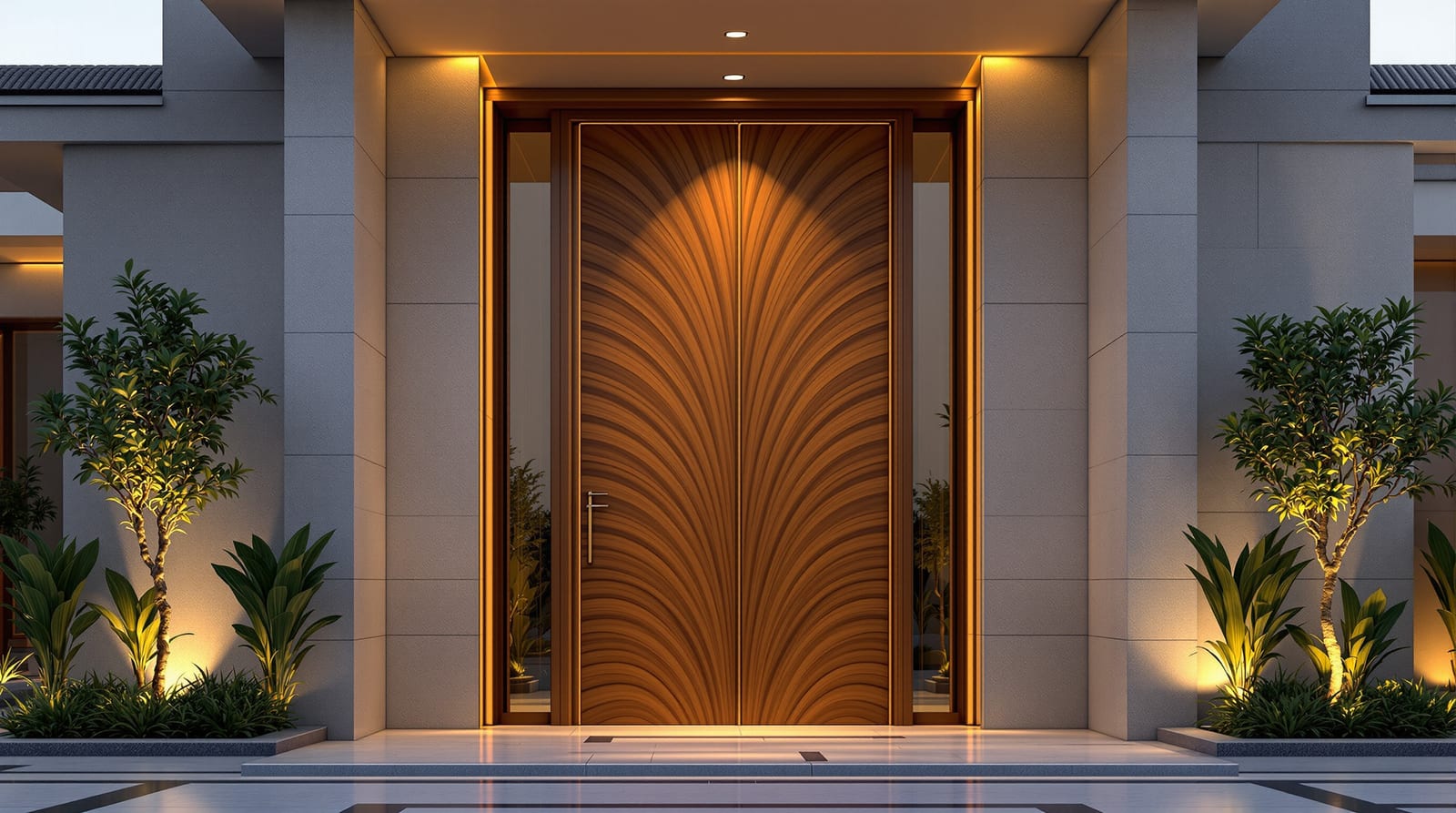
Pivot Doors in India: The Luxury Statement Entrance (Mechanism, Cost and Pitfalls)
How a pivot door works, why it lets you hang an oversized leaf, what teak or metal-clad statement entrances actually cost in 2026, and the weather and security details Indian homes must get right.
Walk up to a new architect-designed bungalow in Bengaluru, Hyderabad or Gurugram and the front door tells you the budget before you cross it. A pivot door - a single, oversized leaf that swings on a top-and-bottom pivot instead of side hinges - is the entrance equivalent of a double-height ceiling: it is doing a structural job, but mostly it is making a statement. Nothing else reads as "this house was designed, not just built" so instantly. It is also one of the easiest doors to get badly wrong, because the very things that make it dramatic - the size, the weight, the slim reveals - are the things that fail when the monsoon, the dust and a casual local fabricator get involved.
This guide is the honest version: how a pivot door actually works, why the mechanism lets you hang a leaf no ordinary hinge could carry, what it costs in 2026 rupees, and the weather, security and installation details that separate a pivot door that glides for twenty years from one that sags and scrapes in two.
What a pivot door is - and what it is not
An ordinary door hangs from two or three hinges screwed to one edge, so it rotates about that edge. A pivot door instead turns on a vertical axis carried by a pivot set: a load-bearing pin and bearing at the top (in the frame head) and a heavy-duty unit at the bottom - usually a floor spring set into the floor, or a concealed bottom pivot if the closing is handled elsewhere. The leaf rotates about that axis, which can sit on the edge (an "offset" pivot, looking much like a normal door) or set in from the edge (a "centre" pivot, where a sliver of the door swings backward as the rest swings forward).
The key consequence: the load of the leaf goes down into the floor and up into the frame head, not sideways into the jamb through screws. That is why a pivot can carry a leaf that would tear ordinary hinges out of their frame - leaves 1100-1500 mm wide, 2400-3000 mm tall, 50-80 mm thick, weighing 80-200 kg or more. A pivot door is not a "type of material" - it is a way of hanging a door, and you can hang teak, veneered flush, metal-clad, or even glass leaves this way.
It is also not the same as a floor-spring glass door at a shop entrance, even though they share the floor-spring hardware. The residential pivot we mean is a solid, insulated, lockable statement leaf at the boundary of a home - so it must do the security and weather jobs a shopfront door never has to.
The mechanism, drawn
The pivot set is the whole story. Here is what sits above and below an offset pivot leaf:
The floor spring does three jobs at once: it carries part of the weight, it controls the closing speed (hydraulic damping, so the heavy leaf does not slam), and it can hold the door open at 90 degrees. Specify it by load rating and leaf width - a good unit (Dorma, Hafele, Geze, Ozone, Hardwyn and similar brands sell residential-grade floor springs) is rated for the leaf you are hanging; under-rating it is the single most common cause of a pivot door that drops and scrapes within a year.
Why people choose a pivot door
- Scale. It lets you hang a genuinely oversized leaf - the proportions a tall double-height entrance lobby asks for - without a clumsy second leaf or sidelight.
- The swing. A heavy leaf on a well-set floor spring moves with a slow, weighty, expensive feel. It is theatrical, and that is the point.
- Clean lines. Hardware is concealed (no visible hinges), reveals are slim, and the leaf can be a single unbroken plane of teak, veneer, fluted timber, brass or weathering steel - perfect for a modern or minimalist facade.
- Design freedom. Centre-pivot leaves can be very wide because the load is balanced about the axis, opening up dramatic 4-5 ft single doors that ordinary hinges cannot sustain.
Where pivot doors belong (and where they do not)
A pivot door is, almost by definition, a main-entrance door in a premium or modern home: independent bungalows, large villas, farmhouses, design-led apartment penthouses, and the lobby doors of boutique hotels and offices. It rewards a sheltered, generous entrance - a porch, a recessed portico, a covered foyer - both for drama and for weather protection.
It is the wrong choice for almost everything else. Internal rooms do not need it and cannot justify the cost or the floor work. A small, unsheltered, street-facing flat door is a poor candidate: the centre-pivot version leaves a permanent gap on the hinge side that is hard to weather-seal and easy to peer through, and the sheer mass is wasted on a 3 ft opening. For ordinary internal openings, a flush door or panel door is right; where you want drama without the cost, a solid teak main door on good hinges gives most of the presence for a fraction of the hardware grief.
What a pivot door costs in India (2026)
A pivot door is the most expensive way to hang a leaf in the house, and the leaf itself is often the smaller part of the bill - the floor work, the imported floor spring and the precision installation add up fast. The figures below are indicative shutter-plus-hardware costs for 2026 and vary widely by city, leaf material, size and vendor; treat every number as a range, not a quote.
| Item | Indicative 2026 cost | Notes |
|---|---|---|
| Veneered/engineered pivot leaf (mid) | ₹40,000-90,000 | Block-board or engineered core, veneer or laminate face, standard oversize |
| Solid teak / CP-teak pivot leaf | ₹90,000-2,00,000+ | Premium timber, carved or fluted, large format |
| Metal-clad / brass / steel pivot leaf | ₹1,00,000-3,00,000+ | Fabricated, insulated core, bespoke finish |
| Frosted/laminated glass pivot leaf | ₹60,000-1,50,000 | Toughened + laminated; lower security, more for internal lobbies |
| Floor spring (residential, load-rated) | ₹6,000-25,000 | Dorma/Hafele/Geze/Ozone; price tracks the load rating |
| Top pivot + concealed hardware set | ₹4,000-15,000 | Bearing, patch fittings, pivot pin |
| Lock + full-height handle | ₹8,000-40,000 | Multi-point lock or smart lock + bespoke pull |
| Installation / floor cutting / alignment | ₹5,000-20,000 | Skilled, precise; floor spring box must be cast/cut level |
| Frame / structural sub-frame | ₹6,000-25,000 | Often steel sub-frame for a heavy leaf |
Add the typical 18% GST on materials and hardware. Realistically, an installed residential pivot main door lands between ₹70,000 and ₹3,00,000+, with most aspirational-but-sane builds in the ₹1,00,000-2,00,000 band. For a structured view across all door types and budgets, see the door cost guide for 2026 and main door cost guide; to compare against a conventional carved entrance, the teak door cost guide.
How a pivot door compares with the alternatives
| Pivot door | Solid/teak hinged main door | Double (french-style) entrance | |
|---|---|---|---|
| Maximum leaf size | Very large (1100-1500 mm wide) | Limited by hinges (~1000-1200 mm) | Two leaves spread the width |
| Visual statement | Highest - the signature modern entrance | High, especially carved teak | High, symmetrical, classical |
| Hardware visible | Concealed (clean lines) | Hinges visible | Hinges + meeting astragal |
| Floor work needed | Yes - floor spring set in slab | No | No |
| Weather sealing | Harder (centre pivot leaves a gap) | Easier (full jamb seal) | Moderate (two seals + centre) |
| Security | Good if leaf + lock + frame are strong | Very good | Lower (two leaves, centre weak point) |
| Installed cost | Highest (₹70k-3L+) | High (₹25k-1.5L) | High (₹40k-2L pair) |
| Best for | Modern/luxury main entrance, sheltered | Any main entrance, traditional or modern | Living-to-garden, grand symmetrical entry |
The honest summary: a pivot door buys you scale and drama and costs you money, floor work and sealing difficulty. If your entrance is sheltered and your budget is real, it is worth it. If not, a heavy hinged teak door gives most of the presence without the hardware risk.
The details Indian homes must get right
Weather and the monsoon
This is where pivot doors disappoint people. An offset pivot can be weather-stripped almost like a normal door and is the safer choice for any opening that sees rain or dust. A centre pivot leaves a gap on the hinge side as the leaf rotates - dramatic, but a path for driven rain, dust and insects unless the door is well recessed under a porch. Three rules for Indian conditions:
- Put a pivot door under a porch or deep portico. Direct exposure to monsoon and west sun is the enemy of both the timber and the floor spring.
- Choose materials that move little: engineered/block-board cores, WPC or metal-clad leaves resist swelling far better than a solid plank of un-seasoned timber. Solid teak is fine if properly seasoned and finished, but a single huge solid timber leaf is the one most likely to warp - many premium pivot leaves are engineered cores with a teak or veneer face for exactly this reason. Compare core behaviour in the door materials comparison and the engineered-wood lifecycle costing guide.
- Detail a drained, sealed floor-spring box. Standing water around the floor spring rusts and seizes it; the box must shed water and the spring should be a corrosion-resistant grade, especially on the coast.
Floor and structure
The floor spring is cast or cut into the slab, so it has to be planned before the final floor finish goes down - retrofitting one into a finished marble or wooden floor is messy and expensive. A heavy leaf also wants a rigid sub-frame (often steel) so the top pivot bearing does not work loose. Levelling matters more than on any other door: a floor spring set even slightly out of plumb makes a 150 kg leaf drift open or closed on its own.
Security
A big door is not automatically a secure door. The centre-pivot gap, the floor-spring cut-out and the lack of a continuous jamb on one side can all be weak points if ignored. Specify a multi-point lock (or a quality smart lock) that throws bolts into head and floor, an offset pivot for a sealable, lockable edge on exposed entrances, and a solid insulated core rather than a hollow one. The leaf, lock, frame and fixing must all be strong - read the door security guide before you finalise. A pivot main door pairs naturally with a video door system given the kind of home it usually fronts.
Size and accessibility
Pivot leaves are usually well above the NBC 2016 main-door norm of 1000-1200 mm wide x 2100 mm tall - that is part of the appeal - so clear width is rarely a problem; a 1100 mm+ leaf comfortably exceeds the ~800-900 mm clear opening recommended for wheelchair access in the RPwD Harmonised Guidelines 2021. Watch the threshold instead: keep the floor-spring cover plate flush and any sill under about 12 mm so the entrance stays step-free. For the full size and clearance picture see the door size standards guide.
Pivot doors and Vastu
Vastu Shastra speaks to the placement and behaviour of the main door, not its mechanism - so a pivot door can sit perfectly within Vastu intent. The tradition favours a main door in the north, east or north-east, made the largest in the house, opening inward and clockwise, with a threshold (dehleez) and an even, auspicious feel. A pivot door is already the largest, grandest leaf in the home, which aligns with the spirit of "the main door should dominate." The cautions are practical: a centre-pivot leaf does not open cleanly "inward" in the classical single-direction sense, so if inward, clockwise opening matters to you, choose an offset pivot configured to open inward. Treat all of this as tradition plus sensible reasoning - a large, well-placed, welcoming main door is genuinely better - and cross-check the dedicated entrance Vastu guide and Vastu main door guide before committing.
Buying and maintaining a pivot door
Buy the hardware first, leaf second: a beautiful teak slab on an under-rated floor spring is a door that will sag. Insist on a load-rated floor spring matched to the leaf, an installer who has fitted pivots before (not a general carpenter improvising), and a sub-frame strong enough for the weight. Get the floor work into the construction schedule early. Once installed, the maintenance is light but specific: have the floor spring's closing speed and hold-open adjusted yearly, keep the box drained, re-oil or re-coat the leaf finish on schedule, and watch for any drift that signals the spring needs servicing. For where the pivot door sits among all the other choices, the types of doors guide maps the full set, and the home doors complete guide ties the cluster together; for the hardware itself, the door hardware guide.
Frequently asked questions
How much does a pivot door cost in India?
Indicatively, an installed residential pivot main door runs from about ₹70,000 to over ₹3,00,000 in 2026, with most realistic builds between ₹1,00,000 and ₹2,00,000. The leaf, the load-rated floor spring, the floor work and the precise installation are all significant line items - and 18% GST applies on materials and hardware. See the main door cost guide for the full breakdown.
What is the difference between an offset pivot and a centre pivot?
An offset pivot sits near the edge of the leaf, so the door looks and seals much like a normal hinged door - the safer choice for exposed or street-facing entrances. A centre pivot sits in from the edge, so a sliver of the door swings backward as the rest swings forward, allowing very wide leaves and a more dramatic look, but leaving a gap that is harder to weather-seal and secure.
Are pivot doors good for the monsoon and Indian weather?
They can be, with care. Use an offset pivot, put the door under a porch or portico, choose an engineered, WPC or metal-clad core that resists swelling, and detail a drained, corrosion-resistant floor-spring box. An exposed centre-pivot leaf in solid un-seasoned timber is the combination most likely to warp, leak and seize.
Is a pivot door secure enough for a main entrance?
Yes, if specified properly: a solid insulated leaf, a multi-point or smart lock that bolts into head and floor, an offset pivot for a sealable lockable edge, and a rigid frame and fixing. The size alone does not make it secure - read the door security guide and consider a video door system.
Can I retrofit a pivot door into an existing home?
It is possible but awkward, because the floor spring must be set into the slab - cutting it into a finished marble or wooden floor is messy and expensive, and a heavy leaf usually wants a steel sub-frame. Pivot doors are far easier and cheaper to plan into a new build or a major renovation than to retrofit later.
Export this guide
Related Guides — Deep-dive reading
The Complete Home Door Guide for Indian Homes (2026): Types, Materials, Cost, Security & Vastu
Everything an Indian homeowner needs to specify the right door for every opening — from main entrance to bathroom — with real 2026 prices, IS/NBC standards and Vastu sense.
Home Doors & EntrancesDouble Doors in India (2026): Two-Leaf Entrances, Proportions, Hardware & Cost
When a double-leaf door makes sense for Indian main entrances, pooja rooms and master suites, plus active/inactive leaf hardware, the Vastu note on even panels, security at the meeting stile and the rupee premium over a single door.
Home Doors & EntrancesReinforced Wooden Doors in India (2026): Making the Timber Main Door Actually Secure
A homeowner's decision guide to choosing or upgrading the wooden main or flat door most Indian homes actually have, so it genuinely resists a break-in, without pretending a hollow flush door is secure.
SecurityRelated Tools — Try Free
Door Cost Calculator
Estimate the all-in cost of a door — leaf, frame, hardware, fitting and GST — by type, material and size.
Door CalculatorDoor Material Comparison Tool
Compare 2–4 door materials on cost, durability, maintenance, security and moisture resistance.
Comparison ToolDoor Security Rating Calculator
Score your main door out of 100 across leaf, frame, lock and hardware — and see the top upgrades.
Security Tool