
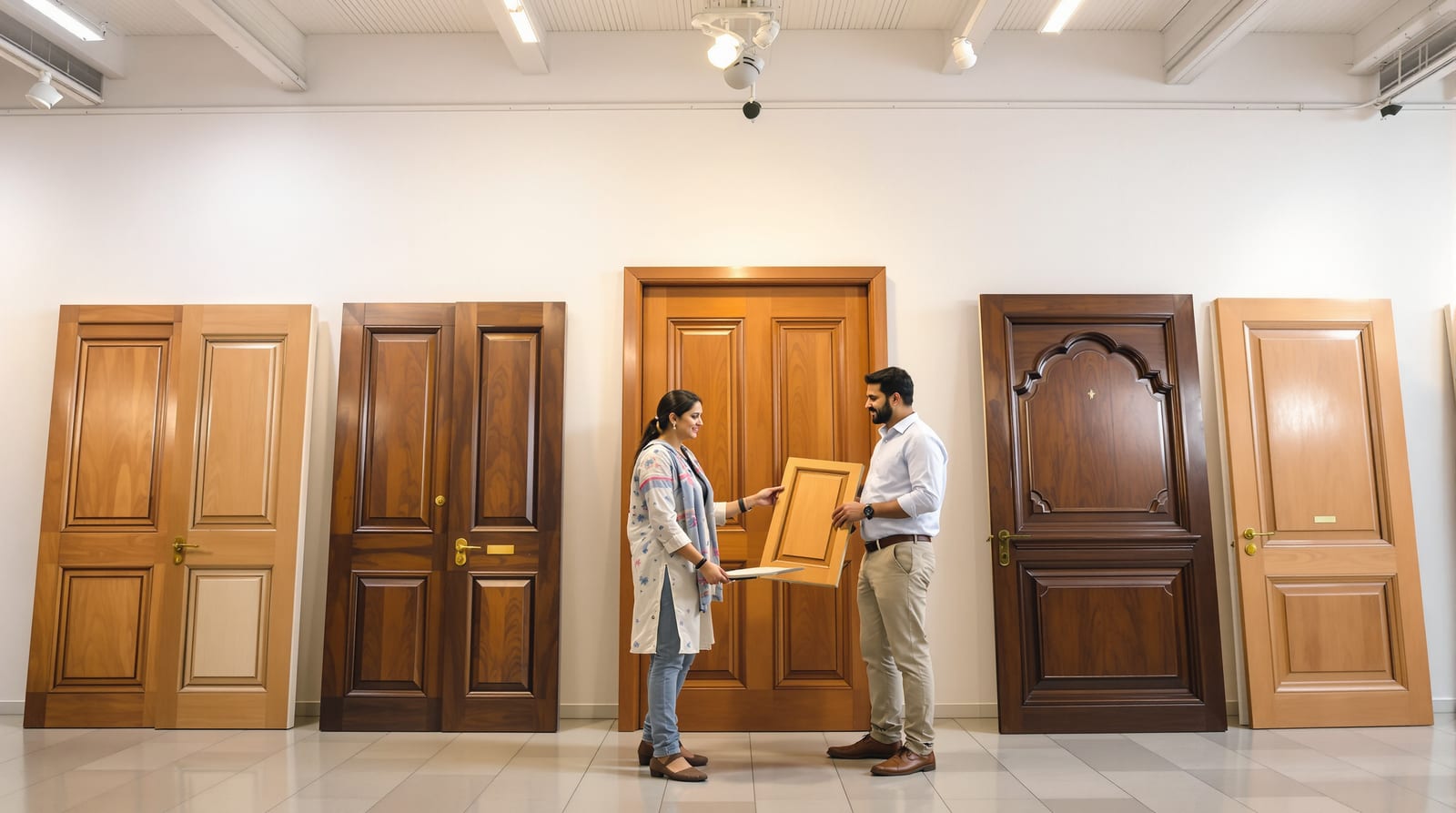
Homeowner's Door Buying Guide (India): What to Check, What to Pay, What to Avoid
A no-nonsense buying guide for Indian homeowners — local carpenter vs branded factory door, what to inspect before you pay, a quote checklist, GST, warranties, installation and the scams to dodge.
A door is one of the few things you buy once and live with for fifteen to thirty years, yet most Indian homeowners decide it in five minutes — on the carpenter's word, or on whichever shutter looks "solid" in the showroom. That is exactly where money leaks and regrets begin: a hollow shutter sold as solid, a "teak" frame that is rubberwood, a quote that hides the frame, hardware and labour until the bill lands. This guide is the homeowner's playbook — how to choose between a local carpenter, a branded factory door and a custom unit, what to physically inspect before you pay, a line-by-line quote checklist, and the GST, warranty and installation traps that catch first-time buyers.
First decide: carpenter, factory-made, or custom?
Almost every door in India comes from one of three routes, and each suits a different buyer. The cheapest is not always the best value once you count rework, swelling in the monsoon, and the carpenter's vanishing warranty.
| Route | Best for | Typical quality | Price signal | Warranty reality |
|---|---|---|---|---|
| Local carpenter (on-site / panel built) | Tight budgets, odd sizes, repairs, matching old work | Highly variable — depends entirely on the individual | Often cheapest on paper | Usually verbal only; hard to enforce |
| Factory-made / branded (flush, WPC, moulded) | Bedrooms, kitchens, bathrooms, bulk needs | Consistent, IS-tested cores, machine-pressed | Mid; clear per-shutter price | Written, 1-15 yrs; honoured if you keep the bill |
| Custom / carpenter-craft (carved teak main door) | Statement main door, heritage look | Excellent if the artisan is good | Highest | Depends on artisan reputation |
A practical rule used by many designers: buy factory-made for everything routine (bedroom, bathroom, kitchen, utility) where you want predictable IS-grade quality and a real warranty, and spend on a carpenter or specialist only for the main door where craft and impact matter. Mixing routes is normal and smart. For the full type-by-type and material-by-material picture before you buy, start with the complete home door guide and the how to choose doors decision guide.
Why "carpenter is cheaper" can be false economy
An on-site carpenter quoting "₹3,000 for a bedroom door" is often quoting only the shutter — the frame (chowkat), hinges, handle, lock, finishing and his own labour come on top, and the wood is whatever is in the timber yard that week. A factory flush door at ₹2,500-4,000 arrives kiln-dried, machine-pressed and IS 2202 tested for resistance to delamination and swelling. In a Mumbai or Kochi monsoon, an under-seasoned carpenter door can swell, jam and need planing within one rainy season; a properly cured factory shutter usually does not.
What to physically inspect before you pay
Whether you are in a showroom or watching a carpenter, your hands and eyes catch most problems. Run this check on the actual shutter you will receive, not a sample.
- Tap test for core: knock across the shutter face. A solid or block-board core sounds dull and even; a cheap hollow/cellular core sounds drummy and echoes near the centre. A "solid wood" door that sounds hollow in the middle is not what you are paying for. (See solid vs hollow-core doors for what each is legitimately good at.)
- Lift it: a genuine solid wood or block-board flush door is noticeably heavy. A featherweight "premium" door is a hollow shell.
- Edges and lipping: the four edges should have a continuous hardwood lipping (border), not exposed core or thin veneer wrapped over filler. Press the corners — they should not flex.
- Faces flat and square: sight along the surface for bow or twist. Place it against a flat reference; a bowed shutter never closes cleanly.
- Veneer/laminate finish: look for bubbles, lifting at edges, mismatched grain, or glue squeeze-out. On natural veneer, check it is real wood, not a printed laminate sold at veneer prices.
- Moisture / seasoning: ask if timber is kiln-seasoned (moisture ~10-12%). Unseasoned wood is the No.1 cause of later warping and cracks in Indian conditions.
- Termite/borer: inspect for pinholes or powder, especially on cheaper softwood frames. Insist on a treated frame in coastal and humid belts.
- IS marking and brand stamp: factory flush doors should carry the maker's stamp and reference IS 2202 (Pt 1); panelled/glazed shutters relate to IS 1003 and frames to IS 4021. Steel door frames follow IS 4351, FRP shutters IS 14856. No marking on a "branded" door is a red flag.
- Frame (chowkat) match: confirm the frame timber, section size and that it is treated and primed on all faces — including the hidden back face that touches the wall, where rot usually starts.
The quote checklist (get every line, in writing)
The single most useful thing you can do is force the seller to itemise. A "₹4,000 per door" headline almost always omits half the cost. Ask for each line below, per door, on the quotation — then compare vendors line by line, not on the bottom number.
| Line item | What to confirm | Indicative cost (varies by city/vendor) |
|---|---|---|
| Shutter (door leaf) | Type, core, size, finish, IS reference | Flush ₹1,200-4,000; veneered/designer ₹4,000-9,000; teak main ₹25,000-1,50,000+ |
| Frame / chowkat | Material, section size, treated, primed | Sal/teak ₹350-900 per running foot; WPC/steel frames cheaper, more uniform |
| Hinges | Quantity (3-4 per door), SS vs MS, brand | Part of ₹1,500-8,000 hardware bundle |
| Handle / knob | Type, finish, brand | Within hardware bundle |
| Lock | Mortise/cylindrical/rim; main vs internal grade | Internal ₹500-2,500; main door ₹2,500-8,000+ |
| Door stopper, tower bolt, peephole, magic eye | Included or extra | A few hundred ₹ each |
| Installation / fitting labour | Per door, includes alignment & sealing | ₹800-3,000 per door |
| Finishing (polish/paint) | Coats, melamine/PU/paint, who does it | Quoted separately if not pre-finished |
| Transport & loading | Free or charged | Often a hidden add |
| GST | 18% on most doors & hardware — see below | Add ~18% |
| Warranty | Written, duration, what it covers | Get the certificate |
If a vendor refuses to itemise, treat the whole quote as suspect. A genuine seller has nothing to hide in a per-line breakdown. For ground-truth numbers per type and material, cross-check against the door cost guide and main door cost guide, and use the door cost calculator and material comparison tool before you commit.
GST, invoices and why the "cash rate" costs you more
Most wooden doors, flush doors, WPC/uPVC doors and door hardware attract 18% GST. Vendors often quote a lower "cash, no-bill" rate to skip it — and many homeowners take it. Three reasons not to:
- No bill = no warranty. Branded factory warranties (often 1-15 years on flush/WPC doors) are honoured only against a tax invoice. A cash deal voids your strongest protection.
- No bill = no recourse. If the door warps, delaminates or the lock fails, a consumer complaint needs an invoice. Without it you have nothing.
- The "saving" is often illusory. Cash rates frequently bundle in inferior cores or skip seasoning, so you pay in rework. Insist on a GST invoice with the HSN code, vendor GSTIN, item description and warranty noted.
When you compare two quotes, make sure both are GST-inclusive (or both exclusive) before judging the cheaper one — an 18% gap is exactly the size of one full tax line.
Warranties: read what they actually cover
A "10-year warranty" sounds reassuring until you read the exclusions. Branded flush and WPC doors commonly warrant against borer/termite attack, delamination and manufacturing defects — but typically exclude: damage from water-logging or improper sealing, doors not finished/painted within a stated period, on-site cutting that breaches the core, and poor installation by a third party. Practical points:
- Get the warranty certificate, not a verbal "company guarantee," and staple it to your GST invoice.
- Confirm whether installation by the vendor is required to keep the warranty valid — many are.
- For carpenter-made doors, ask for at least a written note covering warping and joint failure for 12 months; verbal assurances are unenforceable in practice.
- Finish the door promptly. An unpolished/unpainted shutter left exposed in a humid monsoon is the most common warranty-voiding mistake.
Installation: where good doors go bad
A well-made door fitted badly will jam, sag or whistle drafts within months. Installation quality matters as much as the door. Insist on:
- Frame fixed plumb and square, properly anchored to the wall, with the gap packed and sealed (no daylight, no rot path behind the frame).
- 3-4 hinges on internal doors, 4 on heavy main doors, mortised flush — not surface-screwed at an angle.
- Even reveal gap all around (about 3 mm sides/top) and a small bottom clearance; the door should swing and latch without forcing.
- Threshold/sill kept low (≤ ~12 mm) so it is not a trip hazard — important for elders and anyone using a wheelchair; see accessible doors.
- Correct hand and swing — confirm which way the door opens before fitting; main doors traditionally open inward and the leaf should be the largest in the home (see the main door design guide and, for direction and threshold tradition, entrance Vastu).
Get sizes right at the order stage, not after the frame is in. Standard openings are roughly main door 1000-1200 mm × 2100 mm, bedrooms 900 × 2100 mm, bathrooms 700-750 × 2000-2100 mm — the door size standards guide and the door size calculator cover this in full.
Scams and traps to avoid
The door trade has a handful of recurring tricks. Knowing them is most of the defence.
- "Solid wood" that is hollow-core. Tap and lift before you believe the label.
- "Burma teak" that is rubberwood or plantation timber. True teak is heavy, oily, with tight straight grain; ask for the species in writing on the invoice. Verify against the teak wood doors guide.
- Laminate sold as natural veneer. Printed laminate repeats its grain pattern; real veneer does not. Price the difference.
- The frame omitted from the quote so the headline looks cheap, then added later.
- Undersized hinges/hardware on heavy doors — they sag within a year.
- "Free fitting" that means a rushed, out-of-plumb install. Tie part of the payment to a satisfactory fit-and-finish check.
- Advance fully paid up front. Keep a meaningful retention (say 20-30%) until the door is installed, aligned, finished and inspected.
- No-bill cash rate — as above, it strips your warranty and recourse.
Budget tiers: what to expect at each level
Prices are indicative and vary by city, timber rates and vendor; treat them as ranges, not quotes. All exclude or note GST as flagged.
| Tier | Per internal door (shutter + frame + basic hardware + fitting) | Main door (installed) | What you get |
|---|---|---|---|
| Value | ~₹4,000-8,000 | ₹15,000-30,000 | WPC/flush shutter, WPC or treated softwood frame, basic SS hardware, branded internal lock |
| Mid | ~₹8,000-15,000 | ₹30,000-60,000 | Veneered/designer flush or panel door, seasoned hardwood frame, quality hinges & mortise lock |
| Premium | ~₹15,000-30,000+ | ₹60,000-1,50,000+ | Solid/teak or carved main door, custom frame, brand hardware, smart lock option |
A common sensible split for a typical 2-3 BHK: spend at the mid-to-premium tier on the main door (security, first impression, durability — see door security and smart door locks), and at the value-to-mid tier on bedrooms and bathrooms using factory flush or WPC doors. WPC is especially worth it in bathrooms and coastal homes because it does not swell, rot or attract termites — see WPC doors. For the right material per opening overall, the door materials comparison and best door material guide lay out the trade-offs.
A quick anatomy of what you're paying for
The diagram below shows where the money sits in a single door — it is never just the shutter.
Frequently asked questions
Is a factory-made door better than a carpenter-made one?
For routine internal doors, usually yes — factory flush and WPC doors are kiln-dried, machine-pressed, IS 2202 tested and come with a written warranty, so quality is predictable. A skilled carpenter can match or beat them for a custom main door, but quality depends entirely on the individual and the timber, and the "warranty" is typically verbal. A common approach is factory-made for bedrooms, bathrooms and kitchens, and a carpenter or specialist only for the showpiece main door.
Should I pay cash to save GST on a door?
No. Most doors and hardware carry 18% GST, and skipping the bill strips you of your warranty and any consumer recourse if the door fails. The "saving" is often offset by an inferior, unseasoned product. Always insist on a GST invoice with the vendor's GSTIN, item description, HSN code and warranty noted.
How do I check if a "solid wood" door is genuine?
Tap across the face — solid and block-board cores sound dull and even, while hollow cores sound drummy near the centre. Lift it; genuine solid wood is heavy. Check that all four edges have continuous hardwood lipping rather than exposed filler, and ask for the timber species in writing on the invoice. For teak, look for heavy weight, oily feel and tight straight grain.
What should the quote include besides the door?
Per door: the shutter, the frame (chowkat), hinges, handle, lock, door stopper and other fittings, installation labour, finishing/polish, transport, GST and the written warranty. If a vendor will not itemise these, treat the quote as incomplete — the headline "per door" price almost always hides the frame, hardware and labour.
How much should I budget for a complete door, installed?
Indicative and varies by city: a value internal door (shutter, frame, basic hardware, fitting) runs about ₹4,000-8,000; mid about ₹8,000-15,000; premium ₹15,000-30,000+. A main door installed ranges from roughly ₹15,000-30,000 at the value end to ₹60,000-1,50,000+ for solid or carved teak. Spend more on the main door and keep internal doors economical with factory flush or WPC shutters.
Export this guide
Related Guides — Deep-dive reading
The Complete Home Door Guide for Indian Homes (2026): Types, Materials, Cost, Security & Vastu
Everything an Indian homeowner needs to specify the right door for every opening — from main entrance to bathroom — with real 2026 prices, IS/NBC standards and Vastu sense.
Home Doors & EntrancesCustom vs Ready-Made Doors: Buyer's Guide India 2026
Factory ready-made, made-to-order from a brand, or carpenter-built on site — costs, lead times, fit and warranty compared for Indian homes.
Home Doors & EntrancesDoor Installation Cost in India 2026: Fitting Labour ₹ Per Door + Hardware, City Variance & GST
A focused 2026 guide to what it actually costs to fit a door in India — carpenter labour per door for flush, panel, heavy main and sliding shutters, plus hinges, mortise lock, tower bolt and closer hardware ₹ ranges, with worked bedroom and main-door totals.
Home Doors & EntrancesRelated Tools — Try Free
Door Material Comparison Tool
Compare 2–4 door materials on cost, durability, maintenance, security and moisture resistance.
Comparison ToolDoor Cost Calculator
Estimate the all-in cost of a door — leaf, frame, hardware, fitting and GST — by type, material and size.
Door CalculatorBefore vs After — Cost Reality Check
Compare what you expected to pay vs what you actually paid, category by category.
Reality Check