
 Lesson 5.4
Lesson 5.4 · Region & Vernacular
Rajasthan, Goa & the North-East
A desert haveli, a Portuguese-era Goan house and a North-East bamboo village each answer their own climate and culture - and the North-East adds a model this whole module has not shown yet: the community, not the owner, hosts.
A Rajasthan haveli, a Goan house and a North-East bamboo home share almost no materials and agree on one thing - build for the place you are actually in, not the place you wish you were.
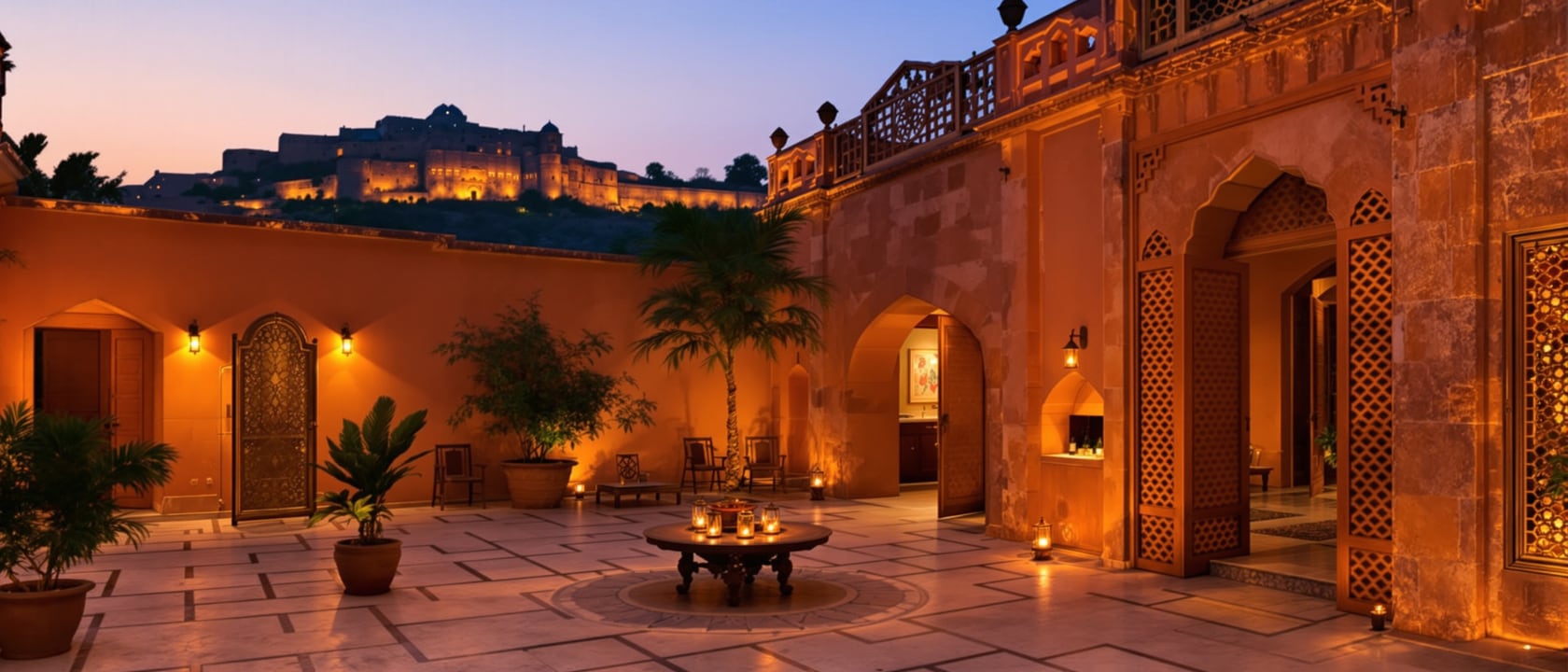
Nowhere does India's climate and culture range wider than across these three regions in a single lesson. In Rajasthan, the problem is a desert's brutal daily swing - blistering daytime heat and surprisingly cold nights - answered by the thick-walled, courtyard-centred haveli, its stone jaali screens and projecting jharokha windows working together without a single moving part. In Goa, the problem is a wet, salty, monsoon-heavy coast, answered by the Indo-Portuguese house with its breathable laterite walls, louvred wooden shutters instead of sealed glass, and the balcao - a covered porch that is as much a social institution as a building feature. And across the North-East's hill states, the problem is relentless rainfall and often difficult, damp or flood-prone ground, answered by bamboo construction raised on stilts, a material and a method developed over generations of actually living with this specific land.
The North-East adds something else this module has not shown yet: in many of its most celebrated homestay villages, it is not one family renting out a spare room, but a whole village operating a shared, community-based tourism model - a tourism committee, rotating host families, and benefit-sharing arranged at the community level rather than purely by individual owners competing with each other. This lesson walks through all three regions' passive-design answers to their own climate, then closes by asking the question this entire module has been building toward: which region, which guest and which season are actually yours, and how does your own building already answer the brief your climate handed it?
A jaali, a shutter and a stilt floor are the same idea three times over: let the place you are actually in tell you how to build.
Rajasthan: cooling a desert haveli without machines
A desert climate's defining challenge is not simply heat, it is the diurnal swing - daytime temperatures that can be genuinely extreme alongside night-time temperatures that drop sharply, sometimes by 15-20 degrees Celsius in a single day. The traditional haveli answers this primarily through sheer thermal mass: walls built thick in sandstone, lime-plastered brick or similar heavy masonry absorb the day's heat slowly and release it slowly after dark, which is precisely why a haveli's inner rooms can feel genuinely cool at 3pm and comfortably warm, not cold, well after midnight - the wall is simply running several hours behind the outside temperature at every point in the cycle.
The courtyard, present in almost every substantial haveli, does additional work: it creates a shaded, planted or water-cooled microclimate at its centre, and as warm air rises and exits above it, cooler air is drawn in from the surrounding rooms, producing a gentle, continuous circulation without any mechanical assistance. The jaali - a perforated stone or carved sandstone screen, often extraordinarily intricate - does three jobs simultaneously that a plain wall or glazed window cannot: it filters and diffuses the harsh desert sun into a soft, dappled light; it maintains the privacy expected in Rajasthan's traditional domestic architecture, particularly around women's quarters historically; and it still allows a breeze to pass through, unlike a solid wall.
The jharokha - a projecting, often ornately carved balcony window - extends a room's opening outward beyond the main wall line, catching airflow at a slightly different height and angle than a flush window would, while also throwing useful shade onto the wall below it and giving residents a vantage point over the street or courtyard without stepping fully outside. A haveli homestay room done well should lean into, not against, these features: keep jaali screens functioning rather than sealing them behind glass for a 'cleaner' look, and treat the courtyard as the building's lungs, never as spare land for an extra structure. A heritage haveli room, particularly one with real family history behind it, can command genuinely high rates - commonly ₹6,000-12,000 a night in well-known heritage circuits - precisely because this depth of story and craft cannot be manufactured by any amount of new capital.
Goa: the Portuguese house and the monsoon coast
Goa's climate problem is almost the inverse of Rajasthan's: not a dry desert swing but sustained warmth, high humidity and a genuinely heavy monsoon, roughly June to September, that any building here must actively shed rather than merely tolerate. The Indo-Portuguese house that defines much of Goa's heritage housing stock answers this with laterite - the same reddish, porous stone found in Kerala - prized for local availability and for breathing moisture out rather than trapping it inside the wall, a genuinely important property given how much rain and humidity the material must cope with over a typical year.
Windows traditionally use louvred wooden shutters rather than sealed glass, which is a deliberate, climate-smart choice many renovations get wrong by 'upgrading' to glazing: shutters can be angled to let air move through even while closed against driving rain, something a sealed glass pane simply cannot do, and they also protect against salt-laden coastal air that can corrode metal fittings faster near the sea. Roofs are typically tiled and sloped to shed the monsoon's volume efficiently, continuing the same shed-and-shade logic this entire module keeps returning to in different materials.
The balcao - a covered porch, usually with built-in stone or masonry seating, at the front of the house - is as much a cultural institution as a climate feature. It is traditionally where a Goan household would sit, greet neighbours and watch the street go by, and in a homestay it becomes the natural guest-welcome space: the first thing a guest experiences on arrival, shaded and ventilated, well before they reach an actual guest room. A renovated Goan village house that keeps its balcao, its laterite walls breathing under a lime wash rather than sealed paint, and its shutters working rather than replaced with glass, sells an authentic slice of Indo-Portuguese coastal life that a new-build villa, however well-appointed, cannot genuinely replicate - echoing, once again, Module 1's home-host-story premium.
The North-East: community, bamboo and a different ownership model
Across the North-East's hill states - Meghalaya and Nagaland are two of the better-known examples for homestay tourism - the climate problem is relentless rainfall (parts of Meghalaya rank among the wettest places on earth) combined with often steep, damp or flood-prone terrain. The traditional answer, refined over generations, is bamboo construction raised on stilts or a timber-and-bamboo plinth: lifting the living floor well above ground level keeps it clear of standing water and damp, allows air to circulate underneath the structure and reduce moisture buildup in the floor itself, and historically offered some protection from pests and small animals that a ground-level floor would be more exposed to. Bamboo itself, when properly treated and detailed, is a genuinely strong, fast-growing, locally abundant material, not the 'primitive' or temporary material it is sometimes mistakenly assumed to be by visitors unfamiliar with the tradition.
What distinguishes much of North-East homestay tourism from the rest of this module, though, is not the building material but the ownership and hosting model. In several celebrated homestay villages, the enterprise is organised at the community level rather than purely as competing individual businesses: a village tourism committee coordinates bookings, rotates hosting duties or income among multiple families, and manages shared infrastructure and benefit-sharing collectively. This is a genuine expression of community-based tourism, a recognised model in sustainable tourism more broadly, and it changes the practical shape of 'becoming a host' in these regions - an individual owner may be joining and contributing to an existing community system rather than building an entirely independent business from zero, with real implications for how registration, pricing and guest allocation actually work locally.
A homestay guest coming to the North-East is typically drawn by precisely this combination: genuine, living culture and community rather than a performance staged for tourists, striking natural landscapes, and a sense of participating in something collectively run rather than purchasing a purely private, individually branded stay. An owner or prospective host in this region should approach any existing village tourism committee or cooperative structure early and honestly, understanding it as a partner and a framework to work within, not an obstacle to route around.
Each region, its guest and its season
Pulling the three regions together alongside this module's earlier Coorg, Himachal and Kerala lessons, a clear pattern emerges: every region's passive-design answer and its tourism calendar are two expressions of the same underlying climate, and an owner who reads both honestly prices and markets far more effectively than one who copies a generic national assumption. Rajasthan's heritage and history-focused guest typically travels October to March, avoiding the genuinely punishing heat of May and June; a desert haveli that leans into its jaali-and-courtyard cooling can extend its comfortable season a little further than a sealed modern hotel room would, but the extreme pre-monsoon months remain a real low point worth planning around rather than fighting.
Goa's beach-and-coastal-life guest peaks November to February, with the June-to-September monsoon a genuine quiet period for most of the coast - though, echoing Kerala's lesson, a smaller niche of storm-watching and monsoon-season travellers has grown in parts of Goa, and a homestay with a working balcao and reliably dry, breathable rooms is well placed to serve them if it chooses to market for that specific guest rather than simply closing for the season. The North-East's guest, drawn by community, nature and culture rather than beach weather, typically finds October to April the most accessible window, with the heavy June-to-September monsoon genuinely limiting road access and travel comfort across much of the hill terrain, a constraint a village tourism committee usually already plans its collective calendar around.
The closing idea for this entire module is simple and worth carrying into every later design and pricing decision in this course: there is no single 'correct' homestay look or season, only the one your actual region, climate and community have already worked out, usually over far longer than any individual owner's lifetime. Module 6 now turns from the building's relationship with its climate and region to the practical fit-out, essentials and story that turn any of these buildings, in any of these regions, into a homestay ready to receive its first guest.
Jharokha
A projecting, often ornately carved balcony or oriel window common in Rajasthani haveli architecture
Catches airflow at a different angle than a flush window and shades the wall below it.
Balcao
A covered porch, often with built-in seating, at the entrance of a traditional Goan house
Both a climate buffer and a social welcome space - the natural guest-arrival point in a Goan homestay.
Laterite
A reddish, porous stone used in Goan and Kerala construction, valued for local availability and breathability
Should be finished with a breathable lime wash, not sealed modern paint.
Community-based tourism
A tourism model where a community, not only an individual owner, organises hosting, income-sharing and infrastructure
Common in several North-East homestay villages; see the Community-based tourism reference below.
Workshop - your region's passive-design brief
A closing exercise for this module: whichever region you are actually building in, name the one or two passive-design features your own climate has already handed you, and check you are not accidentally undoing them.
Just your property, a notebook, and this module's four lessons as reference.
Goal: a one-page passive-design brief for your own region and building
Inputs: your property, this module's four lessons
Time: ~25 minutes
- 1Name your region's defining climate challenge in one sentence - a desert swing, a heavy monsoon, biting cold, relentless rainfall, or another pattern specific to your location.
- 2List the traditional material and form your region uses to answer that challenge, drawing on whichever of this module's four lessons is closest to your situation.
- 3Walk your own building and check whether any past renovation has already compromised this answer - a glazed-in jaali or verandah, a sealed wall, an elevated floor built over or closed off.
- 4If you are in a region with an existing community or village tourism structure, note what you know about it and one question you still need to ask before registering independently.
- 5Write one sentence naming the single passive-design feature you will protect above all others as your homestay plan develops.
You’ll walk away with
A one-page passive-design brief: your region's climate challenge, its traditional answer, your building's current state against it, and one feature to protect.
Three altitudes on the same idea
Read the band that fits you — or all three.
For you, the owner-host, the lesson across all three regions is the same: your climate and your community already handed you a working brief, long before you started planning. Keep a haveli's jaali and courtyard open, a Goan house's shutters and laterite breathing, and if you are in the North-East, approach any existing village tourism committee as a genuine partner rather than working around it. Price and market around your actual season, not a generic national assumption about when tourists travel.
If you are advising across any of these three regions, your main job is often to stop a well-meaning renovation from undoing the passive system that already works. Do not glaze over a haveli's jaali, do not replace Goan louvred shutters with sealed glass, and treat bamboo construction in the North-East as a genuinely sophisticated, locally evolved system worth detailing well rather than a material to upgrade away from. In the North-East specifically, understand the client's relationship to any community tourism structure before proposing a purely individual-brand design.
If this is new to you, notice how differently these three regions solve problems that are, underneath, all variations on heat, water and comfort. A haveli's thick wall, a Goan shutter and a North-East stilt floor are doing conceptually related jobs - managing heat, managing water, managing airflow - in three completely different materials and forms. Training your eye to see the underlying problem behind any regional style is the single most transferable skill this module can give you.
“Bamboo construction in the North-East is a primitive or temporary building method that a serious homestay should eventually replace with concrete.”
Do it yourself
No tools needed - reason it through for your own region.
- 1What specific climate problem is a haveli's thick wall and courtyard answering, and how does the jaali add a third function neither alone provides?
- 2Why are louvred wooden shutters often a better choice than sealed glass for a traditional Goan house?
- 3What two problems does raising a bamboo home on stilts solve in the North-East's climate and terrain?
- 4What is distinctive about the ownership and hosting model in several North-East homestay villages compared to the rest of this module?
- 5Why does this lesson argue there is no single 'correct' homestay look or season across India?
The one line to carry out
Peer-reviewed journals & authoritative standards
- 01Haveli - the courtyard mansion form and its passive cooling features — Wikipedia, 2026.
- 02Community-based tourism - shared, locally organised models of hosting and benefit-sharing — Wikipedia, 2026.
- 03Rajasthan Heritage Homestay - the regional design and operating guide — Studio Matrx, 2026.
- 04Goa Homestay - the regional design and operating guide — Studio Matrx, 2026.
- 05North-East Homestay - the regional design and operating guide — Studio Matrx, 2026.
With the region and the climate read honestly, Module 6 turns to the practical work of setting up - the fit-out that lasts, the essentials checklist, and the food, naming and story that turn any of these buildings into a homestay ready for its first guest.
The author
Amogh N P
Architect, interior designer, and creative polymath. Studio Matrx began in his notebooks — his vision of design made honest, useful, and open to everyone. Its Academy is written and taught in his memory, and free, forever.
More about Amogh →