
 Lesson 5.3
Lesson 5.3 · Region & Vernacular
Kerala & the Warm-Humid Coast
Backwater, highland and heritage tharavad are three different ways to stay in Kerala - and the state's one counter-intuitive trick is that its quietest beach month is its busiest Ayurveda month.
Kerala's quietest month for beach bookings is its busiest month for Ayurveda - the same monsoon, read two completely different ways.
Most of India's coast treats the monsoon as dead season, and much of Kerala's beach tourism does too - fewer flights, fewer package tours, hotels discounting hard from roughly June to September. But walk into an Ayurveda resort or a wellness-focused homestay in the same weeks and you will often find it fully booked, charging rates close to its peak-season price, for a completely different kind of guest who came specifically for the monsoon, not despite it. The traditional belief behind this, long predating any marketing department, holds that the cool, humid monsoon air helps the skin absorb medicated oils more readily during Panchakarma and other Ayurveda treatments - whether or not a guest personally holds that belief, the pattern of demand it has produced is real and well established across Kerala's wellness sector.
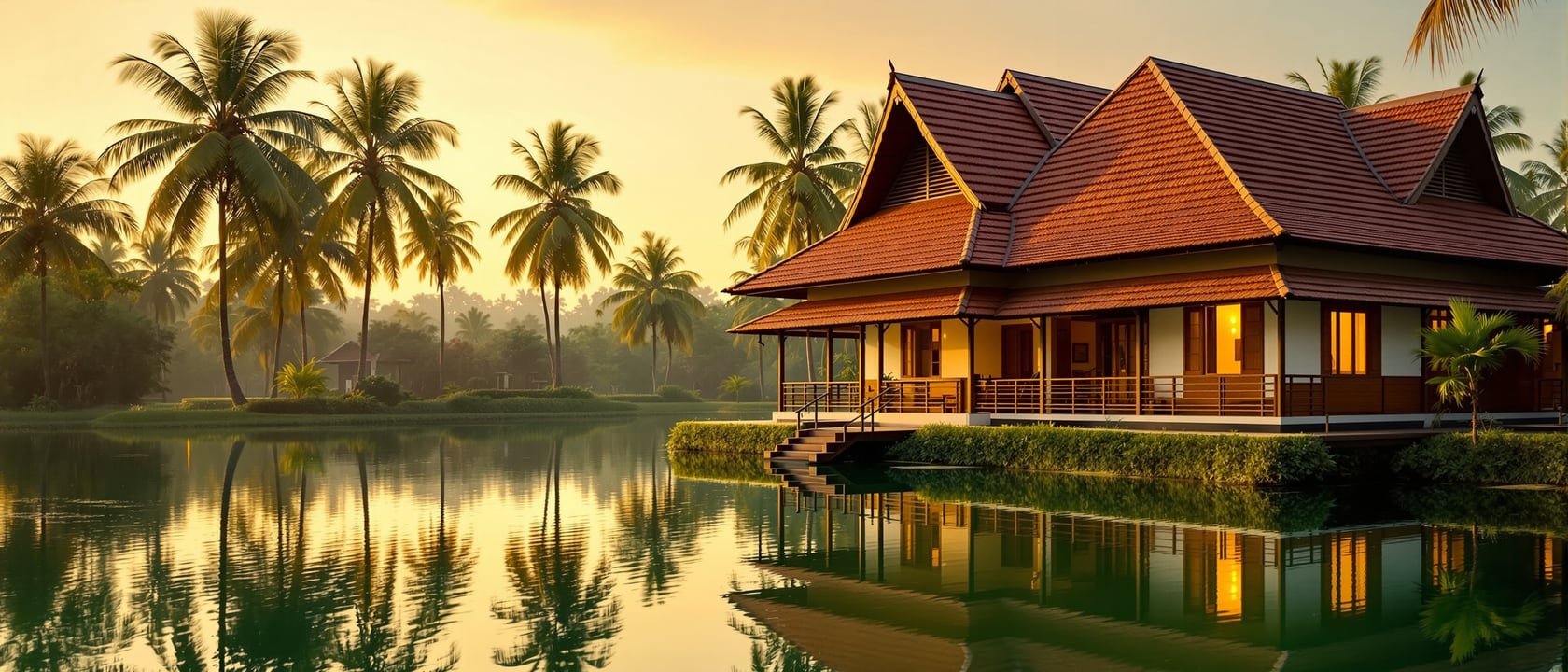
This counter-season is just one expression of a state whose homestay landscape is genuinely varied: a backwater homestay on a canal near Alleppey or Kumarakom sells a completely different experience from a highland plantation stay near Munnar or Wayanad, which in turn differs sharply from a heritage tharavad - an ancestral courtyard home - in the state's interior. All three sit inside the same warm, humid coastal-and-midland climate, and all three lean on the same underlying design logic: the nalukettu courtyard house, with its sloping tiled roof and central open courtyard, built specifically to stay livable through heat, humidity and, eventually, that same strange, profitable monsoon. This lesson walks through all three stay types, the courtyard house that often sits behind them, and the counter-seasonal strategy that rewards an owner willing to read Kerala's calendar honestly rather than copying the beach-tourism assumption wholesale.
The same monsoon that empties the beach fills the Ayurveda centre - always ask whose low season you are actually looking at.
Three ways to stay in Kerala
The first and most internationally recognised type is the backwater homestay - a home on or near the canals and lagoons around Alleppey, Kumarakom and the wider Kuttanad region, where the guest draw is the water itself: the famous houseboat experience nearby, village life along the canal, paddy fields below sea level, and a slower, waterborne rhythm to the day. A backwater homestay typically works best complementing, not competing with, a houseboat stay - many guests spend one or two nights on the water and one or two in a homestay on land, and a good host builds relationships with reputable houseboat operators rather than treating them as rivals.
The second type is the highland plantation homestay, found around Munnar, Wayanad and Idukki's hill tracts, where tea, coffee, cardamom and spice estates sit at an elevation cool enough to feel like a genuine escape from the coastal heat. This type shares real DNA with the Coorg and Chikmagalur plantation bungalows from Lesson 5.2 - timber construction, deep verandahs, an estate walk as the signature experience - but sits inside Kerala's own tourism circuit and typically draws guests who are combining a hill stop with a backwater or coastal leg of a longer Kerala trip.
The third, and often the most architecturally distinctive, is the heritage tharavad homestay - an ancestral family home, frequently built in the traditional nalukettu courtyard form described in the next section, found across central Kerala districts like Thrissur, Kottayam and Palakkad. A tharavad homestay sells family history and traditional architecture directly: carved wooden pillars, a working courtyard, sometimes a family deity's shrine still in active use, and a host who can speak to generations of the house's own story - precisely the irreplaceable 'story' layer Module 1 identified as a homestay's real premium. Each of these three types draws a genuinely different guest and a different price point, and a first-time Kerala owner's first honest task is identifying which one their own home and location actually fit, rather than trying to be all three at once.
Inside the nalukettu: the courtyard house
The nalukettu is Kerala's defining vernacular house form, and it answers the state's hot, humid, monsoon-heavy climate with a single powerful idea: an open central courtyard, the nadumuttam, around which four wings of the house are arranged. The courtyard does several jobs simultaneously. It draws warm air up and out through a kind of natural stack effect, pulling cooler air in through the surrounding rooms and creating a gentle, continuous airflow without any mechanical help. It brings daylight deep into the plan without exposing the interior rooms to direct, harsh sun, since the wings themselves shade the courtyard edges for much of the day. And during the monsoon, it collects and channels rainwater in a controlled way, often into a well or tank, rather than letting it simply run off the building.
The roof over a nalukettu is traditionally steeply pitched and covered in terracotta tile, with deep eaves projecting well beyond the walls - exactly the kind of shade-and-shed combination Lesson 5.1 described as a universal move, expressed here in Kerala's own material, clay tile rather than Himachal's slate or Coorg's Mangalore tile. Walls are traditionally laterite - a reddish, porous volcanic-derived stone widely available across Kerala - or timber, both of which breathe moisture reasonably well in a climate where a sealed, non-breathing wall can trap damp and encourage mould. The four wings of a traditional nalukettu each historically had defined roles tied to family life and ritual; in a homestay conversion, the courtyard is usually kept as the shared heart of the building while guest rooms are carved from one or two of the wings, with the owner-host's own living space retained in another, echoing Module 4's zoning principle of keeping a clear boundary between the host's world and the guest's.
Converting a genuine tharavad into a homestay requires real care: resist the temptation to enclose the courtyard with glass or a roof for 'more usable space', since doing so removes the building's primary cooling and lighting mechanism in one move, and avoid painting over laterite with a sealed modern paint that traps moisture inside the stone rather than letting it breathe out, which can accelerate decay rather than preserve it.
The monsoon counter-season: Ayurveda's gift to off-peak revenue
Kerala's tourism calendar has a conventional shape: roughly November to March is the established beach and backwater peak, when the weather is pleasant, international arrivals are highest, and most homestays and hotels charge their top rates. The monsoon, roughly June to September, is the conventional trough - fewer package tours, wetter roads, a genuine dip in general leisure travel. A homestay owner who only sees this one calendar will plan for four or five quiet months a year and simply absorb the loss.
But Kerala's Ayurveda and wellness sector reads the same monsoon in reverse, and the pattern is well established enough to plan a real business around. The traditional reasoning - humid, cool monsoon air opening the skin's pores and improving oil absorption during treatments like Panchakarma - has made the monsoon the peak season for Ayurveda bookings specifically, with many certified Ayurveda centres and partnering homestays running at high occupancy through these very months when the beach trade is lowest. A homestay in a position to credibly offer or partner into this - typically in central Kerala or near an established Ayurveda centre, with a genuine, licensed Ayurveda practitioner involved - can build a real counter-seasonal revenue stream precisely when its beach-facing peers are empty.
This comes with an important honesty boundary that Studio Matrx's stance applies directly: a homestay owner should never present themselves as offering medical treatment, and should always defer Ayurveda treatment itself to licensed, qualified practitioners and registered centres, with any food served still meeting ordinary FSSAI standards regardless of wellness framing. What a homestay can legitimately offer is a comfortable, humidity-managed base for a guest who is travelling specifically for a certified treatment programme elsewhere, or a genuine partnership with a nearby licensed centre - packaged honestly, not as a medical claim of your own. Done this way, the monsoon stops being four months of forced discounting and becomes a specific, named season with its own guest and its own price.
Designing for warm-humid comfort without AC overload
Kerala's baseline climate - hot, humid, with a genuinely heavy monsoon - rewards exactly the universal passive moves Lesson 5.1 introduced, expressed in locally specific ways. Deep eaves on a steeply pitched roof are non-negotiable, not decorative, because monsoon rain in Kerala can be genuinely intense and a shallow roof or short overhang will drive water into walls and windows that a deep one simply sheds. A raised plinth, higher than in a drier region, matters more here too, since parts of Kerala's lowlands and backwater areas are prone to standing water during the heaviest weeks, and a guest room floor needs real clearance above typical flood lines.
Laterite's breathability is a genuine asset worth protecting rather than sealing over: a laterite wall finished with a breathable lime-based plaster or wash, rather than a modern sealed acrylic paint, lets accumulated moisture escape slowly rather than becoming trapped and encouraging mould and damp patches, a common and avoidable complaint in humid-climate guest rooms. Light interior colours reduce heat absorption and make a room feel airier in high humidity, where a dark, heavy palette can read as oppressive rather than cosy. And the courtyard's stack ventilation, where a nalukettu or courtyard-adjacent layout exists, should be kept working rather than closed off - a ceiling fan sized and positioned correctly to work with, not against, this natural airflow will do far more for guest comfort per rupee of running cost than jumping straight to AC in every room.
Where a guest room genuinely needs AC - during the hottest, stillest weeks before the monsoon breaks, roughly March to May, when even good passive design can struggle - treat it exactly as Lesson 5.1 recommended: a backup for the hardest weeks, not the primary plan, sized to the room and used alongside, not instead of, the shade, ventilation and breathable materials Kerala's own vernacular architecture already worked out. The next lesson moves west and north, to Rajasthan's desert haveli, Goa's Portuguese house and the North-East's bamboo tradition, three more climate-specific answers to the same underlying question this module keeps asking.
Nalukettu
Kerala's traditional courtyard house form, with four wings arranged around a central open courtyard
See the Nalukettu reference below for its architectural history.
Nadumuttam
The open central courtyard at the heart of a nalukettu, used for light, ventilation and rainwater collection
Should be kept open in a homestay conversion, never glassed in.
Panchakarma
A traditional Ayurveda treatment programme involving detoxification therapies over several days
Always administered by a licensed Ayurveda practitioner, never by a homestay host directly.
Laterite
A reddish, porous stone widely used in Kerala's traditional walls, valued for local availability and breathability
Should be finished with breathable lime-based plaster, not sealed modern paint.
Workshop - your counter-season audit
A planning exercise to test whether your Kerala (or any strongly seasonal) homestay has a credible counter-season offer hiding in its low months, and to check your building against the courtyard-and-laterite checklist.
Just your property and a notebook; local tourism-season knowledge helps.
Goal: one honest counter-season idea plus a building-materials check
Inputs: your location, your region's conventional peak and low months
Time: ~25 minutes
- 1Write down your region's conventional peak months and its conventional low months, as most general tourism treats them.
- 2Ask honestly: is there a specific guest type - wellness, work-from-anywhere, a festival, a harvest, a quieter kind of traveller - who might actually prefer your 'low' months, and why?
- 3If a credible counter-season candidate exists, note what you would need to deliver it honestly (a genuine licensed partner, specific amenities, different marketing) rather than just a discount.
- 4If your building has a courtyard, laterite walls or similarly breathable traditional materials, walk it and check for any sealed modern paint, enclosed verandah or closed-off courtyard that might be undermining its natural cooling.
- 5Write one sentence naming your counter-season idea (or honestly concluding you do not currently have one) and one sentence naming your top building-materials fix.
You’ll walk away with
A one-page note: your region's two calendars (conventional and counter-seasonal, if one exists), and one building-materials fix.
Three altitudes on the same idea
Read the band that fits you — or all three.
For you, the owner-host, the biggest strategic idea in this lesson is the counter-season. If your home or region can credibly support an Ayurveda-adjacent offer, honestly and without overstating your own role, the monsoon stops being four lost months and becomes a specific, plannable season. Beyond that, protect your courtyard and laterite walls from well-meaning but climate-wrong renovations - sealed paint and a glassed-in courtyard solve nothing and quietly undo the cooling your building already does for free.
If you are converting a Kerala tharavad or any courtyard home into a homestay, your most important early decision is to keep the nadumuttam open and working. Use breathable lime-based finishes on laterite rather than sealed modern paints, carve guest rooms from the wings rather than the courtyard itself, and size ceiling fans to work with the courtyard's natural stack ventilation rather than fighting it with closed-off, AC-only rooms that lose the building's real character and its real cooling system at once.
If this is new to you, the single most useful idea to take away is that 'off-season' depends entirely on who you ask. The same monsoon that empties Kerala's beaches fills its Ayurveda centres, which is a reminder to always check a region's full calendar, across every guest type it might draw, before assuming any month is simply dead. The same discipline applies wherever you end up hosting - look for the guest your 'low season' might actually suit.
“The monsoon is uniformly dead season for homestays in Kerala, so an owner should just expect to lose income for four months a year.”
Do it yourself
No tools needed - reason it through for your own region.
- 1Name Kerala's three main homestay types from this lesson and the guest each primarily draws.
- 2What specific job does the nadumuttam courtyard do for a nalukettu's ventilation and daylighting?
- 3Why is Kerala's monsoon simultaneously a low season and a peak season, and for which two different guest types?
- 4What is the honesty boundary a homestay must respect when positioning itself near Ayurveda tourism?
- 5Why should laterite walls be finished with breathable lime plaster rather than sealed modern paint?
The one line to carry out
Peer-reviewed journals & authoritative standards
- 01Nalukettu - Kerala's traditional courtyard house form — Wikipedia, 2026.
- 02Ayurveda - traditional treatment system and its seasonal practice in Kerala — Wikipedia, 2026.
- 03Kerala Tourism - Department of Tourism, Government of Kerala — Kerala Tourism, 2026.
- 04Kerala Homestay (Backwater & Plantation) - the regional design and operating guide — Studio Matrx, 2026.
- 05Courtyard house - the open-centre plan as a ventilation and daylighting device — Wikipedia, 2026.
From Kerala's humid coast, the module turns to three sharply different regions at once - Rajasthan's dry desert heat, Goa's monsoon coast and the North-East's wet, community-built bamboo tradition.
The author
Amogh N P
Architect, interior designer, and creative polymath. Studio Matrx began in his notebooks — his vision of design made honest, useful, and open to everyone. Its Academy is written and taught in his memory, and free, forever.
More about Amogh →