

Fire Safety Audit in India (2026): The Independent Check That Proves You Are Actually Safe
A periodic, independent audit tests a building's whole fire provision against NBC Part 4 and the Fire NOC - and separates compliant-on-paper from safe-in-reality. This guide sets out what it covers, who does it, and why findings must be fixed, not filed.
Two buildings can hold the same Fire NOC, the same set of stamped drawings and the same shiny fire panel on the wall - and one of them is safe while the other is a death trap. The difference is almost never visible on paper. The pump that will not start, the fire door wedged open, the sprinkler valve someone closed, the exit locked from the inside, the smoke damper painted shut, the log book that has been blank for three years - none of these show up in a file. They show up only when someone competent, and independent, walks the building and actually tests the thing rather than admiring the certificate. That walk is the fire safety audit, and it is the single most honest instrument in the whole of building fire safety.
This is the audit chapter of Studio Matrx's fire-safety library, sitting under the complete guide to fire safety in India. It is the governance twin of the fire-safety inspection guide: where an inspection is the frequent, routine self-check the building runs on itself, an audit is the deeper, periodic, independent assessment of the whole fire-safety provision against the code and the NOC. It is written for RWA committees, facility managers, developers, hospital and hotel owners and building committees who carry the legal duty - so you can commission a real audit, read its report correctly, and above all act on it.
Scope and safety - read this first. A fire safety audit is a professional, engineering-grade assessment carried out by a competent fire-safety auditor or an empanelled third party against the National Building Code (via SP 7 : 2026, Part 4 Fire and Life Safety), your premises Fire NOC, and the State Fire Services Act and Rules. In many states a periodic fire safety audit or a self-declaration is now a statutory duty for certain occupancies - the requirement, the interval and who may audit all vary by state, so verify your own state's rules. This guide helps you commission, read and act on an audit; it is educational guidance, not legal advice, and it is never a manual for passing an audit cosmetically. When any system is found dead, the correct response is to fix it, not to file the finding. In a real fire the one rule that overrides everything: get everyone out and call the fire brigade on 101 or 112.
Audit versus inspection - and why you need both
The words "inspection" and "audit" get used interchangeably in India, and that confusion is itself a safety problem, because the two do different jobs and neither replaces the other. An inspection is the frequent, largely internal check - daily, weekly, monthly, quarterly - that confirms nothing has broken since last time: the extinguishers are charged, the exits are clear, the panel is in normal status. It is maintenance discipline. An audit is the periodic, in-depth, independent assessment of the entire fire-safety provision - passive, active, escape, documentation and the NOC together - measured against the code and the building's approved design, by someone who does not run the building.
The distinction that matters most is independence. The people who run a building slowly stop seeing its faults; the wedged door and the stacked corridor become invisible because they are there every day. An auditor from outside sees them at once, and has no incentive to look away. That is why an audit is worth commissioning even in a building that inspects itself diligently - and why an audit alone, once a year, is no substitute for the daily and weekly inspection that catches decay between audits.
| Dimension | Fire safety inspection | Fire safety audit |
|---|---|---|
| Frequency | Frequent - daily, weekly, monthly, quarterly | Periodic - typically annual or as the state rules require |
| Who does it | Owner, facility team, sometimes the AMC contractor | Competent fire-safety auditor or empanelled third party - independent |
| Depth | Confirms nothing has broken since last time | Assesses the whole provision against NBC Part 4 and the NOC |
| Output | Log entries, snags to fix | A graded report with a corrective action plan and timeline |
| Primary value | Catches day-to-day decay early | Catches systemic gaps and the compliant-on-paper illusion |
Read the two guides together: this one and the fire-safety inspection guide. A building that both inspects itself constantly and is independently audited periodically is doing fire governance properly; one that does neither has a Fire NOC and nothing behind it.
What a real audit covers - the whole provision, tested
The defining feature of an audit is breadth. An inspection may look at one system; an audit looks at every layer of the building's fire defence and, crucially, how they work together - because fire safety fails in the gaps between systems as often as within them. A perfect alarm is worthless if the exit it should send people to is locked. Sprinklers are worthless if the pump that feeds them will not start. The audit's job is to test the whole chain, not to tick off components in isolation.
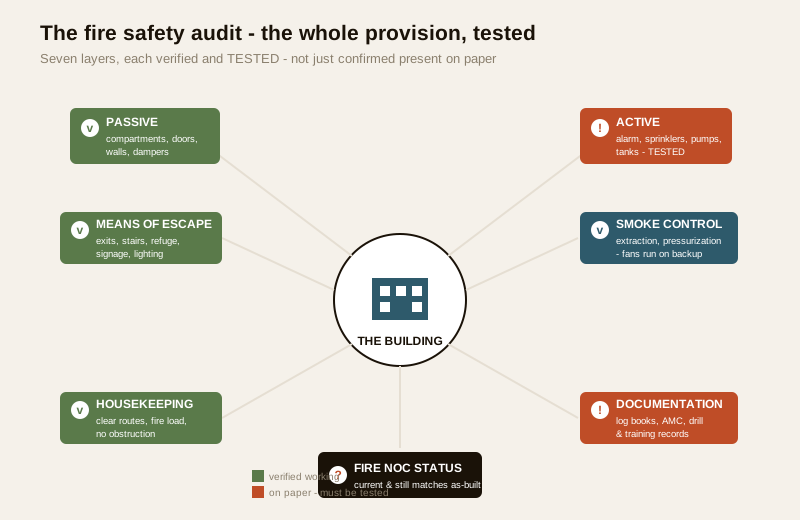
The heart of the matter is one word in the caption: tested. The commonest way an Indian fire audit is corrupted is that the auditor confirms a system is present - the pump exists, the alarm panel is on the wall, the extinguishers hang in their brackets - without confirming it works. A real audit runs the pump, triggers a detector to prove cause-and-effect, checks the extinguisher's pressure and service date, opens a fire door to confirm it self-closes. The table below sets out what each layer means and what "tested, not just present" looks like for it.
| Audit layer | What it covers | What "tested, not just present" means |
|---|---|---|
| Passive protection | Compartmentation, fire-rated walls, smoke barriers, fire doors, fire dampers | Doors self-close and are not wedged; fire-stopping at service penetrations is intact; dampers are free to operate, not painted shut |
| Active systems | Detection and alarm, sprinklers, hydrants, pumps, tanks, extinguishers | The pump starts and holds pressure; the tank is full; a detector actually raises the alarm; extinguishers are charged and in service date |
| Means of escape | Exits, stairs, refuge areas, exit signage, emergency lighting | Exits are unlocked and unobstructed; stairs are clear; signage is visible; emergency lights actually come on when mains drops |
| Smoke management | Smoke control, staircase pressurization, basement smoke extraction | The fans start and the air paths are clear; pressurization holds the stair; the system runs on backup power |
| Housekeeping and fire load | Storage, combustibles, corridor obstruction, electrical safety | Escape routes are clear; combustible storage is controlled; nothing is stacked against exits or under detectors |
| Documentation | Log books, AMC records, drill and training records | The records exist, are current, and match reality - not a blank book signed in one sitting |
| Fire NOC status | The premises Fire NOC and its currency | The NOC exists, is current, and the building as-built still matches what it certifies |
Notice that the last two layers - documentation and the NOC - are where the paper-versus-reality gap is widest, and they are covered next because they are the ones most often faked.
The documentation and the Fire NOC - where paper meets reality
An audit does not only test hardware; it tests the building's story about itself. The log books, the AMC service reports, the drill and training records and the Fire NOC together are supposed to prove that the building is watched, serviced, practised and legally certified. In a well-run building they line up with what the auditor sees on the walk. In a neglected one they are the first thing to fall apart - a log book blank for years, an AMC that means one signature and no work, drill records for drills that never happened, and a Fire NOC obtained once at handover and never renewed as the building, its use and its occupancy changed around it.
- Log books and inspection records. The auditor cross-checks the inspection and maintenance logs against the state of the equipment. A charged, in-date extinguisher with a blank service card is a documentation failure even if the extinguisher is fine; a signed log against a dead pump is worse - it is a false record.
- AMC and service certificates. A named, competent contractor servicing the alarm, sprinklers, hydrants and pumps to a stated schedule, with written reports every visit - not a cheap annual certificate manufactured around an unserviced system.
- Drill and training records. Evidence that fire drills are actually run and that staff have had real fire-safety training - because a building of people who have never touched an extinguisher or walked their escape route is unsafe however good its hardware.
- The Fire NOC. The auditor confirms the NOC exists, is current under the State Fire Services Act and Rules, and - critically - that the building as it stands today still matches what the NOC certifies. A change of use, an added floor, a subdivided tenancy or a covered-over refuge area can silently invalidate a NOC that is technically still in date.
The honest point: a building can be perfectly documented and still unsafe, and it can be safe and poorly documented - but in practice the two decay together, and the documentation is where an experienced auditor first smells trouble.
Who does the audit - and the state-by-state duty
An audit is only as good as the independence and competence of the person doing it. The whole value proposition collapses if the "auditor" is the same contractor who installed the systems, or a relative of the owner, or anyone with a reason to pass the building. The auditor must be a competent fire-safety professional - and increasingly, in the states that mandate audits, an empanelled third party approved by the state fire service precisely to guarantee that independence.
This is where the law has moved, and where the biggest confusion lies, so it must be stated carefully: many Indian states now mandate a periodic fire safety audit, or a periodic fire-safety self-declaration, for certain occupancies - typically high-risk and public buildings such as hospitals, hotels, malls, high-rises and educational institutions. But the requirement is not uniform. Whether an audit is mandatory, how often, for which occupancies, whether it must be a third party and whether self-certification is allowed - all of this varies by state under each State Fire Services Act and Rules. There is no single national mandate you can point to; you must check your own state's fire rules. Treat any blanket claim that "a fire audit is required every year in India" with caution - the shape of the duty is genuinely different across states.
| Who might "audit" | Independence | When it is appropriate |
|---|---|---|
| The state fire service (statutory inspection for the NOC) | Fully independent, regulatory | NOC grant and renewal; not the same as a commissioned audit |
| An empanelled third-party fire auditor | Independent, state-approved | Where the state mandates a periodic third-party audit |
| A competent independent fire-safety consultant | Independent if unconnected to the systems | Voluntary or mandated audits; due diligence; post-incident review |
| The installing or AMC contractor | Not independent - conflicted | Servicing and testing, yes; auditing their own work, no |
| The building's own facility team | Not independent | Routine inspection - not the periodic audit |
For the distinction between the routine self-check and this periodic independent assessment, read the fire-safety inspection guide alongside this one; and to prepare a building before an auditor arrives, walk it against the fire safety audit checklist.
The output - a risk-graded report and a corrective action plan
An audit that produces a "pass" certificate and nothing else has failed at its one real job. The proper output of a fire safety audit is a report that finds the gaps, grades each one by the risk it carries, and sets out a corrective action plan with an owner and a timeline for every finding. Grading by risk is what makes the report usable: it tells the building committee what to fix this week versus this quarter, and it stops a genuinely lethal finding - a locked exit, a dead pump - being buried in a list next to a faded signage sticker.
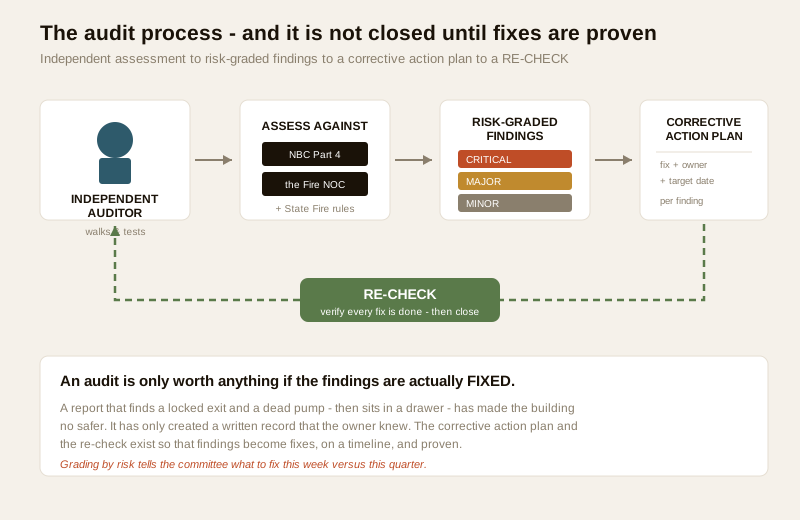
A good audit report has a predictable structure, and knowing that structure helps a building committee commission the right thing and read it correctly.
| Report element | What it should contain | Why it matters |
|---|---|---|
| Scope and basis | What was assessed and against which codes - NBC Part 4, the Fire NOC, the state rules | Fixes the audit to a real standard, not the auditor's opinion |
| Findings | Every gap found, described plainly, with evidence | The substance - what is actually wrong |
| Risk grading | Each finding graded, for example critical / major / minor | Tells the owner what to fix first and how urgently |
| Corrective action plan | Each finding paired with a fix, an owner and a target date | Turns findings into action; without this the report is inert |
| Timeline and re-check | When each fix is due and when it will be verified | Closes the loop - the audit is not done until fixes are proven |
The single most important idea in this whole guide follows from that last row: an audit is only worth anything if the findings are actually fixed. A report that finds a locked exit and a dead pump, is filed neatly in a drawer, and changes nothing, has not made the building one degree safer - it has merely created a written record that the owner knew. That record can, after a tragedy, be the difference between negligence and gross negligence. The corrective action plan and the re-check exist precisely so that findings become fixes.
The India reality - skipped, rubber-stamped, or filed and forgotten
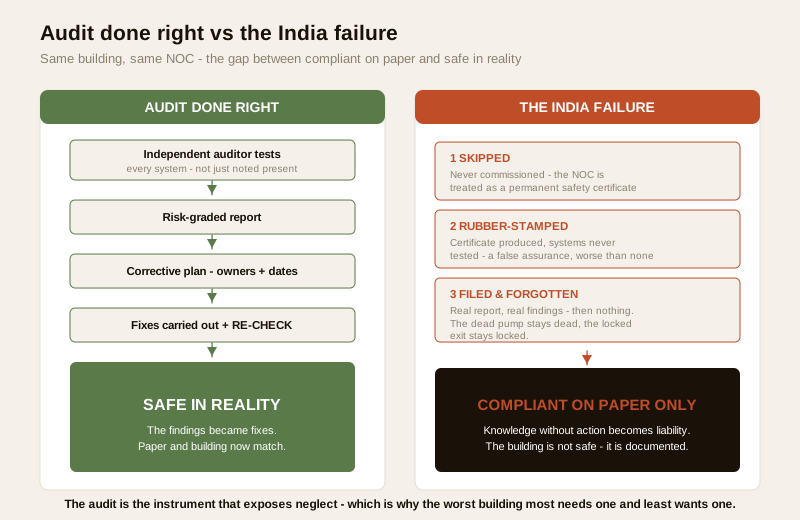
Everything above describes an audit done properly. The honest picture across much of India is three failure modes, and naming them is the whole point of this guide.
- The audit is skipped. Where the state does not mandate it, or does not enforce the mandate, many buildings simply never commission one. The Fire NOC obtained at handover is treated as a permanent certificate of safety, and the building is never independently assessed again as its systems age and its use drifts.
- The audit is rubber-stamped. A certificate is produced with little or no real assessment - the "auditor" confirms systems are present without testing them, or is conflicted, or is paid to pass the building. This is worse than no audit, because it manufactures a false assurance and a paper trail that says everything is fine.
- The audit is done, then filed and forgotten. The most heartbreaking mode: a real audit finds real, serious problems, produces a proper report - and then nothing is fixed. The report sits in a file. The dead pump stays dead. The locked exit stays locked. The building has paid for the truth and then ignored it.
Underlying all three is the same disease that runs through this whole fire-safety library: the treatment of fire safety as a paperwork exercise to be got past once, rather than a living duty. A Fire NOC obtained once and never renewed, systems installed for the NOC and then left to rot, drills never run, a maintenance calendar never opened - the audit is the instrument designed to expose exactly this, which is why the neglected building most needs one and least wants one.
Tie the audit into the building's wider governance: the fire-safety maintenance calendar turns the audit's corrective actions into a running schedule, the emergency-preparedness guidance sets it in the building's overall readiness, and the setting-specific guides for apartments, hospitals, hotels, offices and high-rises show how the audit sits within each occupancy's compliance under commercial and apartment security.
Audit done right versus the India failure
The gap between an audit that saves lives and one that is theatre comes down to two things: whether the assessment is real and independent, and whether the findings are fixed. Get both right and the audit closes the gap between compliant-on-paper and safe-in-reality. Get either wrong and it becomes an expensive way of documenting that nobody cared.
When the law requires a professional - and why you never let a finding sit unfixed. A fire safety audit is an engineering-grade, independent assessment that must be carried out by a competent fire-safety auditor or an empanelled third party against the National Building Code (SP 7 : 2026, Part 4), your Fire NOC, and your State Fire Services Act and Rules - and in many states a periodic audit or self-declaration is now a statutory duty for certain occupancies, so verify your own state's requirement. Commission the audit, insist it tests systems rather than merely noting their presence, and demand a risk-graded report with a corrective action plan and timeline. Then do the one thing that makes the whole exercise worth anything: fix the findings, on the timeline, and prove it at re-check. An audit filed and forgotten is not safety - it is a written record that you knew and did nothing. Route the assessment to the professional; keep the fixing, the governing and the record-keeping as the owner's non-delegable duty.
Key takeaways
- An audit is the independent, periodic, whole-building check - passive protection, active systems, means of escape, smoke management, housekeeping, documentation and the Fire NOC, assessed together against NBC Part 4 by someone who does not run the building; it is the twin of the routine inspection, not a replacement for it.
- Tested, not just present - the defining feature of a real audit is that it runs the pump, triggers a detector, opens a fire door and checks the emergency lights, rather than confirming systems merely exist; present-but-dead is the commonest way Indian buildings pass on paper and fail in fire.
- Many states now mandate a periodic audit or self-declaration for certain occupancies - but it varies by state - there is no single national mandate, so check your own State Fire Services Act and Rules for whether an audit is required, how often, for which buildings and whether a third party is compulsory.
- The output is a risk-graded report and a corrective action plan - findings graded critical, major and minor, each paired with a fix, an owner and a timeline, closed only at re-check; a certificate with no findings has failed at its job.
- An audit is only worth anything if the findings are fixed - skipped, rubber-stamped, or done-then-filed are India's three failure modes; a report of real problems left in a drawer makes the building no safer and turns knowledge into liability.
References
- National Building Code of India, SP 7 : 2026 (the NBC), Part 4 "Fire and Life Safety" - the framework against which a fire safety audit assesses a building's passive protection, active systems, means of escape and smoke management by occupancy and height; the older SP 7 : 2016 edition is withdrawn but still widely quoted. Verify the current edition via the BIS catalogue: https://www.services.bis.gov.in/
- IS 1642 : 2013, Bureau of Indian Standards - Fire Safety of Buildings (General): Details of Construction, Code of Practice - relevant to the compartmentation and fire-rated construction an audit examines under passive protection. Verify the current status via the BIS catalogue: https://www.services.bis.gov.in/
- The relevant State Fire Services Act and Rules and the Model Building Bye-Laws (MoHUA) - these set whether and how often a periodic fire safety audit or self-declaration is mandatory, for which occupancies, whether an empanelled third party is required, and how the audit ties to Fire NOC grant and renewal. The requirement varies by state - confirm your own state's provisions.
- Supporting Indian standards checked within an audit's active-systems scope - for example IS 2189 : 2026 (detection and alarm), IS 15105 : 2021 (sprinklers), IS 3844 : 1989 / IS 13039 : 2014 (hydrants) and IS 2190 : 2024 (extinguisher maintenance) - always verify the current edition of any code via the BIS catalogue before relying on it: https://www.services.bis.gov.in/
This is an educational overview, not legal advice, and not a substitute for a competent fire-safety auditor or a licensed fire-safety consultant. A fire safety audit, its scope, the Fire NOC and any statutory audit or self-declaration duty are qualified professional and legal matters - engage a competent auditor and the State Fire Services, and verify any standard's current status via the BIS catalogue before relying on it.
Export this guide
Related Guides — Deep-dive reading
Fire Safety Inspection in India (2026): The Routine Checks That Catch Failures Early
The cheap, frequent in-house walk-round - are exits clear, extinguishers charged, the alarm panel normal, fire doors closing - that catches the drift toward a neglected building before it can matter, and the log that proves you looked.
SecurityFire Safety Maintenance Calendar for India (2026): The Year-Round Routine That Keeps It All Working
India's core fire-safety disease is installed for the NOC, then neglected. The cure is a written, owned maintenance calendar - who checks what, when - so no fire-safety element ever silently fails.
SecurityFire System Approval Process in India (2026): Getting Your Fire Systems Signed Off
The systems side of fire compliance, explained for homeowners and RWAs. How the alarms, sprinklers, hydrants, pumps and emergency lighting in a building get designed to the fire scheme, installed by a competent agency, tested, commissioned, inspected and certified as part of the fire approval.
SecurityRelated Tools — Try Free
Apartment Interior Planning Checklist
51-item checklist across structural, ceiling, lighting, furniture, storage, electrical, kitchen, bathroom.
ChecklistElectrical Safety & Load Audit
Home electrical audit — 10 categories, 65+ checkpoints across earthing, RCCB, MCB, wiring, switchboards, appliance circuits, DG/inverter backup.
Safety AuditApartment vs Villa Interior Planning Guide
Compare ceiling height, structural flexibility, lighting, storage, and services between apartments and villas.
Planning Guide