
Fire Alarm Panels in India (2026): The FACP, Battery Standby & Reading Fault vs Fire
The Fire Alarm Control Panel is the brain of a building's fire system - what it watches, what it drives, why it needs battery standby through a power cut, and how to read FIRE vs FAULT vs DISABLE.
Every building fire-alarm system - the detectors on the ceilings, the break-glass call points on the escape routes, the sounders and strobes in the corridors - reports to one box on the wall, usually near the main entrance or the security desk. That box is the Fire Alarm Control Panel, the FACP, and it is the single most important, least understood object in the whole system. It is the brain: it watches every input, it decides what has happened, it drives every output, and when the power fails - as it routinely does in India - it is the panel's own battery that keeps the entire system alive and able to raise an alarm. A building can have perfect detection and perfect wiring, but if the panel is sitting in permanent fault or with half its zones switched off, the building has no fire-alarm system at all.
This is the control-panel chapter of Studio Matrx's fire-safety library, sitting under the complete guide to fire safety in India. It is written for the people who own, manage or specify a building system - RWA committees, facility managers, builders, and the professionals who advise them - so you can understand what the panel does, hold your contractor accountable, and above all read the panel correctly when it is telling you something.
Scope and safety - read this first. A building Fire Alarm Control Panel and everything wired to it is a statutory, engineered installation - designed, installed, commissioned and certified by a licensed fire-alarm contractor to IS 2189 : 2026 and the National Building Code (via SP 7 : 2026, Part 4 Fire and Life Safety), and tied to the premises Fire NOC under your State Fire Services Act and Rules. This guide helps you understand and specify and operate that system; it is educational guidance, not legal advice, and never a manual for installing, programming, silencing or bypassing a panel. When the panel shows FIRE, one rule overrides everything below: get everyone out and call the fire brigade on 101 or 112.
What the panel actually is - the brain of the system
Think of the FACP as the central nervous system of the building's fire response. Everything else in the alarm system is either a sense organ reporting to it or a muscle it commands. The panel continuously monitors its inputs, and the instant one of them signals fire, it makes a decision and drives its outputs - all in under a second, and all while supervising itself and its wiring for faults.
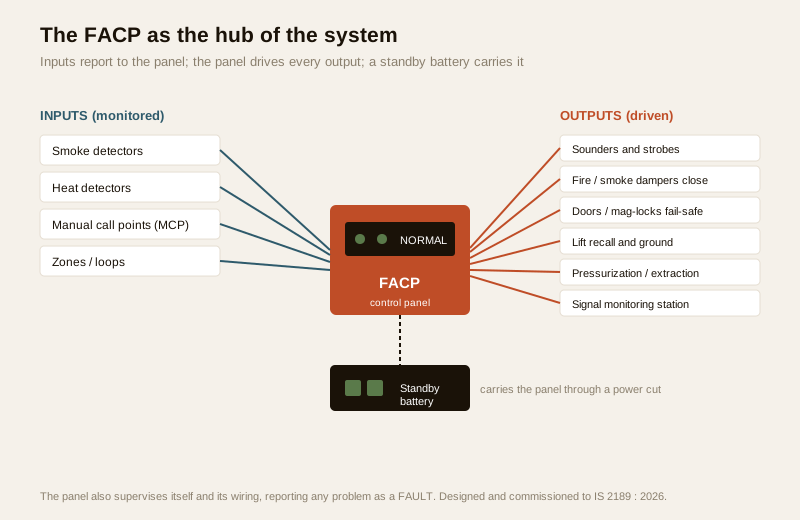
On the input side, the panel watches:
- Every automatic detector - the smoke detectors, heat detectors, flame detectors and gas detectors covering the building.
- Every manual call point - the break-glass units on the escape routes that let a person raise the alarm by hand.
- The circuits that connect them - either wired zones on a conventional system or addressable loops on an addressable system or supervised radio links on a wireless system.
On the output side, the panel drives:
- The sounders and strobes that alert and evacuate the building - the audible and visible warning.
- Cause-and-effect safety functions: closing fire and smoke dampers, releasing held-open fire doors and door mag-locks so they fail safe (shut for fire, unlocked for escape), recalling lifts to a safe floor and grounding them, starting stair-pressurization and smoke-extraction fans, and shutting down air-handling where required.
- A signal to a monitoring station or the security desk, and often to a repeater panel, so the alarm reaches the people who must respond.
At all times the panel also supervises itself - the health of its detectors, the integrity of every wire, the charge in its batteries - and reports any problem as a fault. That self-supervision is what separates a real fire-alarm system from a collection of standalone alarms: the panel knows when part of itself has stopped working, and it tells you.
Cause-and-effect - the panel as decision-maker
On a simple building the panel's job is mostly to sound the alarm. On a large or complex building it does far more, through programmed cause-and-effect: a defined input (a detector in a particular zone) triggers a defined set of outputs. This is where an addressable system earns its cost, because the panel can be programmed so that a fire in one part of the building produces exactly the right, staged response rather than one blanket reaction.
| The panel senses (cause) | The panel commands (effect) |
|---|---|
| Detector or call point triggers in a zone | Sounders and strobes operate; the zone and device are indicated |
| Fire confirmed on a floor | Fire and smoke dampers in that path close to stop smoke spread |
| Fire on an escape route | Held-open fire doors release and shut; door mag-locks release so people can escape |
| Alarm in a high-rise | Lifts recall to the ground or refuge floor and are grounded; stair-pressurization fans start |
| Smoke in a protected space | Smoke-extraction fans start; air-handling units shut down to stop feeding the fire |
| Any fire signal | Monitoring station and security desk are alerted; repeater panels show the location |
The exact cause-and-effect matrix is designed by the fire consultant for the building and programmed by the licensed contractor - it is not something an owner adjusts. But the owner should hold a copy of the cause-and-effect document, understand at a high level what the panel is meant to do, and confirm at commissioning that each effect actually happens when tested. This matters most in the high-rise and hospital settings, where phased evacuation, lift recall and pressurization are load-bearing parts of the life-safety strategy.
Why battery standby is not optional in India
Here is the fact that makes the panel's battery the most important battery in the building: a fire and a power cut arrive together far more often than chance would suggest. An electrical fault that trips the supply is itself a common ignition source; a fire that damages wiring cuts the mains; and India's routine load-shedding means the grid is simply absent for stretches of every day in much of the country. If the fire-alarm system went dark whenever the mains did, it would be useless exactly when it is most needed.
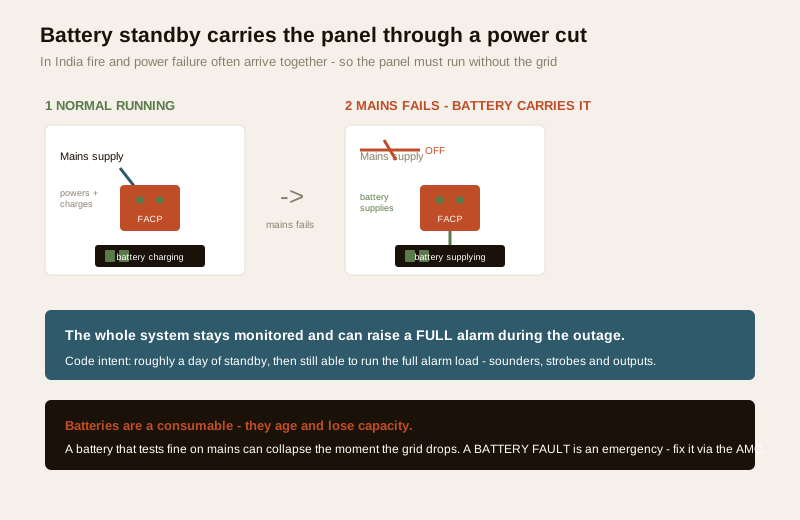
So the panel is built to run without the grid. In normal operation the mains powers the panel and trickle-charges a bank of standby batteries. When the mains fails, those batteries seamlessly take over and carry the whole system - keeping every detector monitored and, crucially, keeping the panel able to drive a full alarm if a fire starts during the outage. The design intent in the code is that the standby battery holds the system in its quiescent monitored state for a long period (the code intent is on the order of a day of standby) and then still has the reserve to run the full alarm load - sounders, strobes and outputs - for a further period, so that a fire during a power cut is not a fire nobody hears.
| Battery standby - what the owner must know | Why it matters |
|---|---|
| The panel must have healthy standby batteries at all times | They are the system's only power during a mains failure, which in India is frequent |
| Code intent is roughly a day of standby plus a period of full alarm load | The system must survive a long outage and still be able to raise a full alarm |
| Batteries age and lose capacity - they are a consumable | A battery that tests fine on mains can collapse the moment the grid drops |
| A "battery fault" on the panel is a real emergency, not a nuisance | It means the system may not survive the next power cut - fix it at once via the AMC |
| Battery replacement is part of the maintenance contract, on a schedule | Dead batteries are the single most common reason a "working" system fails a real test |
The honest India reality is that the battery is where neglected systems die first. A building installs the system to get its Fire NOC, the batteries slowly lose capacity over two or three years, nobody replaces them, and one day the power cuts out during a real fire and the panel that looked perfectly healthy on mains simply goes dark. Treat the standby battery as the beating heart it is: keep it under the AMC, replace it on schedule, and never dismiss a battery fault.
Repeater and mimic panels
On any building bigger than a small shop or office, the main FACP is not where the responders are. It might be in an electrical room or a basement, while the people who first need to know about a fire - the security guard, the lobby staff - are at the front desk. That gap is closed by a repeater panel (also called a mimic panel): a secondary display, sited at the security desk or main entrance, that mirrors the main panel's status. A repeater shows the same FIRE, FAULT and DISABLE information as the master, so the person on duty sees exactly where the fire is without running to the main panel. A mimic panel goes further and shows the building's zones as a lit floor plan, so the location is obvious at a glance. For any apartment tower, office, hotel or hospital, a repeater at the manned point is essential - the panel is only as useful as its being seen.
Reading the panel - the one human skill that matters
You can own a perfect system and still lose the building if the person on duty cannot read the panel. A fire-alarm panel is almost always telling you one of three things, and the correct human response to each is completely different. This is the single most important operational knowledge in this guide.
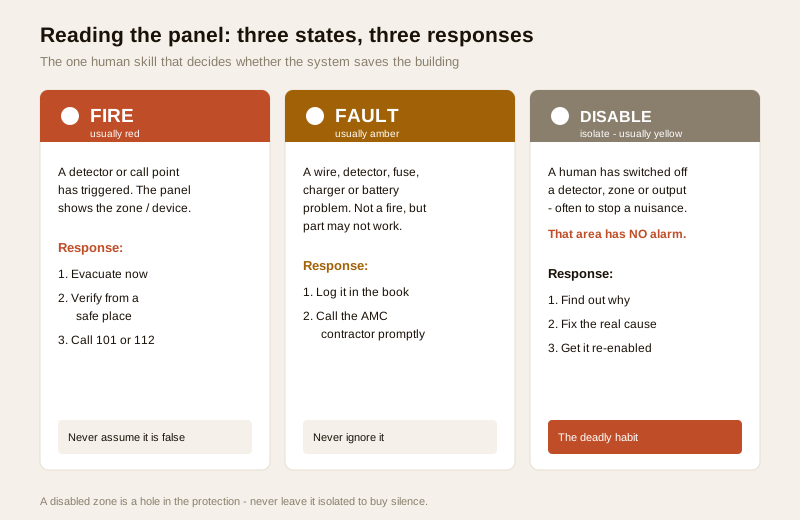
FIRE (usually red) - evacuate, verify, call the brigade
A FIRE indication means a detector or a manual call point has operated. The panel will show the zone, and on an addressable system the exact device and location. The response is to treat it as real: raise and confirm the building evacuation, get everyone out by the escape routes, and call the fire brigade on 101 or 112. Verification - checking whether it is a genuine fire - is done by a trained person going toward the indicated location only as far as is safe, never by assuming it is false and doing nothing. The deadly instinct is to assume every alarm is a nuisance and wait. Get people moving first; confirm second.
FAULT (usually amber) - log it, call the AMC, never ignore it
A FAULT indication means the panel has found a problem with itself: a broken wire, a detector that has stopped answering, a blown fuse, a charger problem, or - most seriously - a battery fault. A fault is not a fire, but it is not nothing: it means some part of the system may not work when a fire comes. The correct response is to record it in the panel log book, note the time and what the panel says, and call the AMC contractor to fix it - promptly for a battery or a whole-zone fault. What you must never do is treat a persistent fault as background noise. A panel that has been beeping in fault for months, with someone having taped over the buzzer, is a system nobody can trust.
DISABLE / ISOLATE (usually yellow) - the deadly habit
This is the one to fear. A DISABLE or ISOLATE indication means a human being has deliberately switched off a detector, a zone or an output - usually to stop a nuisance alarm. An isolated zone is a hole in the building's protection: in that area, the fire-alarm system is simply off. It is done for the best of short-term reasons - a zone keeps false-alarming, a contractor is doing dusty work, the buzzer is annoying the front desk - and it becomes lethal when it is forgotten and left in place. Fires have killed people in buildings whose alarm systems were fully installed and certified, because the zone covering the fire had been isolated months earlier and never re-enabled. If you see a disable or isolate indication, the response is to find out why, get the underlying nuisance fixed properly by the contractor, and get the zone re-enabled - never to accept it as normal.
Never solve nuisance alarms by leaving zones off
This deserves its own heading because it is the single most common way a real building's fire system fails. When detectors keep false-alarming - kitchen steam reaching a smoke detector, dust from construction, a detector sited wrong - the tempting fix is to isolate the zone and enjoy the silence. It works, and it is deadly, because the zone stays off long after everyone has forgotten it was ever switched off.
The correct fix is never to leave the zone isolated. It is to find and remove the cause of the false alarms: relocate a badly sited detector, change a smoke detector to a heat detector where cooking or steam is the problem, clean dust-fouled units, or have the contractor re-survey the zoning. Isolating a zone is a legitimate, logged, temporary step during maintenance or hot works - taken by the contractor, recorded, and reversed the moment the work is done. It is never a standing solution to a nuisance. A disabled zone is not a fire-alarm system; it is a decoration.
The log book and the AMC - proof the panel is alive
A fire-alarm panel is only trustworthy if someone can show it has been watched and maintained. Two things provide that proof:
- The log book. Every panel should have a log book at the panel, in which every event is recorded: fires and false alarms with time and zone, every fault and how it was cleared, every test, and every occasion a zone was isolated and re-enabled. The log book is both an operating discipline and the evidence a fire officer or insurer will ask for. A panel with a blank or missing log book is a panel nobody is really watching.
- The Annual Maintenance Contract (AMC). The system must be under a maintenance contract with a competent fire-alarm contractor, covering periodic testing of detectors and call points, battery checks and replacement, cleaning, and clearing of faults. The apartment and office fire-safety guides set out how the AMC and periodic testing sit within the building's overall compliance. Detailed testing regimes and the emergency-communications layer are covered separately in the maintenance material to come; here the point is simply that an unmaintained panel is a panel that will fail its one real test.
Use the fire-alarm system selector to think through which architecture suits your building, the fire-detector selector to match detectors to each space, and the emergency-preparedness guidance to tie the panel into the building's evacuation plan. For the wider electrical picture behind both the fire risk and the panel's supply, see the electrical guides and the electrical fire-safety guide.
When the law requires a professional - and why you never leave it disabled. The FACP, its programming, its wiring and its commissioning are qualified professional tasks. A building fire-alarm system must be designed, installed, tested and certified by a licensed fire-alarm contractor to IS 2189 : 2026 and the National Building Code (SP 7 : 2026, Part 4), tied to the Fire NOC under the State Fire Services Act and Rules. Route every panel installation, re-programming and cause-and-effect change to that contractor - and route the commissioning and periodic testing to them too. What is squarely on the owner and the manager is the discipline: read the panel correctly, keep the log book, maintain the battery under the AMC, respond to every fire, chase every fault, and never, ever leave a zone isolated to buy silence. A panel left in permanent disable is the most dangerous state a fire-alarm system can be in, precisely because it looks quiet.
Key takeaways
- The Fire Alarm Control Panel is the brain of the system - it monitors every detector, call point, zone and loop, drives the sounders and every cause-and-effect output (dampers, doors, lifts, pressurization, monitoring), and supervises itself and its wiring for faults.
- Battery standby is essential in India - because power cuts and fires so often arrive together, the panel must run the whole system on standby batteries during an outage; code intent is roughly a day of standby plus a period of full alarm load, and dead batteries are the most common reason a "working" system fails for real.
- Learn to read the panel - FIRE means evacuate, verify from safety and call 101 or 112; FAULT means log it and call the AMC, never ignore it; DISABLE or ISOLATE means someone has switched off protection and it must be re-enabled.
- Never solve nuisance alarms by leaving zones isolated - an isolated zone is a hole in the protection that gets forgotten and kills; fix the cause of the false alarm and re-enable the zone.
- The log book and the AMC are the proof the panel is alive - keep the log, maintain the battery, and route all installation, programming and commissioning to a licensed fire-alarm contractor certifying to IS 2189 : 2026 and the Fire NOC.
References
- IS 2189 : 2026, Bureau of Indian Standards - Selection, Installation and Maintenance of Automatic Fire Detection and Alarm System, Code of Practice. The core code governing the control panel, its zoning and loops, battery standby provision, and the cause-and-effect outputs of a building fire-alarm system. Verify the current edition via the BIS catalogue: https://www.services.bis.gov.in/
- National Building Code of India, SP 7 : 2026 (the NBC), Part 4 "Fire and Life Safety" - the framework requiring automatic fire detection and alarm systems, control panels and integrated fire-safety measures in buildings by occupancy and height; the older SP 7 : 2016 edition is withdrawn but still widely quoted. Verify the current edition via the BIS catalogue: https://www.services.bis.gov.in/
- The relevant State Fire Services Act and Rules and the Model Building Bye-Laws (MoHUA) - these set when a Fire NOC and a certified, maintained fire-alarm system with a control panel are legally required for a given premises, and the periodic maintenance obligations that follow.
- Manufacturer datasheets and installation manuals for the specific control panel, batteries and field devices installed - the authority for the panel's battery-standby rating, indication conventions, fault codes and cause-and-effect programming; always follow the equipment's own documentation and the commissioning contractor's records.
This is an educational overview, not legal advice, and not a substitute for a licensed fire-safety consultant or fire-alarm contractor. The Fire Alarm Control Panel, its programming, commissioning, the Fire NOC and any statutory installation or maintenance are qualified professional tasks - engage licensed fire professionals and the State Fire Services, and verify any standard's current status via the BIS catalogue before relying on it.
Export this guide
Related Guides — Deep-dive reading
Addressable Fire Alarm Systems in India (2026): Loops, Exact Location & When You Need One
The system for larger, complex buildings where you must know exactly which device triggered - how the loop and unique device addresses work, when the Fire NOC demands one, and how to specify it well.
SecurityHow to Choose a Fire Alarm in India (2026): A Life-Safety, Code-Governed Buying Guide
A fire alarm is not shopped on price or looks. It is specified to the National Building Code and the local fire officer, built from listed and certified parts, and installed by a licensed contractor. This guide shows a homeowner, manager or architect how to choose and verify one correctly.
SecurityFire Alarm Maintenance in India (2026): AMC, Battery Standby & Keeping It Alive
Most Indian fire-alarm systems are installed for the Fire NOC and then rot - dead batteries, painted detectors, isolated zones, a blank log book. This guide sets out what proper maintenance per IS 2189 : 2026 actually involves.
SecurityRelated Tools — Try Free
Fire Detector Selector
Smoke, heat, CO, gas or flame? Pick a space and its fuels and hazards and get the right detector type(s) to consider — with the one placement rule that matters most for each, including the LPG-low vs PNG-high gas rule.
Detector SelectorAcoustic Privacy (STC) Visualizer
Indian healthcare acoustic visualizer — compare wall assemblies and noise sources, see received SPL after STC attenuation, and check FGI 2018 / IS 1950 / NABH speech-privacy compliance with live dual-canvas waveform.
Acoustic ToolContract Studio
AI generates professional architecture service agreements with milestones and scope.
ArchitectAI