

Fire Drills in India (2026): Rehearsing the Escape So It Works Under Real Panic
Under real smoke people do what they have rehearsed, not what a plan says. This guide sets out how to run a proper fire drill - plan, alarm, evacuate, roll-call, time it, debrief - the Indian way it should be done.
There is a cruel gap between the fire-safety plan pinned to the notice board and what people actually do when the alarm goes off for real. Under genuine smoke, a screaming alarm and rising panic, human beings do not read instructions and reason their way out. They do what their body already knows how to do - what they have rehearsed. If they have never once walked the escape route, they will freeze, or head for the door they came in by, or crowd into the lift, or mill about waiting for someone to tell them what is happening. A building can hold a valid Fire NOC, a certified alarm and two protected staircases and still lose people, because the occupants were never drilled. Fire drills are the single mechanism that turns a paper plan into muscle memory - the practised evacuation rehearsal that makes the escape happen almost automatically on the worst day.
This is the drills chapter of Studio Matrx's fire-safety library, sitting under the complete guide to fire safety in India. It is the human, behavioural half of the fire-escape planning and emergency-exit planning story: those guides design the routes, this one rehearses them until they work under pressure. It sits alongside fire-safety training - training teaches individuals what to do, the drill proves the whole building can do it together - and it feeds the assembly-areas guide, where the roll-call actually happens. It is written for facility managers, RWA committees, school and hospital administrators, hotel and office managers, fire wardens - and, honestly, everyone, because in a fire everyone in the building is a participant.
Scope and safety - read this first. A fire drill is a practised, supervised rehearsal of your building's real evacuation plan, run to the framework of the National Building Code (via SP 7 : 2026, Part 4 Fire and Life Safety) and the requirements of your State Fire Services Act and Rules and the Fire NOC for your occupancy. How often you must drill, and any mandatory format, is set by those rules and your occupancy type - not by any universal number, so verify the required cadence for your building rather than trusting a figure quoted online. This guide helps you plan, run and learn from a drill; it is educational guidance, not legal advice, and it never replaces the fire-safety consultant, the fire warden training, or the local fire department, who should be involved in designing and, ideally, witnessing your drills. In a real fire, one rule overrides everything: get everyone out by the escape routes and call the fire brigade on 101 or 112 - never wait to "confirm" it first.
Why a rehearsal, not a plan, is what saves people
A written evacuation plan is necessary and worthless on its own. It assumes a calm reader with time to think, and a fire delivers neither. Real smoke fills a corridor in seconds and hides the exit signs; the alarm makes it hard to hear instructions; and fear collapses people's decision-making down to instinct and habit. Whatever route a person has actually walked, in daylight, with a warden pointing the way, is the route their body will reach for when they cannot think. That is the whole psychological basis of drilling: you are not testing whether people can read the plan, you are laying down a physical habit so the escape survives the loss of clear thought.
This is why a drill has to be more than a fire-alarm test. Sounding the alarm proves the alarm works; walking everyone out, timing it, and accounting for them proves the building works - the routes, the wardens, the doors, the assembly point and the people all together, under conditions that at least gesture at the real thing.
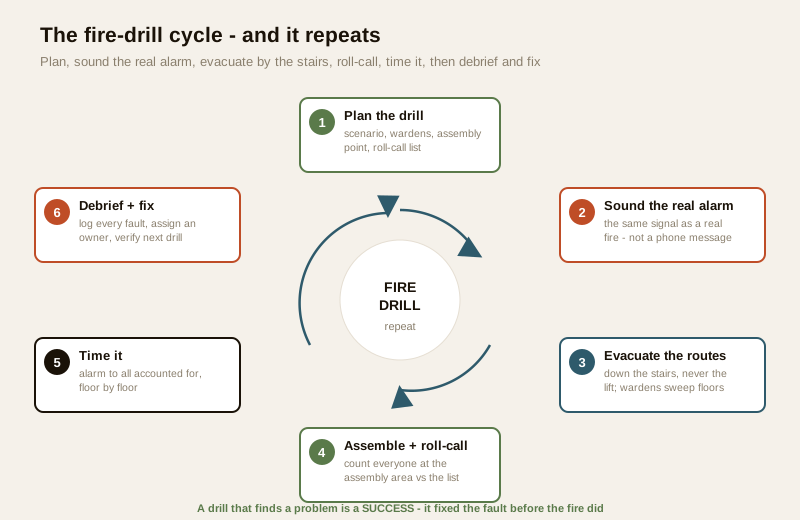
The six steps in that cycle are the spine of this guide, and the last one is the point of the whole exercise: a drill exists to find and fix problems before a real fire does. Hold that thought, because it inverts how most people judge a drill.
The honest India reality - the drill that never happens, or happens as a farce
In much of India, the fire drill exists in one of two failed states, and both are lethal.
The first is that it simply never runs. The plan is drawn, the NOC obtained, the notice board printed - and no drill is ever held. Staff turn over, new people arrive who have never walked the route, tenants change, and the building carries on for years never once having rehearsed the thing it will one day desperately need. On the day of the fire, nobody has ever done this before.
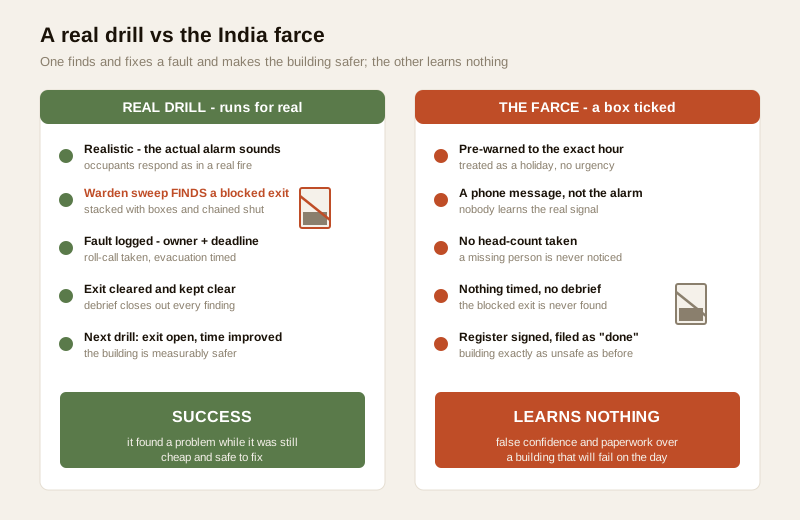
The second is worse, because it hands out false confidence: the drill runs, but as a farce. It is pre-announced to the day and hour so nobody is inconvenienced. The "alarm" is a WhatsApp message or a peon walking floor to floor, never the real sounder. People amble down at their own pace, treating it as a tea break. There is no roll-call, so nobody would ever know a person was left behind. Nothing is timed. Wardens are named on paper but have no vests, no torches and no idea they are meant to sweep the floors. And crucially there is no debrief - so the blocked exit, the alarm that could not be heard in the canteen, the confused warden, the locked terrace, all go unnoticed and unfixed. Everyone signs the register, the farce is filed as "drill conducted", and the building is exactly as unsafe as before, now with paperwork.
| The farce drill (learns nothing) | The real drill (builds the habit and finds faults) |
|---|---|
| Pre-warned to the exact time; treated as a holiday | Realistic; occupants respond to the alarm as they would to a real one |
| "Alarm" is a phone message or someone shouting | The actual building alarm sounds, exactly as in a real fire |
| People stroll down casually, no urgency | Occupants move promptly by the rehearsed escape routes |
| No head-count; nobody would notice a missing person | Full roll-call at the assembly area against a live list |
| Not timed | Evacuation timed, floor by floor, and recorded |
| No debrief; problems stay hidden | Structured debrief; every fault logged and assigned an owner |
| Filed as "done", building unchanged | A written record plus a corrective action list that improves the building |
The reframe that fixes all of this is a single sentence: a fire drill that uncovers a problem is not a failure - it is a success. A blocked exit found on a drill day is a blocked exit that will be open on the fire day. If your drills never find anything wrong, they are almost certainly farces, not drills.
Step one - plan the drill properly
A good drill is designed, not improvised. Before anyone is evacuated, the organiser - usually the facility manager or the appointed fire safety officer, working from the building's fire-escape plan - settles a handful of decisions.
- The scenario. Decide the pretend fire's location, because it changes the answer. A fire assumed at the main entrance forces people to use the alternative exit and tests whether they know it exists. Vary the scenario across drills so occupants do not simply memorise one route.
- The wardens. Confirm who the floor wardens and the chief warden are, that they know their roles, and that they have their high-visibility vests, torches and floor checklists ready. Their role has its own section below.
- The assembly point. Fix the assembly area - a safe, marked place clear of the building and of fire-tender access routes - where everyone gathers and is counted. Everyone must know which one is theirs.
- The roll-call basis. Decide how you will know who is in the building today: an attendance list, a visitor register, contractor sign-in sheets, the night-shift roster. You cannot account for people you never counted in.
- Special-needs planning. Identify in advance anyone who cannot use stairs unaided, and how they will be evacuated or moved to a refuge area - this must be planned, not discovered mid-drill.
- Safety of the drill itself. Brief people that it is a drill (for a planned drill), keep a warden at stair heads to prevent falls, and make sure medical help and the real emergency numbers are on hand in case a genuine incident occurs during the exercise.
Announced, unannounced, or a surprise drill?
There is a real tension here. A fully announced drill is gentle and good for a first attempt or for occupants who have never done one - it teaches the route without shock. But because everyone is braced for it, it flatters the building and hides how people really behave. An unannounced or surprise drill - where occupants do not know the day or hour - is far more honest, because it tests the genuine reaction: does the alarm actually rouse people from the basement plant room and the noisy canteen, do wardens act without prompting, does the crowd move or freeze? The mature pattern is to announce the first drills while people learn, then move to periodic surprise drills that test the habit for real. Whatever you choose, senior management, the wardens and building security must be briefed in advance so the surprise does not cause a genuine panic or a call-out of the fire brigade to a non-fire.
Step two and three - sound the real alarm and evacuate by the routes
The drill must begin with the actual building alarm - the same sounders and any voice-evacuation message occupants would hear in a real fire - not a substitute signal. This is deliberate: it teaches people to associate that specific sound with "leave now", and it simultaneously tests whether the alarm can in fact be heard everywhere, which is one of the most common faults a drill exposes.
On the alarm, occupants evacuate by the designed escape routes, and the non-negotiable rules of the fire-escape plan apply in full:
- Leave immediately on the alarm - do not stop to collect belongings, finish a task or investigate.
- Use the stairs, never the lift. Lifts can fail, open onto the fire floor, or trap occupants; the protected staircase is the escape route. A drill is where this rule is drilled into people who would otherwise instinctively press the lift call button.
- Move to the nearest safe exit, using the alternative route if the scenario blocks the usual one.
- Wardens sweep and shepherd - checking rooms, toilets and quiet corners on their floor, directing people to the correct stair, and being the last to leave their area once it is clear.
- Close doors behind the last person where the plan calls for it, to slow smoke and fire spread.
- Do not re-enter the building for any reason until the chief warden or fire officer declares it safe.
Non-ambulant occupants and anyone who cannot use the stairs follow the pre-planned route - assisted evacuation, evacuation chairs where provided, or holding at a designated refuge area for rescue - which is exactly why that was planned in step one rather than improvised now.
Step four and five - account for everyone, and time it
Getting people out is only half the job. The drill is not over until you know that everyone who was inside is now outside and accounted for - and this is the step India's farce drills omit entirely.
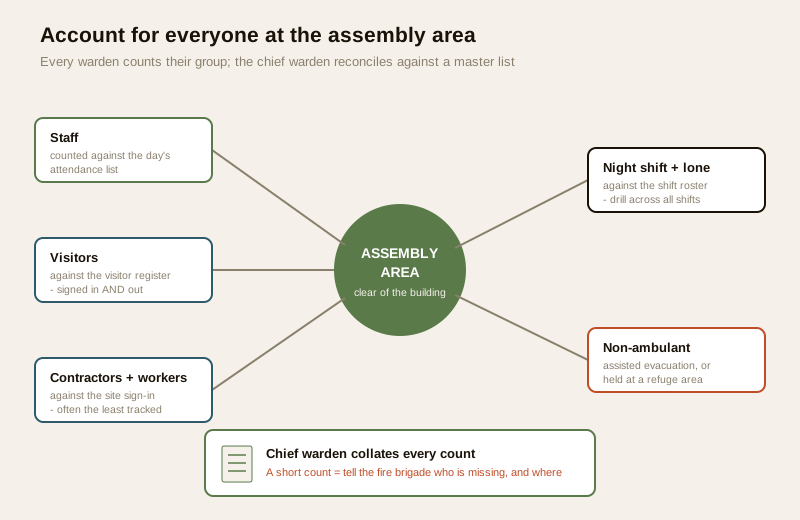
At the assembly area, each floor or zone warden reports their count to the chief warden, who reconciles it against a master list of everyone who should be in the building. The catch is that a real building holds far more people than the staff roster:
- Staff - counted against the day's attendance.
- Visitors - which is why a visitor register that logs people in and out matters; an unsigned-out visitor is a person you must assume is still inside.
- Contractors and their workers - often the least tracked and most at-risk group, working in plant rooms, basements and on terraces; they must sign in and be counted.
- The night shift and lone workers - drills too often run only in daytime, so the night-shift evacuation is never rehearsed and the security guard or lone operator is never in anyone's count. Run drills across shifts.
- Non-ambulant occupants - accounted for wherever the plan put them: outside, or safely holding at a refuge area awaiting rescue.
If the count comes up short, that is critical information a warden relays to the fire brigade on arrival - "one person unaccounted for, last seen on the third floor" can direct a rescue. On a drill it is a lesson; in a fire it saves a life.
And time it. Someone - usually the chief warden - starts a stopwatch when the alarm sounds and records when the last person is accounted for, ideally with floor-by-floor split times. The clock turns a vague sense of "that went alright" into a hard number you can compare across drills and against what the escape routes should deliver. A time that is slow, or that gets slower, is telling you something - a bottleneck at a stair, a warden who was slow to sweep, a door that jammed.
| What to measure or check on the drill | What a bad result is telling you |
|---|---|
| Total evacuation time (alarm to all accounted for) | Slow or worsening - a bottleneck, an unclear route, or hesitant occupants |
| Could the alarm be heard everywhere? | A silent zone - basement, canteen, plant room, terrace - is unprotected |
| Did everyone use stairs, not the lift? | Lift instinct not yet drilled out; more rehearsal or clearer signage needed |
| Were all exits usable and unlocked? | A blocked or locked exit found - a critical fault to fix at once |
| Did the roll-call reconcile? | A gap in who-is-in-the-building tracking (visitors, contractors, shifts) |
| Did wardens act correctly and sweep their floors? | Warden confusion or absence - retrain and re-equip |
| Were non-ambulant occupants moved as planned? | The assisted-evacuation plan is theoretical, not workable - revise it |
Step six - debrief and fix, or the whole drill was pointless
Everything up to now generates information; the debrief is where information becomes a safer building. Held soon after, while memories are fresh, the debrief gathers the organiser, the wardens and ideally some occupants and honestly reviews what happened. What went well? What went wrong? The alarm nobody in the canteen heard, the fire door that would not open, the warden who did not know he was meant to sweep the toilets, the crowd that hesitated at the ground-floor exit, the contractor nobody had counted, the evacuation time that was twice what it should be - all of it is captured.
Then, and this is the part that is almost always skipped, every issue is written down, assigned to a named owner, given a deadline, and fixed - and the fix is verified at the next drill. A blocked exit is cleared and kept clear. An inaudible alarm is reported to the fire-alarm maintenance contractor. A confused warden is retrained and re-equipped. This closes the loop of the drill cycle - and it is precisely why finding a problem is a success: the drill has done its job of surfacing a fault while it was still cheap and safe to fix. A drill filed as "conducted" with no findings and no actions has, in almost every real building, simply failed to look.
The fire wardens - the people who make a drill work
A drill without trained wardens is just a crowd leaving a building. The warden system is what gives an evacuation order, direction and accountability, and drilling is how wardens rehearse their own roles as much as occupants rehearse theirs.
- Floor or area wardens raise and pass on the alarm, direct their floor's occupants to the correct escape route, sweep every room, toilet and quiet corner to confirm it is empty, assist anyone who needs help, and are the last to leave their area, closing doors as they go. At the assembly point they report their headcount.
- The chief warden (or incident controller) takes overall charge at the assembly area: collates every warden's count against the master list, times the evacuation, decides when it is safe to re-enter, and is the single point of contact who briefs the fire brigade on arrival - including who, if anyone, is unaccounted for and where.
- Deputies and coverage. Because a fire will not wait for the named warden to be present, every warden role needs a trained deputy, and the roster must cover every shift, including nights and weekends. Wardens need to be identifiable (vests) and equipped (torch, checklist), which is why the drill also checks that this kit exists and works.
Warden competence is built through fire-safety training; the drill is where that training is exercised under realistic conditions and its gaps exposed.
Drills tailored to the setting - schools, hospitals, offices, hotels
A drill is not one-size-fits-all; the evacuation strategy differs by occupancy, and the drill must rehearse the strategy that actually applies.
- Schools rehearse a whole-population, teacher-led evacuation of children who need calm, firm direction, a class-by-class head-count against the register at the assembly point, and accounting for the youngest and any children with disabilities. Regular, practised drills matter enormously here because children respond superbly to a rehearsed routine and terribly to a novel emergency. See school fire safety.
- Hospitals usually cannot simply empty the building - patients are on beds, on ventilators, in surgery. The strategy is typically horizontal evacuation: moving patients through smoke barriers into an adjacent fire compartment on the same floor, away from the fire, rather than down the stairs, with vertical evacuation only if necessary. Hospital drills rehearse this staged, staff-intensive movement and the accounting of non-ambulant patients. See hospital fire safety.
- Hotels must rehearse evacuating guests who do not know the building and may be asleep - which puts the weight on the alarm, clear exit signage, in-room escape information and staff who guide guests out. Staff drills, run across all shifts, are the core. See hotel fire safety.
- Offices and apartments rehearse a broadly self-evacuating adult population, but still need wardens, roll-call, and particular attention to visitors, contractors and anyone needing assistance. See office fire safety and apartment fire safety.
Across all of them the emergency-preparedness framework sits above the drill, tying it into the building's wider readiness, and the fire-escape-plan builder helps set out the routes the drill rehearses.
How often - and why there is no universal number
Ask "how often must we drill?" and the honest answer is: as often as your rules require, which depends on your occupancy and jurisdiction, not on a number someone quotes on the internet. The National Building Code (SP 7 : 2026, Part 4) frames the requirement for evacuation planning and practice; the binding cadence and any mandatory format come from your State Fire Services Act and Rules, the conditions on your Fire NOC, and occupancy-specific requirements - higher-risk and higher-occupancy buildings (schools, hospitals, hotels, high-rises, malls) are generally required to drill more frequently and more formally than a small office. So verify the required frequency for your building with your fire consultant and the local fire department rather than adopting a figure at large.
What is universal is the shape of good practice: drill regularly and often enough that the habit stays fresh and every occupant has done it; drill across all shifts, not just convenient daytime hours; re-drill after significant change - new staff intake, a layout alteration, a new tenant; keep a written record of every drill (date, scenario, evacuation time, attendance, findings and corrective actions) both because your fire officer and insurer will want it and because the record is how you see whether you are actually improving. Use the fire-safety audit checklist to confirm drills are being held and recorded, and read the fire-safety inspection and fire-safety audit guides for how drills feed the wider governance that keeps a building safe over time.
Keep it governed - and involve the professionals. A fire drill is not a box to tick once for the Fire NOC and forget; it is a repeated rehearsal that must be planned, run realistically, honestly debriefed and improved on a cadence set by your occupancy and your State Fire Services Act and Rules, within the National Building Code (SP 7 : 2026, Part 4) framework. Design your evacuation strategy and your drill programme with a qualified fire-safety consultant, train your wardens properly, and where you can, invite the local fire department to witness a drill and advise - many will. Keep the written record, close out every finding, and treat a drill that exposes a fault as the success it is. The building that has genuinely rehearsed its escape is the one whose people get out when it matters; the building that only filed a "drill conducted" note is trusting to luck.
Key takeaways
- People do what they have rehearsed, not what a plan says - under real smoke and panic, occupants fall back on physical habit, so a practised fire drill, not a notice-board plan, is what actually gets them out.
- A real drill has six steps - plan the scenario and wardens, sound the actual alarm, evacuate by the stairs (never the lift), roll-call everyone at the assembly area, time it, then debrief and fix what failed - and it is the debrief-and-fix step that makes the whole thing worthwhile.
- Account for everyone, not just staff - the roll-call must reconcile against staff, visitors, contractors, the night shift and non-ambulant occupants; a short count is critical information for the fire brigade, and drills must run across all shifts.
- A drill that finds a problem is a success - a blocked exit, an inaudible alarm or a confused warden discovered on a drill day is a fault fixed while it is still cheap and safe; India's real danger is the drill that never runs, or the pre-warned farce with no roll-call that learns nothing.
- Frequency comes from your rules, not a universal number - drill as often as your occupancy, State Fire Services rules and Fire NOC require (schools, hospitals, hotels and high-rises more often and more formally), tailor the drill to the setting (school evacuation, hospital horizontal evacuation, hotel guest evacuation), keep a written record, and govern it forever.
References
- National Building Code of India, SP 7 : 2026 (the NBC), Part 4 "Fire and Life Safety" - the framework requiring means of egress, evacuation planning and the practised procedures a fire drill rehearses, by occupancy and building height; the older SP 7 : 2016 edition is withdrawn but still widely quoted. Verify the current edition via the BIS catalogue: https://www.services.bis.gov.in/
- The relevant State Fire Services Act and Rules and the Model Building Bye-Laws (MoHUA) - these set when fire drills, a fire warden system and evacuation records are legally required for a given occupancy, and the frequency and format that a Fire NOC and its renewal depend on; confirm the binding cadence for your building with your local fire department.
- IS 2189 : 2026, Bureau of Indian Standards - Selection, Installation and Maintenance of Automatic Fire Detection and Alarm System - relevant because the drill relies on and tests the building alarm and any voice-evacuation system whose audibility a drill routinely exposes. Verify the current edition via the BIS catalogue: https://www.services.bis.gov.in/
This is an educational overview, not legal advice, and not a substitute for a licensed fire-safety consultant, fire warden training or the local fire department. The frequency, format and conduct of fire drills, the fire warden system and the evacuation records for your building are governed by your occupancy, the National Building Code, your State Fire Services Act and Rules and your Fire NOC - engage qualified fire professionals and verify any standard's current status via the BIS catalogue before relying on it.
Export this guide
Related Guides — Deep-dive reading
Security for People Living Alone in India (2026): Calm, Practical Habits When There Is No Second Person to Notice
Living alone is an ordinary and growing part of Indian life - the student in a new city, the working single, the elder whose children are abroad, the person after a separation. It does not call for fear. It calls for a few deliberate habits, because there is no second person in the home to notice trouble, raise the alarm, or catch an accident. This is calm self-reliance, layer by layer.
SecurityAssembly Areas in India (2026): The Safe Muster Point Where Everyone Is Counted
The evacuation is not over when you reach the door - it is over when everyone is accounted for. This guide explains the assembly area, the muster point where the roll-call happens and no one is left inside.
SecurityFire Safety Audit in India (2026): The Independent Check That Proves You Are Actually Safe
A periodic, independent audit tests a building's whole fire provision against NBC Part 4 and the Fire NOC - and separates compliant-on-paper from safe-in-reality. This guide sets out what it covers, who does it, and why findings must be fixed, not filed.
SecurityRelated Tools — Try Free
Circadian Light Meter
Patient-centric circadian lighting visualizer for Indian healthcare design — time-of-day × intensity → CCT, melanopic lux (EML / mEDI), melatonin suppression, and an alertness curve. Calibrated against WELL v2 L03 Circadian Lighting Design, CIE S 026:2018, Brainard 2001, and Lucas et al. 2014.
Circadian ToolLift Safety Audit Checklist
Interactive checklist that scores your home lift on safety devices, compliance and upkeep.
ChecklistAcoustic Privacy (STC) Visualizer
Indian healthcare acoustic visualizer — compare wall assemblies and noise sources, see received SPL after STC attenuation, and check FGI 2018 / IS 1950 / NABH speech-privacy compliance with live dual-canvas waveform.
Acoustic Tool