
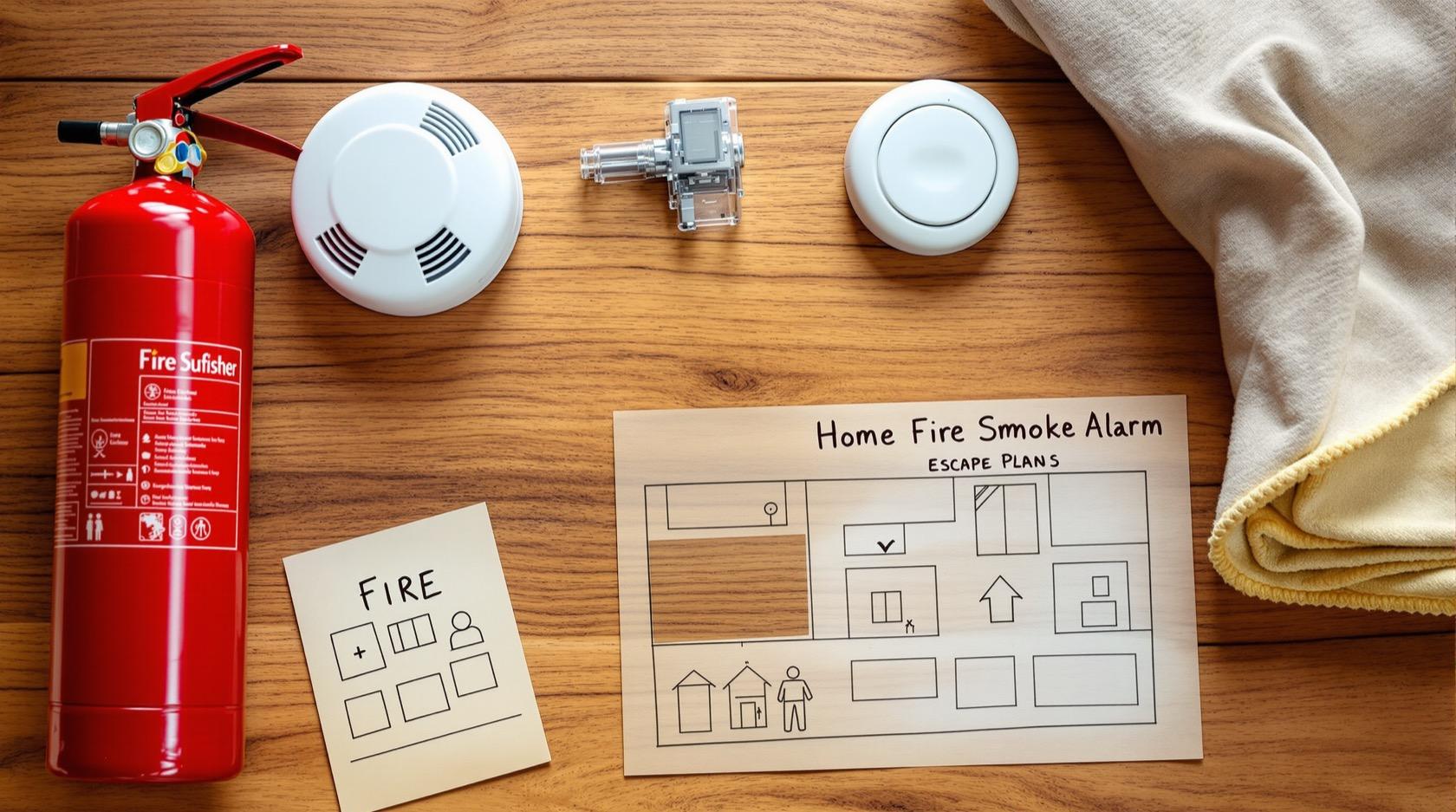
The Complete Guide to Fire Safety in India (2026): Prevention, Detection, Escape and Compliance
The definitive overview of fire safety for Indian homes and buildings: how fires start and spread, the four pillars of prevent, detect, suppress and escape, and where the law and a licensed professional take over.
Every serious fire is really a race against time, and the terrible truth is that most people lose it not to flame but to smoke, in the dark, seconds after they should have already been moving. Fire safety is the discipline of winning that race before it starts: making a fire less likely, learning of it in the first moments, having the means to smother a small one, and getting every person out through a route you planned while you were calm. This guide is the map to all of that for an Indian home or building, and it is the pillar that every other guide in the Studio Matrx fire safety library hangs off.
The honest starting point: most Indian homes have no smoke alarm and no extinguisher, and many buildings quietly defeat the protection they do have by locking an exit gate or wedging a fire door. This page sets out the realistic baseline every home should reach, explains what bigger buildings need by law, and is scrupulous about the line between what you can and should do yourself and what belongs to a licensed fire consultant and the State Fire Services.
Scope, compliance and safety — read this first. This guide helps you plan, specify, maintain and evacuate. It is strictly protective: it will never explain how to defeat any fire protection, and it warns plainly against the deadly mistakes people make. But the design, installation and certification of detection and alarm systems, sprinklers, hydrants, pumps, compartmentation and pressurization — and the statutory Fire No-Objection Certificate (Fire NOC) and occupancy certificate — are the work of licensed fire-safety consultants and contractors and your State Fire Services, never a DIY project. Where something is mandatory by law we say so; where it is good practice we say that too. Any work touching your electrical mains belongs to a licensed electrician — see the electrical hub. This is educational guidance, not legal advice.
How a fire starts: the fire triangle
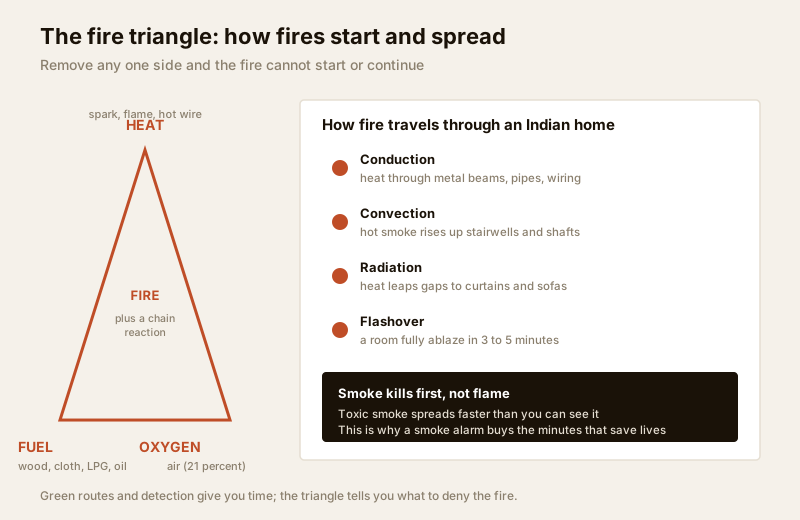
Every fire needs three things at once, and denying it any one of them is the whole basis of prevention and suppression. That is the fire triangle:
- Fuel — anything that burns: timber and furniture, cloth and curtains, paper, cooking oil, LPG, petrol, plastics, even the dust and lint behind an appliance.
- Heat — the source of ignition: a spark from faulty wiring, an overloaded socket, a gas flame, a discarded bidi or agarbatti, an overheating lithium battery on charge.
- Oxygen — ordinary air is 21 percent oxygen, more than enough.
Add a self-sustaining chemical chain reaction and you have fire. Take away any side of the triangle and it dies — cut the fuel (turn off the gas), remove the heat (cool it with water on a Class A fire), or smother the oxygen (a fire blanket over a pan). Understanding the triangle is why different fires need different extinguishers, a point we come back to below.
How fire spreads through a building
Knowing how a fire travels is what makes an escape plan realistic. Heat moves three ways — by conduction along metal beams, pipes and wiring; by convection as hot smoke rises up stairwells, lift shafts and service ducts; and by radiation, leaping across a gap to ignite curtains or a sofa without touching them. In a typical room a fire can reach flashover — the moment everything flammable ignites at once — in as little as three to five minutes. And long before flame reaches you, toxic smoke fills a room from the ceiling down, blinding and choking. Smoke, not flame, is what kills most fire victims. This single fact is why early detection matters more than anything else you can buy.
The four pillars of fire safety
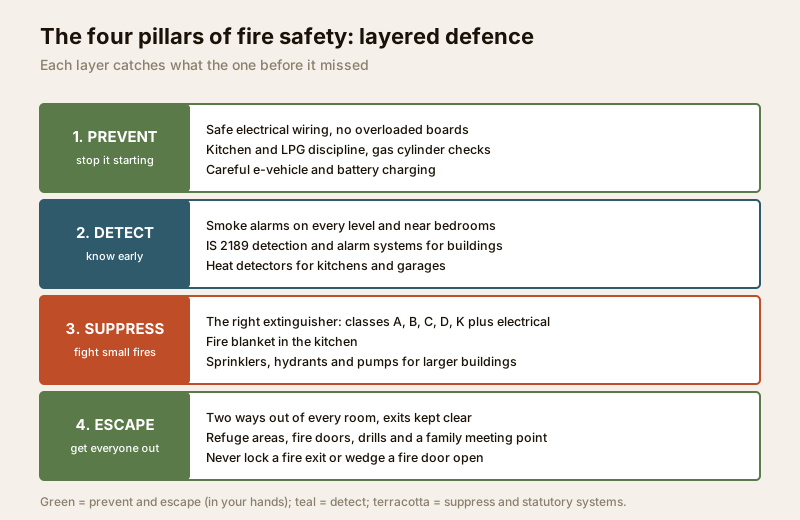
Good fire safety is not one measure but a layered defence, where each layer catches what the one before it missed. There are four pillars, in order: prevent, detect, suppress, escape. Everything in this library, and every other guide it links to, sits under one of them.
Pillar 1 — PREVENT: stop the fire starting
Most home fires are preventable, and prevention costs almost nothing. The big four ignition sources in Indian homes are electrical faults, the kitchen, LPG, and — increasingly — battery charging.
- Electrical hygiene. Overloaded extension boards, cheap non-ISI adaptors, cascaded multi-plugs, and ageing aluminium wiring cause a large share of home fires. Do not daisy-chain boards, do not run high-load appliances (geysers, irons, microwaves) off thin extension leads, and get warm switches, flickering lights or a tripping MCB investigated by a licensed electrician, not ignored. Fixed wiring is professional work; see the electrical hub.
- Kitchen discipline. The kitchen is where most home fires begin. Never leave a flame or hot oil unattended, keep dupattas and loose sleeves away from the burner, keep a fire blanket within reach, and never throw water on a burning pan of oil — it erupts. Smother it or use a Class K or dry-powder extinguisher.
- LPG safety. Check the cylinder connection and the rubber hose (replace it every couple of years and check the ISI mark), close the regulator knob at night and when away, and if you smell gas do not switch anything on or off — open windows, shut the regulator, and leave.
- E-vehicle and battery charging. Charge e-scooters, e-bikes and their lithium batteries on a hard, ventilated surface away from exits, using only the maker's charger, and never overnight in a stairwell or lobby that is also your escape route. A battery fire is fast, hot and hard to extinguish.
Pillar 2 — DETECT: know in the first moments
Because smoke moves faster than you can react while asleep, early detection is the highest-value thing most Indian homes are missing. For a home, this means a smoke alarm on every level and outside the bedrooms — an inexpensive, battery-powered device that will wake a sleeping family minutes before they would otherwise stir. Test it monthly and change the battery yearly; never remove one because it chirped or nuisance-tripped near a kitchen (fit a heat detector there instead).
For apartments, offices and larger buildings, detection becomes a proper automatic fire detection and alarm system designed to IS 2189 : 2026 — a network of smoke and heat detectors, manual call points, sounders and a control panel, designed, installed and maintained by professionals and tied into the building's life-safety systems. That is not a homeowner purchase; it is a specified, certified system. What a homeowner can do is keep their own alarm working and hold the building's AMC to account.
Pillar 3 — SUPPRESS: fight only a small fire
Suppression is for a fire that is still small and only if your escape route is behind you — never fight a growing fire; get out and call the fire brigade (dial 101). The core home tool is a portable fire extinguisher, and the single most important thing is matching its class to the fuel, because the wrong agent can make a fire worse. Fire classes in India:
| Class | Fuel type | Common examples | Suitable agent |
|---|---|---|---|
| A | Ordinary solids | Wood, paper, cloth, furniture | Water, foam, ABC dry powder |
| B | Flammable liquids | Petrol, diesel, paint, solvents | Foam, CO2, ABC dry powder |
| C | Flammable gases | LPG, CNG, methane | ABC dry powder (isolate the gas first) |
| D | Combustible metals | Magnesium, aluminium swarf | Special dry powder only |
| K | Cooking oils and fats | Deep-fryer, kadhai oil | Wet chemical (Class K), fire blanket |
| Electrical | Live electrical equipment | Wiring, appliances, panels | CO2 or dry powder — never water |
For a typical home, a multipurpose ABC dry-powder extinguisher plus a kitchen fire blanket covers the realistic risks; add a small CO2 or Class K option if you cook a lot with oil. Selection, installation and maintenance follow IS 2190 : 2024 and the extinguisher itself is built to IS 15683 : 2018. Learn the PASS technique — Pull the pin, Aim at the base, Squeeze the lever, Sweep side to side — and check the pressure gauge is in the green every month.
Bigger buildings add fixed suppression — automatic sprinkler systems designed to IS 15105 : 2021, wet and dry risers, hydrants, hose reels and fire pumps — whose thresholds are set by occupancy and height under the National Building Code. These are engineered, statutory systems installed and certified by licensed contractors, not something a resident specifies or maintains alone.
Pillar 4 — ESCAPE: get everyone out
If prevention, detection and a first-aid extinguisher all fail, the plan that saves lives is a rehearsed escape. The principles are the same for a flat, a villa or a school:
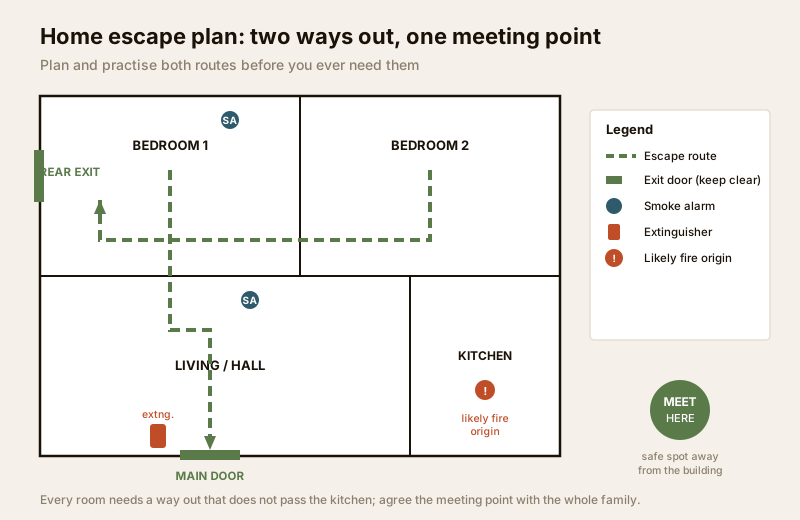
- Two ways out of every room and every floor. Never rely on a single staircase or a single door; single-staircase buildings are a known Indian death trap. From a bedroom, the second way out might be a window onto a flat roof or a second internal route that does not pass the kitchen.
- Keep every exit route clear, always. A corridor, stairway, landing or refuge area stacked with scooters, cartons, shoe racks or gas cylinders is a route that will fail you in smoke and darkness. This is the most common and most fatal failing in Indian buildings.
- Refuge areas and fire doors work only if respected. A fire door must self-close and stay shut to hold back smoke — never wedge or prop one open. A refuge area on a high floor is a place to wait for rescue, not a store room.
- Practise. Run a drill so children and elders know the routes in the dark; agree a meeting point well clear of the building where you count heads; and teach everyone the number 101 and Stop-Drop-Roll if clothing catches.
The deadly mistakes — never do these
Fire protection saves lives only when it is left to work. Across Indian buildings the same lethal shortcuts recur, and every one of them has killed:
- Never lock or block a fire exit. A padlocked collapsible gate on a stairwell traps everyone above it.
- Never wedge, prop or remove a fire door. It exists to stop smoke; open, it does nothing.
- Never disable, cover or paint over a smoke detector. A silenced alarm is no alarm.
- Never obstruct a stairway, corridor, landing or refuge area, and never park over a fire hydrant or across the fire-tender path. The brigade cannot save you if it cannot reach you.
The statutory layer: NBC, occupancy and the Fire NOC
Above the four pillars sits the law, and here the homeowner's job is to understand it and insist on it, not to design it. The framework:
- The National Building Code (NBC), published as SP 7. The NBC is India's model technical code, and its Part 4, "Fire and Life Safety" sets the fire requirements — travel distances, exit widths, staircase numbers, compartmentation, detection and suppression by occupancy. Cite the code via SP 7 : 2026; the older SP 7 : 2016 (NBC 2016) has been withdrawn, though it is still widely quoted in practice, so confirm you are working from the current edition.
- Occupancy classification. The NBC groups buildings by use — residential, educational, institutional (hospitals), assembly, business, mercantile, industrial, storage, hazardous — and the fire requirements scale with the occupancy's risk and the building's height. This is why a home, an apartment, an office and a hospital each need very different systems.
- The Fire NOC. Buildings above a threshold height or occupancy type must obtain a Fire No-Objection Certificate from the State Fire Services, confirming the fire systems and escape provisions meet the rules, and renew it periodically. This is a legal instrument obtained by qualified professionals; a resident's role is to check the building holds a current one.
- State law and bye-laws. Fire safety is enforced through each State Fire Services Act and Rules, the Model Building Bye-Laws (MoHUA), and the local municipal or development-authority fire rules — which is where the enforceable thresholds actually live.
The following table maps the honest requirement to the building type, from the home baseline up to a statutory high-rise.
| Building type | Realistic minimum | Typically statutory (professional + NOC) |
|---|---|---|
| Independent home | Smoke alarms, ABC extinguisher, fire blanket, two-way escape plan, LPG discipline | Rarely NOC-bound, but wiring and LPG must be safe |
| Apartment / high-rise | In-flat smoke alarm, extinguisher, know the building's exits and refuge | Detection and alarm, sprinklers/risers, hydrants, pressurized stairs, Fire NOC |
| Office / commercial | Extinguishers, marked exits, trained wardens, drills | Alarm system, suppression by area, Fire NOC, periodic audit |
| School / hospital / hotel | Above, plus assisted-evacuation planning for occupants who cannot self-rescue | Full engineered systems, compartmentation, Fire NOC, mandatory drills |
For the detail on each, see the dedicated guides for homes, apartments, offices, schools, hospitals and hotels, and the passive-protection guides on fire-rated doors, fire exit doors and smoke-control doors.
The honest India baseline every home should have
Strip away the high-rise engineering and here is the achievable, affordable standard every Indian home can reach this month — the level that turns a fatal fire into a survivable one:
1. A smoke alarm on each level and outside the bedrooms, tested monthly.
2. One ABC dry-powder extinguisher and a kitchen fire blanket, with everyone shown how to use them.
3. A written, practised escape plan with two ways out and a family meeting point.
4. Clear exits and safe habits — nothing blocking the door or stairs, LPG and electrical discipline, careful battery charging.
5. The fire brigade number, 101, saved and taught to children.
You can gauge where you stand with the home fire-safety scorecard, and pair fire readiness with all-hazard planning in the emergency-preparedness guide.
When the law requires a professional and a Fire NOC. You can and should plan your escape, keep smoke alarms and extinguishers, run drills and keep exits clear. But the moment a building needs a fire detection and alarm system, sprinklers, hydrants, pumps, pressurized staircases or compartmentation — which the National Building Code triggers by occupancy and height — that design, installation, certification and the Fire NOC from the State Fire Services must be handled by licensed fire-safety consultants and contractors. Do not treat any DIY measure as a substitute for a statutory system, and never accept a building without a current Fire NOC. If in doubt about what your building needs, ask a registered fire consultant and your local fire office.
Key takeaways
- Fire needs fuel, heat and oxygen — deny any one and it dies; and remember smoke, not flame, kills first, which is why early detection matters most.
- Fire safety is four layered pillars — prevent, detect, suppress, escape — and every measure, from a smoke alarm to a sprinkler system, belongs to one of them.
- The realistic Indian home baseline is smoke alarms, an ABC extinguisher and fire blanket, a two-way escape plan, a meeting point, and clear exits — achievable this month, and it saves lives.
- Match the extinguisher class to the fuel (A, B, C, D, K and electrical), fight only a small fire with your escape behind you, and dial 101 for anything more.
- Statutory systems and the Fire NOC belong to licensed professionals and the State Fire Services — and never lock an exit, wedge a fire door, disable a detector or block a stairway; those shortcuts kill.
References
- National Building Code of India, published as SP 7 : 2026, Bureau of Indian Standards — see Part 4, Fire and Life Safety for occupancy classification, escape provisions and fire-system requirements. The earlier SP 7 : 2016 (NBC 2016) is withdrawn; verify the current edition via the BIS catalogue: https://www.services.bis.gov.in/
- IS 2189 : 2026 (automatic fire detection and alarm systems), IS 2190 : 2024 and IS 15683 : 2018 (portable fire extinguishers), and IS 15105 : 2021 (fixed automatic sprinkler systems), Bureau of Indian Standards — confirm current status via the BIS catalogue: https://www.services.bis.gov.in/
- The State Fire Services Act and Rules of the relevant state, the Model Building Bye-Laws (MoHUA), and local municipal or development-authority fire rules govern occupancy and height thresholds, mandatory systems and the Fire NOC — check your state's and city's current requirements.
This is an educational overview, not legal advice, and it is not a substitute for a licensed fire-safety consultant. The design, installation and certification of fire-detection, suppression and compartmentation systems, and the statutory Fire NOC, are qualified professional and statutory tasks — engage licensed fire consultants, contractors and your State Fire Services, and verify any standard's current status via the BIS catalogue before relying on it.
Export this guide
Related Guides — Deep-dive reading
Security for People Living Alone in India (2026): Calm, Practical Habits When There Is No Second Person to Notice
Living alone is an ordinary and growing part of Indian life - the student in a new city, the working single, the elder whose children are abroad, the person after a separation. It does not call for fear. It calls for a few deliberate habits, because there is no second person in the home to notice trouble, raise the alarm, or catch an accident. This is calm self-reliance, layer by layer.
SecurityBathroom Fire Safety India: NBC 2016 Part 4, Fire-Rated Materials & Electrical Ignition
The bathroom is rarely thought of as a fire risk, yet it hides several: a leaky geyser element, an over-run exhaust-fan motor, cheap flammable PVC panels overhead, and aerosol cans stored beside a heat source. This is an honest, practical reference to fire and life safety in the Indian bathroom — the NBC 2016 Part 4 context that actually applies to homes, the real ignition sources, self-extinguishing false-ceiling and PVC materials, earth-leakage protection as fire prevention, escape considerations, and the carbon-monoxide danger of gas geysers.
BathroomsSmoke Barriers in India (2026): Holding Back the Smoke That Kills First
Smoke, not flame, disables and kills most fire victims and travels far faster and further - this guide explains the walls, doors and curtains that hold smoke back and keep escape routes tenable.
SecurityRelated Tools — Try Free
Electrical Safety & Load Audit
Home electrical audit — 10 categories, 65+ checkpoints across earthing, RCCB, MCB, wiring, switchboards, appliance circuits, DG/inverter backup.
Safety AuditCross-Ventilation Analyzer
Estimate airflow and air changes per hour (ACH) from room size, window areas, layout, and local wind — with NBC 2016 Part 8 compliance check.
Ventilation CalculatorChild & Elder Home-Safety Audit
Room-by-room safety audit for households with children or seniors — 10 categories, 70+ checkpoints tagged by audience.
Safety Audit