
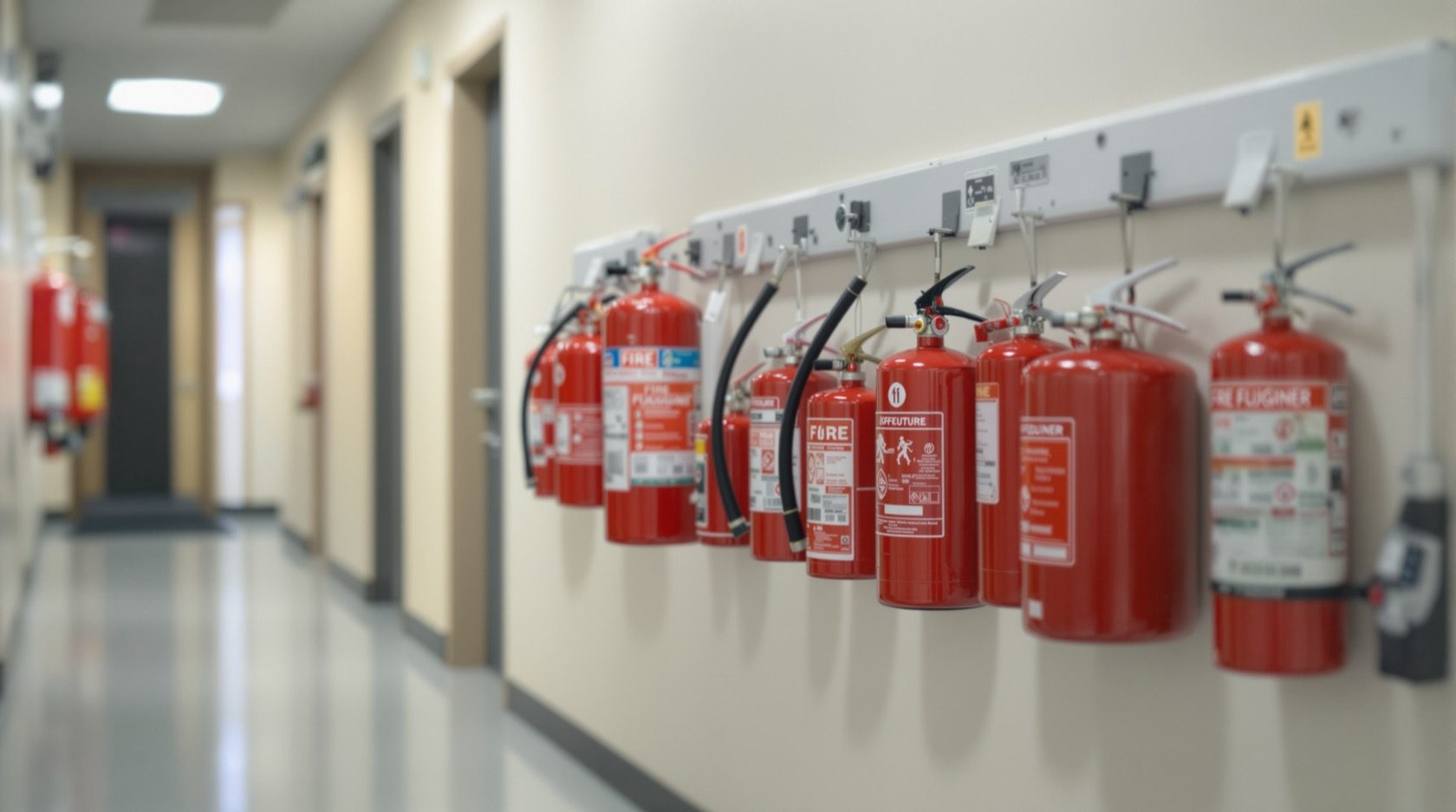
Fire Extinguishers in India (2026): Types, Fire Classes, PASS and the Right One to Buy
The umbrella guide to portable fire extinguishers in India: the fire classes, which agent kills which fire, the deadly wrong-agent mistakes, the PASS technique, and the realistic home kit that actually works.
A portable fire extinguisher is the one piece of active firefighting an ordinary person can pick up and use in the sixty seconds that decide whether a small flame stays small or takes the house. But it only works if two things are true: it is the right agent for the fire in front of you, and you are using it while the fire is still tiny. Get the match wrong and you can make things catastrophically worse — water on burning oil erupts into a fireball, water or foam on live electrical equipment can electrocute you. This is the umbrella guide to fire extinguishers in India: the fire classes, which agent puts out which class, the wrong-agent mistakes that kill, how to actually use one, and the honest, realistic kit for an Indian home.
This is the extinguisher pillar of Studio Matrx's fire-safety library, sitting under the complete guide to fire safety in India. Six companion guides go deep on each type — water extinguishers, foam extinguishers, CO2 extinguishers, dry chemical powder (ABC) extinguishers, wet chemical (Class K) extinguishers and the fire blanket. Read this one first: it is the map that tells you which of those you actually need.
Scope and safety — read this first. A portable extinguisher fights a SMALL, early fire only — nothing bigger than a wastebin. The order is always the same: raise the alarm and get everyone OUT first, call the fire brigade on 101 or 112, and only then, if the fire is small, you have a clear escape behind you, and you have the RIGHT extinguisher, tackle it. Keep your back to the exit. If it does not go out in the first few seconds, or the room is filling with smoke, drop the extinguisher and LEAVE. No possession is worth a life, and no fire is worth being trapped by. This guide is educational, not legal advice or a substitute for a licensed fire-safety professional.
The core idea: match the agent to the fire class
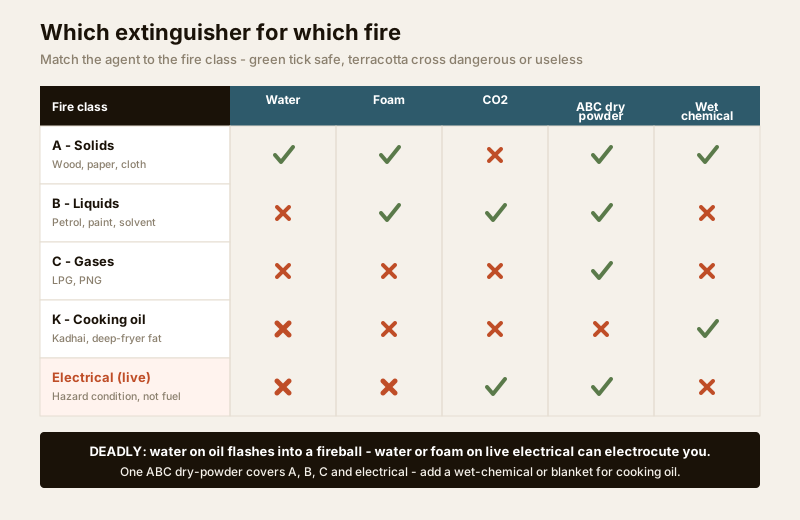
Every fire is classified by what is burning, because what is burning decides what will put it out. Use the wrong agent and, at best, it does nothing; at worst, it spreads the fire or electrocutes you. In the Indian and international system the classes are:
| Class | What is burning | Everyday Indian examples |
|---|---|---|
| Class A | Ordinary solids | Wood, paper, cloth, furniture, cardboard, dry leaves |
| Class B | Flammable liquids | Petrol, diesel, kerosene, paint, thinner, solvent, spirits |
| Class C | Flammable gases | LPG, PNG, other cooking or industrial gases |
| Class D | Combustible metals | Magnesium, sodium, aluminium swarf — specialist industrial only |
| Class K | Cooking oils and fats | Deep-fryer and kadhai oil, ghee, animal fat (also written Class F) |
| Electrical | Live electrical equipment | Wiring, switchboard, TV, charger, motor — a hazard condition, not a fuel |
That last row is the one people misunderstand. Electrical is not a fuel class — it is a hazard condition. The fire is really burning the plastic, oil or dust around live parts (usually Class A or B), but as long as the equipment is energised, any conductive agent (water, foam) can carry current straight back to you. So an electrical fire calls for a non-conductive agent (carbon dioxide or dry powder), and the first real fix is to cut the power. Once it is dead, treat whatever is left as its underlying class. The electrical fire-safety guide covers this hazard in full.
The extinguisher types and what each one is for
There are five agents you will meet in India, plus the fire blanket. Each has a colour band on the body (over a red cylinder, per the Indian standard) and a job it is good at — and jobs it must never do.
| Type (agent) | Puts out | NEVER use on | Where it fits |
|---|---|---|---|
| Water | Class A solids only | Oil (K), live electrical, flammable liquids, gas | Warehouses, paper/timber stores — rare in homes |
| Foam (AFFF) | Class A and Class B liquids | Live electrical, cooking oil (K), gas | Fuel stores, workshops, generator rooms |
| Carbon dioxide (CO2) | Live electrical and Class B liquids | Class A deep-seated, cooking oil (K), open outdoor fires | Server rooms, labs, near electrical panels |
| Dry chemical powder (ABC) | Class A, B, C and electrical | Cooking oil (K) — poor; delicate electronics | The all-round home and general-purpose choice |
| Wet chemical | Class K cooking oil (and Class A) | Live electrical (unless rated) | Commercial kitchens, deep-fryers |
| Fire blanket | Small oil-pan fire, burning clothing | A spreading room fire | Every kitchen — smother, no chemicals |
A few plain-language notes, each with its own deeper guide:
- Water extinguishers cool burning solids. They are cheap and effective on wood, paper and cloth — and lethal used anywhere else, because water conducts electricity and sinks under burning oil.
- Foam extinguishers blanket a burning liquid to cut off its oxygen, so they add Class B to what water can do. Still conductive — keep them off live electrics.
- CO2 extinguishers discharge a cold, non-conductive gas that displaces oxygen and leaves no residue, which is why they are the choice near live electrical equipment and sensitive electronics. They do little on deep-seated Class A and nothing lasting on oil.
- Dry chemical powder (ABC) extinguishers are the general-purpose workhorse: one unit covers Class A, B, C and electrical, which is why the single realistic home extinguisher is an ABC. The trade-off is a messy powder residue and poor performance on a deep fat fire.
- Wet chemical (Class K) extinguishers spray a fine mist that cools cooking oil and reacts with it to form a soapy seal over the surface — the right dedicated tool for a restaurant deep-fryer, where dry powder struggles.
- Fire blankets carry no chemicals at all: you smother a small pan fire or wrap a person whose clothes are alight. Every kitchen should own one, as the kitchen fire-safety guide explains.
The wrong-agent mistakes that kill
Three combinations turn a survivable fire into a fatal one. Learn them until the instinct is rewired.
- Water on a cooking-oil fire (Class K). Water is denser than oil and sinks to the bottom of the pan, where it instantly flashes to steam and expands roughly seventeen-hundred-fold, blasting burning oil upward as a fireball that can hit the ceiling and engulf the cook. Never water on oil — smother it with a blanket or lid and cut the heat.
- Water or foam on live electrical equipment. Both conduct electricity. Aim a jet at an energised switchboard, TV or charger and the current runs up the stream to your hands. Cut the power first; use CO2 or dry powder, never water or foam, while anything is live.
- The wrong single extinguisher bought for everything. Buying a plain water extinguisher "for the house" leaves you helpless — or worse — against the two fires an Indian home most often starts: cooking oil and electrical. The all-round answer is an ABC dry-powder unit, paired with a kitchen blanket.
How to use one: the PASS technique
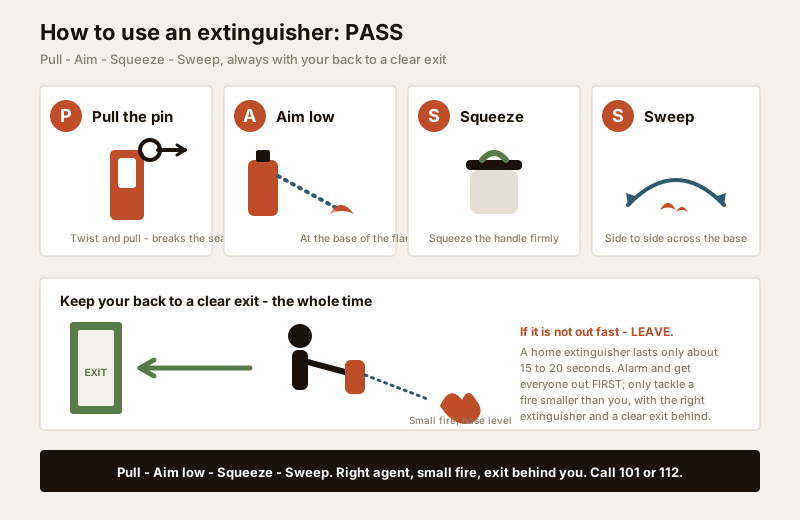
If — and only if — the fire is small, you have raised the alarm, and there is a clear exit behind you, an extinguisher is used the same way whatever the agent. Remember PASS:
1. P — Pull the pin. Twist and pull the safety pin from the handle. This breaks the tamper seal and frees the lever.
2. A — Aim low, at the base. Point the nozzle or horn at the base of the flames, not the tips. You are trying to cut off the fuel, not chase the smoke. Stand back about two to three metres to start.
3. S — Squeeze the handle. Squeeze the two levers together in a smooth, firm grip to discharge the agent. Releasing stops the flow.
4. S — Sweep side to side. Sweep the nozzle across the base of the fire, advancing as it dies down, until the fuel is fully covered.
Two rules frame the whole technique. First, keep your back to a clear exit the entire time, so you are never fighting a fire with the flames between you and the door. Second, a typical home extinguisher lasts only about ten to twenty seconds — if the fire is not out in that first burst, it has beaten you: put the extinguisher down and get out. Watch for re-ignition even after it looks out, especially with CO2, which offers no lasting blanket.
Buying the right extinguisher in India
An extinguisher is life-safety equipment, so buy it to standard and to the right rating — not the cheapest unmarked cylinder online.
- Look for the ISI mark and IS 15683 : 2018. Portable fire extinguishers sold in India are made to IS 15683 : 2018 (performance and construction). The ISI mark and a genuine BIS licence number are your proof the cylinder, valve and agent actually meet spec. An unmarked import may not hold pressure or discharge when you need it.
- Read the class rating on the label, not just the colour. The label states which classes it covers and a fire-rating number (for example a Class A and B rating). Match it to the fires that room can start: an ABC unit for general living areas, a CO2 near the meter board or a lot of electronics, a wet-chemical unit for a commercial kitchen.
- Size it sensibly. For a home, a two-to-four-kilogram ABC dry-powder extinguisher is the usual choice — big enough to matter, light enough to lift and control. Very large cylinders are hard to handle in an emergency.
- Selection, number and placement follow IS 2190 : 2024. How many extinguishers, of what type and rating, and where they go is set by IS 2190 : 2024 (selection, installation and maintenance of first-aid fire extinguishers). For a home this is common sense; for any commercial premises it is a statutory duty tied to the Fire NOC, the National Building Code (via SP 7 : 2026, Part 4 Fire and Life Safety) and your State Fire Services rules — get a licensed fire consultant to schedule it. The fire extinguisher selector turns the selection logic into a quick guided tool.
Placement, the monthly check and annual service
Owning an extinguisher is not the same as being protected. A depressurised or blocked-in extinguisher only looks like safety.
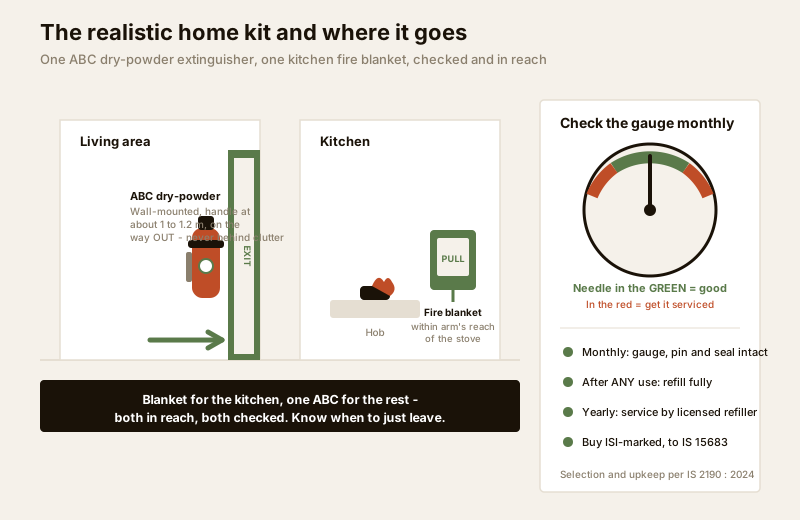
- Mount it where you can reach it. Wall-bracket the extinguisher at handle height (roughly a metre to 1.2 metres to the handle), on the escape route out of a room rather than deep inside the hazard, and never behind a door, curtain or stack of boxes. You should be able to grab it while moving toward the exit, not toward the fire.
- Check the pressure gauge every month. Most stored-pressure extinguishers have a small dial: the needle must sit in the green band. In the red — over- or under-pressure — it may not work; get it serviced. Also glance that the pin and tamper seal are intact and the body is not rusted or dented. This 30-second check is the single most valuable maintenance habit.
- Full service annually, refill after any use. Have every extinguisher professionally inspected and serviced once a year by a licensed refiller under IS 2190 : 2024, and refill it immediately after any discharge — even a one-second test burst can bleed enough pressure that it will not fire next time. A used extinguisher hung back on the wall is a decoration, not a defence.
| Interval | Who | What |
|---|---|---|
| Monthly | You | Gauge needle in green, pin and seal intact, no rust or damage, still accessible |
| After any use | Licensed refiller | Recharge and refill fully — never rehang a discharged unit |
| Annually | Licensed refiller | Full inspection, weigh/pressure-test, service per IS 2190 : 2024 |
| Periodically (per standard) | Licensed refiller | Hydrostatic pressure test / replacement at the standard's stated life |
The realistic Indian home kit
Here is the honest baseline, because most Indian homes have nothing, and many that do have a single expired cylinder wedged behind a cupboard.
- One ABC dry-powder extinguisher, ISI-marked to IS 15683, two to four kilograms, wall-mounted on the way out of the main living area, gauge checked monthly. It covers solids, flammable liquids, gas and electrical — the broadest single cover a home can buy.
- One fire blanket mounted within arm's reach of the stove, for the oil-pan fire and burning clothing — the one thing a kitchen must own, and never a job for a plain water or foam extinguisher.
- Know when to just leave. The extinguisher and blanket are for a flame you catch in its first seconds while everyone is already heading out. Anything bigger is the fire brigade's job, not yours.
That is it. A blanket for the kitchen, one ABC for the rest of the home, both checked and in reach — paired with working smoke detectors and an escape plan, it is the realistic, high-value setup the home fire-safety guide and the home fire-safety scorecard build on. Flats have the added layer of the society's common-area extinguishers and hose reels, covered in the apartment fire-safety guide.
Beyond portable extinguishers
A portable extinguisher is the human-scale end of firefighting. The larger fixed systems — automatic sprinklers, wet and dry risers, hydrants, hose reels, a kitchen hood-and-duct suppression system over a commercial range, and clean-agent systems for server rooms — are engineered installations governed by the National Building Code and the State Fire Services, designed and maintained by licensed professionals. This guide and its six type-specific companions stay at the portable, human scale; the fixed-system guides come next in the library. For any commercial or institutional premises, the extinguisher schedule sits inside that larger picture and the Fire NOC, as the commercial buildings security guide and the wider security library set out. Whatever the setting, none of it replaces the first move of every fire: raise the alarm, get out, and call 101 or 112 — the emergency preparedness guide covers that drill.
When to leave it to professionals. A homeowner can buy, mount and monthly-check a home extinguisher — you should. But the provision, selection, number, placement, servicing and refilling of extinguishers for any shop, office, restaurant, factory or society common area is the owner's statutory duty, discharged through a licensed refiller and certified under IS 2190 : 2024, the Fire NOC, the National Building Code (via SP 7 : 2026, Part 4) and your State Fire Services Act and Rules. Fixed suppression systems are engineered installs, not retail buys. Never rely on an unmarked or unserviced extinguisher, and never let firefighting come before getting people out.
Key takeaways
- Match the agent to the fire class. A solids, B liquids, C gases, K cooking oil, and electrical as a hazard condition — the wrong agent does nothing at best and, at worst, kills.
- Two mistakes are lethal: water on a cooking-oil fire flashes into a fireball, and water or foam on live electrical equipment can electrocute you — cut the power and use CO2 or dry powder near electrics.
- For a home, one ABC dry-powder extinguisher plus a kitchen fire blanket is the honest, high-value kit — the ABC covers solids, liquids, gas and electrical, the blanket smothers an oil-pan fire, and neither is water.
- Use it with PASS — Pull the pin, Aim low at the base, Squeeze the handle, Sweep side to side — always with your back to a clear exit, and leave if it is not out in the first burst.
- Buy to ISI / IS 15683, place, check monthly and service annually — gauge in the green, pin intact, refill after any use, all per IS 2190 : 2024; an expired or discharged extinguisher only looks like protection.
References
- IS 2190 : 2024 — Selection, Installation and Maintenance of First-Aid Fire Extinguishers (Portable and Mobile), Code of Practice, Bureau of Indian Standards — the core code for extinguisher selection, number, placement, servicing and refilling. Verify the current edition via the BIS catalogue: https://www.services.bis.gov.in/
- IS 15683 : 2018 — Portable Fire Extinguishers, Performance and Construction, Specification, Bureau of Indian Standards — the product standard behind the ISI mark on a genuine extinguisher. Verify the current edition via the BIS catalogue: https://www.services.bis.gov.in/
- National Building Code of India, SP 7 : 2026 (the NBC), Part 4 "Fire and Life Safety" — the framework setting extinguisher provision, fire ratings and the Fire NOC for buildings; the older SP 7 : 2016 edition is withdrawn but still widely quoted. Verify the current edition via the BIS catalogue: https://www.services.bis.gov.in/
- The relevant State Fire Services Act and Rules and the Model Building Bye-Laws (MoHUA) — these set when a Fire NOC and a scheduled extinguisher provision are legally required for a given premises, and who may service them.
This is an educational overview, not legal advice, and not a substitute for a licensed fire-safety consultant. Extinguisher provision, servicing and the Fire NOC for any commercial or institutional premises are qualified professional tasks — engage licensed professionals and the State Fire Services, and verify any standard's current status via the BIS catalogue before relying on it.
Export this guide
Related Guides — Deep-dive reading
Water Extinguishers in India (2026): Class A Only — and the Deadly Wrong Uses
The cheapest, simplest extinguisher cools solids brilliantly but can kill on the wrong fire. Here is where a water extinguisher belongs, and why oil, flammable liquids and live electrical are absolute no-go.
SecurityDry Chemical Powder Extinguishers in India (2026): The ABC All-Rounder Explained
The ABC dry powder is the most common extinguisher in India and the right single one for most homes and shops - it fights solids, liquids and gas, is safe on live electrics, but makes a corrosive mess.
SecurityFoam Extinguishers in India (2026): Class A & B, Where They Shine & the Electrical Caution
The AFFF foam extinguisher smothers burning solids and, crucially, flammable liquids like petrol, paint and solvent. Here is where it belongs, and the two fires it must never touch.
SecurityRelated Tools — Try Free
Fire Extinguisher Selector
The wrong extinguisher can make a fire worse. Pick a space and get the right extinguisher type(s) to consider — ABC powder, CO2, foam, wet-chemical, water or a fire blanket — matched to the fire class, with the deadly never-use warnings.
ExtinguisherAccess-Control Schedule Generator
Build the time schedules that decide when each access group can enter — an editable list for your integrator.
Time SchedulesElectrical Safety & Load Audit
Home electrical audit — 10 categories, 65+ checkpoints across earthing, RCCB, MCB, wiring, switchboards, appliance circuits, DG/inverter backup.
Safety Audit