
Fire Safety Training in India (2026): Teaching People to Prevent, React and Escape
A building can have every alarm, sprinkler and exit and still lose people, because nobody knew what to do. Fire safety training is the knowledge layer that makes the hardware work - tiered, inducted, refreshed and recorded.
A building can be perfect on paper - a certified fire-alarm system, a full set of extinguishers, pressurised staircases, lit exit signs, a marked assembly point - and still lose people in a fire, for one reason: nobody in it knew what to do. The alarm sounds and staff look at each other. The receptionist has never seen the panel that is now screaming at them. The person nearest the fire has never touched an extinguisher and does not know that this one is wrong for this fire. Half the floor heads for the lift. There is no fire warden to sweep the toilets and store rooms, no head-count at the gate, nobody to tell the fire brigade whether everyone is out. Every rupee spent on hardware is wasted in those first two minutes. Fire safety training is the knowledge layer that turns all of it from equipment into safety - it trains the people.
This is the training chapter of Studio Matrx's fire-safety library, sitting under the complete guide to fire safety in India. It is the companion to the fire drills guide - training is what you teach; drills are how you rehearse it - and it is written for facility managers, RWA committees, employers, school and hospital administrators, hotel operators and the fire-safety consultants they engage. The aim is a building where the right knowledge is in the right heads, kept fresh, and provable to an auditor.
Scope and safety - read this first. Fire safety training in a building is part of the fire and life-safety framework under the National Building Code (via SP 7 : 2026, Part 4 Fire and Life Safety) and the emergency-preparedness duties in your State Fire Services Act and Rules and the Model Building Bye-Laws (MoHUA), and it is increasingly checked in a statutory fire safety audit. Hands-on training - live extinguisher use, warden roles, working the alarm panel - should be designed and delivered by a competent trainer or fire-safety consultant, in coordination with the local fire department. This guide helps you plan, tier, induct, refresh and record that training; it is educational guidance, not legal advice. Nothing here overrides the one rule that beats every technique below: if a fire is beyond the earliest, smallest stage, do not fight it - raise the alarm, get everyone out, and call the fire brigade on 101 or 112.
Why training is the layer that makes everything else work
Fire safety is often bought as hardware and forgotten as knowledge. The systems are installed for the Fire NOC, certified, and then the human half - the part that actually operates in the first two minutes - is left untrained. This is the same "installed, not working" disease that afflicts fire-alarm maintenance and drills, except here the neglected component is people.
The honest India reality is stark. In a great many buildings the security guard or receptionist who will be first to the alarm panel has never been shown how to read it or silence a false alarm properly. Staff have never held an extinguisher, let alone discharged one, and do not know that the water type on the wall is lethal on an electrical or cooking-oil fire. There is no named fire warden on any floor. Kitchen staff have never been taught the class-K and hood-suppression basics. High staff turnover means that even where training once happened, the trained people left and were never replaced. And a lot of what passes for "training" is a signed attendance sheet from a session nobody remembers - paper compliance with no knowledge behind it. The whole point of a real training programme is to close that gap between the certificate and the competence.
The four tiers of fire safety training
Not everyone needs the same training, and pretending they do is why training programmes collapse under their own weight. The workable model is a tiered one: broad, thin awareness for absolutely everyone, then progressively deeper competence for smaller groups who carry more responsibility. Think of it as a pyramid - a wide base of basic awareness, then hands-on responders, then fire wardens, then a few role-specialists at the top.
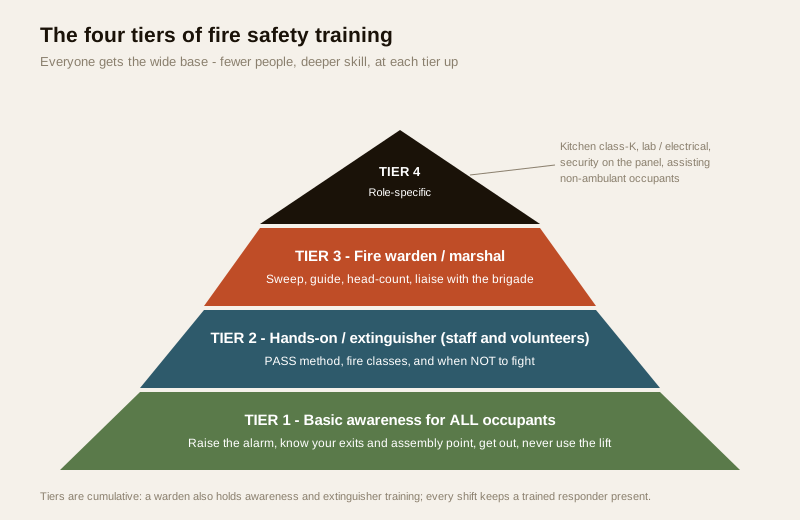
| Tier | Who | Depth | Core outcome |
|---|---|---|---|
| 1 - Basic awareness | Every occupant, resident, employee, student, guest-facing | Short, universal | Recognise the alarm, know the nearest exits and the assembly point, evacuate calmly, never use the lift |
| 2 - Hands-on / extinguisher | Volunteers, floor staff, security | Practical, refreshed | Use an extinguisher by the PASS method on a small fire of the right class - and know when not to |
| 3 - Fire warden / marshal | Nominated wardens per floor / zone | Role-based, drilled | Sweep the area, guide people out, do the head-count, liaise with the fire brigade |
| 4 - Role-specific | Kitchen, lab, electrical, security, carers | Task-tailored | The specific hazard and system for their job - class-K, panel operation, assisting non-ambulant people |
The tiers are cumulative: a fire warden also has the awareness and extinguisher training beneath them; a kitchen supervisor may sit in tiers 1, 2 and 4. What matters is that every single occupant has tier 1, that enough people per floor have tiers 2 and 3 that a shift is never left without a trained responder, and that anyone whose job carries a specific fire hazard has the matching tier-4 training.
Tier 1 - basic awareness for everyone
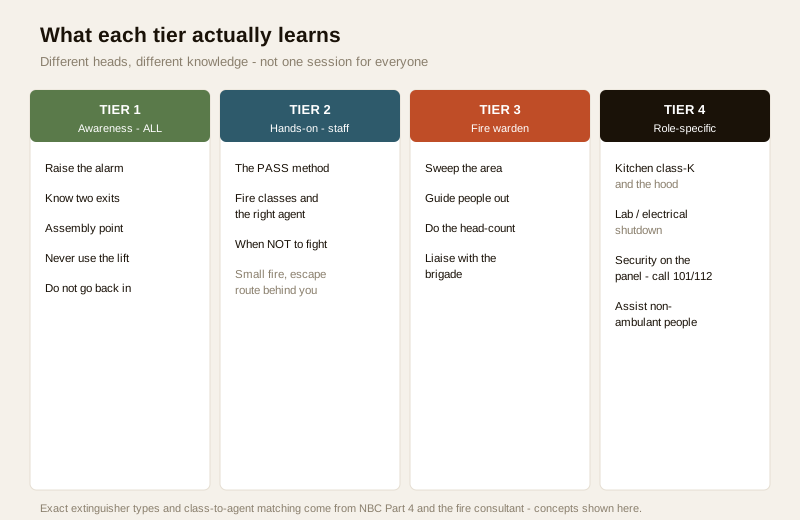
This is the tier that saves the most lives because it reaches the most people, and it is also the cheapest and most neglected. Basic awareness is not a course; it is a short, universal briefing that every person who spends time in the building should receive, whether they are a permanent employee, a contractor, a student or a long-term resident. It answers four questions, and no more: how do I know there is a fire, where do I go, how do I get out, and what must I never do.
The golden escape rules that every awareness briefing must land are simple and universal:
- Raise the alarm. Operate the nearest manual call point, shout fire, and do not assume someone else has already done it. Early warning is the single biggest determinant of who gets out.
- Know two ways out. Everyone should know the nearest exit from where they usually are, and a backup for when the nearest is blocked by fire or smoke - which is the whole logic of escape planning and emergency-exit planning.
- Go to the assembly point and stay. Move to the marked assembly area and remain there so the head-count works - drifting away makes people appear "missing" and sends responders back into danger.
- Never use the lift. Lifts can fail, open onto the fire floor, or fill with smoke; the staircase is the escape route, and in taller buildings a refuge area is where those who cannot descend wait for rescue.
- Do not stop, do not go back. No belongings, no returning for anything or anyone once out - a small fire can double in size in under a minute, and the people who go back are the ones who do not come out.
For a building's own occupants, tie the awareness briefing to the specific setting - the office, school, hotel, hospital or apartment guide each describes what awareness looks like there, and a home-fire-safety briefing for residents completes the picture. Guests and residents get an even shorter version: the hotel room-door notice, the apartment lobby poster, the reminder before a public event.
Tier 2 - hands-on extinguisher training for staff and volunteers
The second tier is where training stops being a talk and becomes a skill. A portable fire extinguisher is only useful in the hands of someone who has actually used one, on the right class of fire, and who has the judgement to know when to walk away instead. Reading the label on the day of the fire is far too late. This tier is for a defined group - floor volunteers, security staff, kitchen and workshop staff, anyone likely to be first to a small fire - not for everyone, because fighting a fire is a decision awareness-only occupants should not be encouraged to make.
Hands-on training has to cover three things together, because any one without the others is dangerous:
- The PASS method - Pull the pin, Aim at the base of the flames, Squeeze the handle, Sweep side to side - practised on a live or simulated fire so the hands remember it, not just the head.
- The fire classes and the right agent - that a water extinguisher is lethal on an electrical or cooking-oil fire, that class-K exists for kitchen fats, that carbon-dioxide and dry-powder have their own uses and limits. The fire-extinguishers guide sets out the class-to-agent matching this training must teach.
- When not to fight - the most important judgement of all. Fight only a small, contained fire, at the very earliest stage, with a clear escape route behind you and the alarm already raised. If the fire is bigger than a waste bin, if it is between you and the exit, if the room is filling with smoke, or if the first extinguisher does not knock it down - stop, get out, and let the brigade handle it.
| Fire class | Typical fuel | Common right agent (verify on the label) | Never use |
|---|---|---|---|
| A | Wood, paper, cloth, most solids | Water, foam, ABC dry powder | - |
| B | Petrol, oil, solvents, paint | Foam, CO2, ABC dry powder | Water jet |
| C | Flammable gases | Dry powder (isolate the gas supply first) | Water |
| Electrical | Live electrical equipment | CO2, dry powder | Water, foam |
| K | Cooking oils and fats | Class-K wet chemical | Water, CO2 (splash / re-ignition) |
The exact extinguisher types, ratings and placement for a given building come from NBC Part 4 and the fire consultant, not from this table - treat it as the concept the training must convey. And the training itself, especially any live-fire practice, must be run by a competent trainer with the right safety controls, never improvised.
Tier 3 - fire warden and marshal training
If tier 1 gets people out and tier 2 tackles the smallest fires, tier 3 is the tier that organises the evacuation itself. A fire warden - also called a fire marshal - is a nominated occupant, trained for the role, who takes charge of their floor or zone the moment the alarm sounds. Without wardens, an evacuation is a crowd; with them, it is a managed sweep that leaves nobody behind. Every floor or fire zone needs enough trained wardens (and deputies to cover leave and shifts) that one is always present when the building is occupied.
Warden training teaches four duties, performed in order:
- Sweep - move through the assigned area checking the places people get trapped or do not hear the alarm: toilets, store rooms, meeting rooms, quiet corners, closing doors behind to slow the fire and buy compartmentation time.
- Guide - direct people firmly and calmly to the nearest safe exit, steer them away from a stair that is filling with smoke to their backup route, and keep them off the lifts.
- Head-count - at the assembly area, account for the floor against a roster or a known headcount and identify anyone unaccounted for.
- Liaise - meet the fire brigade on arrival and hand over what only the warden knows: which areas are clear, who might still be inside and where, where the fire appears to be, and where the fire-tender access and hydrants are. The warden does not re-enter a burning building to search - that information goes to the professionals.
Warden training also covers the building's systems at an overview level - what the alarm panel is telling them, where the emergency lighting and exit signage lead, and how the voice-evacuation system supports their instructions - so that wardens work with the building's engineering, not against it. Wardens are the people most heavily exercised in fire drills, which is where their training is proven and their timing sharpened.
Tier 4 - role-specific training
The top tier is narrow and deep: training tailored to a specific job that carries a specific fire hazard or a specific fire-safety duty. A generic session cannot cover these; each needs its own content, delivered to the people who hold that role.
| Role | What their training must add |
|---|---|
| Kitchen and canteen staff | Class-K cooking-oil fires, the hood and duct fire-suppression system and how to trigger and never obstruct it, safe shutdown of gas and appliances, why water on hot oil is catastrophic |
| Laboratory and workshop staff | The specific chemicals, gases and processes present, correct extinguisher and shutdown for each, spill and containment basics, and why some fires must not be fought at all |
| Electrical and plant staff | Isolating power safely, electrical-fire agents, working around electrical hazards, and why de-energising often matters more than extinguishing |
| Security and reception | Reading and responding to the fire-alarm panel, verifying and handling alarms without disabling zones, calling the brigade on 101 or 112 with a clear location, and opening access and directing tenders |
| Staff who assist others | How to help non-ambulant, elderly, disabled or very young occupants evacuate or reach a refuge area - the buddy system, evacuation chairs, and never leaving an assisted person behind |
The security and reception role deserves emphasis because it is the most commonly neglected against its importance: these are the people physically nearest the panel and the phone, first to know and first to call, and in far too many Indian buildings they have had no training on either. A guard who can read the panel, call 101 correctly with the exact address and floor, open the gate for the tender and point the fire crew to the hydrants is worth more in the first five minutes than any single piece of hardware.
Induction, refreshers and the training records auditors check
Training is not an event; it is a cycle, and the cycle is what high staff turnover destroys. Two mechanisms keep it alive. The first is induction - every new joiner, on their first days and before they are left to work unsupervised, receives at least the tier-1 awareness briefing, learns the alarm, the exits and the assembly point for their actual workplace, and is told who the floor wardens are. In a high-turnover building this is the difference between a trained workforce and a building full of people who have never seen the plan. The second is periodic refreshers - awareness and warden training repeated on a defined cycle so that skills do not decay and so that the inevitable churn of people is caught up, with hands-on extinguisher practice refreshed regularly because it is a perishable physical skill.
And all of it must be recorded, because an untraceable training programme is, to an auditor, no programme at all. The record is not bureaucracy for its own sake - it is how you prove, to a fire officer, an insurer or a fire safety audit, that the right people were actually trained, and it is how you know who is due a refresher.
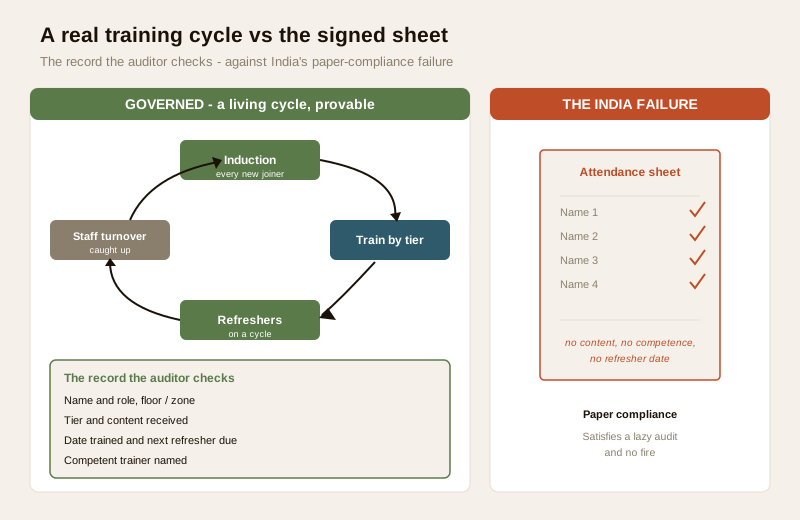
| What the record captures | Why it matters |
|---|---|
| Who was trained - name, role, floor/zone | Proves coverage - every occupant has awareness, every floor has wardens on every shift |
| What tier / content they received | Shows the training matched the role, not a one-size session |
| When - date of training and date of next refresher due | Drives the refresher cycle and flags lapses before they become gaps |
| Who delivered it and their competence | An auditor checks the trainer was competent, not just that a session happened |
| Drill participation and outcomes | Links training to rehearsal - see the fire drills guide |
The India failure to name plainly is the signed sheet - a training "record" that is nothing but an attendance list from a session that was a formality, with no content, no competence, and no knowledge left behind. A signed sheet satisfies a lazy audit and no fire. A real record ties a named person to a real session of defined content, delivered by a competent trainer, with a next-refresher date - and it is backed by drills that prove the training works. When a fire safety audit or inspection examines your training, this is exactly the difference it is looking for.
Who delivers the training
Awareness briefings and inductions can be delivered in-house by a trained facility team or a senior warden, and that is often the most sustainable model because it scales with turnover. But the deeper tiers - live extinguisher practice, warden training, role-specific hazard training - should be designed and led by a competent trainer or a fire-safety consultant, and many organisations bring one in to build the programme, train the trainers and wardens, and certify the sessions. The local State Fire Services often run community fire-safety outreach, demonstrations and training support, and coordinating with the fire department also builds the relationship that matters on the day of a real fire. Whichever route, the test is competence and a real transfer of skill - not a visiting vendor and a signed sheet. Tie the whole programme into the building's broader emergency-preparedness plan and its inspection and maintenance calendar so that trained people, working systems and rehearsed procedures all stay current together.
Keep it governed - and when the law or a hazard requires a professional. Fire safety training is not a box ticked once at handover; it is a living cycle of induction, refresher and record that must survive every staff change, and it is examined in a fire safety audit under your State Fire Services Act and Rules and the fire and life-safety framework of the National Building Code (SP 7 : 2026, Part 4). Deliver basic awareness and induction in-house if you can sustain it, but route live-fire extinguisher practice, fire-warden training and role-specific hazard training to a competent trainer or fire-safety consultant, and coordinate with the local fire department. Keep the records real - named people, defined content, competent trainers, refresher dates - and prove the training with drills. A building whose people are trained, refreshed and rehearsed is safe in a way that no quantity of unused hardware can match; a building of untrained occupants standing under a certified alarm is not.
Key takeaways
- Training is the layer that makes the hardware work - every alarm, extinguisher and exit is wasted if the people in the building do not know what to do in the first two minutes; fire safety training puts the right knowledge in the right heads.
- Tier the training - broad tier-1 awareness for every occupant (raise the alarm, two ways out, assembly point, never the lift, do not go back), hands-on tier-2 extinguisher training for volunteers and staff (PASS, fire classes, when not to fight), tier-3 fire-warden training (sweep, guide, head-count, liaise), and tier-4 role-specific training for kitchen, lab, electrical, security and carers.
- Fire wardens organise the evacuation - nominated, trained wardens per floor turn a fleeing crowd into a managed sweep with a head-count and a handover to the brigade; the warden never re-enters a burning building.
- Induct every new joiner and refresh everyone - high turnover destroys untended training, so awareness goes into induction and all tiers are refreshed on a cycle, with perishable extinguisher skills practised regularly.
- Keep real records and beware the signed sheet - who was trained, on what, when, by whom, with the next refresher due; a signed attendance sheet with no content or competence is what an auditor and a fire both see through - prove the training with drills.
References
- National Building Code of India, SP 7 : 2026 (the NBC), Part 4 "Fire and Life Safety" - the framework for fire and life safety, means of egress, and the fire-safety management and emergency-preparedness provisions within which occupant training, fire wardens and evacuation procedures sit; the older SP 7 : 2016 edition is withdrawn but still widely quoted. Verify the current edition via the BIS catalogue: https://www.services.bis.gov.in/
- IS 2190 : 2024, Bureau of Indian Standards - Selection, Installation and Maintenance of First-Aid Fire Extinguishers, Code of Practice - the reference behind extinguisher classes, agent selection and the competence expected of people trained to use them. Verify the current edition via the BIS catalogue: https://www.services.bis.gov.in/
- The relevant State Fire Services Act and Rules and the Model Building Bye-Laws (MoHUA) - these set the fire-safety management, emergency-preparedness, staff-training and record-keeping obligations for a premises, and increasingly the periodic fire safety audit and self-declaration provisions under which training records are examined; the State Fire Services also commonly provide community fire-safety training and outreach.
This is an educational overview, not legal advice, and not a substitute for a competent fire-safety trainer or consultant. Fire-warden training, live extinguisher practice, role-specific hazard training and any statutory fire safety audit are qualified professional tasks - engage a competent trainer or fire-safety consultant and the State Fire Services, and verify any standard's current status via the BIS catalogue before relying on it.
Export this guide
Related Guides — Deep-dive reading
Fire Safety Inspection in India (2026): The Routine Checks That Catch Failures Early
The cheap, frequent in-house walk-round - are exits clear, extinguishers charged, the alarm panel normal, fire doors closing - that catches the drift toward a neglected building before it can matter, and the log that proves you looked.
SecuritySecurity for People Living Alone in India (2026): Calm, Practical Habits When There Is No Second Person to Notice
Living alone is an ordinary and growing part of Indian life - the student in a new city, the working single, the elder whose children are abroad, the person after a separation. It does not call for fear. It calls for a few deliberate habits, because there is no second person in the home to notice trouble, raise the alarm, or catch an accident. This is calm self-reliance, layer by layer.
SecurityFire Drills in India (2026): Rehearsing the Escape So It Works Under Real Panic
Under real smoke people do what they have rehearsed, not what a plan says. This guide sets out how to run a proper fire drill - plan, alarm, evacuate, roll-call, time it, debrief - the Indian way it should be done.
SecurityRelated Tools — Try Free
Child & Elder Home-Safety Audit
Room-by-room safety audit for households with children or seniors — 10 categories, 70+ checkpoints tagged by audience.
Safety AuditElectrical Safety & Load Audit
Home electrical audit — 10 categories, 65+ checkpoints across earthing, RCCB, MCB, wiring, switchboards, appliance circuits, DG/inverter backup.
Safety AuditFire Door Rating Checker
See the likely fire-door rating (30/60/90/120 min) and components a location needs per IS 3614 / NBC — guidance, confirm with your architect.
Compliance Tool