

Fire Sprinkler Systems in India (2026): How They Work, Types & When NBC Requires Them
Automatic fire sprinklers control or extinguish a fire at its origin, day or night - and only the head over the fire opens, not the whole building. This guide explains wet, dry, pre-action and deluge systems and where the NBC requires them.
Of every fire-protection system a building can carry, the automatic fire sprinkler is the one that acts entirely on its own. It needs no person to notice the fire, no guard to open a valve, no fire brigade to arrive. When a fire grows hot enough beneath a head, that head opens and puts water directly onto the fire - at three in the morning, in an empty warehouse, during a power cut, whether anyone knows the building is burning or not. Sprinkler systems are, by a wide margin, the most effective fixed fire-protection a building can have, and in the occupancies where the National Building Code requires them they are not optional decoration but the core of the life-safety strategy.
This is the sprinkler chapter of Studio Matrx's fire-safety library, sitting under the complete guide to fire safety in India. It is written for the people who own, manage, develop or specify buildings - RWA committees, facility managers, builders, developers, and hospitality, healthcare and industrial owners - so you understand what a sprinkler system is, how it actually works, the four types and where each belongs, and how to tell a living system from one "installed for the NOC" and left to rot. It is not a design or installation manual: the hydraulics, spacing and commissioning are a licensed fire-protection engineer's work.
Scope and safety - read this first. A fire sprinkler system is a statutory, engineered installation - its hydraulic design, head spacing, hazard classification, installation, commissioning and certification are the work of a licensed fire-protection engineer and contractor, to IS 15105 : 2021 and the National Building Code (SP 7 : 2026, Part 4 Fire and Life Safety), and tied to the premises Fire NOC under your State Fire Services Act and Rules. Whether a building must have sprinklers, and of what design, depends on its occupancy, height and area - there is no single universal threshold. This guide is educational, not legal advice, and never a manual for draining, isolating or shutting down a system. If a fire starts, get everyone out and call the fire brigade on 101 or 112 - the sprinkler buys time, it does not replace evacuation.
Busting the Hollywood myth - only the head over the fire opens
The single most common misunderstanding about sprinklers comes straight from film and television, where one wisp of cigarette smoke sets off every head in the building and drowns the entire floor. This is wrong, and the truth is the whole point of how sprinklers work.
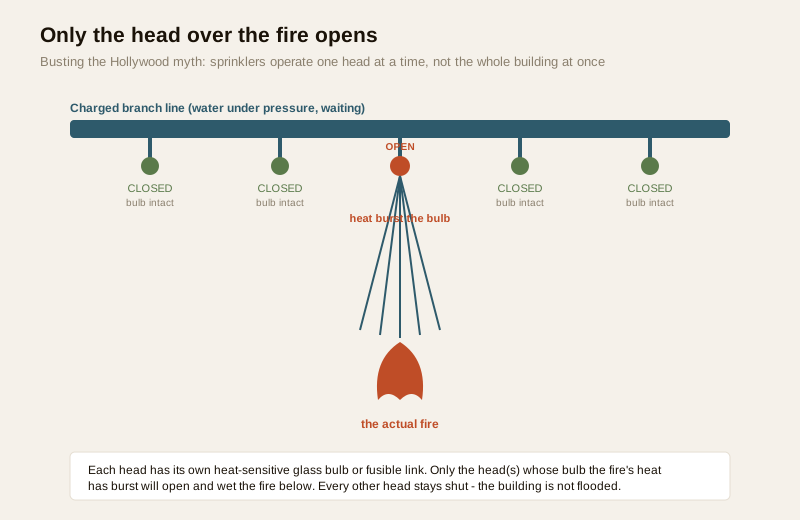
Each sprinkler head is an independent, self-contained device held shut by a small heat-sensitive element: either a liquid-filled glass bulb that shatters at a set temperature, or a metal fusible link that melts. The head stays closed until the air directly beneath it - and only there - gets hot enough to break that element. So in a real fire, only the head or heads immediately above the flames operate. The rest of the building's heads, even those a few metres away, stay firmly shut and dry.
This matters for three reasons. First, it means sprinklers put water exactly where the fire is and nowhere else - the water damage is a fraction of what people imagine, and far less than the fire (or the fire brigade's hoses) would cause. Second, it means the system's water supply only has to feed the small number of heads that actually open, not thousands at once - which is why the pump-and-tank sizing works at all. Third, it explains why a fire is so often controlled by just one or two heads before it can grow: the sprinkler hits it while it is still small, at its origin, which is the whole design intent. Statistically, a properly designed and maintained sprinkler system controls or extinguishes the overwhelming majority of fires with a handful of heads, long before the fire brigade arrives.
The one exception - a system where every head does open together - is the deluge system, and it is deliberately built that way for a specific high-hazard reason, covered below. For every ordinary building, the rule holds: one fire, the head(s) over it, and nothing else.
How a sprinkler head decides to open
A standard sprinkler head is a deceptively simple piece of engineering. Water is held back by a cap or seal, which is in turn held in place by the heat-sensitive element. The head does nothing - it is just a plugged nozzle - until heat arrives.
| Head element | How it triggers | Typical use |
|---|---|---|
| Glass bulb (liquid-filled) | The liquid expands with heat and shatters the glass at a rated temperature, releasing the seal | The common modern head; bulb colour indicates the rating |
| Fusible link (metal alloy) | A solder link melts at a rated temperature and lets the seal fall away | Older and industrial heads |
The temperature rating is chosen for the space: a normal room gets a head rated for ordinary temperatures, while a space that is routinely warm - a boiler room, a kitchen, a roof void under the sun - gets a higher-rated head so that everyday heat does not trip it. The rating is part of the fire engineer's design, not something to swap on site. Heads also come in different orientations (pendent hanging down, upright sitting up, sidewall from a wall) and different spray patterns, all selected to suit the ceiling and the hazard.
Crucially, a head can only ever open once. After a fire, every head that operated must be replaced with the correct type and rating - the system is not "reset", it is repaired back to full readiness by the contractor.
The four types of sprinkler system
People say "a sprinkler system" as though there is one kind. There are four, distinguished by what sits in the pipes and what has to happen before water reaches an open head. Choosing between them is a design decision driven by the building's temperature, the value and water-sensitivity of what is being protected, and the hazard level.
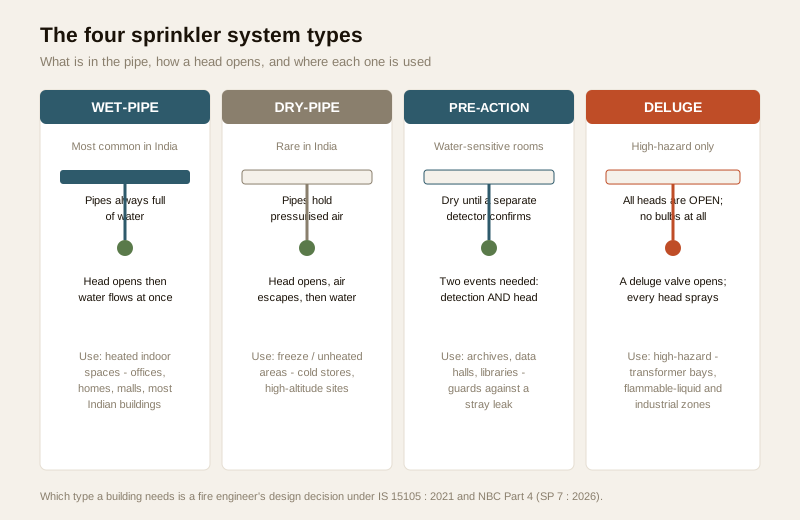
Wet-pipe - the default, and by far the most common in India
In a wet-pipe system the pipes are permanently full of water under pressure, right up to every closed head. When a head opens, water is already there and flows onto the fire instantly. It is the simplest, most reliable and cheapest system, and it is what the vast majority of Indian buildings - offices, apartments, malls, hotels, hospitals - use, because our indoor spaces stay above freezing. If you point at a sprinkler head in an Indian building, it is almost certainly fed by a wet-pipe system.
Dry-pipe - for spaces that can freeze
A dry-pipe system holds pressurised air (or nitrogen) in the pipes instead of water; the water is held back at a dry-pipe valve. When a head opens, the air escapes first, the valve trips, and water then fills the pipe and reaches the head - a short delay. Dry-pipe systems exist for one reason: to protect unheated spaces that could freeze, where water sitting in the pipes would freeze and burst them. In India this is genuinely rare - relevant mainly to cold-storage rooms, some high-altitude locations and certain freezer spaces - which is why most Indian fire professionals rarely see one.
Pre-action - for water-sensitive spaces like archives and data centres
A pre-action system is the careful cousin. Its pipes are normally dry, and it adds a second condition before water can ever enter: a separate fire-detection system (smoke or heat detectors, tied to the fire alarm panel) must confirm a fire and open a pre-action valve, AND a sprinkler head must open from the heat. Only when both happen does water reach the fire. This double-knock design exists to protect spaces where an accidental discharge would be catastrophic - archives, rare-book libraries, museums, server rooms and data halls - because a knocked or leaking head alone will not release water; the detection system has to agree there is really a fire first. For the most valuable IT spaces, a pre-action sprinkler often sits alongside, or is considered against, a clean-agent gaseous system that leaves no water at all.
Deluge - open heads for high hazard
A deluge system is the outlier that behaves like the myth - on purpose. Its heads are open (no bulb, no fusible link), and the water is held back at a deluge valve. When a separate detection system operates, the deluge valve opens and water pours from every head in the zone at once, blanketing the whole area. This is used only where a fire could spread across a surface almost instantly - transformer and cable areas, flammable-liquid handling, certain industrial and power installations - where wetting only the point of ignition would be too slow. Deluge is a specialist, high-hazard system, always engineered for the specific risk.
| System | In the pipes | What must happen to release water | Where it fits |
|---|---|---|---|
| Wet-pipe | Water, always | A head opens | Heated indoor spaces - most Indian buildings |
| Dry-pipe | Pressurised air | A head opens, air escapes, valve trips, water follows | Freeze-prone / unheated spaces - rare in India |
| Pre-action | Air (normally dry) | Detection confirms a fire AND a head opens | Water-sensitive - archives, data halls, museums |
| Deluge | Nothing (open heads) | Detection opens the deluge valve; all heads flow | High-hazard - transformers, flammable liquids |
Hazard classification and coverage - why spacing is engineered
You cannot simply dot sprinkler heads across a ceiling. How many heads, how far apart, and how much water each must deliver all flow from the building's hazard classification - a formal grading of how severe a fire in that space could be, set out in IS 15105 : 2021 and the NBC.
Broadly, spaces are graded as light hazard (low fire load and slow-spreading - offices, schools, hospital wards, most residential), ordinary hazard (moderate - shops, general manufacturing, car parks, restaurants) and high or extra-high hazard (severe and fast - flammable-liquid stores, high-piled warehousing, certain industrial processes). The higher the hazard, the closer the heads, the more water per square metre, and the more heads the system must be able to feed at once - which in turn drives the size of the pumps and the tank.
| Hazard class (indicative) | Typical spaces | Design implication |
|---|---|---|
| Light hazard | Offices, homes, hospital wards, schools | Widest head spacing, lowest water density |
| Ordinary hazard | Shops, restaurants, car parks, general industry | Closer spacing, higher density |
| High / extra-high hazard | Flammable-liquid stores, high-rack warehousing, heavy industry | Tightest spacing, highest density, largest supply |
The exact spacings, water densities, area of operation and pipe sizes are the fire engineer's hydraulic calculation for that specific building - the numbers above are only the shape of the logic, not values to design from. Getting them wrong makes a system that looks complete but cannot actually control the fire it was built for, which is why this is professional work, verified against IS 15105 and NBC Part 4 and signed off for the Fire NOC.
The valve set, the flow switch, and the tie to the fire alarm
A sprinkler system is far more than heads and pipes. At the base of the riser sits the control valve set - the main isolation valve (kept locked in the open position, because a shut sprinkler valve is one of the deadliest failures a building can have), an alarm valve, and a flow switch that senses water actually moving in the pipes. The moment a head opens and water starts to flow, the flow switch signals the fire alarm panel, which sounds the building alarm and can notify a monitoring station - so the sprinkler operating is not a silent event that nobody discovers until the ceiling caves in. This tie between the suppression system and the detection-and-alarm system, built to IS 2189 : 2026, is what turns a sprinkler discharge into a coordinated building response: water on the fire, alarm to the occupants, signal to the responders.
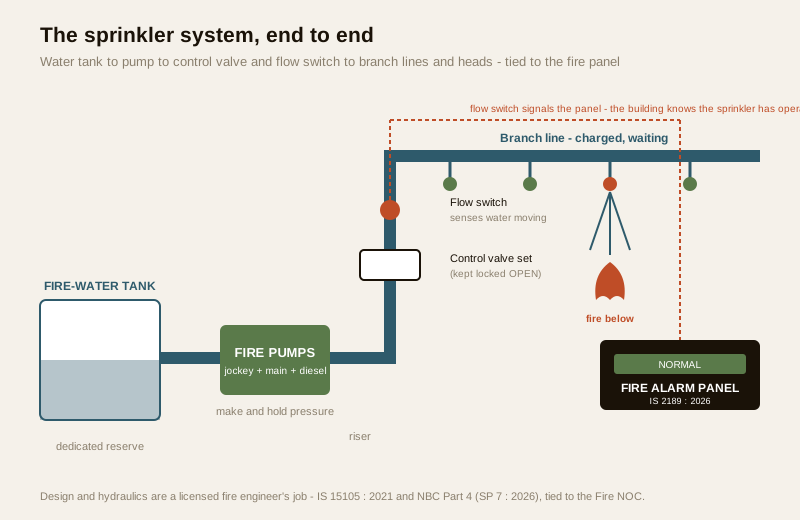
And a sprinkler system is only ever as good as what feeds it. The heads and pipes are useless without a reliable supply of water at the right pressure, which is the job of the fire pumps - typically a jockey pump holding system pressure, a main pump that starts on demand, and a diesel-driven standby pump that runs when the power fails - drawing from a dedicated fire-water tank whose reserve is sized so the system can run long enough for the fire brigade to arrive. In India, where power cuts are routine, the diesel standby pump and the tank reserve are not luxuries; they are the difference between a system that works during the outage that so often accompanies a fire and one that fails exactly when needed. The sprinkler heads, the pumps and the tank are one continuous system - study all three together, and never let the hydrants and hose reels (internal hose reels, fire hydrants) that usually share the same pump and tank fall out of that picture either.
For water-mist protection - a related but distinct technology that uses very fine droplets and far less water, increasingly used for specific risks and heritage spaces - see the water-mist systems guide. For cooking-line protection over commercial kitchen ranges, the specialist system is kitchen-hood suppression, not sprinklers.
Where the NBC requires sprinklers - and where they matter most
Whether a building must have a sprinkler system is not a matter of choice or a single magic number. It is set by the National Building Code (SP 7 : 2026, Part 4) and the State fire rules, and it depends on the building's occupancy type, its height, and its area - among other factors. A tall office tower, a large mall, a hospital, a hotel, an underground car park and a big warehouse are the kinds of occupancies where automatic sprinklers are typically required; a small low-rise building may not be. The only correct answer to "do I need sprinklers?" is: it depends on your building's classification under NBC Part 4, and that determination - and the design that follows - is made by a fire consultant and confirmed for the Fire NOC. Do not take any threshold quoted online, including any in this guide, as the rule for your building.
Where sprinklers are required, they become central to the fire strategy in exactly the settings covered elsewhere in this library:
- In a high-rise building, sprinklers control a fire on its floor of origin, buying the time that phased evacuation and fire-brigade access depend on.
- In a basement or underground car park, where smoke and heat build with nowhere to vent and access is hard, automatic sprinklers are often the primary means of controlling a fire.
- In a hospital, where many occupants cannot self-evacuate, sprinklers holding a fire in check are part of the defend-in-place strategy.
- In a hotel and a large office, sprinklers protect sleeping or unfamiliar occupants and large open floor plates.
Sprinklers do not replace the rest of the system - the fire extinguishers for first-aid firefighting, the detection and alarm that warns people, the escape routes that get them out. They are the automatic layer that fights the fire itself while everything else does its job.
The India reality - "installed" is not "working"
Here is the hard truth that this whole library keeps returning to, and it is at its most dangerous with sprinklers because they look permanent and maintenance-free. A building installs a sprinkler system to get its Fire NOC, and then - because nothing appears to be wrong - nobody touches it again. Years later, when a fire finally comes, the system that passed its inspection does nothing. The failures are depressingly consistent:
| Neglect - the deadly reality | Why the system then fails |
|---|---|
| The main control valve is quietly shut (often after maintenance or a leak) | No water can ever reach any head - the entire system is dead while looking intact |
| The fire-water tank is empty or the reserve is being used for other supply | Heads open onto a fire but nothing comes out |
| The fire pumps never start - jockey pump dead, no auto-start, no diesel backup | No pressure, so even a full tank cannot feed the heads, especially during a power cut |
| Sprinkler heads painted over, or boxed in by false ceilings, racking or ducting | A painted or obstructed head cannot sense heat or spray - it is a dummy |
| Heads left in place after a discharge, or wrong-rated heads fitted | The system cannot operate correctly on the next fire |
| No AMC, no flow-switch test, no valve check, no log book | Nobody knows any of the above until the fire exposes it |
Every one of these is a maintenance failure, not a design failure, and every one is fixable through a competent contractor and an Annual Maintenance Contract. A sprinkler system needs its valves confirmed open and locked, its flow switches tested, its pumps run and its tank kept full, its heads kept clear and unpainted, all on a schedule and all logged - the same discipline the apartment and office fire-safety guides set out for every fixed system. Use the fire-suppression system selector to think through what class of system a space needs, the home fire-safety scorecard to sense-check a building's overall fire posture, and the emergency-preparedness guidance to tie suppression into the evacuation plan. For the electrical faults that start so many of the fires sprinklers are meant to catch, see the electrical guides and the electrical fire-safety guide.
Never drain, shut or isolate the system - keep it live and under an AMC. A sprinkler system protects the building only while it is charged, pressurised, its valves locked open, its pumps ready and its tank full. Draining pipes, shutting the control valve, leaving a discharged system un-repaired or a pump in permanent manual-off turns a life-safety system into a decoration - and does it silently, so the building looks protected until the day it is not. Isolating a valve or draining a zone is a temporary, logged step taken by the licensed contractor during maintenance and reversed the moment the work is done - never a standing state. Route all design, installation, modification, commissioning and periodic testing to a licensed fire-protection engineer and contractor, certified to IS 15105 : 2021 and NBC Part 4 (SP 7 : 2026) and tied to your Fire NOC. What is on the owner and manager is the discipline: keep it live, keep it maintained, keep the log, and never buy convenience by shutting a valve.
Key takeaways
- Only the head over the fire opens - each sprinkler head is triggered independently by its own heat-sensitive glass bulb or fusible link; the myth that one alarm floods the whole building is false, and this is precisely why sprinklers put water only on the fire, at its origin, day or night.
- There are four types - wet-pipe (pipes always charged, by far the most common in India), dry-pipe (pressurised air, for freeze-prone spaces, rare here), pre-action (dry until a separate detector confirms a fire, for archives and data halls) and deluge (open heads, all flow at once, for high hazard).
- Spacing and water density are engineered from the hazard class - light, ordinary or high hazard drives the head spacing, the water per square metre and the size of the pumps and tank; these are a fire engineer's hydraulic calculation to IS 15105 : 2021 and NBC Part 4, not values to guess.
- The system is only as good as its pumps, tank and valve set - a locked-open control valve, a flow switch tied to the fire alarm panel, working fire pumps with diesel standby and a full fire-water tank are all part of one system; a shut valve, dry tank or dead pump makes complete heads useless.
- "Installed" is not "working" - shut valves, empty tanks, dead pumps, painted and obstructed heads and no AMC are the deadly India reality; keep the system live, maintained and logged, and route all design and work to a licensed fire-protection engineer certifying to IS 15105 : 2021 and the Fire NOC.
References
- IS 15105 : 2021, Bureau of Indian Standards - Design and Installation of Fixed Automatic Sprinkler Fire Extinguishing Systems, Code of Practice. The core code governing sprinkler system types, head selection, hazard classification, spacing, water density, the control valve set and the installation and testing of automatic sprinklers in India. Verify the current edition via the BIS catalogue: https://www.services.bis.gov.in/
- National Building Code of India, SP 7 : 2026 (the NBC), Part 4 "Fire and Life Safety" - the framework that determines whether automatic sprinklers are required for a building by occupancy, height and area, together with the fire-water storage and pumping provisions that feed them; the older SP 7 : 2016 edition is withdrawn but still widely quoted. Verify the current edition via the BIS catalogue: https://www.services.bis.gov.in/
- IS 2189 : 2026, Bureau of Indian Standards - Selection, Installation and Maintenance of Automatic Fire Detection and Alarm System, Code of Practice - governing the flow switches, detection and fire-alarm interface that a sprinkler system (and especially a pre-action or deluge system) is monitored by and integrated with. Verify the current edition via the BIS catalogue: https://www.services.bis.gov.in/
- The relevant State Fire Services Act and Rules and the Model Building Bye-Laws (MoHUA) - these set when a Fire NOC and a certified, maintained automatic sprinkler system are legally required for a given premises, and the periodic maintenance obligations that follow.
This is an educational overview, not legal advice, and not a substitute for a licensed fire-protection engineer or fire consultant. Sprinkler system design, hydraulics, hazard classification, installation, commissioning, the Fire NOC and any statutory maintenance are qualified professional tasks - engage licensed fire professionals and the State Fire Services, and verify any standard's current status via the BIS catalogue before relying on it.
Export this guide
Related Guides — Deep-dive reading
Sprinkler System Maintenance in India (2026): Keeping a Life-Safety System Ready
A fire sprinkler system is a life-safety installation that must work on the one day it is needed — this professional guide covers the scheduled checks, statutory tests and record-keeping that keep a wet, dry or pre-action system live: water supply and pressure, valves in the correct open position, control and alarm valves, sprinkler heads kept clear, and the roles of the competent fire contractor versus the facility manager.
SecurityVoice Evacuation Systems in India (2026): PAVA, Phased Messages & Intelligibility
Why malls, hotels, hospitals, airports and high-rises replace the bell with spoken instructions - how a voice-alarm (PAVA / EVAC) system tells people exactly what to do, floor by floor, and why intelligibility, zoning and standby power decide whether it works.
SecurityHigh-Rise Fire Safety Requirements in India (2026): Why Height Changes Everything
As a building gets tall, a whole layer of fire and life-safety systems stops being optional and becomes the reason the building is legal to occupy. A plain-language guide for professionals to what generally kicks in with height, why, and who to verify it with.
SecurityRelated Tools — Try Free
Rainwater Tank Sizer
How big should your rainwater tank be? Computes annual harvest, recommended tank capacity in litres, water-bill savings, and payback — for 10 Indian cities.
RWH CalculatorSmoke Detector Quantity Calculator
How many smoke detectors does a floor need? Enter the area, the coverage per detector and the enclosed rooms and stair landings to get the total — the greater of the area count and the per-space minimum. An indicative planning estimate; a fire consultant designs to NBC.
Detector CountBurglar Alarm System Selector
Answer a few questions about your property, cabling, coverage, monitoring and power and get the right burglar alarm — wired / wireless / hybrid, self or professionally monitored — with the design non-negotiables.
Alarm Selector