
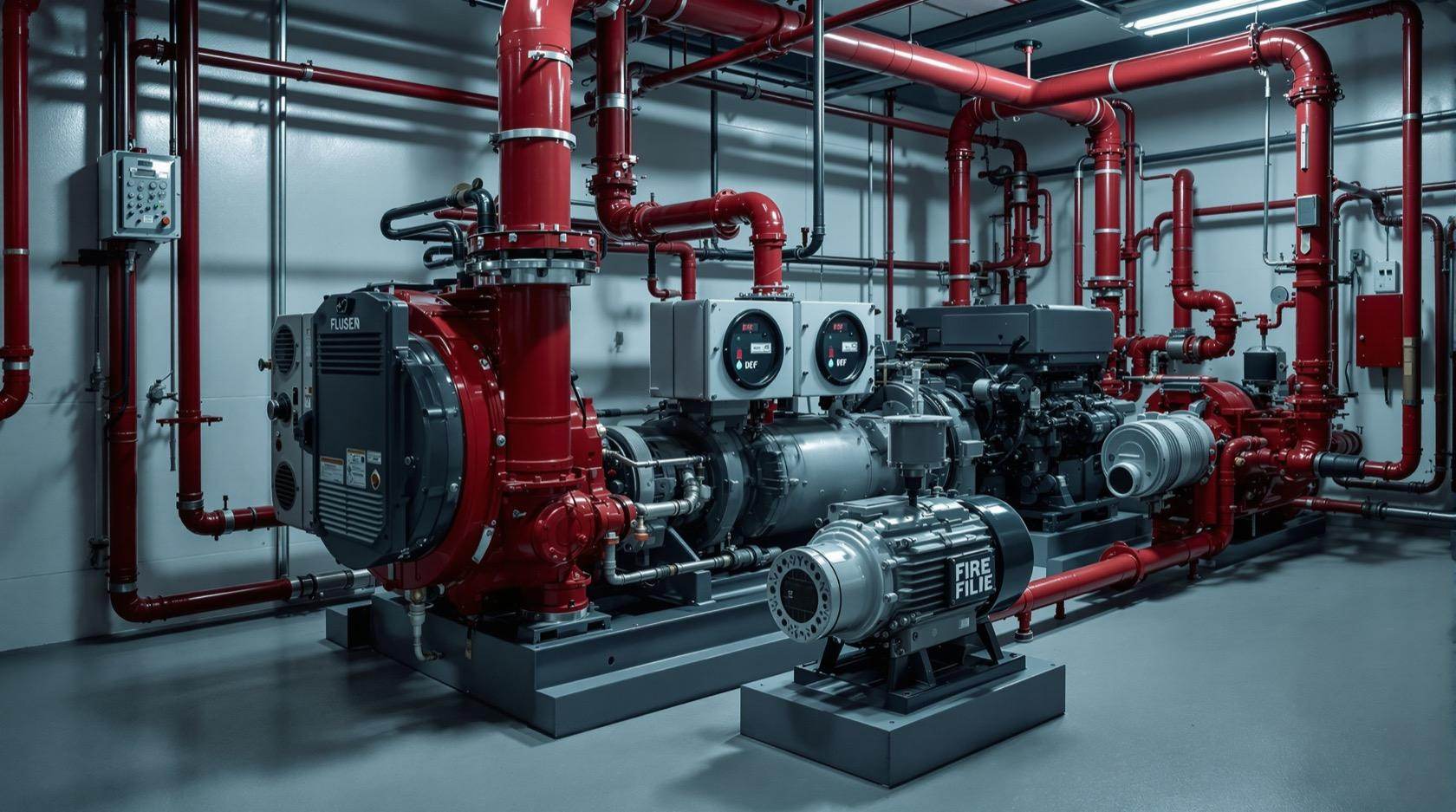
Fire Pumps in India (2026): The Pump Set That Powers Hydrants & Sprinklers
The fire pump set is the heart of a building's water-based fire protection - the main electric pump, the diesel-engine backup for India's power cuts, and the jockey pump that holds pressure so the mains do not cycle needlessly.
A fire-water tank full to the brim and a building laced with hydrant risers and sprinkler pipes are, on their own, just standing water and empty steel. Nothing moves. The thing that turns that stored water into a firefighting stream - that gives the hydrant landing valves and the sprinkler heads the pressure and flow they need to actually fight a fire - is the fire pumps set sitting in the pump room. It is the heart of the whole water-based system. When a sprinkler opens over a fire, or a firefighter cracks a landing valve on the tenth floor, it is the pump set that senses the pressure fall and throws the design flow up the riser to meet it. Without a working pump set, the tank, the risers and the heads are a certified decoration.
This is the pump-room chapter of Studio Matrx's fire-safety library, sitting under the complete guide to fire safety in India. It is written for the people who own, manage or specify a building's fire system - RWA committees, facility managers, builders, developers and the professionals who advise them - so you can understand what the pump set is, why it is built the way it is, and above all how to keep it able to start on the one day it is needed.
Scope and safety - read this first. A building fire pump set is a statutory, engineered installation. Its number of pumps, the flow and head each must deliver, the diesel backup, the controllers and the pipework are all designed by a licensed fire-protection engineer through a hydraulic calculation for your specific building, tied to the National Building Code (via SP 7 : 2026, Part 4 Fire and Life Safety) and the applicable IS fire-pump standard, and certified for the premises Fire NOC under your State Fire Services Act and Rules. This guide helps you understand and specify and maintain that system; it is educational guidance, not legal advice, and never a design manual. Do not size, set, adjust or bypass a fire pump from anything you read here - that is the fire engineer's and the licensed contractor's job. When there is a fire, get everyone out and call the fire brigade on 101 or 112.
What the fire pump set actually does
Every water-based fire system in a building - the internal hydrants and hose reels, the external yard hydrants, the automatic sprinklers, and where fitted the water-mist system - needs two things at the point of use: enough pressure to throw water where the fire is, and enough flow to keep throwing it. The stored water in the fire-water tank supplies the volume, but a tank sitting at the bottom of a building cannot on its own push water to the top floor at firefighting pressure. That is the pump set's entire reason to exist: it draws from the tank and delivers the water into the system risers at the pressure and flow the design demands.
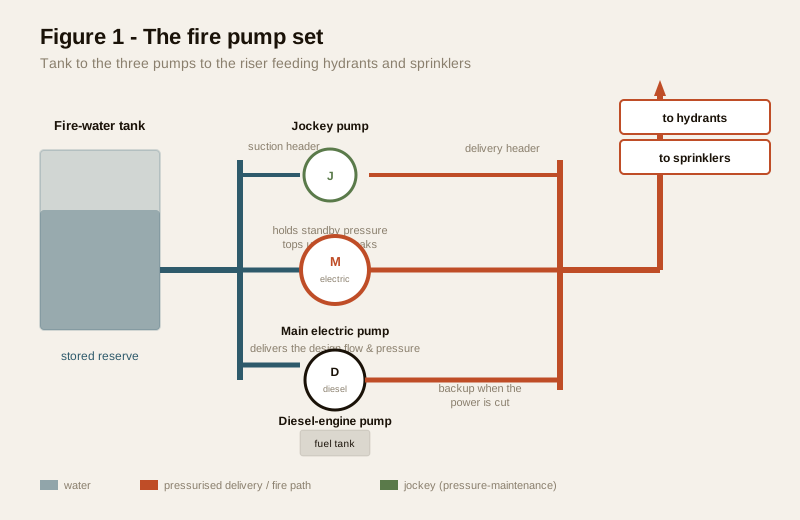
The set does its work automatically and on demand. In its resting state the whole system above the pumps is kept full of water and held at a standby pressure. The moment that pressure drops - because a sprinkler has opened, or a landing valve has been used, or the system is leaking - the pumps sense the fall and start, restoring pressure and pouring flow into the system for as long as the demand lasts. Nobody has to run to the pump room and press a button. The pump set is meant to answer the fall in pressure by itself, which is exactly why the auto-start arrangement, and its neglect, matter so much.
The actual flow and head each pump must deliver are never a number you guess or copy from another building. They come from NBC Part 4 and a fire engineer's hydraulic calculation for your specific building - its height, its occupancy, the number of hydrants and sprinklers that must run at once, the friction in the pipework and the pressure needed at the worst-case outlet. This guide deliberately gives no flow, head or capacity figures, because a wrong number here is dangerous. What follows is how the set is arranged and how you keep it working - the sizing stays with the engineer.
The standard Indian pump set - three pumps, three jobs
The pump room in a properly designed Indian building is not one pump but a set of three, each with a distinct job. Understanding why there are three, and what each does, is the single most useful thing an owner or manager can learn about the system.
| Pump | Its job | Why it exists |
|---|---|---|
| Main electric pump | Delivers the full design flow and pressure to fight a fire | The workhorse - it does the actual firefighting duty on mains power |
| Diesel-engine pump | Delivers the same duty when there is no electricity | India's power cuts mean the mains can be absent exactly when a fire starts; the diesel pump is the backup that still runs |
| Jockey pump | Maintains standby pressure and tops up minor leaks | Keeps the system pressurised so the big pumps do not start for every small pressure drop |
The main electric pump - the workhorse
The main electric pump (often called the main duty pump) is the one that does the firefighting work. It is an electric motor-driven pump sized by the hydraulic calculation to deliver the building's design flow at the design pressure - enough for the required number of hydrants and sprinklers to operate together at the far, high, worst-case point in the building. When a real demand appears, this is the pump that carries it. On a large building the design may call for more than one duty pump, and often a standby duty pump of the same rating so that the loss of one does not lose the system - again, how many and of what rating is the engineer's determination, not a rule of thumb.
The diesel-engine pump - not optional in India
This is the pump that makes an Indian pump room different from a textbook one. The diesel-engine driven pump does the same firefighting duty as the main electric pump, but it is powered by its own diesel engine rather than the electricity grid. Its whole purpose is the power cut. A fire and a power failure arrive together far more often than chance suggests - an electrical fault is itself a common ignition source, a fire damages wiring and drops the supply, and India's routine load-shedding means the grid is simply absent for stretches of every day in much of the country. If the pump set could only run on mains, the building would have no water pressure precisely when it most needs it.
So the diesel pump is the vital backup, and in India it is not an optional extra - it is the difference between a system that works in a real fire and one that does not. It starts automatically if the electric pump fails to run or fails to maintain pressure (for example because the mains are gone), and it runs on the fuel in its own day tank, independent of the grid. A diesel pump that has never been serviced, whose battery is flat, or whose fuel tank is empty or full of stale diesel, is the commonest single reason a fully-installed Indian pump room fails on the day - and it is invisible until tested. The high-rise and basement settings, where escape depends utterly on the water system holding up through an outage, lean hardest on this pump.
The jockey pump - the small pump that saves the big ones
The jockey pump (also called the pressure-maintenance pump) is the small one, and its job is not to fight fire at all. Its job is to hold the system at its standby pressure. Real pipe systems leak a little - a weeping valve, a fitting that seeps - and every small leak slowly bleeds pressure. If the only pumps were the big duty pumps, that slow bleed would eventually drop the pressure enough to start them, they would slam up to full pressure, shut off, and the cycle would repeat - hard starting and stopping that wears the pumps and their controllers out.
The jockey pump prevents this. It is small, it runs often, and it tops up the small losses, keeping the system sitting just above the pressure at which the main pumps would start. So the main and diesel pumps stay resting until a real demand - a sprinkler opening, a landing valve used - draws far more water than the little jockey can supply, at which point the pressure falls past the jockey's ability and the main pump takes over. A dead jockey pump is a quietly serious fault: without it, every minor leak eventually starts a main pump, so the mains cycle needlessly, and the wear that follows shortens the life of the very pumps the building depends on.
Auto-start on pressure drop - how the set decides
The intelligence of the pump set is not in the pumps but in the auto-start arrangement - the pressure switches and the controllers that decide which pump runs and when. This is the logic that turns a fall in system pressure into the right pump starting, without a human in the loop.
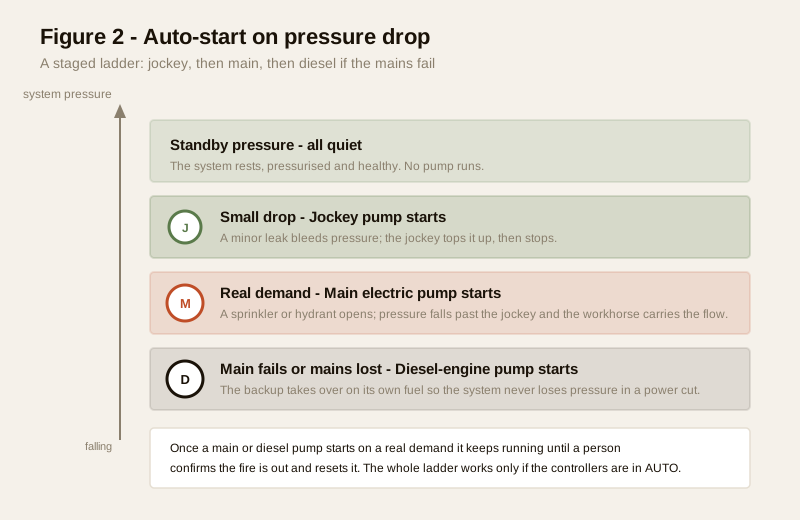
Each pump has a pressure setting, arranged as a staged ladder so they cut in one after another as demand grows:
| Pressure state | What starts | Meaning |
|---|---|---|
| System at standby pressure | Nothing runs | All quiet - the system is pressurised and healthy |
| Small drop from a minor leak | Jockey pump starts, then stops | Routine top-up - the jockey holds the standby pressure |
| Larger drop from a real demand | Main electric pump starts | A sprinkler or hydrant is in use - the workhorse carries the flow |
| Main pump fails or mains lost | Diesel-engine pump starts | The backup takes over so the system does not lose pressure |
Two features of this logic matter for the owner. First, a properly set pump does not stop itself once a main or diesel pump has started on a real demand - it is designed to keep running until a person confirms the fire is out and manually resets it, so the pump can never shut off mid-fire because pressure momentarily recovered. Second, the whole ladder only works if the settings are correct and the controllers are set to automatic - and that is exactly where neglected systems fail, which the next section confronts. The setting of these switches, like the sizing of the pumps, is the fire engineer's and commissioning contractor's work, tied to the hydraulic design - it is never adjusted by building staff.
The pump room and controllers
The pumps live in a dedicated pump room, and its arrangement is part of the engineered design. The room draws from the fire-water tank - ideally so that the pumps are always primed with water waiting at their inlet rather than having to suck it up from below, because a pump that has to lift its own supply is slower and less reliable to start. The suction pipework, the delivery header that joins the pumps into one output, the isolating valves, the pressure gauges, the test line that lets the pumps be run and measured without a fire, and the diesel pump's fuel tank and exhaust all belong to the room's design.
Each pump has its own controller - the panel that starts and stops it and carries the pressure switches, the automatic/manual selector, and the alarms. The controllers are where the auto-start logic lives, and they are the single most abused part of the whole set, because the selector that should sit on AUTOMATIC can be turned to MANUAL or OFF. A pump left with its controller in manual-off will not start no matter how far the pressure falls - the tank can be full, the pump perfect, the pipework sound, and still no water moves, because a switch is in the wrong position. This is covered in the failure-modes section below, but the principle is simple: the controllers must be left in AUTO, and any pump found in manual or off is a system that is switched off without looking switched off.
Testing - the discipline that keeps the set alive
An installed pump set is not a working pump set. Pumps that sit idle for months seize; diesel engines that are never run will not start; batteries go flat; fuel goes stale; jockey pumps fail silently; and controllers drift or get switched out of auto. The only way to know the set will start on the day is to start it regularly and watch it - the same maintenance-and-testing discipline that governs every other fire system, applied to the pump room.
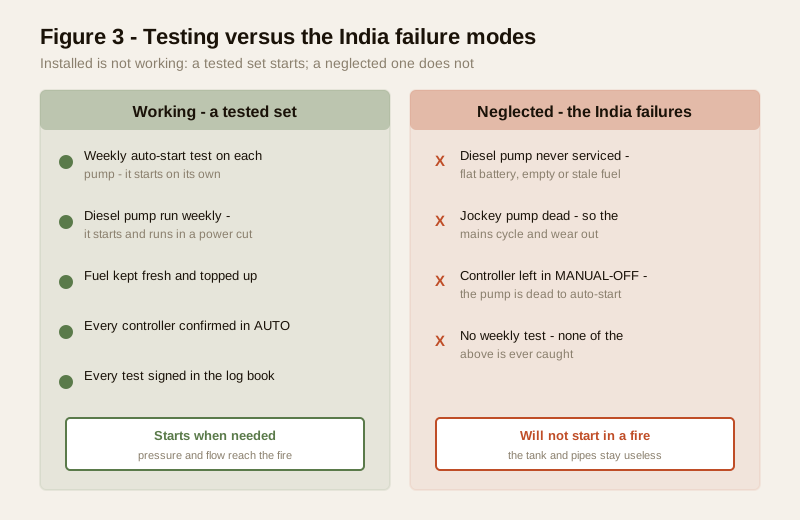
The testing regime is set by the AMC contractor to the applicable standard, but its shape is well understood:
| Test | Roughly how often | What it proves |
|---|---|---|
| Auto-start test on each pump (drop the pressure, confirm the pump starts on its own) | Weekly | The pressure switches and controllers still start each pump automatically |
| Run the diesel-engine pump and confirm it starts and runs | Weekly, on a schedule | The engine will actually start in a power cut - battery, fuel and starting all healthy |
| Check and top up diesel fuel; confirm it is fresh, not stale or contaminated | Regularly with the run | There is fuel to run on, and it will not clog or gel when needed |
| Confirm every controller is in AUTOMATIC and no pump is isolated | Every visit | The set is actually armed, not silently switched off |
| Full flow/performance test against the design duty | Periodically, per the AMC | The pumps still deliver the flow and pressure the hydraulic design requires |
The two weekly tests - the auto-start check and the diesel run - are the heart of it. A pump set that is auto-started weekly and whose diesel is run and fuelled weekly is a set you can trust; one that is not tested is a gamble whose odds you only discover during a fire. Record every test in the pump-room log book, the same way the apartment and office fire-safety guides describe for the building's overall regime, and treat any failed start as an emergency for the AMC, not a note for later.
The India reality - how pump rooms fail
The honest truth about Indian pump rooms is the same as for every other fire system: installed to get the Fire NOC, then quietly abandoned. The pumps are almost never the problem - they are robust. It is the neglect around them that kills the system, and it is always invisible until the day of the fire.
- The diesel pump never serviced, no fuel. The most dangerous and commonest failure. The engine is never run, its battery goes flat, its fuel tank runs dry or fills with years-old stale diesel that will not burn cleanly. In the power cut of a real fire - exactly when the diesel is the only pump that can run - it turns over and dies, or does not turn at all. The building has no water pressure at the moment it most needs it.
- The jockey pump dead, so the mains cycle. The little jockey fails and nobody notices, because the big pumps cover for it - every small leak now drops the pressure far enough to start a main pump, which slams up and shuts off, over and over. The hard cycling wears out the main pumps and controllers, so a dead jockey quietly destroys the pumps that matter.
- The controller in manual-off. Someone switched a controller to manual or off - during maintenance, to stop a nuisance start, to do dusty work - and never switched it back. The pump is now dead to the auto-start logic. Everything looks normal; nothing will start.
- No weekly test. With no auto-start test and no diesel run, none of the above is ever caught. The set decays in silence, and the first real test it ever gets is a fire, which it fails.
Every one of these is a maintenance failure, and every one is fixed the same way: a genuine AMC with a competent fire-pump contractor, the weekly tests actually done and logged, the diesel run and fuelled, and the controllers left in AUTO. Use the fire-suppression system selector to think through which water-based systems your building needs, and read the fire-water tanks guide for the reserve the pumps draw from and the sprinkler and hydrant guides for the systems they feed. For the electrical supply that feeds the main pump and the wider risk picture, see the electrical guides and the electrical fire-safety guide.
Never drain, isolate or switch off the pump set - keep it live and AMC'd. A fire pump set is only protection while it is armed. Never leave a controller in manual or off, never close the suction or delivery isolating valves, never let the tank the pumps draw from run dry, and never let the diesel pump sit unserviced or unfuelled. Any of these silently turns a certified pump room into a room of idle steel that will not start when a sprinkler opens or a firefighter needs pressure. The design, sizing, setting and commissioning of the pumps belong to a licensed fire-protection engineer and contractor, tied to NBC Part 4, the applicable IS fire-pump standard and the Fire NOC. What is squarely on the owner and manager is the discipline: keep the set under a real AMC, run the weekly auto-start test and the diesel run, keep the fuel fresh, and confirm the controllers are in AUTO every single visit.
Key takeaways
- The fire pump set is the heart of the water system - it draws from the fire-water tank and delivers the pressure and flow that make the hydrants and sprinklers work; without it the tank and pipes are useless.
- Three pumps, three jobs - the main electric pump does the firefighting duty, the diesel-engine pump is the vital backup that runs when the power is out (not optional in India, where power cuts are constant), and the small jockey pump holds standby pressure so the big pumps do not cycle needlessly.
- The set auto-starts on a pressure drop - a staged ladder starts the jockey for small leaks, the main pump for a real demand, and the diesel pump if the main fails or the mains are gone; it only works if the controllers are left in AUTO.
- Testing is what keeps it alive - a weekly auto-start test on each pump, a weekly diesel run with fresh fuel, and a check that every controller is in AUTO, all logged; an installed pump set that is never tested is a gamble discovered during a fire.
- The India failure modes are neglect - a diesel pump never serviced with no fuel, a dead jockey so the mains cycle, a controller left in manual-off, and no weekly test are the four ways a certified pump room fails; the fix is a genuine AMC. All sizing, setting and commissioning belong to a licensed fire engineer tied to NBC Part 4.
References
- National Building Code of India, SP 7 : 2026 (the NBC), Part 4 "Fire and Life Safety" - the framework governing whether and what water-based fire protection, fire-water storage and pumping a building requires by occupancy, height and area, and the basis for the fire engineer's hydraulic design of the pump set; the older SP 7 : 2016 edition is withdrawn but still widely quoted. Verify the current edition via the BIS catalogue: https://www.services.bis.gov.in/
- The applicable Bureau of Indian Standards fire-pump standard for the selection, installation, testing and maintenance of automatic fire-pumping sets - confirm the current standard number and edition with your fire-protection engineer and via the BIS catalogue before relying on it: https://www.services.bis.gov.in/
- IS 15105 : 2021 (sprinkler systems) and IS 3844 : 1989, reaffirmed 2020 (internal hydrants and hose reels) - the codes for the water-based systems the pump set supplies, which define the flow and pressure demand the pumps must meet. Verify current editions via the BIS catalogue: https://www.services.bis.gov.in/
- The relevant State Fire Services Act and Rules and the Model Building Bye-Laws (MoHUA) - these set when a Fire NOC and a certified, maintained fire pump set are legally required for a given premises, and the periodic testing and maintenance obligations that follow.
This is an educational overview, not legal advice, and not a substitute for a licensed fire-protection engineer or contractor. The design, hydraulic sizing, pressure settings, installation, commissioning and certification of a fire pump set, the Fire NOC and any statutory testing or maintenance are qualified professional tasks - engage licensed fire professionals and the State Fire Services, and verify any standard's current status via the BIS catalogue before relying on it.
Export this guide
Related Guides — Deep-dive reading
Sprinkler System Maintenance in India (2026): Keeping a Life-Safety System Ready
A fire sprinkler system is a life-safety installation that must work on the one day it is needed — this professional guide covers the scheduled checks, statutory tests and record-keeping that keep a wet, dry or pre-action system live: water supply and pressure, valves in the correct open position, control and alarm valves, sprinkler heads kept clear, and the roles of the competent fire contractor versus the facility manager.
SecurityFire Pump Maintenance in India (2026): Run Tests, Diesel Upkeep and the AUTO Rule
The fire pump is what gives sprinklers, hydrants and hose reels their pressure and flow. This professional upkeep guide covers the pump SET (main electric, diesel and jockey pumps and the controller), the weekly run test, auto-start checks, diesel engine and battery care, the DIY-safe vs contractor split, and the one rule that defeats everything if broken: leave the controller in AUTO.
SecurityFire Water Tanks in India (2026): The Dedicated Reserve That Feeds Everything
The fire-water tank is the reserve that must always be full so the pumps, hydrants and sprinklers have water the moment a fire starts - what it is, how the reserve is ring-fenced, and why a dry tank is the deadliest failure in Indian buildings.
SecurityRelated Tools — Try Free
Access-Control Battery-Backup Calculator
Size the standby battery so an access system keeps running through a power cut, with an egress life-safety note.
Battery BackupFire Pump Capacity Calculator
Size a fire pump from the design flow and head using the standard hydraulic power formula, with a motor margin and a recommended standard motor rating. An indicative estimate; NBC needs a pump set — main electric plus standby diesel plus jockey — designed by a fire consultant.
Pump SizingFire Suppression System Selector
Sprinklers, hydrants, kitchen-hood, clean-agent gas or water mist? Pick what you are protecting and see the fixed suppression a fire engineer would typically consider — an orientation to a proper NBC Part 4 design, not the design itself.
Suppression