
Fire Alarm Maintenance in India (2026): AMC, Battery Standby & Keeping It Alive
Most Indian fire-alarm systems are installed for the Fire NOC and then rot - dead batteries, painted detectors, isolated zones, a blank log book. This guide sets out what proper maintenance per IS 2189 : 2026 actually involves.
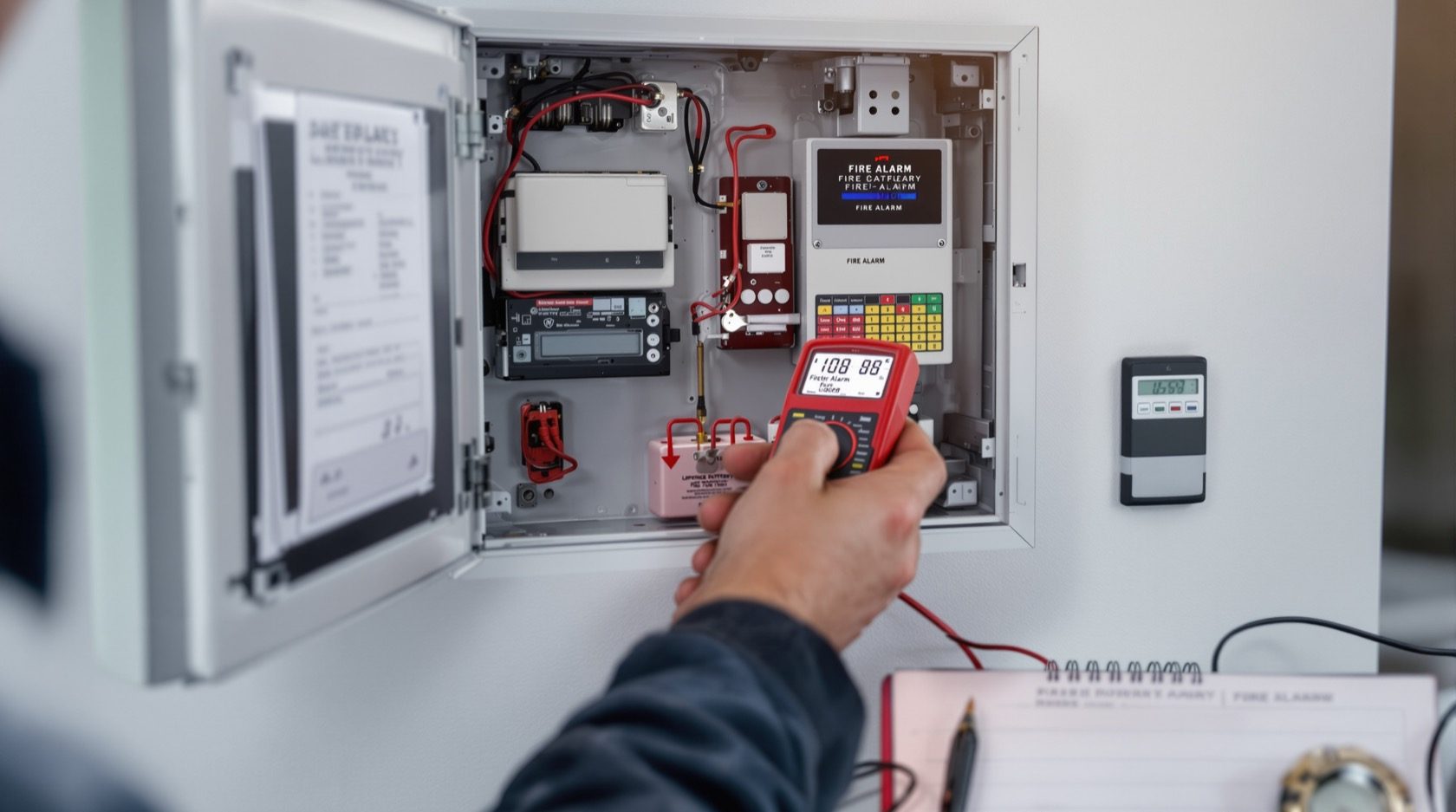
Walk into almost any Indian building - an apartment tower, a shop, a small office, a hotel - and there is a fair chance it has a fire-alarm panel on the wall that was installed years ago, passed once for the Fire NOC, and has not been touched since. The battery behind it is dead. Two zones are switched off because they kept false-alarming. A detector on the third floor has been painted over during a repaint. The log book, if it exists at all, is blank. The panel beeps quietly in fault, and someone has taped over the buzzer. On paper the building has a fire-alarm system. In reality it has a decoration. Fire alarm maintenance is the entire difference between those two things.
This is the maintenance chapter of Studio Matrx's fire-safety library, sitting under the complete guide to fire safety in India, and it closes the detection-and-alarm story that runs through the fire-alarm panels, smoke detectors and fire-alarm zoning guides. It is written for RWA committees, facility managers, builders and the shop, office, hotel and hospital owners who carry the legal duty - so you can specify a real Annual Maintenance Contract, split the daily work correctly, hold your contractor accountable, and never let your system slide into the installed-but-dead state that kills people.
Scope and safety - read this first. A building fire-alarm system is a statutory, engineered installation, and its fire alarm maintenance is governed by IS 2189 : 2026 (Selection, Installation and Maintenance of Automatic Fire Detection and Alarm System) and the National Building Code (via SP 7 : 2026, Part 4 Fire and Life Safety), tied to your premises Fire NOC under the State Fire Services Act and Rules. The technical servicing - battery replacement, detector sensitivity testing, panel fault clearance - is the job of a licensed fire-alarm contractor under an AMC, not the owner. This guide helps you specify, schedule and audit that maintenance; it is educational guidance, not legal advice, and it is never a manual for silencing, isolating or bypassing any part of the system. When the panel shows FIRE, one rule overrides everything below: get everyone out and call the fire brigade on 101 or 112.
"Installed" is not "working" - the honest India reality
A fire-alarm system is not an object you buy once. It is a living system that only works if it is watched and serviced, and every component in it degrades on a predictable timetable. Batteries lose capacity over two or three years. Smoke detectors slowly fill with dust and either go blind or start false-alarming. Painters, contractors and store staff steadily wall the detectors in behind paint and stacked boxes. Left alone, a perfectly certified system quietly becomes a non-system - and the tragedy is that it looks fine right up until the fire, because the failures are silent.
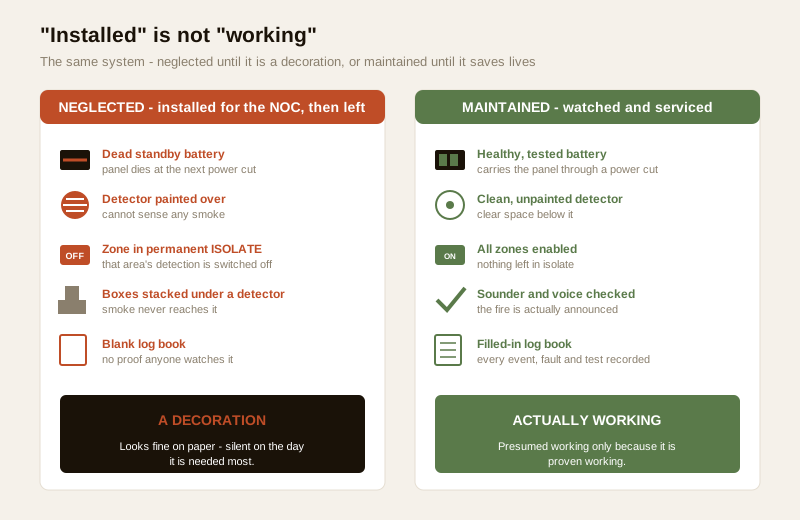
The table below names the silent failures - the ways a "working" system is actually dead - and each of them is exactly what a real maintenance regime exists to catch.
| The silent failure | Why it kills the system | What maintenance does about it |
|---|---|---|
| Dead standby battery | The panel goes dark the moment the power cuts - and fire and power cuts arrive together in India | Periodic load/autonomy check and scheduled battery replacement |
| Detector painted over or dust-choked | A painted or fouled detector cannot sense smoke - the room is unprotected | Visual checks keep them clean and clear; periodic cleaning and sensitivity testing |
| Zone left in permanent isolate | That whole area's detection is switched off, usually forgotten | Log discipline and AMC re-enabling; fix the false-alarm cause instead |
| Sounder or voice disconnected | The fire is detected but nobody is warned | Functional sounder and voice-alarm checks on schedule |
| Panel sitting in unresolved fault | Part of the system has already failed and no one is acting | Prompt fault clearance under the AMC; never tape over the buzzer |
| Blank or missing log book | No proof the system was ever watched; the fire officer and insurer will ask | Daily/weekly logging by the owner, service records by the AMC |
The single most important sentence in this guide: a fire-alarm system that has not been maintained and tested is presumed broken, not presumed working. Treat it that way and the maintenance regime below stops being a bureaucratic chore and becomes what it is - the thing that keeps the system alive.
Who does what - owner and AMC split the work
Maintenance fails most often not because the work is hard but because nobody owns it. The fix is to split the responsibility cleanly and in writing: a small set of simple, frequent checks that the owner or facility team does with their eyes and a pen, and a larger set of technical services that only a licensed fire-alarm contractor can do under the AMC. Neither substitutes for the other. An AMC without daily owner attention still lets a system rot between visits; owner attention without a competent AMC cannot test a battery under load or measure a detector's sensitivity.
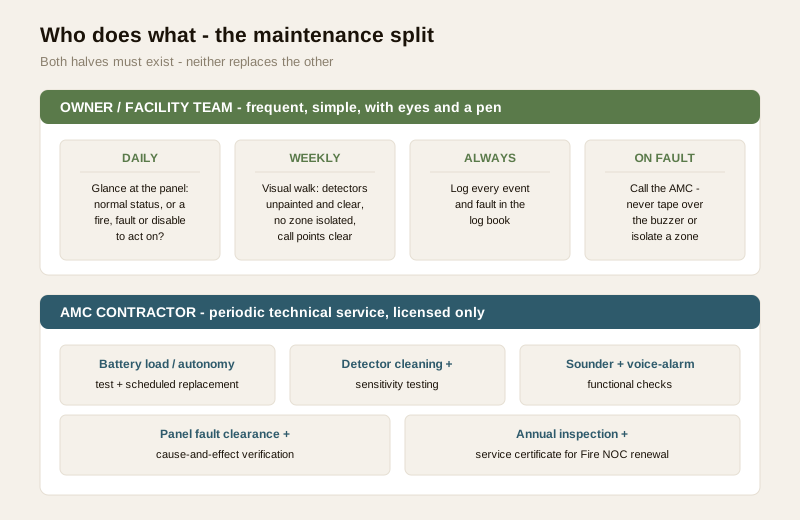
| Interval | Who | What is checked (indicative - follow IS 2189 : 2026 and the AMC) |
|---|---|---|
| Daily | Owner / facility | Glance at the panel: is it showing normal status, or is there a fire, fault, or disable indication that needs acting on? |
| Weekly | Owner / facility | Visual walk - detectors unpainted and unobstructed, nothing stacked under them, no zone left isolated, call points clear; note anything wrong in the log |
| Periodic (per contract) | AMC contractor | Functional testing of a rotating sample of detectors and call points, sounder and voice-alarm checks, battery testing, cleaning, fault clearance |
| Periodic / annual | AMC contractor | Detector sensitivity testing, full battery autonomy check, cause-and-effect verification, and the inspection that supports Fire NOC renewal |
The exact intervals are set by IS 2189 : 2026, the equipment manufacturer's manuals, and the terms of your AMC - so treat the column above as the shape of the regime, not the letter of it. What is not negotiable is that both halves exist: someone in the building is looking at the system every day, and a competent contractor is technically servicing it on a defined schedule.
What the owner and facility team must do
- Look at the panel daily. A ten-second glance is enough to catch a new fault or a fire indication. The panel is only useful if someone sees it.
- Walk the building weekly. Confirm detectors are clean, unpainted and unobstructed, that nothing is stored under or against them, and that no zone has been left in isolate. This is the check that catches the slow, physical decay contractors and storekeepers cause.
- Log everything. Every fire, false alarm, fault and its clearance, every test and every isolation-and-restore goes in the log book with the date and time. This is covered in its own section below.
- Respond correctly to faults. A fault means part of the system has failed - call the AMC, do not tape over the buzzer, and never "solve" a nuisance alarm by leaving a zone off.
What the AMC contractor must do
- Battery standby testing and replacement - the single most important periodic task, covered in its own section below.
- Detector cleaning and sensitivity testing - removing accumulated dust and confirming each detector still responds within its rated sensitivity, replacing units that have drifted.
- Functional testing of a rotating sample of detectors, manual call points, sounders and any voice-evacuation or emergency-communication system.
- Panel fault clearance and cause-and-effect verification - resolving every logged fault and confirming that a triggered detector still drives its programmed outputs (dampers, doors, lifts, pressurization).
- The periodic inspection and service certificate that supports Fire NOC renewal and satisfies your insurer.
The routine testing regime - how often, what to test, and how to test without crying wolf - is set out in the companion fire-alarm testing guide; this guide is about the maintenance that keeps the whole system serviceable between those tests.
Battery standby - the commonest silent failure
If you remember one technical thing from this guide, remember the battery. The standby battery is the system's only power source during a mains failure, and in India mains failures are routine and often coincide with the very electrical faults that start fires. A panel that looks perfectly healthy while running on mains can go completely dark the instant the grid drops - because the battery behind it quietly died two years ago and nobody replaced it. This is not a rare edge case; it is the single most common way a "working" Indian fire-alarm system fails a real test.
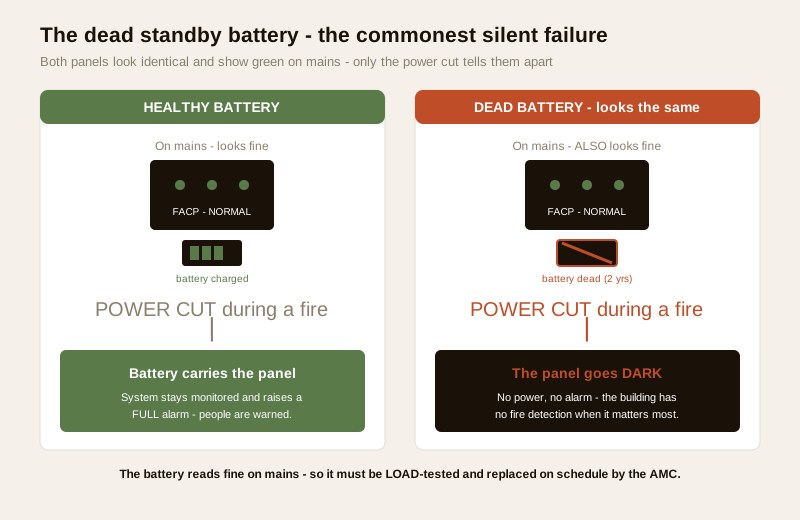
The reason the battery is so dangerous is that its failure is invisible until the exact moment it matters. A weak battery holds the panel's indicators green as long as the mains keeps it topped up. The system only reveals it is dead when the mains disappears - which is precisely when you need it. So the battery cannot be judged by looking at the panel; it has to be actively tested under load, on a schedule, by the AMC, and replaced as a consumable.
| Battery task | Who | Why it matters |
|---|---|---|
| Watch for a "battery fault" indication on the panel | Owner - daily | A battery fault is a real emergency, not a nuisance; it means the system may not survive the next power cut |
| Load / autonomy test - run the panel on battery and confirm it holds | AMC - periodic | The only way to know the battery still carries the system; a battery that reads fine on mains can collapse under load |
| Scheduled replacement as a consumable | AMC - every few years per IS 2189 : 2026 and the datasheet | Batteries age and lose capacity on a predictable timetable; replace before they fail, not after |
| Log the replacement date and the next-due date | Owner and AMC | So the next replacement is not forgotten - the commonest reason batteries are never changed |
Code intent under IS 2189 : 2026 is that the standby battery holds the system in its monitored state for a long period (on the order of a day) and still has reserve to drive a full alarm load for a further period. That only remains true if the battery is healthy - which is why the fire-alarm panels guide calls the standby battery the most important battery in the building, and why a battery fault must be fixed at once through the AMC, never dismissed.
Keep detectors clean, unpainted and unobstructed
The second great silent killer is physical. Detectors live on ceilings where they get in the way of painters, decorators and storekeepers, and the Indian building routinely deals with that by painting over them, taping them shut during dusty work, or stacking goods right up to the ceiling beneath them. Every one of these blinds the detector as surely as removing it.
- Never paint a detector. A coat of paint over a smoke detector's grille or a heat detector's element stops it sensing anything. Before any repaint, detectors must be protected and then the covers removed and checked afterwards - and a painted detector must be replaced, not just wiped, because paint is inside it. This is a standing item on the weekly visual walk.
- Never obstruct a detector. A smoke detector needs clear air around it and the ceiling space below it kept open - stacked boxes, false ceilings added later, new partitions and mezzanines can all put a detector in a dead pocket or block the smoke from reaching it. Storage must be kept clear of the ceiling.
- Keep them clean. Dust, cooking grease and insects accumulate inside detectors and either desensitise them or cause false alarms. Periodic cleaning by the AMC - not a household wipe - is what keeps them within their rated sensitivity, and a heat detector is the right answer where a smoke detector keeps fouling in a kitchen or dusty area rather than isolating the zone.
- Respect the detector's life. Detectors have a service life and drift out of sensitivity with age; sensitivity testing and end-of-life replacement are part of the AMC, guided by the manufacturer's datasheet and IS 2189 : 2026.
The theme running through all of this: the physical decay of detectors is slow, invisible from the panel, and caused by ordinary building activity - which is exactly why the owner's weekly visual walk and the AMC's periodic cleaning together are the only defence.
Never leave zones isolated - the deadly shortcut
This is the habit that turns a certified system into a lethal one, and it deserves its own heading because it is the most common maintenance failure of all. When detectors keep false-alarming - kitchen steam, construction dust, a badly sited unit - the tempting fix is to switch the zone to isolate and enjoy the silence. It works instantly, and it is deadly, because the zone stays off long after everyone has forgotten it was ever switched off. People have died in buildings whose fire-alarm systems were fully installed and certified, because the zone covering the fire had been isolated months earlier and never restored.
Isolating a zone has exactly one legitimate use in maintenance: a temporary, logged, contractor-controlled step during servicing or hot works, restored the moment the work is done. It is never a standing solution to a nuisance alarm. The correct fix for repeated false alarms is always to remove the cause - relocate a badly sited detector, change a smoke detector to a heat detector where steam or cooking is the problem, clean fouled units, or have the contractor re-survey the zoning. A disabled zone is not a maintenance measure; it is a hole in the building's protection. Sounders and voice-alarm systems must likewise never be permanently disconnected to stop noise - the same rule applies to every output the panel drives.
The log book - the proof the system is alive
A fire-alarm system is only trustworthy if someone can show it has been watched and maintained, and the instrument of that proof is the log book kept at the panel. It is both an operating discipline and the evidence a fire officer or insurer will demand. Every event goes in it: fires and false alarms with the time and zone, every fault and how and when it was cleared, every test, and every occasion a zone was isolated and restored, with the reason and the times. A panel with a blank or missing log book is a panel nobody is really watching - and to an inspector it reads as a system that cannot be relied on.
| What goes in the log book | Recorded by | Why |
|---|---|---|
| Fire and false-alarm events - time, zone, cause | Owner / facility | Reveals recurring false-alarm sources to fix at the cause |
| Every fault and its clearance - time raised, time cleared | Owner and AMC | Proves faults are acted on, not left to rot |
| Every test performed and its result | AMC (and owner for weekly checks) | Shows the system is being proven, not presumed working |
| Every zone isolation and restoration - reason and times | Owner and AMC | Guards against the deadly "isolated and forgotten" failure |
| AMC service visits and battery replacement dates | AMC | The maintenance record the Fire NOC renewal and insurer rely on |
What a good AMC covers and how to hold it accountable
An AMC is only as good as its scope and your oversight. A cheap contract that quietly means one visit a year and a signed certificate is worse than useless, because it manufactures paper compliance around a dead system. When you specify or renew a fire-alarm AMC, insist that it names the standard (IS 2189 : 2026), lists the tasks and their frequencies, and produces evidence you can check.
- Named scope and schedule. The contract should specify battery testing and replacement, detector cleaning and sensitivity testing, functional testing of detectors, call points, sounders and any voice system, panel fault clearance, and cause-and-effect verification - each with a stated frequency.
- A competent, licensed contractor. Confirm the contractor is competent to work on your specific panel and is licensed for fire-alarm work under your State Fire Services regime.
- Written service reports every visit. Each visit should produce a report listing what was tested, what was found, what was replaced, and what remains outstanding - filed with the log book. No report, no proof the work happened.
- Fault response times. The contract should commit to a response time for faults, and a shorter one for battery or whole-zone faults, which are emergencies.
- You audit it. Cross-check the service reports against the log book, confirm the battery replacement dates are current, and physically spot-check that detectors are clean and no zone is isolated. Do not outsource your attention along with the work.
Use the fire-alarm system selector to understand which architecture your building has and what it needs to keep serviceable, the fire-detector selector to match the right detector to each space so it does not become a chronic false-alarm source, and the emergency-preparedness guidance to tie maintenance into the building's overall readiness. The apartment, office, hotel and hospital fire-safety guides set out how the AMC sits within each setting's compliance, and the complete guide to fire safety ties it to the rest of the building's protection.
Neglect has consequences beyond the fire
Two external forces make maintenance non-optional even for an owner who is tempted to cut corners. The first is the Fire NOC: its renewal under the State Fire Services Act and Rules depends on the building's fire systems being maintained and demonstrably functional, and a fire officer inspecting a dead panel, a blank log book or isolated zones can refuse renewal - which can stop the building's lawful occupation. The second is insurance: a fire-loss claim can turn on whether the fire-alarm system was maintained and its log book kept, and an insurer that finds a system left to rot has grounds to dispute the claim. Maintenance is not only the moral duty to the people in the building; it is the condition on which the building's legal occupancy and its financial protection both rest.
When the law requires a professional - and why you never leave it disabled or unserviced. The technical maintenance of a building fire-alarm system - battery testing and replacement, detector sensitivity testing, panel fault clearance, cause-and-effect verification - is a qualified professional task that must be carried out by a licensed fire-alarm contractor under an AMC, to IS 2189 : 2026 and the National Building Code (SP 7 : 2026, Part 4), and tied to the Fire NOC under your State Fire Services Act and Rules. Route all of it to that contractor. What sits squarely on the owner and the manager is the discipline that keeps the system alive between visits: look at the panel daily, walk the building weekly, keep detectors clean, unpainted and unobstructed, log every event, chase every fault, hold the AMC accountable - and never, ever leave a zone isolated or a sounder disconnected to buy silence. A fire-alarm system installed for the NOC and then abandoned is not a fire-alarm system. It is a decoration that will be quiet on the day it is needed most.
Key takeaways
- Installed is not working - a fire-alarm system that is not maintained and tested is presumed broken, not presumed working; dead batteries, painted detectors, isolated zones and blank log books are silent failures that look fine right up until the fire.
- Split the work clearly - the owner or facility team looks at the panel daily, walks the building weekly, logs every event and responds to faults; the AMC contractor does the periodic technical service - battery testing, detector cleaning and sensitivity, sounder and voice checks, fault clearance and cause-and-effect verification.
- The standby battery is the commonest silent failure - it looks healthy on mains and dies the moment the power cuts, so it must be load-tested and replaced as a consumable on schedule; a battery fault is an emergency, not a nuisance.
- Keep detectors clean, unpainted and unobstructed, and never leave zones isolated - fix the cause of nuisance alarms rather than switching off protection, because an isolated zone that is forgotten is exactly how certified systems kill people.
- The log book and a well-specified AMC are the proof the system is alive - and maintenance is the condition on which Fire NOC renewal and a valid fire-insurance claim both rest; route all technical servicing to a licensed contractor certifying to IS 2189 : 2026.
References
- IS 2189 : 2026, Bureau of Indian Standards - Selection, Installation and Maintenance of Automatic Fire Detection and Alarm System, Code of Practice. The core code governing the maintenance regime, battery-standby provision, detector servicing and testing intervals for a building fire-alarm system. Verify the current edition via the BIS catalogue: https://www.services.bis.gov.in/
- National Building Code of India, SP 7 : 2026 (the NBC), Part 4 "Fire and Life Safety" - the framework requiring automatic fire detection and alarm systems and their upkeep in buildings by occupancy and height; the older SP 7 : 2016 edition is withdrawn but still widely quoted. Verify the current edition via the BIS catalogue: https://www.services.bis.gov.in/
- The relevant State Fire Services Act and Rules and the Model Building Bye-Laws (MoHUA) - these set when a Fire NOC and a certified, maintained fire-alarm system are legally required for a given premises, and the periodic maintenance and record-keeping obligations that a Fire NOC renewal depends on.
- Manufacturer datasheets and installation and maintenance manuals for the specific control panel, standby batteries and field devices installed - the authority for battery replacement intervals, detector service life and cleaning, sensitivity-testing methods and fault codes; always follow the equipment's own documentation and the AMC contractor's service records.
This is an educational overview, not legal advice, and not a substitute for a licensed fire-safety consultant or fire-alarm contractor. Fire-alarm maintenance, battery and detector servicing, the AMC, the Fire NOC and any statutory testing are qualified professional tasks - engage licensed fire professionals and the State Fire Services, and verify any standard's current status via the BIS catalogue before relying on it.
Export this guide
Related Guides — Deep-dive reading
Fire Alarm Testing in India (2026): The Weekly Test, Battery Autonomy & Cause-and-Effect
The routine test regime that proves a fire-alarm system actually works - the weekly call-point test, functional detector and sounder checks, the battery standby test and cause-and-effect verification, done without crying wolf.
SecurityFire Safety Inspection in India (2026): The Routine Checks That Catch Failures Early
The cheap, frequent in-house walk-round - are exits clear, extinguishers charged, the alarm panel normal, fire doors closing - that catches the drift toward a neglected building before it can matter, and the log that proves you looked.
SecurityFire Safety Maintenance Calendar for India (2026): The Year-Round Routine That Keeps It All Working
India's core fire-safety disease is installed for the NOC, then neglected. The cure is a written, owned maintenance calendar - who checks what, when - so no fire-safety element ever silently fails.
SecurityRelated Tools — Try Free
Electrical Safety & Load Audit
Home electrical audit — 10 categories, 65+ checkpoints across earthing, RCCB, MCB, wiring, switchboards, appliance circuits, DG/inverter backup.
Safety AuditAcoustic Privacy (STC) Visualizer
Indian healthcare acoustic visualizer — compare wall assemblies and noise sources, see received SPL after STC attenuation, and check FGI 2018 / IS 1950 / NABH speech-privacy compliance with live dual-canvas waveform.
Acoustic ToolContract Studio
AI generates professional architecture service agreements with milestones and scope.
ArchitectAI