
The Complete Guide to Parking and Garage Security in India (2026): Access, CCTV, Lighting, People-Safety & Vehicle Protection
The pillar overview of parking and garage security for Indian apartments, offices and homes — how to control who enters, watch every corner, light and de-isolate the space, and protect the vehicles, without ever blocking the escape route or the fire tender.
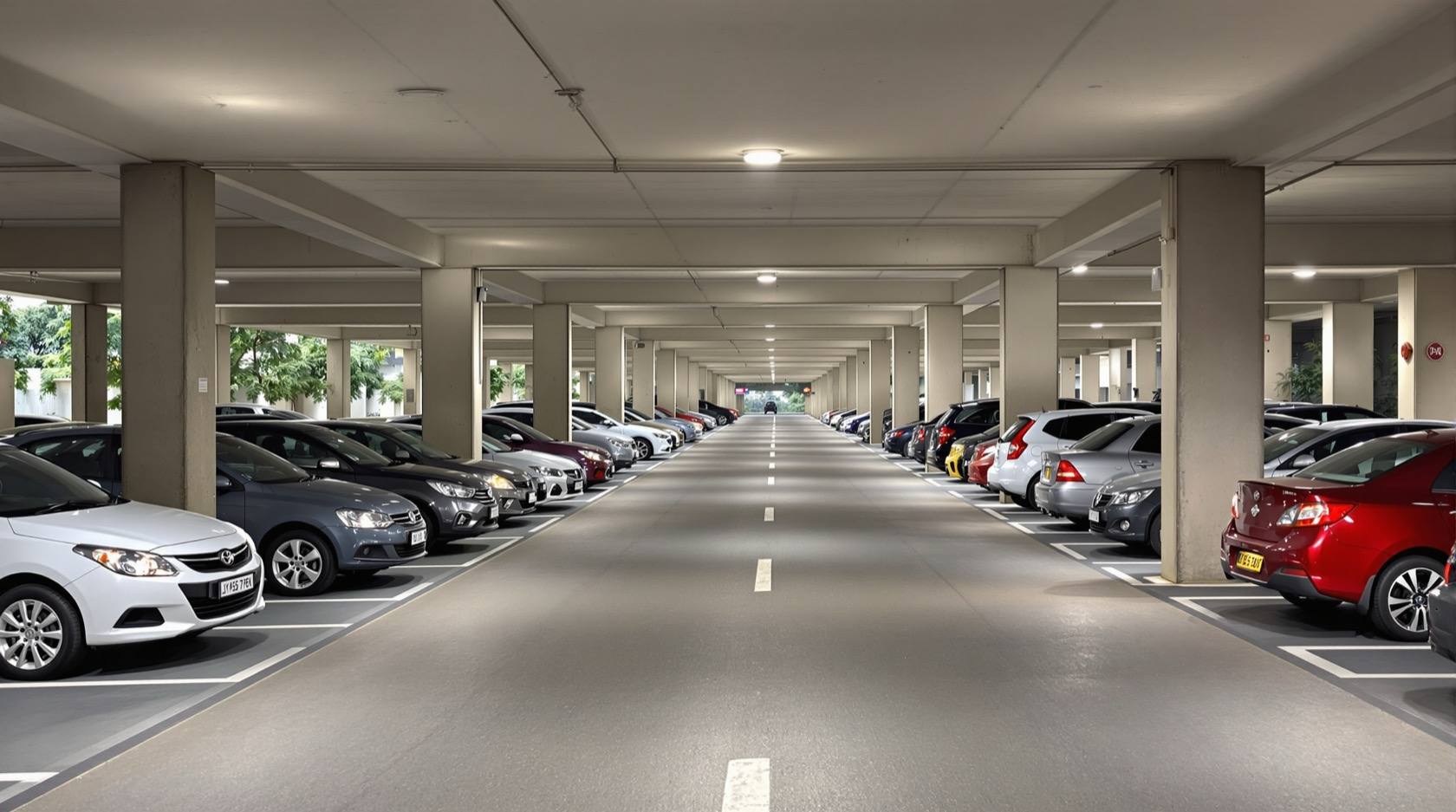
Ask a resident where the least-safe part of their building is and, more often than not, they will point downstairs. The basement car park is out of sight, it is used at all hours, it holds some of the most valuable movable things anyone owns, and it is where a surprising share of both theft and personal-safety incidents actually happen. Yet in most Indian buildings it is secured by a few fused tube lights with dark corners between them, a boom barrier that lifts for every car without a glance, and a camera or two pointed at nothing in particular. Parking and garage security is the discipline of turning that neglected slab into a designed space — one where entry is controlled, every corner is watched, the light is even and the space does not feel isolating, and the vehicles and the people using them are genuinely protected. This guide is the map of the whole thing.
This is the pillar of Studio Matrx's parking security library: the overview every other guide in the section hangs off. Here we set out the four jobs a parking area must do together, walk through the three settings — basement, open or stilt, and the private home garage — introduce each sub-topic with a link to its own deep guide, and hold three threads that never leave the page: life-safety comes before security, people-safety is as real as vehicle theft, and the cameras and number plates you record are personal data. It is written for RWAs, facility managers, architects and builders who plan and run shared parking, and it is readable for the homeowner securing a single garage.
Scope, stance & safety. This library is strictly defensive. It helps you plan, decide and coordinate a parking area that is harder to defeat and safer to use — never how to steal a vehicle, defeat a barrier or bypass access control. Hold three rules from the start: life-safety overrides everything — a car park, and especially a basement, is an escape route, the fire tender's access and a fire risk, so security must never block egress, obstruct the fire-tender lane or compromise the mandated emergency lighting and exit signage; electrical, barrier, gate and EV-charger work is licensed-professional work; and CCTV and number-plate capture are personal data under the Digital Personal Data Protection Act, 2023. This is educational guidance, not legal advice.
The four jobs of parking and garage security
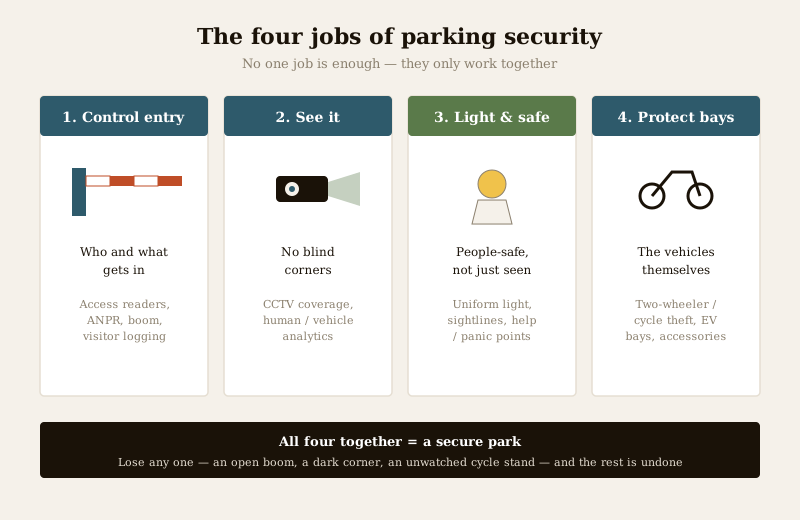
Every parking area that actually works does four jobs, and the failure of any one undoes the rest. An open boom, a dark corner, an unlit stairwell or an unwatched cycle stand each quietly cancels the money spent everywhere else. The four jobs are: control who and what enters, see it, light it and make it feel safe, and protect the vehicles and special bays.
| The four jobs | What it does | Typical measures | Fails when |
|---|---|---|---|
| Control entry | Decides who and what gets in | Access readers, ANPR, boom barrier, visitor logging | The boom lifts for every car unchecked |
| See it | Catches what happens, no blind spots | CCTV coverage, human and vehicle analytics | Cameras miss the corners and the stands |
| Light & feel safe | Removes cover and isolation | Uniform light, sightlines, help and panic points | A few dark bays and no way to call for help |
| Protect bays | Guards the vehicles themselves | Secured two-wheeler and cycle stands, EV-bay controls | The commonest losses go unaddressed |
Do an honest self-audit before you spend a rupee. The parking security audit walks the whole area against these four jobs, and the home security risk scorecard and the site perimeter security assessment tool put the parking area in the context of the whole property. Almost always the audit finds the same top three: an entry that lets anyone in, dark corners the cameras never cover, and a two-wheeler stand nobody watches.
Job 1 — control who and what enters
The gate to a car park is the single point where you get to decide. Once a vehicle or a person is inside, everything is harder. Yet the most common failure in India is exactly here: the boom lifts for every car, the guard waves people through, and the "resident sticker" on the windscreen is a design any car can copy. Controlling entry means the barrier only opens for a credential the building trusts, and every visitor is logged.
The building blocks each have their own guide. Start with parking access control for the overall approach — how readers, barriers and the guard work as one system. For vehicles, RFID vehicle access reads a tag on the windscreen so residents pass without stopping while others cannot; ANPR CCTV cameras read the number plate itself, which is powerful but is also personal-data capture you must handle with care. The boom barrier is the physical gate that enforces the decision, and it must be coordinated so it never falls on a person or traps a vehicle in the fire-tender lane. For people on foot and every non-resident vehicle, visitor vehicle management logs who came, in what, and when they left. The broader logic of credentials and readers lives in the complete guide to access control, and where the car park sits behind a community gate, coordinate with the gate access control and gate security guides so you are not screening the same vehicle twice or, worse, not at all.
Job 2 — see it, with no blind spots
A camera is only worth what it can see. Parking areas are unusually hostile to CCTV: columns block sightlines, ramps change the geometry, headlights and dark corners fight the exposure, and open stilt parks add rain and glare. The goal is honest, overlapping coverage — every bay, every corner, both directions of the ramp, the two-wheeler stand and the lift lobby all in frame, with no blind corner an intruder can learn to use.
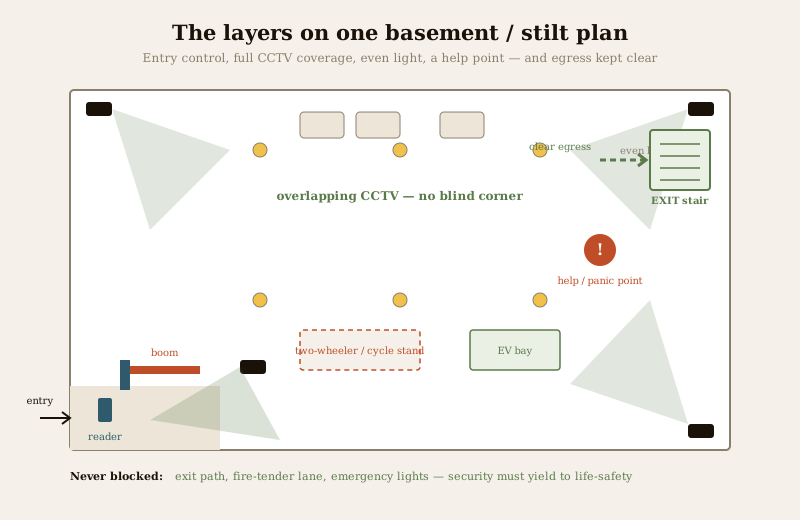
The dedicated guides carry the detail. CCTV placement for parking is the core: where cameras go, how to overlap them around columns, how to cover the ramp and the stands, and how to avoid the dark corner that every basement seems to grow. CCTV human and vehicle detection turns raw footage into useful alerts — a person loitering by the bikes at 2 a.m. matters more than the hundredth car of the day — and cuts the review burden that makes most recordings useless in practice. Number-plate reading is covered in ANPR CCTV cameras. Whatever you install, remember that recordings only help if someone can retrieve them: label cameras, keep the recorder secure and time-synced, and know how long footage is kept before it is overwritten.
Job 3 — light it, and make it feel safe
This is the job most often reduced to "put in more tubes", and it is the one that carries the most human weight. Light does two things at once. It removes the cover a thief needs, and it removes the isolation a person feels. An isolated basement or an unmanned stilt park at night is a genuine personal-safety concern in India, and it is felt most acutely by women, by anyone walking alone to a far corner, and by residents coming home late. That concern is not paranoia and it is not solved by a camera nobody is watching. It is solved by a space that is evenly lit with no dark bays, that has clear sightlines to the lift and the exit rather than blind corners, and that offers a visible, working way to call for help.
The specifics live in their own guides. Parking security lighting covers even, uniform illumination — the aim is no dark patch between fittings, not raw brightness — and how parking light must also support the cameras and never fail into total darkness; coordinate it with the mandated emergency lighting that must stay lit when the mains drops. Parking panic buttons and the wider panic buttons guide cover help and panic points — fixed call points at the lift lobby, the far corners and along the walk to the stairs, that reach a guard or a monitored line and are tested so they actually work. Design the light and the sightlines so the space reads as watched and reachable, not as a place to hurry through. Handle this thread with care and dignity: the goal is a car park people can use without fear, stated plainly and without fear-mongering.
Job 4 — protect the vehicles and the special bays
The romantic image of parking crime is a stolen car. The reality in most Indian buildings is quieter and far more common: the missing two-wheeler, the cycle lifted from an unwatched stand, the side mirror or the badge prised off in the night, the EV charging cable cut and carried away for its copper. These are the losses residents actually suffer, and they are the ones a generic "put a camera up" plan tends to miss because the attention goes to the cars.
Each real risk has its own guide. Vehicle theft prevention covers the whole picture — two-wheelers and cycles first because they are the commonest loss, then cars, then the accessory and part theft that a good stand layout and camera angle can deter. Bicycle parking security treats the cycle stand as its own problem: a well-placed, well-lit, watched stand with proper anchoring, because a bike leaning against a column is an invitation. EV charging bay security covers the growing new target — cable and connector theft, tampering, and access to the charger — and it must be read alongside EV charging fire safety, because an EV bay is a fire-risk bay as much as a security one, and the two disciplines share the same corner of the basement.
Three settings: basement, open or stilt, and the home garage
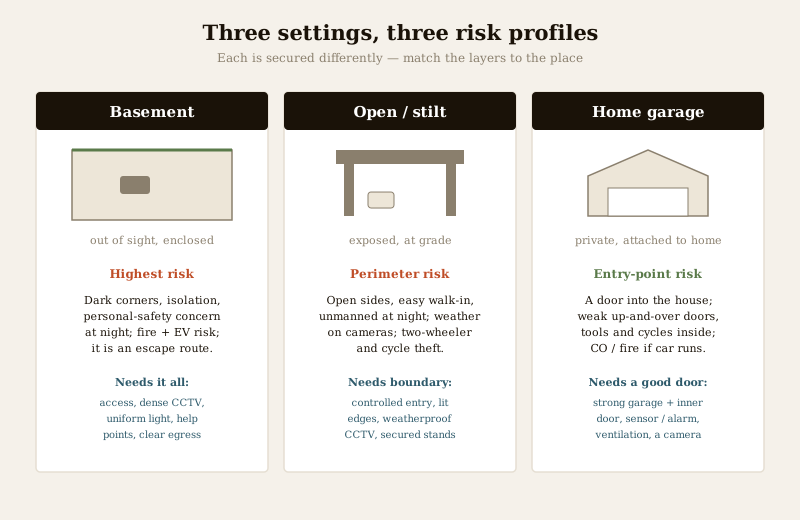
The same four jobs land differently in different places. A pillar has to name the three settings and hand each to its own guide, because their risk profiles are genuinely different.
| Setting | Defining risk | What it most needs | Its guide |
|---|---|---|---|
| Basement | Out of sight, enclosed, isolating at night; fire and EV risk; it is an escape route | The full stack: controlled entry, dense CCTV, uniform light, help points, clear egress | Basement parking security |
| Open / stilt | Exposed, open sides, easy walk-in, unmanned at night; weather on cameras | A defined boundary: controlled entry, lit edges, weatherproof CCTV, secured stands | Open parking security |
| Home garage | A door into the house; weak doors; tools and cycles inside; CO and fire if a car runs | A strong garage and inner door, a sensor or alarm, ventilation, one camera | Garage security |
The basement is the hardest case and the one this pillar returns to most: it concentrates every risk, and it is a life-safety space before it is a security one — start with basement parking security and the basement parking security assessment. The open or stilt park is a perimeter problem as much as a parking one — its open sides are the vulnerability — so read open parking security alongside the complete guide to perimeter security. The home garage is a different animal: it is private, but it is an entry point into the house and often the least-secured door on the property — garage security covers the garage door, the inner door and ventilation, and connects to smart garage locks and RFID locks for controlling that access.
The life-safety non-negotiables
Above all four jobs sits a hard constraint that overrides every security decision: a car park must never trap people or block rescue. A basement is, by design, an escape route, the fire tender's way in, and a place where fuel and EV batteries make fire a real risk. Three things are non-negotiable, and they beat any security measure that conflicts with them.
- Never block egress. Every locking regime, barrier and layout must let people get out fast on foot in an emergency. A boom or a shutter that seals a basement with people inside is a death trap. Coordinate with exit signage and keep the marked escape route physically clear at all times.
- Never obstruct the fire tender. The fire-tender access lane and the mandated turning and clearance must stay open — do not let a barrier, a bollard line or an overflow of parked two-wheelers close it. See fire-tender access.
- Never compromise emergency lighting. The emergency lighting and exit signage that stay lit when the mains fails are life-safety equipment; security lighting supplements them but must never replace or disable them.
These are governed by the National Building Code of India (SP 7:2026, Part 4 on fire and life-safety, which addresses basements and parking) together with your State Fire Services and local building bye-laws — verify the current edition and the specific provisions locally rather than assuming a number. Where a security measure and a safe exit ever conflict, safe exit wins. Say this to whoever installs your system, and treat it as a design constraint, not an afterthought.
CCTV and ANPR are personal data: the DPDP thread
A parking camera records the faces and movements of residents, staff and visitors, and an ANPR reader records their number plates and travel patterns. Under the Digital Personal Data Protection Act, 2023, that is personal data, and a building that runs it casually is exposed. The discipline is simple and worth stating plainly: collect only what security genuinely needs, post clear notice that CCTV and number-plate recording are in use, secure the footage and the recorder against casual access, keep it only as long as there is a reason to, and do not run ad-hoc face recognition or share recordings informally on resident groups. For an RWA this is a governance matter, not just a technical one — decide who can view footage, log every retrieval, and write it into the society's rules. The same principle runs through the ANPR CCTV cameras and CCTV placement for parking guides.
Who secures it, and the audit
Shared parking is an RWA and facility-management responsibility, and the parts that carry current, structure or statutory weight belong to licensed professionals: a licensed electrician for lighting and mains, a qualified installer for barriers, gates, EV chargers and camera cabling, and PSARA-licensed guards where you deploy manpower. Your job as an owner, RWA or facility manager is to plan the layout, decide the layers and coordinate the trades — and then to keep checking, because a car-park system decays quietly. The boom that always lifts, the camera knocked out of alignment by a reversing truck, the tube that fused six months ago, the panic button nobody has tested — these are how a designed space slides back into a neglected slab.
Run the parking security audit on a schedule against the four jobs, and place the parking area inside the whole-property view offered by the building security systems guide, the security guide for gated communities and the ultimate guide to home security. Parking is one zone of a larger system; secure it as part of the whole, not in isolation.
Key takeaways
- Parking is an overlooked, high-loss, high-risk zone — out of sight, used at all hours, holding valuable vehicles, and where personal-safety incidents happen — and it deserves designed security, not a few tubes and an open boom.
- Four jobs, done together: control who and what enters, see every corner with no blind spot, light the space and make it feel safe, and protect the vehicles and special bays. Lose any one and the rest is undone.
- People-safety is as real as vehicle theft. An isolated basement or stilt park at night is a genuine concern, felt most by women and anyone walking alone; even light, clear sightlines and working help or panic points answer it. And the commonest real loss is not a stolen car but a stolen two-wheeler, cycle, accessory or EV cable.
- Three settings, three profiles: the basement needs the full stack and is a life-safety space first; the open or stilt park is a perimeter problem; the home garage is an entry point into the house.
- Life-safety and privacy override security. Never block egress, the fire-tender lane or emergency lighting — a basement is an escape route and a fire risk — and treat CCTV and ANPR as personal data under the DPDP Act, 2023: collect only what you need, post notice, secure it, and never run ad-hoc recognition.
Where to go next
- Control entry: parking access control, RFID vehicle access, boom barriers, ANPR CCTV cameras, visitor vehicle management.
- See it: CCTV placement for parking, CCTV human and vehicle detection.
- Light it and make it safe: parking security lighting, parking panic buttons, emergency lighting, exit signage.
- Protect the vehicles: vehicle theft prevention, bicycle parking security, EV charging bay security, EV charging fire safety.
- By setting: basement parking security, open parking security, garage security, smart garage locks.
- Audit and the bigger picture: parking security audit, the parking security hub, the security hub, the home security risk scorecard and the site perimeter security assessment.
References
- National Building Code of India (SP 7:2026), Part 4 — Fire and Life Safety, for the provisions governing basements, parking, means of egress, fire-tender access and emergency lighting; verify the current edition and the specific clauses via the BIS catalogue: https://www.services.bis.gov.in/ , and confirm your State Fire Services and local building bye-laws, which vary by city.
- The Digital Personal Data Protection Act, 2023, for the handling of CCTV footage and number-plate (ANPR) data as personal data — notice, purpose limitation, security and retention. Refer to the Act and the rules as notified.
- The Private Security Agencies (Regulation) Act, 2005 (PSARA), for the licensing of any security-guard manpower deployed in the parking area.
- Manufacturer and installer specifications for boom barriers, access readers, EV chargers and CCTV, and the applicable electrical safety requirements — treat mains-electrical, barrier, gate and EV-charger work as licensed-professional tasks; do not rely on generic figures for clearances, lux levels or ramp gradients, which come from the design and the local bye-laws.
This is an educational overview, not legal advice. It is strictly defensive — about planning, deciding and coordinating a parking area that is safer and harder to defeat, never about defeating one. Life-safety overrides every security measure: never block egress, the fire-tender lane or emergency lighting. Electrical, barrier, gate and EV-charger work are qualified professional tasks; CCTV and ANPR data are personal data under the DPDP Act, 2023; and you should verify the current edition of the National Building Code and your local bye-laws via the BIS catalogue before relying on any provision.
Export this guide
Related Guides — Deep-dive reading
Parking Security Lighting in India (2026): Lighting Basement, Stilt and Open Parking So Nothing Hides in the Dark
How to light apartment and commercial parking so vehicles, people and number plates are clearly seen, cameras can actually read the scene, and the space stops being a soft spot for theft and lurking, without ever compromising the emergency lighting on the escape route.
SecurityBasement Parking Security in India: A Professional Guide
The basement is the hardest parking to secure and the highest personal-safety risk in the building — fully enclosed, out of sight, full of blind corners, and used at odd hours. Here is the layered response, kept honest about people-safety and non-negotiable about life-safety.
SecurityVisitor Vehicle Management in India: A Professional Guide
The everyday weak point of every society and office gate is not the resident's car — it is the visitor, the cab, the delivery rider and the contractor who must be let in without opening the whole park to anyone. This is the process, not just the hardware: verify at the gate before the boom lifts, park visitors away from resident bays, and never jam the gate a fire tender needs.
SecurityRelated Tools — Try Free
Home Security Risk Scorecard
Score your home across six security layers — perimeter, entry points, lighting, detection, alarm and habits — and get a prioritised action plan.
Security ScorecardCCTV Blind-Spot Checker
The dead zone under a wall- or pole-mounted camera, from mounting height, downward tilt and vertical field of view.
Blind SpotGate Access Planner
Size a vehicle gate or boom barrier — lanes needed at peak and the right credential speed (RFID, ANPR, manual).
Gate Flow