
Parking Access Control in India (2026): Boom Barriers, RFID, ANPR and Safe Vehicle Entry
How to control vehicle entry and exit at a society, office or mall car park: long-range RFID tags, ANPR number-plate reading, QR for visitors, boom barriers and bollards, and the safety loops that stop a barrier ever striking a car or a person.
A car park is where a building's access control meets two tonnes of moving metal. Get it right and residents drift in without stopping, visitors are logged, and the guard is freed from lifting a chain by hand. Get it wrong and you have a boom arm coming down on a bonnet, a queue of cars backed onto the main road on a power cut, and a plate-reading camera quietly building a database nobody has a lawful basis to keep.
Parking access control is the discipline of deciding which vehicle may enter or leave a car park, proving it at the lane, and driving a barrier — without ever endangering the vehicle, the driver, or a pedestrian crossing the lane. This guide is part of the Studio Matrx access control library: it covers the credential methods that work for vehicles, the barrier hardware, resident-versus-visitor flows, ticketless entry, integration with the gate and the wider apartment or office system, and the safety and privacy rules that are non-negotiable in India.
Scope & safety. This guide helps an RWA, facility manager, architect or integrator plan, specify and supervise a parking access system. The actual barrier fitting, mains supply, safety-loop calibration and any interlock with the fire or gate system are a coordinated licensed job for an integrator plus an electrician. Two rules are absolute: a boom barrier must have safety loops or sensors so it never lowers onto a vehicle or a person, and the exit lane must let vehicles out on power loss or a fire alarm — a barrier on an escape route must fail to a safe, open or freely liftable state and carry a manual release, per the National Building Code and local fire rules. Vehicle numbers and entry times captured by ANPR are personal data under the Digital Personal Data Protection Act, 2023. This is educational guidance, not legal advice.
What makes vehicles different from people
A person walks up to a reader, taps a card or phone, and steps through a door. A vehicle can't do that gracefully: the driver would have to stop, lower a window in the rain, and stretch to a reader — every single time, for every resident, at both entry and exit. That is why parking credentials are built to be read at a distance, without the driver acting.
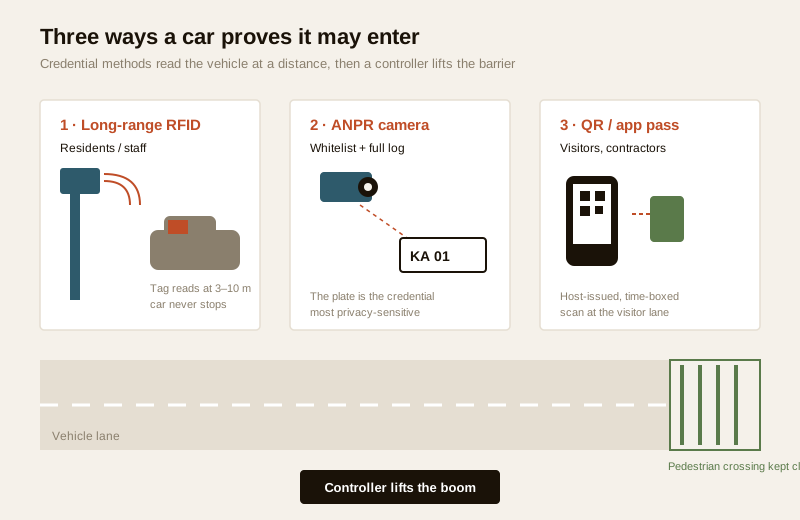
Three method families dominate, and most good systems combine them:
- Long-range RFID — a passive UHF windshield sticker or an active tag reads from 3–10 metres as the car rolls up, so residents never stop. This is the workhorse for society and office resident parking.
- ANPR (Automatic Number Plate Recognition) — a camera reads the number plate itself, so the plate is the credential; no tag to issue. Excellent for a whitelist of known vehicles and for logging everyone, but it is the most privacy-sensitive method. See the dedicated ANPR guide.
- QR / app for visitors — a one-time QR code sent to a guest's phone, or an app pass, scanned at the lane. This ties parking straight into visitor management.
Choosing the credential mix
| Method | Reads at | Best for | Watch-outs (India) |
|---|---|---|---|
| Long-range UHF RFID tag | 3–10 m, no stop | Resident / staff parking, high volume | Tag can be moved between cars; pair with ANPR to bind tag-to-plate |
| ANPR camera | Plate distance, no tag | Whitelist entry + full logging | Dirty/obscured/non-standard plates; strongest DPDP duty |
| QR / app pass | Scan at short range | Visitors, contractors, valet | Needs a lit, reachable scanner; phone battery/signal |
| Card / fob at a pedestal | Tap, driver reaches out | Small sites, back-up lane | Driver must stop and reach — poor in rain, slow |
| Guard + intercom override | Manual | Exceptions, failures, deliveries | Always keep a human fallback; see guard intercom |
The common pattern for an Indian society: RFID for residents, ANPR reading and logging every plate for a defence-in-depth and enforcement record, and QR for pre-approved visitors — with a guard who can always raise the barrier manually. Binding the RFID tag to a registered number plate (the ANPR must match the tag) is the standard mitigation for a tag simply being carried into another car — a design caution handled by matching, never by teaching anyone to defeat it.
The barrier hardware
The credential decides whether to open; the barrier is what opens. Three physical forms cover almost every Indian car park.
Boom barrier
A horizontal arm that lifts to roughly vertical. It is the default for a lane you want to open and close many times a minute: fast (a good one clears in 0.9–3 seconds), cheap to run, and unmistakably a "stop" signal to a driver. It does not physically stop a determined vehicle — the arm breaks away — so a boom is an access control and traffic device, not a crash barrier. For hostile-vehicle protection you add bollards.
Rising / fixed bollard
A steel post that retracts into the ground (automatic) or is fixed/removable (manual). Automatic bollards are for lanes where you need genuine vehicle denial — a mall service entry, a plaza no-go zone — and are far costlier. Most societies use a boom for daily flow and a few fixed bollards to channel traffic.
Sliding / swing gate
Where the car-park entry is the property gate, a motorised sliding gate both secures the perimeter and controls parking in one leaf. Slower than a boom, so it suits lower-frequency entries or overnight lockdown rather than a busy morning rush.
The safety layer is not optional
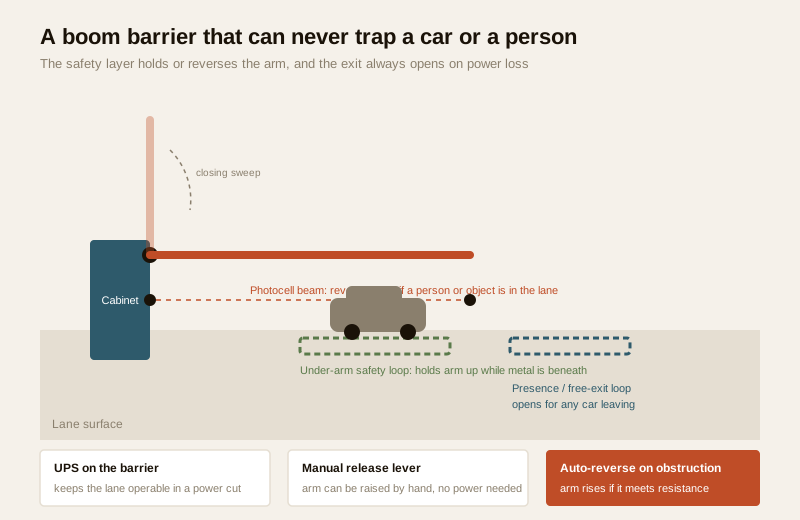
A boom barrier is a heavy arm moving over a lane people and cars share. Every barrier in a residential or commercial car park must carry, and have commissioned and tested, the following:
| Safety device | What it does | Why it is mandatory |
|---|---|---|
| Closing safety loop (under-arm) | Inductive loop in the road under the arm | Holds the arm up while metal (a car) is under it; the arm can never come down on a vehicle |
| Photocell / infrared beam | Beam across the lane at the arm | Detects a pedestrian or object; reverses or holds the arm |
| Auto-reverse on obstruction | Motor senses resistance | If the arm meets anything while closing, it stops and rises |
| Presence / free-exit loop | Loop before the barrier on exit | Opens the exit for any vehicle leaving — no credential needed to get out |
| Manual release + UPS | Hand crank / clutch, battery backup | On power loss the arm can be raised by hand and stays operable |
These are the vehicle-parking equivalent of the fire-egress rule that governs every setting in this section: the way out must never be blocked. An exit barrier that demands a working credential and mains power to raise is a trap — a fire, a medical emergency or a simple power cut must not leave cars unable to leave. Specify a free-exit loop (or a fire/alarm interlock that raises and holds the arm), a UPS on the barrier, and a manual release, and have the integrator demonstrate each on handover. Calibration of the safety loops and any interlock is a licensed commissioning task, not a DIY setting.
Resident, visitor and staff flows
Good parking access is mostly about designing flows, not buying gadgets. The role-based thinking that governs doors applies to lanes.
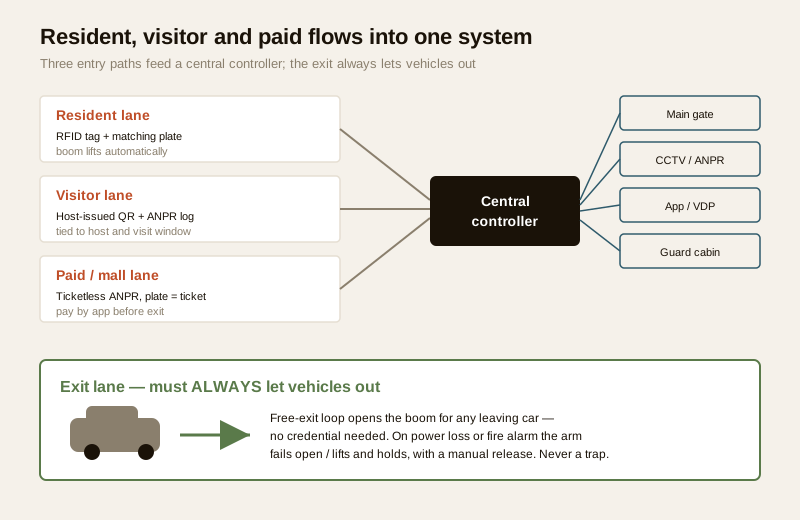
- Residents / permanent staff — a registered RFID tag bound to a number plate, valid on their allotted slots and lanes. Deactivation is instant when a resident leaves or a tag is lost — a reason to keep the whole system on a cloud or networked controller the RWA can manage, not a standalone box only the vendor can touch.
- Visitors — pre-approved by a resident through the app, issued a time-boxed QR that works at the visitor lane only, and captured by ANPR so the log ties the plate to the host and the visit window. This is where parking and visitor management become one system.
- Daily / hourly / paid parking (malls, commercial) — a ticketless flow: ANPR reads the plate on entry, the plate becomes the ticket, the driver pays by app or at a kiosk keyed to the plate, and ANPR at exit checks payment before the boom lifts. No paper, no fumbling for a stub in the rain.
- Exceptions — ambulances, fire tenders, movers, a failed tag — always resolvable by a guard raising the barrier and, ideally, logged with a reason. Never design a lane with no human override.
Integrating with the gate and the building
Parking access is rarely a standalone island. At its best it is one layer of the building's whole access control system, sharing identities and logs with:
- The main gate — so a resident's one credential clears both the community gate and their parking, and a visitor approved once is expected at both.
- CCTV and ANPR — the plate-reading cameras double as surveillance and evidence; overview cameras on the lane record every barrier cycle. See the CCTV hub.
- The video door phone / intercom — a visitor at the barrier can be verified by the resident through the video door phone or the guard via intercom before the arm lifts.
- Reporting — entry/exit audit trails for the RWA or facility team, and enforcement of slot rules (no double-parking a single tag).
For the wider picture of securing a whole community or commercial block, see the gated-community and commercial-building security guides. To size and price a scheme, the Studio Matrx access control system designer and cost estimator let you model lanes, readers and barriers before you buy.
Indian ground realities
- Power cuts — the barrier, reader, ANPR camera and controller must sit on a UPS, and the exit must be usable when the grid is down. Budget for battery backup on every lane.
- Monsoon, dust and heat — outdoor RFID readers, ANPR cameras and barrier cabinets need an IP-rated (typically IP54–IP65) enclosure, a shaded or hooded reader so glare and rain don't blind the plate camera, and drainage so the in-road loop pits don't flood.
- Plate quality — Indian plates vary wildly (fancy fonts, faded, obscured); ANPR accuracy drops on non-standard plates, so keep RFID as the primary resident credential and ANPR as the log/enforcement layer, not the sole gate.
- Cost bands (indicative, ₹) — sanity-check quotes, don't treat as fixed.
| Item | Indicative price (₹) |
|---|---|
| Boom barrier (arm 3–6 m, with loop detector) | 35,000 – 1,20,000 per lane |
| Long-range UHF RFID reader + antenna | 15,000 – 60,000 |
| UHF windshield tag (per vehicle) | 60 – 250 |
| ANPR camera + software (per lane) | 60,000 – 2,50,000+ |
| Automatic rising bollard (per unit) | 2,00,000 – 6,00,000+ |
| Safety loops, photocells, UPS per lane | 8,000 – 30,000 |
Privacy: number plates are personal data
The moment a lane reads and stores a number plate with a timestamp, it is processing personal data under the Digital Personal Data Protection Act, 2023 — a plate, tied to a resident or visitor, tied to when they came and went, is a movement record. An RWA or facility operator running ANPR is a data fiduciary and must:
- Have a lawful basis and a clear notice — signage at the entry stating the car park is monitored, who operates it, and why (security, enforcement), with a stated purpose.
- Minimise — capture only what the purpose needs; don't quietly build a permanent history of every resident's comings and goings beyond what security requires.
- Set a retention period and delete on schedule — ANPR logs and parking records should not live forever; agree a defined window (aligned to your CCTV retention) and purge.
- Control access — only named administrators (the RWA committee or facility manager) see the logs; the installer gets no standing remote access to the movement database, and vendor access ends with the contract.
- Handle visitor data lawfully — a visitor's plate and host link is collected for the visit, not kept indefinitely; see visitor management and audit trails.
Treat the parking log with the same care as CCTV footage. It is educational guidance here, not legal advice — an RWA should set its retention and access policy in writing.
When to bring in a professional. Plan the flows, credential mix and privacy policy yourself, and use the designer tool to model it. Hand the barrier and bollard fitting, mains supply, in-road loop cutting, safety-loop and photocell calibration, the free-exit and fire/gate interlock, and ANPR camera commissioning to a coordinated team — a licensed integrator plus an electrician, working to the electrical and fire rules. Insist on a documented handover that demonstrates the arm reversing on a blocked loop, the exit opening on power loss, and the manual release working. Never accept a barrier without commissioned safety loops, and never let a lane be built with no human override.
Key takeaways
- Vehicles need distance-read credentials — long-range RFID for residents (no stopping), ANPR for whitelist entry and logging, and QR/app for visitors; most good Indian sites combine all three with a guard override.
- The barrier is traffic control, not a crash barrier — a boom manages flow and cannot stop a determined vehicle; add bollards where you need genuine denial, and use a sliding gate where the entry is the perimeter.
- Safety loops and a free exit are non-negotiable — a boom must never lower onto a car or person (under-arm loop, photocell, auto-reverse), the exit must let vehicles out on power loss or fire alarm, and every lane needs a UPS and a manual release.
- Design flows, then integrate — bind resident tags to plates, time-box visitor QRs, run malls ticketless, and share identities and logs with the gate, CCTV and the building's access system.
- Plates are personal data — ANPR entry/exit records fall under the DPDP Act, 2023: give notice, minimise, set a retention window, restrict access to named administrators, and revoke vendor access with the contract.
References
- Digital Personal Data Protection Act, 2023 — vehicle number plates with entry/exit timestamps are personal data; an RWA or operator running ANPR or parking logs must provide notice, a lawful basis, minimisation, a retention limit and controlled access.
- Manufacturer specifications — verify boom-barrier duty cycle and opening time, RFID read range and frequency band, ANPR accuracy claims, IP enclosure ratings and safety-loop/photocell compliance on the maker's own datasheet before ordering.
- National Building Code of India (SP 7), Bureau of Indian Standards, and local fire and municipal rules for the fire-egress and electrical aspects of any barrier on an escape route; verify the current edition via the BIS catalogue: https://www.services.bis.gov.in/
This is an educational overview, not legal advice. Barrier and bollard fitting, mains and loop wiring, safety-loop and photocell calibration, and any fire-egress interlock are qualified professional tasks — engage a licensed integrator and electrician, and verify any standard's current status via the BIS catalogue before relying on it.
Export this guide
Related Guides — Deep-dive reading
Visitor Vehicle Management in India: A Professional Guide
The everyday weak point of every society and office gate is not the resident's car — it is the visitor, the cab, the delivery rider and the contractor who must be let in without opening the whole park to anyone. This is the process, not just the hardware: verify at the gate before the boom lifts, park visitors away from resident bays, and never jam the gate a fire tender needs.
SecurityBoom Barriers in India (2026): Traffic Control at the Gate - and What They Do NOT Stop
The rising arm at the society, office and parking entrance controls honest vehicle flow one authorisation at a time - but a boom barrier is not an anti-ram device, and here is how to specify, integrate and make it safe.
SecurityBoom Barrier Not Operating (2026): Diagnose a Stuck or Dead Parking Gate Arm
A calm, ordered diagnostic path for a facility or security team when an apartment, office or parking boom barrier will not raise or lower, is stuck up or down, or will not respond — starting with the manual release so a jammed arm never traps a vehicle or blocks a fire lane, then power, trigger, safety loop and mechanical causes, and a clear line between safe checks and technician-only work.
SecurityRelated Tools — Try Free
Apartment Video Door System Planner
Enter flats, entrances, floors and guard desk for a first-pass building intercom plan — door stations, indoor monitors, guard station, the right architecture and an indicative cost band.
Building PlannerAccess-Control Battery-Backup Calculator
Size the standby battery so an access system keeps running through a power cut, with an egress life-safety note.
Battery BackupGate Access Planner
Size a vehicle gate or boom barrier — lanes needed at peak and the right credential speed (RFID, ANPR, manual).
Gate Flow