
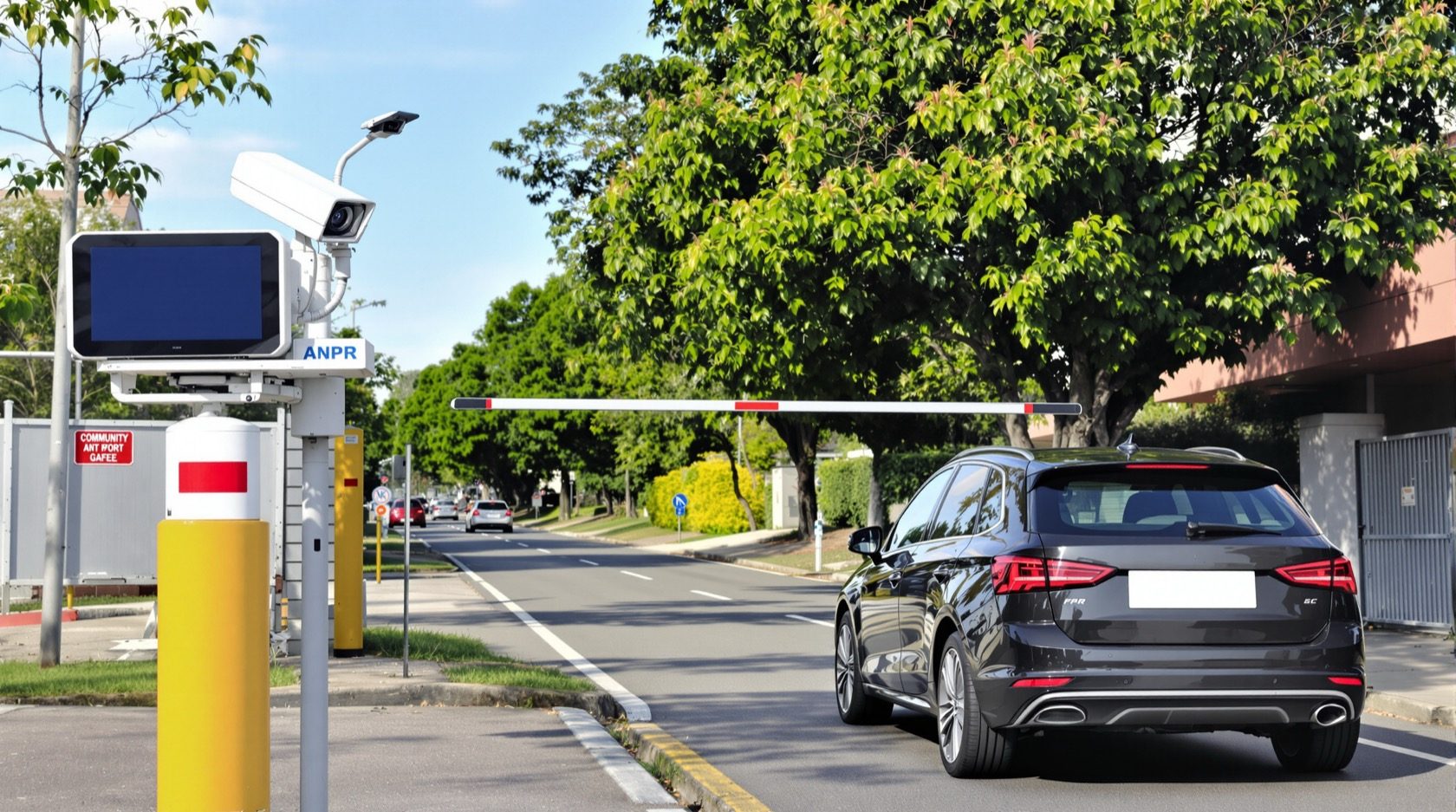
ANPR CCTV Cameras in India: Automatic Number Plate Recognition at Your Gate, Explained
How ANPR cameras read and log vehicle number plates at a society or commercial gate, what they need to actually work well on Indian plates and lanes, their accuracy limits, and the privacy duties of keeping a log of who comes and goes.
ANPR cameras — Automatic Number Plate Recognition, sometimes sold as LPR (Licence Plate Recognition) — are specialised cameras paired with software that read the number plate of every vehicle at a gate and turn it into searchable text. Instead of a guard writing each vehicle into a paper register, the system logs the plate, the time in and out, and a snapshot image automatically. For a resident's whitelisted car it can open the boom barrier on its own; for an unknown plate it flags the guard to check.
This is the focused explainer on ANPR in Studio Matrx's CCTV hub. It sits alongside the other recognition and camera-type guides — an ANPR camera is a purpose built on top of an ordinary camera, not a separate shape. This guide helps you decide whether ANPR fits your gate, what it genuinely needs to work, and what duties come with keeping a record of who comes and goes.
Scope & safety. This guide helps you plan and decide. Mounting the camera at height, running cabling, wiring the barrier interlock and any mains-electrical work belong to licensed professionals. A gate barrier must never trap a vehicle or block fire-service or emergency access, and the log ANPR creates is personal data — treat it under the spirit of the DPDP Act, 2023, with a clear, legitimate purpose.
What ANPR actually does
An ANPR setup has two halves working together:
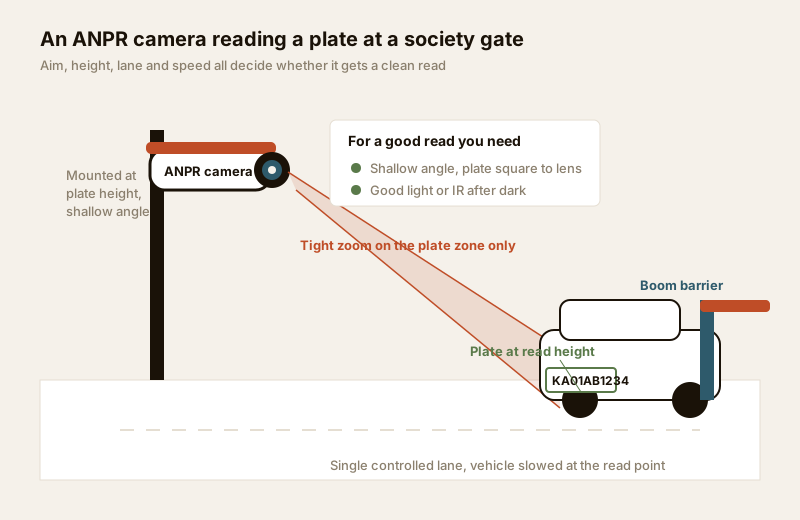
- The camera — a camera, usually a fixed bullet or box unit, aimed tightly at the zone where a plate will appear, often with its own infrared illuminator so it reads plates in the dark.
- The software — the engine that finds the plate in the frame, reads the characters, and matches them against a list. It can run inside the camera ("edge" ANPR) or on the recorder/server.
Together they let a gate do things a paper register never could:
- Auto-entry for residents. Add a resident's plate to a whitelist, and their car is recognised and the boom barrier lifts without anyone stopping — no fumbling for a fob at the gate.
- A searchable log. Every vehicle in and out is recorded with plate, timestamp and image. Weeks later you can search by plate to answer "when did this car last come in?" in seconds.
- Flagging. A plate on a blacklist, or any unknown plate, can alert the guard to hold and verify before the vehicle proceeds.
- Speed at the gate. At a busy society or office gate, automatic reading clears the resident queue far faster than a guard writing each entry by hand.
How the flow works
The logic is a simple pipeline: read, match, act, log.
1. Read. As a vehicle reaches the read point, the camera captures the plate and the software converts the plate image into text characters.
2. Match. The read plate is compared against the resident whitelist (and any block list).
3. Act. On the list -> open the barrier automatically. Unknown or flagged -> hold for the guard to verify the visitor and decide manually.
4. Log. Every event is recorded — matched or not — with plate, time in/out and a snapshot, so the whole gate history is searchable later.
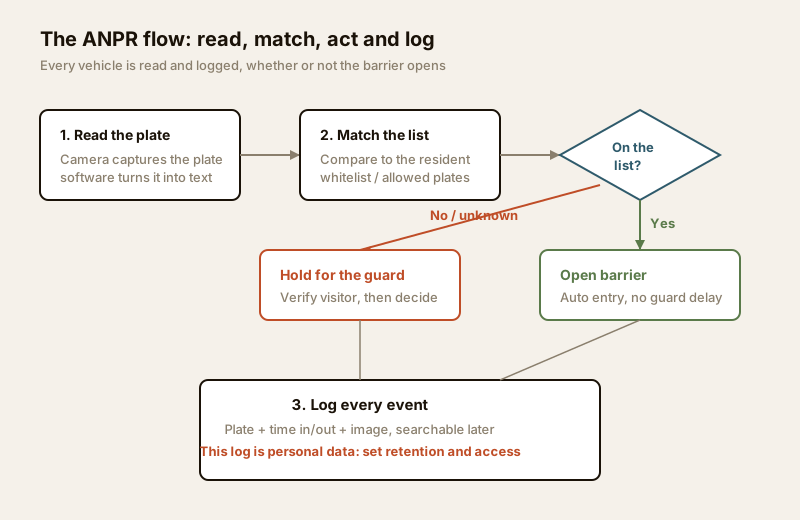
The important thing to notice: the barrier decision and the logging are separate. Even a visitor the guard lets in manually is still logged. That log is the real long-term value of ANPR — and the real responsibility.
What ANPR needs to actually work well
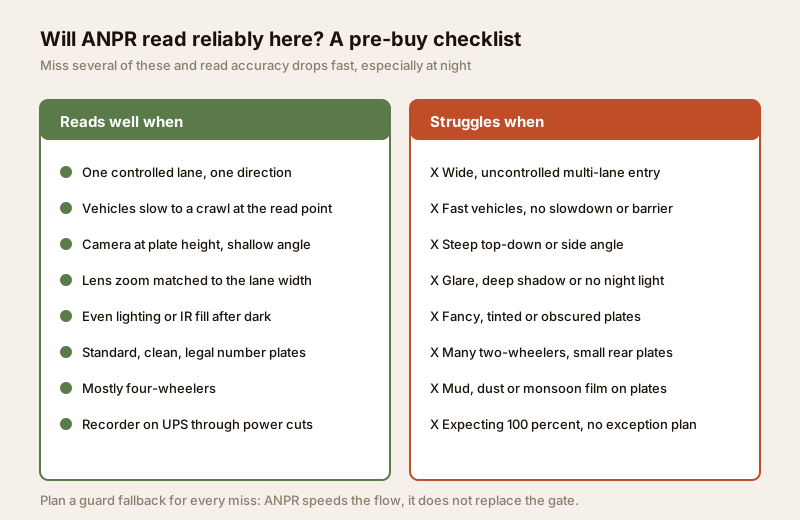
This is where most disappointing installs go wrong. ANPR is not a normal CCTV camera you point at a scene — it is a measurement of a small, fast-moving object, and it is fussy about the conditions. Get these wrong and read accuracy falls off a cliff, especially at night.
| Factor | What a good read needs |
|---|---|
| Camera aim & height | Mounted near plate height at a shallow angle so the plate faces the lens square-on — not a steep top-down or side view |
| Lens / zoom | Focal length matched to the lane so the plate fills enough of the frame to be legible; a dedicated ANPR camera, not a wide overview camera |
| Lane control | A single, defined lane and one direction of travel — not a wide, open, multi-lane entrance |
| Vehicle speed | The vehicle slowed to a crawl at the read point — a barrier or speed bump enforces this; fast plates blur |
| Lighting | Even light, and IR or a dedicated illuminator after dark; glare, deep shadow and headlight flare all defeat a read |
| Plate condition | Standard, clean, legal plates; mud, monsoon film, tinted covers, decorative fonts and bent plates all reduce accuracy |
| Vehicle mix | Best with four-wheelers; small, low, varied two-wheeler rear plates are genuinely hard to read reliably |
| Power | Camera and recorder on a UPS/inverter so a power cut does not blind the gate |
India-specific plate quirks matter a lot here. Number plates vary widely in format, spacing and font; many carry decorative, fancy or partly obscured lettering that no engine reads well; and two-wheelers — a huge share of traffic at any Indian gate — have small rear plates mounted low and at awkward angles. A system tuned for clean four-wheeler plates on a Western highway will not match its brochure numbers at a mixed Indian society gate. Test with your traffic before you trust it.
Where ANPR fits — and where it does not
| Where it fits | Why it works | Watch-outs |
|---|---|---|
| Gated community / society gate | Auto-entry for residents; searchable visitor log; faster than a register | Two-wheeler reads; resident consent; retention policy |
| Commercial / office entrance | Staff whitelist, contractor/visitor log, integrates with access control | One controlled lane needed; peak-hour throughput |
| Industrial / warehouse gate | Log goods vehicles in/out; match against expected deliveries | Big vehicles, dust and mud on plates; wide gates |
| Paid or managed parking | Ticketless entry/exit, time-based, plate-matched | Accuracy exceptions need a manual override lane |
| Small independent home gate | Usually overkill — a doorbell or a good bullet is simpler | Cost and privacy duty rarely justified for one home |
For a single home, ANPR is usually more system than the gate needs — a well-aimed bullet or turret at the gate, as part of a normal residential CCTV scheme, does the job with far less cost and far less data to look after. ANPR earns its place where there is a stream of vehicles and a real reason to log them — which is why it is mostly a society, commercial or industrial tool. For the wider gate picture at an RWA, see the gated-communities security guide.
Accuracy: plan for the exceptions
Be honest with yourself and your committee: ANPR is not 100 percent. Even a good install misreads some plates — a stray character, a plate it cannot see, a two-wheeler it skips, a monsoon-splattered plate. The brochure accuracy figures are measured in ideal lab or highway conditions, not at a busy mixed Indian gate in the rain.
That is fine — as long as you design for the misses rather than pretend they will not happen:
- Keep the guard in the loop. ANPR speeds the gate; it does not replace the person. Every unread or unmatched plate must fall back cleanly to the guard.
- Provide a manual override. The barrier must have a safe manual lift and a way for the guard to admit a vehicle the camera could not read — never leave a resident stuck at a closed barrier because their clean plate happened to misread.
- Do not auto-deny. Use ANPR to auto-admit known residents and to flag the unknown for a human — not to automatically refuse or trap anyone. Auto-denial punishes the system's own errors.
- Review and correct the whitelist. New residents, sold cars and replaced plates all drift; someone has to own keeping the list current.
The privacy and data duty — this is not optional
An ANPR log is a detailed record of who came and went, and when — squarely personal data. Under the spirit of the DPDP Act, 2023, a society or business running ANPR has real duties, and a resident body should treat this seriously before switching it on:
- Legitimate purpose, clearly stated. Security and access management are reasonable purposes; state them. Do not quietly repurpose the log for tracking residents' movements or settling disputes.
- Resident notice and consent. At a society, the RWA should inform residents that vehicle plates are logged, why, how long records are kept and who can see them — ideally via a General Body resolution, not a silent switch-on. This is exactly the ground covered in the security privacy assessment guide.
- A retention limit. Keep logs only as long as the stated purpose needs — a defined window, not forever. Set it, write it down, and auto-purge older records.
- Restricted access. Only named, authorised people should be able to view or search the log; it is not for casual browsing by every committee member or guard.
- Security of the data itself. The log and images must be protected from leaks — a spreadsheet of residents' movements is a genuine risk if it walks out the gate.
Treat the whole thing as a small privacy project, not just a camera purchase. A short written policy — purpose, retention, access, consent — is what separates a responsible ANPR install from a liability.
Integration and India cost bands (indicative)
ANPR rarely stands alone — it usually drives a boom barrier and sometimes ties into wider access control. That interlock (camera talks to barrier controller) is the part most worth getting a professional to wire and test, because a barrier is a moving machine near vehicles and people.
| Item | Typical range (₹) | Notes |
|---|---|---|
| Dedicated ANPR camera (with IR) | ₹8,000 – ₹35,000 | Purpose-built; not a generic overview camera |
| ANPR software / licence (per lane) | ₹10,000 – ₹60,000+ | Edge-in-camera is cheaper; server engines cost more |
| Boom barrier (motorised) | ₹35,000 – ₹1,20,000 | Per lane; loop sensors and safety add to this |
| Barrier interlock + controller | ₹8,000 – ₹30,000 | The camera-to-barrier logic and access panel |
| Recorder + UPS for the gate | ₹15,000 – ₹50,000 | Do not skip the UPS — power cuts blind the gate |
| Install, cabling & commissioning | ₹15,000 – ₹50,000+ | Height work, lane cabling, tuning and testing |
Treat these as ballparks to sanity-check a quote, not fixed rates — they move with brand, lane count, barrier grade and how much civil work the lane needs. Size and cost the wider scheme with the security system cost estimator, and use the camera type selector to confirm the right base camera for each view.
When to bring in a professional. Decide whether ANPR fits, where the lane and read point sit, and your retention and consent policy yourself. Then hand the camera mounting at height, lane cabling, the barrier interlock wiring, and any mains-electrical work to licensed professionals — a barrier is a moving machine near vehicles and must fail safe. Anything at the mains board is a licensed electrician's job; see the electrical hub. Insist the installer tunes and tests with your real traffic, including two-wheelers at night, before sign-off — a brochure accuracy figure is not an acceptance test.
Key takeaways
- ANPR cameras read and log vehicle number plates at a gate — whitelisting residents for automatic barrier entry, flagging unknowns, and building a searchable in/out log that beats a paper register.
- The flow is read -> match -> act -> log; the barrier decision and the logging are separate, and every vehicle gets logged.
- It only works well with the right aim, height, zoom, a single controlled lane, slowed vehicles and night lighting — and Indian plate variety plus two-wheelers make it harder than the brochure suggests.
- It is not 100 percent — always keep the guard as fallback, provide a safe manual override, and never auto-deny.
- The log is personal data: run ANPR with a stated purpose, resident notice and consent, a retention limit and restricted access under the DPDP Act, 2023 — see the privacy assessment and gated-communities guide.
References
- Digital Personal Data Protection Act, 2023 — an ANPR log is personal data; run it with a legitimate, stated purpose, resident notice/consent, a defined retention period and restricted access.
- Ingress Protection (IP) ratings — verify the camera and barrier controller weatherproofing (IP66 or higher for the gate) on the manufacturer's specification sheet before ordering.
- National Building Code of India (SP 7), Bureau of Indian Standards, and local municipal bye-laws for any structural, electrical, barrier and life-safety aspect of a gate install; verify the current edition via the BIS catalogue: https://www.services.bis.gov.in/
This is an educational overview. Camera mounting at height, cabling, barrier interlock wiring and any electrical work are qualified professional tasks — engage licensed installers, ensure the barrier fails safe and never blocks emergency access, and verify any standard's current status via the BIS catalogue before relying on it.
Export this guide
Related Guides — Deep-dive reading
Visitor Vehicle Management in India: A Professional Guide
The everyday weak point of every society and office gate is not the resident's car — it is the visitor, the cab, the delivery rider and the contractor who must be let in without opening the whole park to anyone. This is the process, not just the hardware: verify at the gate before the boom lifts, park visitors away from resident bays, and never jam the gate a fire tender needs.
SecurityRFID Vehicle Access in India (2026): Hands-Free Boom Entry, and Its Honest Limits
The FASTag-style windscreen tag and long-range reader lift the society or office-park boom without the driver stopping - fast, logged and far better than a photocopied resident sticker. But an RFID tag identifies the TAG, not the driver, so treat it as convenience and audit, never high assurance.
SecurityGate Access Control in India (2026): The System at the Main Entrance
How the main gate of a society, villa or office actually controls who and what comes in — the guard, boom barrier, turnstile, cameras and intercom working as one layered system that still lets everyone out in an emergency.
SecurityRelated Tools — Try Free
Gate Access Planner
Size a vehicle gate or boom barrier — lanes needed at peak and the right credential speed (RFID, ANPR, manual).
Gate FlowCCTV Camera Type Selector
Answer five questions and get the right camera form factor — dome, vandal dome, bullet, turret or PTZ — with reasons.
Camera SelectorCCTV Commissioning & Handover Checklist
An interactive go/no-go checklist to run at handover — cameras day and night, recording, alerts, passwords and documents — before you clear the final bill.
Handover Checklist