
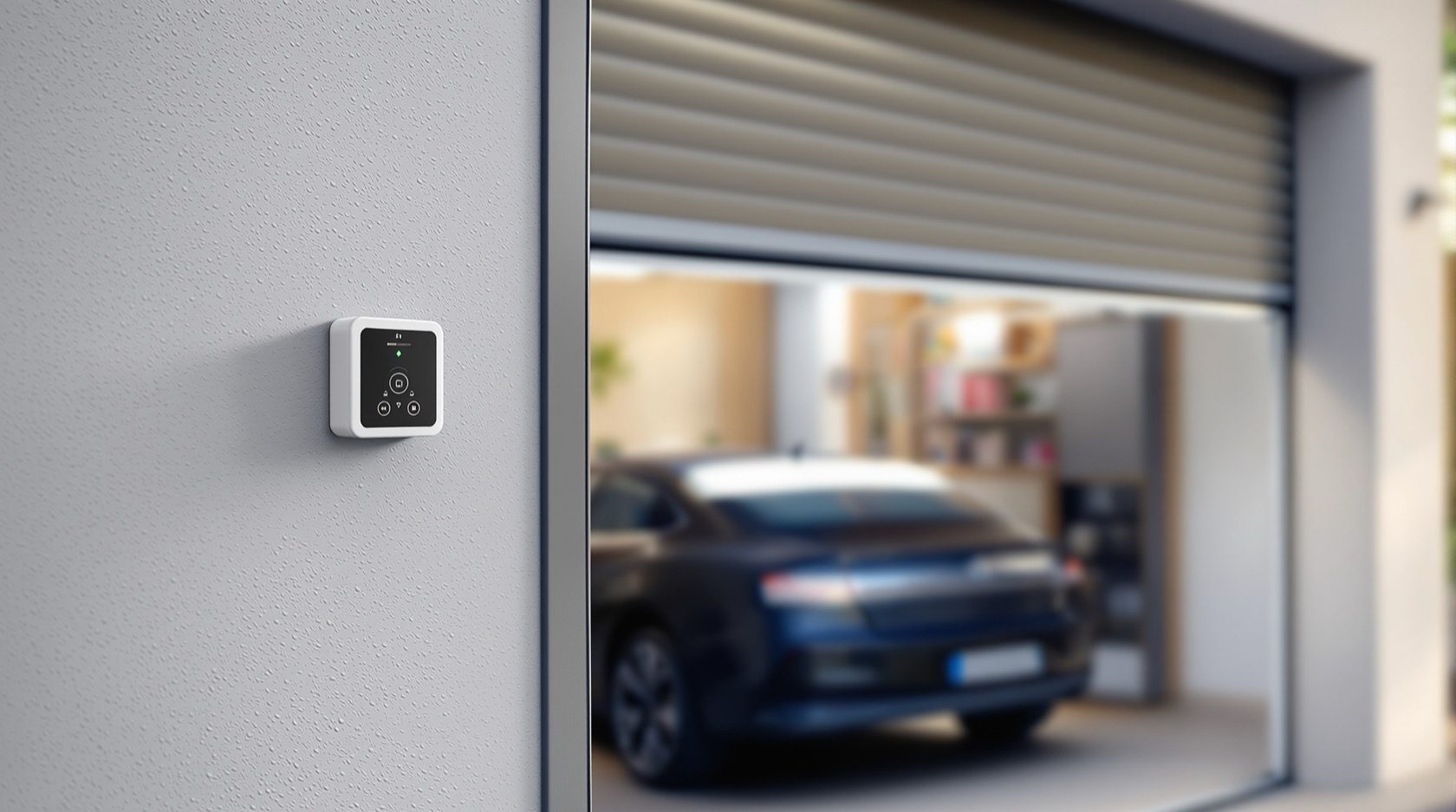
Smart Garage Locks in India (2026): Securing the Door and the Car Park
How to secure a home garage or stilt parking in India: smart control of the roller shutter or sectional garage door itself, plus a smart lock on the pedestrian side-door, with pinch-protection and manual-release safety flagged throughout.
A garage is where a home keeps its two most valuable movable assets — the car and, more and more, whatever is stored around it. Yet it is also the most awkward part of the house to secure, because the "door" is not a door at all: it is a large, heavy, motor-driven panel that has to open wide enough to drive through, and increasingly it answers to a phone. Getting this right in India means thinking about two separate things at once, and never confusing them.
Smart garage locks are best understood as two problems with two different answers. The first is the big opening itself — the roller shutter or sectional panel you drive through — which is "locked" not by a bolt but by a motor and a controller you can drive from an app. The second is the ordinary human-sized pedestrian side-door into the garage, which takes a real lock exactly like any other door. This guide covers both, in India's conditions, and keeps safety in the foreground the whole way, because a powered garage door is the one piece of home hardware that can genuinely hurt someone if it is set up carelessly. It is the garage chapter of Studio Matrx's complete guide to smart locks in India.
Scope & safety. This guide helps you plan, decide and coordinate — not fit anything yourself. A powered garage door is heavy and mains-connected: its motor, wiring, pinch-protection and manual release are a licensed installer's and electrician's job, coordinated with your electrical work. Two rules never bend. First, a powered door must auto-reverse when it meets an obstruction and must have a manual release so you can open it by hand in a power cut. Second, a child must never be allowed to operate it, and the pedestrian door people walk through must always let someone get OUT from inside, even when everything is "locked." Access logs are personal data under the Digital Personal Data Protection Act, 2023. This is educational guidance, not legal advice.
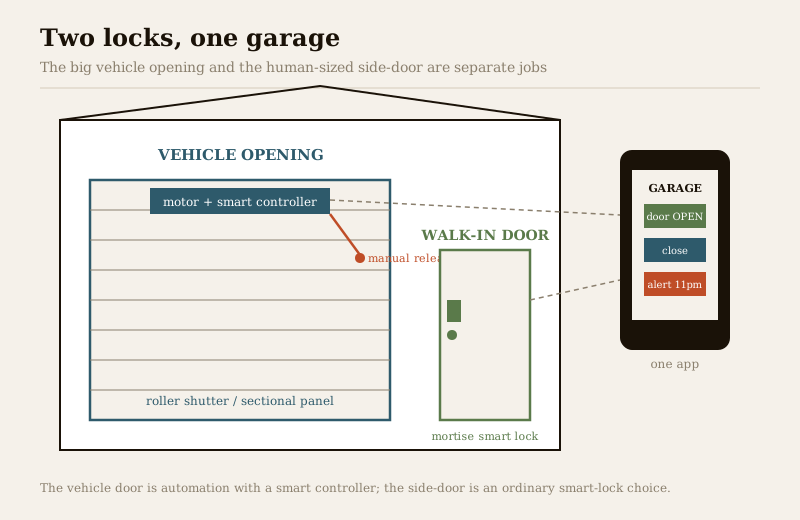
Two locks, one garage
Before you shop for anything, separate the two jobs in your head. They use different hardware, have different failure modes, and carry very different safety weight.
| The vehicle opening | The pedestrian side-door | |
|---|---|---|
| What it is | Roller shutter or sectional/tilt-up panel | An ordinary human door into the garage |
| How it "locks" | A motor + controller; app opens/closes it | A real lock — usually a mortise smart lock |
| Smart part | Wi-Fi/Bluetooth garage controller + app | Fingerprint / PIN / RFID / app credential |
| Main safety risk | Crushing / pinch injury; trapping in a power cut | Egress — people must be able to get out |
| Who fits it | Licensed installer + electrician (mains motor) | Locksmith / installer; mechanical override kept |
The mistake people make is treating the whole garage as "one smart lock." It is not. The vehicle opening is really garage-door automation with a smart controller bolted on; the side-door is a normal smart-lock decision you can read about in the credential guides. Handle them separately and both get easier.
Part one: smart control of the garage door itself
Most Indian garages use one of two door types, and the smart approach differs slightly for each.
- Roller shutters — the rolled-steel curtain common on independent houses and shop-cum-garage frontages. A tubular or side motor rolls it up; a smart controller wired alongside the motor lets an app raise, lower and check it.
- Sectional or tilt-up doors — hinged panels that lift on tracks, more common in newer villas and gated-community units. A ceiling-mounted opener does the lifting; a smart controller (built-in or retrofit) exposes it to your phone.
In both cases the "smart" layer is a controller, not a lock. It gives you four things worth having:
1. Open and close from your phone — no fumbling for a remote, and you can let in a delivery or a family member remotely. This overlaps heavily with app-controlled locks and remote-access locks; the same convenience, applied to a big door.
2. Status and alerts — the single most useful feature. The app tells you the door is open, and can nudge you ("garage still open at 11pm") — the modern answer to "did I shut the garage?"
3. Auto-close — shut the door automatically after a set time or when you leave a geofence. Powerful, and the feature that most needs the safety rules below, because a door that closes on its own must be certain nothing is in its path.
4. Home integration — tie it into your smart home so the garage light comes on when the door opens, or the door state shows on one dashboard with your other Wi-Fi locks.
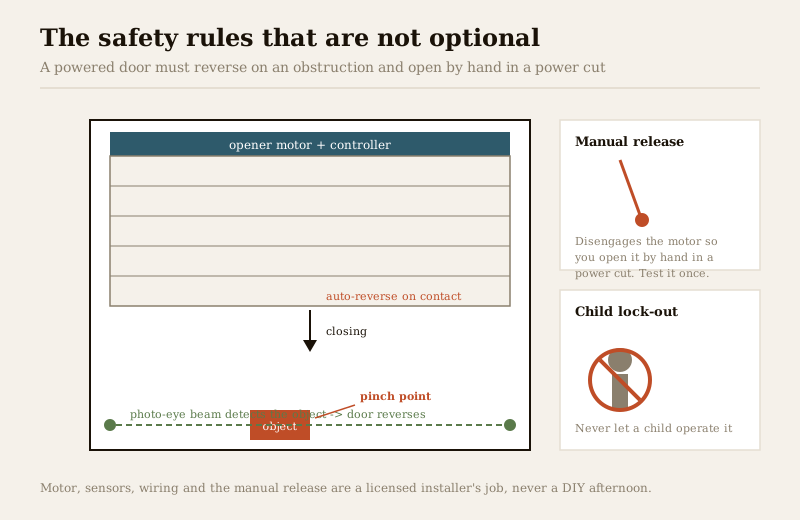
The safety rules that are not optional
A powered garage door is the heaviest moving object in a typical home. Treat these as hard requirements, coordinated with a licensed installer — never a DIY afternoon.
| Safety feature | Why it matters | Non-negotiable? |
|---|---|---|
| Auto-reverse on obstruction | The door must stop and reverse the instant it meets a car, a bag or a person | Yes — mandatory on any powered door |
| Pinch-protection / photo-eye | A beam or edge sensor across the opening detects anything in the path before closing | Yes, especially with auto-close |
| Manual release | A cord or key clutch that disengages the motor so you can open it by hand | Yes — this is how you get in during a power cut |
| Child lock-out | Controls out of children's reach; app not shared to a child's device | Yes — a child must never operate it |
| Force limiting | The motor stops if it senses more resistance than a set threshold | Strongly recommended |
Two of these deserve extra words. Auto-close is genuinely convenient but is the feature that has hurt people worldwide, so it must only be enabled on a door with working obstruction sensing and, ideally, a warning beep-and-flash before it moves. And the manual release is the answer to the most common Indian worry: what happens in a power cut? A powered door with no manual release traps your car inside during a load-shed. Every powered installation must have one, everyone in the house must know where it is, and you should physically test it once. For a deeper look at keeping systems running through outages, see the note on electrical backup for security planning.
Retrofit or new?
You rarely need to replace a working garage door to make it smart.
- Retrofit controller — if your roller shutter or opener already works from a remote, a retrofit smart controller (wired in by an installer alongside the existing motor) adds app control, status and auto-close for a modest cost. This is the common Indian path.
- New motorised door — if you are starting from a hand-operated shutter or building fresh, budget for the motor, the controller and the safety sensors together as one licensed install, not as add-ons later.
| Setup | What you add | Typical cost band (₹) | Notes |
|---|---|---|---|
| Manual shutter, keep it manual | Nothing smart | — | Cheapest; no remote convenience |
| Existing motorised door + retrofit controller | Smart controller module | 4,000 – 12,000 | Adds app, status, auto-close |
| New roller-shutter motor + controller | Motor + controller + sensors | 15,000 – 45,000 | Full licensed install |
| New sectional-door opener + controller | Ceiling opener + sensors + controller | 25,000 – 70,000+ | Villas / gated units |
Prices are 2026 ballparks to sanity-check a quote, not fixed rates — they move with door size, motor brand and whether safety sensors are bundled. Confirm the door type, weight and compatibility before ordering any controller.
Part two: the pedestrian side-door
Almost every well-planned garage has a normal-sized door — into the house, into a utility passage, or beside the shutter. This is where a real smart lock goes, and here the decision is exactly like any other interior/exterior door.
Most Indian doors take a mortise lock body, not a US-style deadbolt, so a mortise smart lock is usually the right fit; on a metal-framed or narrow-stile door a rim or deadbolt form may suit better. Check the door construction before buying — this is the single most common compatibility mistake.
For the credential — how you actually unlock it — pick from the family:
- Fingerprint locks — fast, hands-full-friendly for a door you use with groceries or car keys.
- PIN-code locks — a code you can give a helper or a driver without handing over a physical key.
- RFID locks — a card or fob, tidy for a household with a regular help.
- App-controlled — unlock and share access from your phone, useful if the side-door and the shutter live in one app.
Whatever the credential, keep two things on the pedestrian door: a mechanical key override for when the battery dies, and a backup way in. And remember the egress rule — from inside the garage, a single motion (a thumb-turn or lever) must always let a person out, even with the door "locked," because a garage can catch fire and no one should ever be trapped by their own security.
Where the garage sits: villa, apartment, shop
The right answer changes a lot with the building.
| Setting | Who controls the vehicle door | What you can smart-lock | Watch-outs |
|---|---|---|---|
| Independent house / villa | You | Both the shutter (controller) and the side-door (smart lock) | Coordinate mains + motor with a licensed installer |
| Apartment stilt / basement parking | The RWA / society, usually a shared shutter or boom barrier | Rarely the shutter; sometimes a private lockable store or box | RWA rules govern shared access; see below |
| Shop-cum-garage / mixed use | You | Roller shutter controller + a strong pedestrian-door lock | Higher street exposure; weather + dust on outdoor gear |
In an apartment, the parking shutter or boom barrier is almost always RWA-managed — you cannot bolt your own controller onto a shared society door. What you can do is secure any private lockable store within your bay and coordinate vehicle-entry credentials through the society's system: see video door phones and access control and the gated-community security guide. For a villa, you own the whole decision — combine it with the villas and independent houses security guide. Apartment homeowners will find the apartment security guide more directly useful for the parts they actually control.
India's weather and power realities
Garage hardware, especially on a shutter, lives half-outdoors. Two India-specific cautions:
- Weather and dust. An outdoor controller, keypad or reader needs a real IP rating (look for IP65 or better on anything exposed) so monsoon, dust storms and forty-degree heat do not kill it. A side-door lock under cover has an easier life than a shutter controller on the street face.
- Power cuts and dead batteries. The shutter's manual release is your power-cut plan for the car; the side-door's mechanical key is your dead-battery plan for walking in. Never install a garage where a load-shed can trap the car AND lock you out on foot at the same time — that is two independent overrides doing two different jobs.
Putting it together
For a typical Indian independent house, a sensible, safe garage setup looks like this:
1. Keep or fit a motorised shutter/door with auto-reverse, obstruction sensing and a tested manual release — licensed install.
2. Add a smart controller for app open/close, status alerts and (carefully) auto-close, tied into your smart home.
3. Fit a mortise smart lock on the pedestrian side-door with a credential that suits the household, a mechanical key override, and free egress from inside.
4. Confirm the two independent overrides — manual release for the door, mechanical key for the side-door — and make sure everyone at home knows both.
Not sure which lock the side-door needs, or what the whole thing should cost? Use the smart-lock selector to match a form and credential to your door, and the smart-lock cost calculator to budget the pedestrian-door side of it.
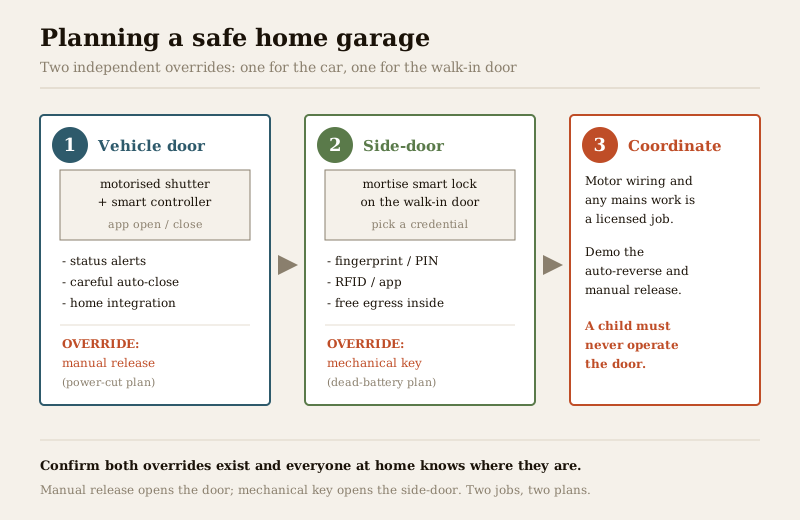
When to bring in a professional. Anything involving the garage-door motor, its mains wiring, the obstruction sensors, the manual release, or a new powered door is a licensed installer's and electrician's job — coordinate it through the electrical hub, never as a DIY task. You can safely choose the credential, plan the layout, and use an installer for the pedestrian-door lock fitting. Insist the installer demonstrates the auto-reverse, shows you the manual release working with the power off, and confirms free egress from inside the garage before you sign off.
Key takeaways
- A garage is two locks, not one — smart control of the big vehicle door (a controller, not a bolt) and a real smart lock on the pedestrian side-door; decide them separately.
- The vehicle door's smart wins are status and control — knowing it is open, closing it from your phone, and careful auto-close; the pillar guide and remote-access locks cover the app side.
- Safety is non-negotiable — auto-reverse on obstruction, pinch-protection, and a tested manual release for power cuts; a child must never operate a powered door, and any mains or motor work is a licensed job.
- The side-door is an ordinary smart-lock choice — usually a mortise smart lock on Indian doors, with a mechanical key override, a backup credential, and free egress from inside.
- Setting decides scope — villa owners control both; apartment stilt/basement shutters are RWA-managed; shop-cum-garage gear needs weatherproof (IP-rated) hardware for monsoon and dust.
References
- Digital Personal Data Protection Act, 2023 — garage app access logs and any entry records are personal data; keep them minimal, grant access only to household members who need it, and revoke a departed helper's or driver's credential promptly.
- Manufacturer specifications — verify the garage-door controller's compatibility with your motor and door type, its safety-sensor and auto-reverse behaviour, the manual-release mechanism, and the IP rating of any outdoor unit on the maker's own datasheet before ordering.
- National Building Code of India (SP 7), Bureau of Indian Standards, and local electrical safety rules for the powered-door motor circuit, wiring and any life-safety egress consideration; verify the current edition via the BIS catalogue: https://www.services.bis.gov.in/
This is an educational overview, not legal advice. A powered garage door is heavy, mains-connected machinery: its motor, wiring, safety sensors and manual release are qualified professional tasks — engage licensed installers and electricians, and verify any standard's current status via the BIS catalogue before relying on it.
Export this guide
Related Guides — Deep-dive reading
Smart Garage Doors & Openers for Indian Homes (2026 Guide)
A garage door is the largest moving object in most homes, and a heavy one. This guide covers smart garage doors and openers for Indian homes end to end — motorised sectional, roller and sliding doors; what a smart opener actually adds; retrofit controllers versus smart openers; the safety sensors you must never skip; rolling-code security; the manual release for power cuts; integration with cameras and your wider smart home; and real brands with ₹ prices.
Smart HomeSmart Locks in India (2026): The Complete Guide to How They Work, How to Choose and How to Fit One Safely
The umbrella guide to smart locks for Indian homes: what a smart lock actually is, the credential that opens it, the lock body it lives in, and the safety, power and privacy calls every buyer must make.
SecurityVideo Door Phones with Smart Locks in India (2026): See, Then Unlock
How to pair a video door phone with a home smart lock so you can video-verify a visitor and let them in without walking over or handing out keys, with a hard focus on mechanical override, power-cut behaviour and egress safety.
SecurityRelated Tools — Try Free
Access-Control Battery-Backup Calculator
Size the standby battery so an access system keeps running through a power cut, with an egress life-safety note.
Battery BackupApartment Video Door System Planner
Enter flats, entrances, floors and guard desk for a first-pass building intercom plan — door stations, indoor monitors, guard station, the right architecture and an indicative cost band.
Building PlannerDoor Lock Selector
Answer a few questions and get the right lock type — mortise, multipoint, deadbolt, privacy or smart — for any door.
Door Tool