
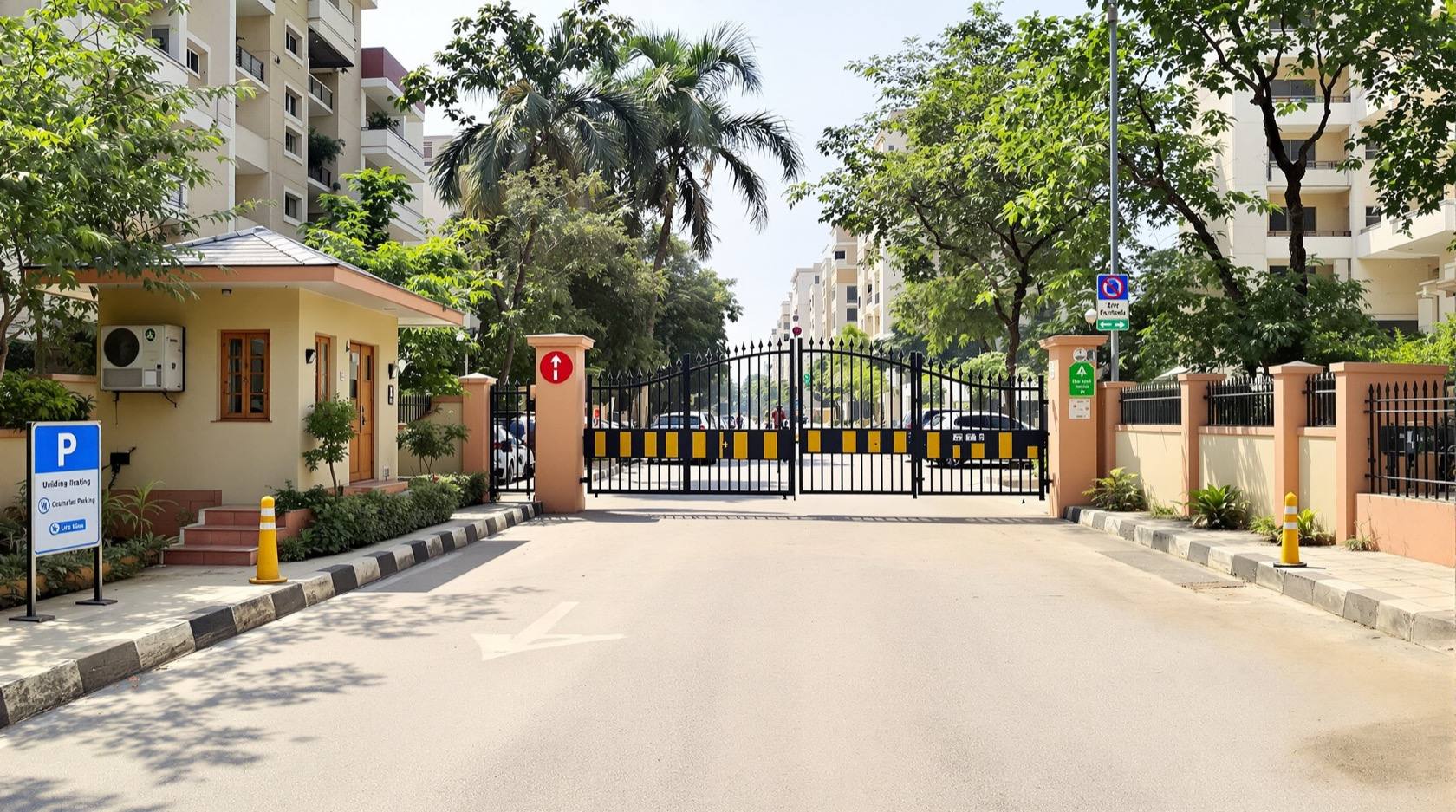
Visitor Vehicle Management in India: A Professional Guide
The everyday weak point of every society and office gate is not the resident's car — it is the visitor, the cab, the delivery rider and the contractor who must be let in without opening the whole park to anyone. This is the process, not just the hardware: verify at the gate before the boom lifts, park visitors away from resident bays, and never jam the gate a fire tender needs.
Walk up to any Indian society or office gate at half past six in the evening and you will see the real security problem of the whole property. The resident cars are the easy part — they have a tag, the boom knows them, they go straight down. The pressure is everything else: the visitor who has come for dinner, the app-cab dropping someone, the food-delivery rider, the two courier vans, the electrician the flat above called, the packers-and-movers truck. Every one of them is a stranger in a vehicle who has a legitimate reason to come in — and the gate has seconds to decide, with cars stacking up behind, whether to let each one through. Get this wrong and the most expensive access-control system in the basement is pointless, because the threat drove in the front gate behind a resident who was waved through.
This is a professional, strictly defensive guide to managing that flow. It sits in the Security Knowledge Hub under the parking and garage sub-hub, beside the complete parking and garage security guide that frames the whole subject. It is deliberately about the process — who verifies, when, against what — because visitor vehicle management is not a device you buy. It is a discipline the gate keeps, or fails to keep, every single day.
Scope & safety. This is an educational planning guide for owners, RWAs and facility managers. You plan, decide and coordinate; licensed professionals install and certify the boom barriers, cameras, electric locks, gates and lighting. It never teaches how to defeat a measure. And one rule overrides every idea in it: the gate is also the way a fire tender comes in and the way residents drive out in an emergency — no visitor process, queue or barrier may ever jam that gate or block that lane. Verify every requirement against the National Building Code of India (SP 7:2026, Part 4) and your local municipal and fire bye-laws for the current edition.
The vehicle side and the people side are two guides
Visitor management has two halves and they are easy to confuse. The people side — who is the person, which flat are they visiting, is the resident expecting them, are they logged in and out — is covered fully in visitor access management. This guide is the vehicle side: the car, the cab, the van and the truck that the person arrives in, where it goes once it is inside, and how it leaves.
They are joined at the gate. A visitor on foot and a visitor in a vehicle raise the same question — who are you here to see, and do they confirm it? — but the vehicle adds a second problem the pedestrian does not have: once it is inside, it takes up space, it can roam, and it can carry things in and out unseen. So read the two together. The people guide tells you how to verify the person; this one tells you what to do with their vehicle, and the two meet at the gate security point where the decision is actually made.
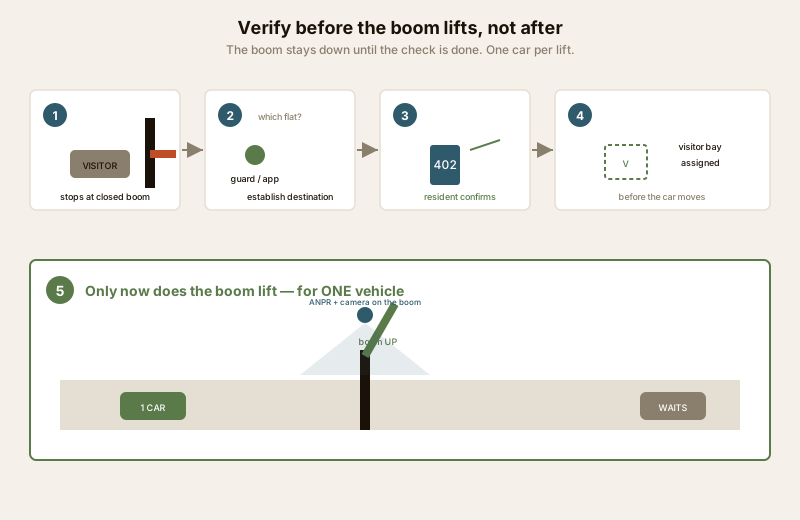
Verify before the boom lifts, not after
The single most important principle in this entire guide is a sequence: verify first, lift second. The order is not negotiable, and the commonest failure in India is that it runs backwards — the boom goes up, the car rolls in, and only then (if ever) does anyone ask who it is. By then the vehicle is already inside the property; you have lost the only moment of control the gate ever had.
The correct sequence at the gate is short and always the same:
1. The vehicle stops at the boom — the boom stays down until the check is done. A closed boom is not rudeness; it is the whole point.
2. The guard or the app establishes who they are visiting — the flat or office number, the name, the reason. A delivery, a guest, a cab, a contractor each has a slightly different check, but all of them name a destination inside.
3. The resident or host confirms — by intercom, by app approval, or by a pre-registered pass. An unconfirmed visitor is not turned away by reflex, but they are not simply waved in either; the guard escalates, not assumes.
4. A visitor bay is assigned — the visitor is told where to park, in the visitor area, before they move.
5. Only now does the boom lift, for one vehicle.
Each of these steps has depth elsewhere. The authorisation logic — passes, approvals, resident confirmation — is the province of parking access control and the wider visitor access management. The physical barrier that holds the line is covered in boom barriers. The plate-capture that puts every entering vehicle on record is in ANPR CCTV cameras. What ties them together is the discipline of running them in order, before the boom lifts.
The resident sticker and the confirmation that never happens
Two Indian gate habits quietly defeat the sequence above, and a professional plan names them.
The first is the resident sticker or FASTag-style tag treated as proof of belonging. A windscreen sticker is trivial to copy, buy second-hand, or move between cars. If the boom lifts on sight of a sticker with no other check, then a sticker is the only credential the property has — and it is a weak one. The tag is fine as a convenience for known resident cars; it is not, on its own, a verification of a visitor.
The second, worse, habit is the confirmation that never happens. The guard asks "which flat", the visitor names one, and the guard writes it down and lifts the boom without calling the flat. Now the register says the visitor came for flat 402, but flat 402 was never asked and may not know they exist. A destination the visitor supplied and no one verified is not a control; it is a formality. The fix is procedural and cheap: the resident confirmation — intercom, app-approve, or a photo-and-approve flow — is the step that turns a claimed destination into a checked one, and it is the step most worth insisting on.
Temporary passes and time-bound e-passes
The way to make verification fast enough to survive the evening rush is to do it before the visitor reaches the gate wherever possible. A temporary pass or time-bound e-pass — a QR code the resident generates in the society app for an expected guest, a plumber, a party of relatives — lets the gate scan-and-check in seconds instead of phoning the flat while cars queue.
The design points that matter for the vehicle side:
- Time-bound and single-use where it can be. A pass that is valid for a window (this evening, this delivery, today only) and then expires cannot be reused next month by someone who kept the screenshot.
- Tied to a destination and, ideally, a plate. A pass that names the flat and captures the vehicle number links the car to the host, so the ANPR log and the pass agree.
- A pass is permission to enter, not a substitute for the gate check. The guard still confirms one vehicle, one pass, and watches the boom. A QR does not stop tailgating on its own.
The generation and approval side of passes lives with visitor access management; what this guide adds is that the pass should carry the vehicle, assign the bay, and expire.
The tailgating problem: the commonest failure of all
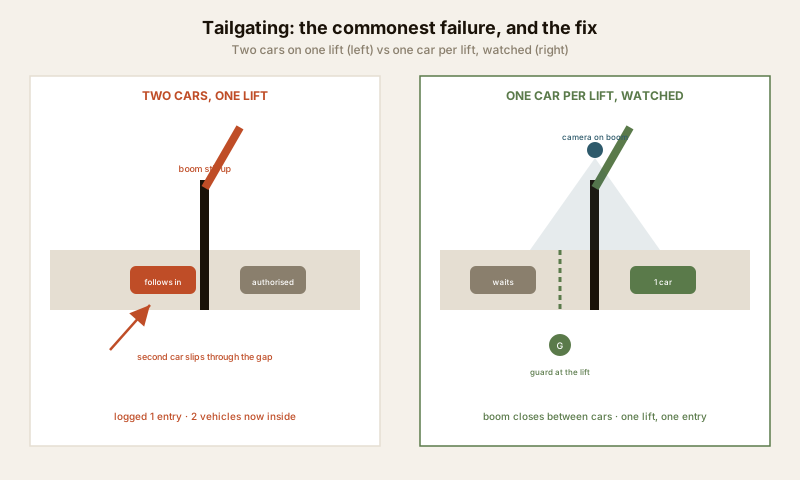
If verification is the principle, tailgating is the failure that undoes it. It is the single most common way an unauthorised vehicle gets into an Indian park, and it needs no cleverness at all: one authorised car is cleared, the boom lifts, and a second vehicle simply follows through the gap before the boom comes back down. Two cars, one lift. The system logged one entry; two vehicles are now inside.
It happens because a boom barrier is slow and a driver is impatient, and because the guard, having cleared car one, has already turned to car three. It defeats ANPR (the second car's plate was never checked), it defeats the pass (the second car had none), and it defeats the whole verify-first sequence in a single move.
The fix is one-car-per-lift discipline, and it is a combination of behaviour and equipment, not one gadget:
- The boom closes between vehicles — it lifts for one, drops, and lifts again for the next. A boom left up for a stream of cars is a boom that is not doing its job.
- A guard at the boom, watching the lift — not just at the cabin. The human who can say "you, wait" to the second car is the actual control; the boom only backs them up.
- A camera on the boom — an ANPR camera plus an overview camera so that a tailgate is at least recorded and reviewable, and so the plate of an unexpected second vehicle is on file. Camera placement for the entry is in CCTV placement for parking.
- Loop or sensor logic where fitted, so the boom will not close on a straddling vehicle but also will not stay up indefinitely — coordinated with the boom barrier install.
None of this works if the discipline is abandoned during the rush, which is exactly when tailgating happens most. The professional stance is that the queue waiting is a smaller problem than the stranger inside — but see the life-safety section, because a queue that backs onto the road or blocks the gate has its own limit.
A defined visitor parking area, kept separate from resident bays
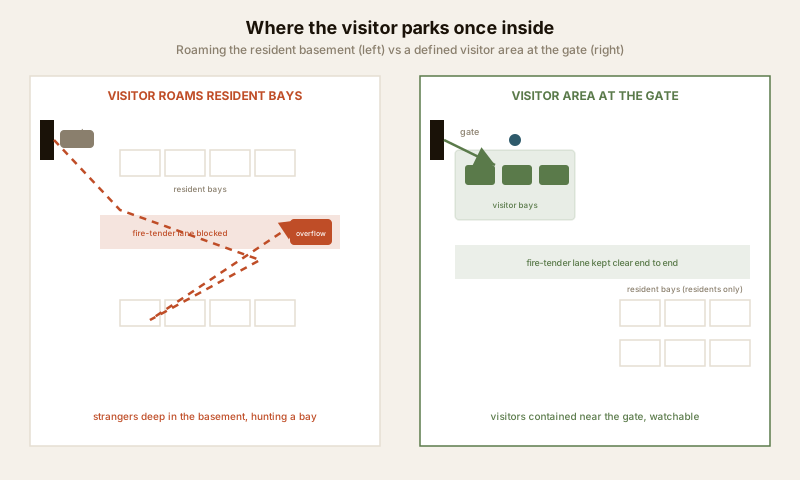
Verifying at the gate solves who comes in. Where they go once inside is the second half of the problem, and it is solved by geometry. The mistake is to let a verified visitor drive off to find any empty bay — which sends strangers roaming through the resident basement, past every parked car, into the least-watched part of the property, to hunt for a space they may not find.
The professional answer is a defined visitor parking area, physically separate from resident bays and, wherever the layout allows, nearer the gate rather than deep in the basement. The reasons are all about containment:
- A visitor who parks near the gate never enters the resident zone in a vehicle. The roaming stops; the basement and stilt resident bays stay for residents.
- A small, defined area is watchable. A handful of visitor bays under a camera and a light is a manageable thing to cover; strangers scattered through the whole open or basement park are not.
- It is fair to residents. Visitor cars in resident bays is a daily society dispute; a defined visitor area is as much about harmony as security.
Where the building genuinely cannot separate them — a small plot, a single basement — the answer is tighter escorting and logging, not pretending the problem away. And in every case the visitor area is subject to the same life-safety rule as the rest of the park: it may not spill into a fire-tender lane or an escape route.
Cabs and app-based rides: drop at the gate or enter?
App-cabs are now the largest single category of "vehicle with a stranger driving" at most Indian gates, and the cleanest policy for them is usually the simplest: drop and pick up at the gate, do not enter. The passenger — a resident or a confirmed visitor — walks the short distance in; the cab, whose driver the property has no relationship with, never comes inside at all.
This is not a rule for every case. A resident with heavy luggage, an elderly or unwell passenger, or a late-night arrival where the walk in is itself a safety concern may be exactly the situation where letting the cab drive to the block is the safer choice — and a rigid "drop at gate always" policy that forces a woman to walk a dark internal road at 1 am has traded a small vehicle risk for a real people-safety one. So the policy is a default with judgement: cabs drop at the gate as the norm; the guard lets one in, logged, when the human situation warrants it. Either way the cab's number goes on the ANPR log if it enters, and it is treated as a visitor vehicle, not a resident one.
Deliveries and e-commerce: a bay, not the run of the park
The volume nobody planned for is delivery. A single mid-size society now takes dozens of food, grocery and e-commerce drops a day, each a two-wheeler or small van with a driver the property does not know, and the temptation is to wave them all through because there are simply too many to check properly. That temptation is the risk.
The professional pattern is a delivery bay or holding point rather than the run of the park:
- A designated delivery/holding bay near the gate where riders and small vans stop, so a stream of unknown vehicles is not threading through the resident basement all day.
- Wherever the model allows, the delivery does not need to reach the flat at all — a mail/parcel room, a locker bank, or the resident coming down to the gate keeps the delivery vehicle at the perimeter and out of the park entirely. This ties into the wider delivery-zone thinking that keeps couriers at a controlled edge rather than roaming.
- Log by exception and volume, sensibly. You cannot phone a flat for every food order; but the delivery bay, a camera on it, and a simple in/out record keep the daily flood contained and reviewable without pretending each rider is a scheduled guest.
The point is not to make delivery hard — residents want their parcels — but to keep a high-volume, low-relationship stream at a defined edge instead of dispersed through the parking floors.
Contractors and moving vehicles: logged, escorted, time-boxed
At the other end from the food rider is the vehicle that comes rarely but stays long and does a lot: the plumber's van, the packers-and-movers truck, the interior contractor's tempo unloading tiles for a week. These are high-impact, low-frequency vehicles and they get the fullest treatment:
- Logged in detail — vehicle, driver, host flat, purpose, expected duration — because this is the vehicle most likely to carry things out as well as in.
- Escorted or supervised where the work and the property warrant it, so an unfamiliar crew with a truck is not left unaccompanied in a resident basement for hours.
- Time-boxed — a defined window, with the vehicle expected to leave by a stated time, so an "all-day" contractor van does not quietly become a fixture in a visitor bay.
- Confirmed by the host exactly as any visitor — a contractor claiming to be "for flat 12" is checked with flat 12 like anyone else.
A moving truck is also the classic case where the vehicle physically conflicts with life-safety: parked across a ramp or in a fire-tender lane "just for the loading". It cannot. The lane and the escape route come first, always.
The log is personal data: the DPDP Act 2023
Every process above generates a record — a name, a flat, a vehicle number, often a photo, and increasingly an ANPR plate capture. All of it is personal data, and the Digital Personal Data Protection Act, 2023 applies. A visitor register is not a neutral notebook; it is a collection of other people's information that the property is now responsible for.
The professional discipline is minimal-collection and secure-handling:
- Collect only what security needs. A vehicle number, a destination and a time are usually enough; there is rarely a reason for a gate to demand and copy a photo of a visitor's ID card, and doing so creates a liability, not a control.
- Do not leave the register open. The classic Indian gate leaves the visitor book on the counter where the next visitor reads the last twenty entries — names, flats, phone numbers, all on display. That is a data leak in a hardbound book. Keep it closed, or better, digital and access-controlled.
- Secure the ANPR and camera data. Plate captures and footage are covered under DPDP just as CCTV is: retain to a stated policy period, restrict who can view, post a visible CCTV notice, and never run ad-hoc recognition against residents or visitors.
- A society is a data fiduciary. The RWA or facility manager holding this data has obligations under the Act — a reason to collect less, secure what you hold, and not treat the gate register as public reading material. Verify the current obligations, since the Act's rules and enforcement are still settling.
| Visitor vehicle type | The real risk | The proportionate process |
|---|---|---|
| Guest / social visitor | Unverified destination, tailgating | Pass or intercom confirm with the flat; boom for one car; park in visitor area |
| App-cab / taxi | Unknown driver enters the park | Default drop at gate; enter only when a person-safety case warrants; log the plate |
| Food / e-commerce delivery | High volume, low relationship, roaming | Delivery/holding bay at the gate; parcel room or locker where possible; log by exception |
| Contractor / service van | Carries things in and out; stays long | Full log, host confirm, escort, time-box; never park across a ramp or lane |
| Movers / packers truck | Large vehicle, blocks lanes, long stay | As contractor, plus explicit fire-tender-lane and escape-route protection |
The guard is the system, and the guard has dignity
None of this runs on hardware alone. The person who actually keeps the discipline is the guard at the boom — the one who holds the boom down, phones the flat, tells the second car to wait, and points the visitor to the right bay. The best-designed process fails the moment the guard is overwhelmed, ignored, or treated as furniture.
Two things follow for a professional plan. First, do not design a process the guard cannot physically run in the evening rush — if verifying every vehicle by phone is impossible at peak, then passes, an app-approve flow and clear visitor-bay signage are not luxuries, they are what makes the discipline survivable. Second, the guard's role carries authority and deserves dignity. A guard empowered to stop a resident's guest, backed by the RWA when a resident is annoyed at being asked to confirm, and given a lit, sheltered, workable cabin, keeps a far better gate than one who has learned that the easiest path is to wave everyone through. The wider treatment of guarding, deployment and the PSARA 2005 framework that governs security personnel is in the gated community security guide.
Life-safety: never jam the gate the fire tender needs
Every idea in this guide is subordinate to one rule, and it is the rule most easily forgotten in the enthusiasm to check every vehicle: the gate and its approach are also the way a fire tender comes in and the way every resident drives out in an emergency. A visitor process that produces a queue backing onto the road, a boom that fails closed, a delivery scrum blocking the entry, or a moving truck parked across the ramp has not made the property safer — it has created a life-safety hazard worse than any it prevents.
- Never jam the gate. The queue your verification creates must not block the entry itself or the internal emergency route. If peak volume backs up, the answer is more throughput (passes, a second lane, an app-approve flow) — not abandoning the check, and not a jam.
- Never obstruct the fire-tender lane or the escape route. No visitor bay, delivery holding point, contractor truck or overflow car may sit in the fire-tender path or across an exit. See fire-tender access.
- The boom and gate must clear for an emergency vehicle. Whatever barrier controls the visitor must open — or be openable manually — for a fire tender and ambulance without delay, and residents must always be able to drive out. A gate that hardens entry can never trap exit.
Verify each of these against the National Building Code of India — SP 7:2026, Part 4 (fire and life-safety) — and the access, ramp and fire-tender provisions of your local municipal and fire bye-laws, in their current editions, with your architect or fire consultant. Do not assume a lane width, a gate clearance or a turning circle from memory; confirm the number against the code for your building.
Key takeaways
- Visitors, cabs, deliveries and contractors are the everyday weak point of every Indian gate — legitimate strangers in vehicles that the gate has seconds to decide about, and the place the most expensive access control is most easily defeated.
- Verify before the boom lifts, never after — destination, resident confirmation, visitor bay assigned, then the boom for one car. A sticker is not verification, and a destination nobody confirmed is not a control.
- Tailgating is the commonest failure — two cars on one lift. Beat it with one-car-per-lift discipline: boom closing between vehicles, a guard at the lift, and a camera on the boom.
- Keep a defined visitor parking area separate from resident bays, near the gate, so visitors are not roaming the resident basement; hold deliveries at a bay and time-box, escort and log contractors.
- The log is personal data under the DPDP Act 2023 — collect minimally, do not leave the register open, secure ANPR and CCTV; the guard is the real system and deserves a workable process and dignity; and never let any of it jam the gate a fire tender needs.
Where to go next
- Read the people side in visitor access management and make the gate decision at gate security; frame the whole subject with the complete parking and garage security guide and the parking sub-hub.
- Build the entry with boom barriers, parking access control, RFID vehicle access and ANPR CCTV cameras; watch it with CCTV placement for parking.
- Keep visitor and resident vehicles apart across basement parking security, stilt parking and open parking security.
- Keep it life-safe with fire-tender access, and see the community picture in the gated community security guide.
- Score your site with the site perimeter security assessment and the home security risk scorecard.
References
- National Building Code of India, SP 7:2026 (Bureau of Indian Standards), Part 4 — Fire and Life Safety, including access, ramp and fire-tender provisions. Verify the current edition and any amendments.
- Local municipal building, parking and fire bye-laws for gate access, fire-tender lanes and internal circulation — confirm the specific requirement for your building with your architect or fire consultant.
- Digital Personal Data Protection Act, 2023 — for visitor registers, ANPR plate capture and CCTV that collect personal data at the gate.
- PSARA 2005 — Private Security Agencies (Regulation) Act, for the deployed guards who run the gate.
This is an educational, strictly defensive planning guide. It does not describe how to defeat any security measure. Barrier, camera, gate, electronic-lock and electrical work is qualified professional work — engage licensed installers, and never let any visitor process, queue or barrier jam the gate, block a fire tender, obstruct an escape route, or violate an applicable National Building Code or municipal bye-law.
Export this guide
Related Guides — Deep-dive reading
Visitor Screening Areas in India (2026): Verifying People at the Gate, With Dignity
How to design the space and procedure where visitors are identified, verified and admitted or turned away — a controlled airlock that verifies before the gate opens, respects DPDP privacy, and never humiliates the people it screens.
SecurityThe Complete Guide to Parking and Garage Security in India (2026): Access, CCTV, Lighting, People-Safety & Vehicle Protection
The pillar overview of parking and garage security for Indian apartments, offices and homes — how to control who enters, watch every corner, light and de-isolate the space, and protect the vehicles, without ever blocking the escape route or the fire tender.
SecurityParking Security Lighting in India (2026): Lighting Basement, Stilt and Open Parking So Nothing Hides in the Dark
How to light apartment and commercial parking so vehicles, people and number plates are clearly seen, cameras can actually read the scene, and the space stops being a soft spot for theft and lurking, without ever compromising the emergency lighting on the escape route.
SecurityRelated Tools — Try Free
Gate Access Planner
Size a vehicle gate or boom barrier — lanes needed at peak and the right credential speed (RFID, ANPR, manual).
Gate FlowHome Security Risk Scorecard
Score your home across six security layers — perimeter, entry points, lighting, detection, alarm and habits — and get a prioritised action plan.
Security ScorecardVisitor Access Planner
Size visitor handling at a gate or reception — lanes needed at peak and the temporary-pass pool.
Visitor Flow