
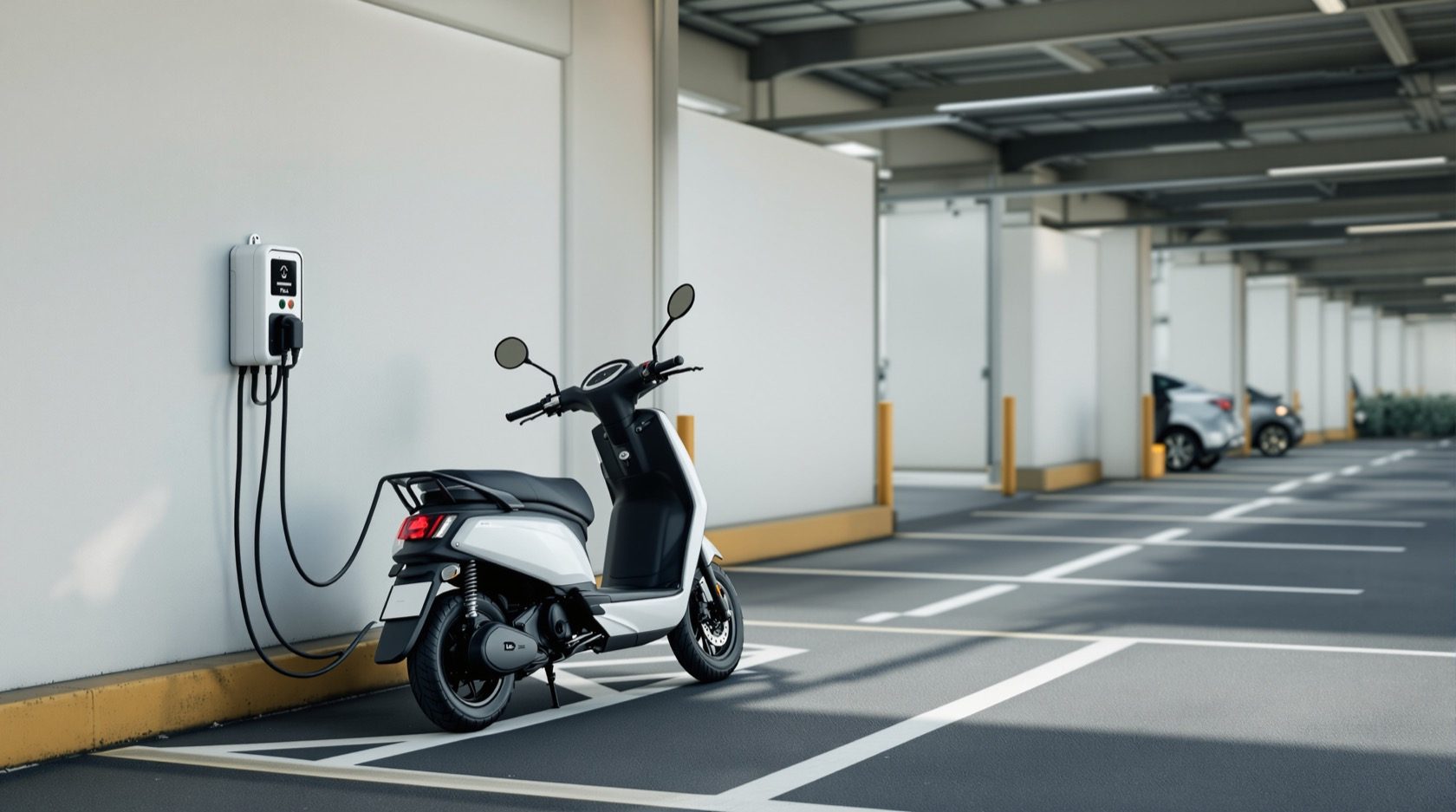
EV Charging Fire Safety in India (2026): Stop Li-ion Thermal Runaway at Home
Why e-scooter, e-rickshaw and EV charging is a fast-rising Indian fire cause, and the safe way to charge: dedicated circuit, genuine charger, never on the escape route, and never unattended overnight.
India is electrifying its two- and three-wheelers faster than almost anywhere on earth, and that is genuinely good news for air quality and running costs. But it has quietly created a new and fast-rising home fire hazard, and most families charging an e-scooter in the hall or an e-rickshaw in the stilt parking have never been warned about it. The danger is not the motor or the wiring of the vehicle — it is the lithium-ion battery pack, and specifically what happens when a damaged, overheated, overcharged or simply poor-quality cell fails. EV charging fire safety is about understanding that one failure mode, called thermal runaway, and building your charging habits so it never gets the chance to start.
This is the electric-vehicle chapter of Studio Matrx's fire-safety library, and it sits under the complete guide to fire safety in India. It is a companion to the electrical fire-safety guide and the battery-room fire-safety guide, because the safe charging point is really an electrical installation and the battery is a stored-energy hazard. When you are done, the home fire-safety scorecard turns the essentials into a quick self-check.
Scope and safety — read this first. This guide helps you charge safely, spot a failing battery, plan an escape and hold vendors accountable. You can and should do all of that. But the charging point itself — a dedicated, correctly-rated circuit with its own protection — is an electrical installation that must be designed and wired by a licensed electrician to the CEA (Measures relating to Safety and Electric Supply) Regulations and IS 1646 : 2015, not run off a bedroom 5-amp point via an extension board. Apartment and basement EV charging is a society-level installation that must follow the National Building Code (via SP 7 : 2026, Part 4 Fire and Life Safety) and any Fire NOC conditions, designed by qualified professionals. This is educational guidance, not legal advice or a substitute for a licensed electrician or fire consultant. And one rule overrides everything: if a battery is smoking, hissing, swelling or on fire, do not fight it — get everyone out and call 101 or 112.
Why a lithium-ion fire is different from any other home fire
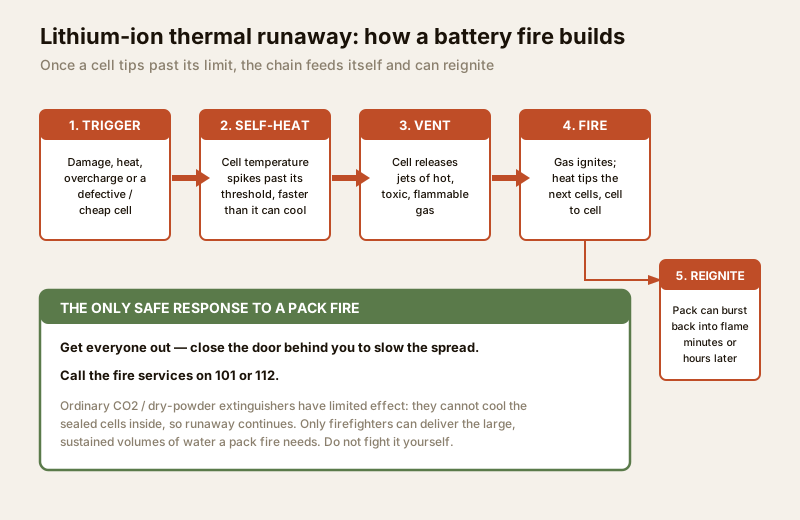
Most home fires need three things and you can take one away — starve it of fuel, air or heat. A lithium-ion battery in thermal runaway carries its own fuel, its own oxidiser and its own heat source inside a sealed metal or plastic pack, which is exactly why it behaves so differently and so viciously.
It starts when a single cell is pushed past its limit — a manufacturing defect, physical damage from a drop or a speed-bump, water ingress, charging in the heat, or overcharging by a mismatched charger. That cell begins to self-heat. Past a threshold the chemistry breaks down and generates its own heat faster than it can escape, so the temperature spikes uncontrollably. The cell vents a jet of hot, toxic and highly flammable gas, which ignites in a fierce fire, and the heat then tips the neighbouring cells into the same runaway — a chain reaction that can consume a whole pack in seconds.
Two features make it especially dangerous in a home:
- It can reignite. Even after the visible flames are knocked down, cells deep in the pack can keep heating and burst back into fire minutes or hours later. A fire you think is "out" is not necessarily out.
- Ordinary extinguishers have limited effect. A CO2 or dry-powder extinguisher may knock down the surface flames but cannot cool the cells inside the sealed pack, so the runaway continues. Firefighters tackle these with very large, sustained volumes of water to cool the whole pack — not something a homeowner can do. Your job is to isolate, evacuate and call the fire services, not to win the fight.
The Indian reality: where these fires actually start
The e-scooter and e-rickshaw fires that make the news share a depressingly consistent set of causes, and almost every one is a habit or a shortcut, not bad luck.
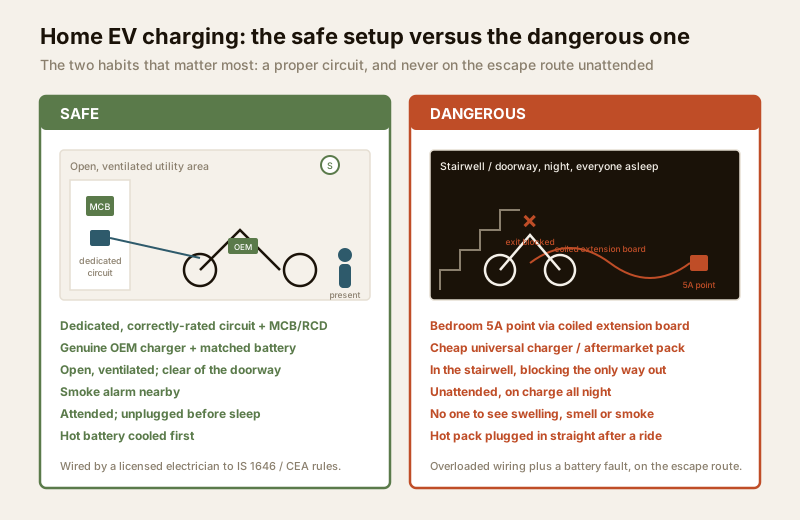
- Cheap or non-genuine batteries and chargers. The aftermarket is flooded with low-cost replacement packs and universal chargers with weak or absent battery-management systems. A charger that does not talk to the pack's own protection can keep pushing current after the battery is full — the classic overcharge path into runaway.
- Charging unattended, overnight, indoors. A pack left on charge all night in the bedroom, hall or shop, with everyone asleep, means no one sees the early swelling, smell or smoke — and the fire spreads through the living space before anyone wakes.
- Charging on or under the escape route. The scooter parked in the stairwell, the e-rickshaw pack charging in the corridor, the extension board snaking across the only doorway. When that pack ignites, it blocks the very route you need to escape.
- Extension boards and overloaded points. A high-current charger run off a 5-amp bedroom socket through a coiled extension board overheats the wiring itself — a second, entirely separate fire risk stacked on top of the battery risk.
- Charging a hot or damaged battery. Plugging in a pack that is still hot from a long ride, or one that was dropped, kerbed or got wet, invites the very failure you are trying to avoid.
These are the failure modes to design out of your own home. The good news is that the safe alternative costs very little.
The safe home-charging setup
Charging an e-scooter or EV at home is safe when you treat the battery as the concentrated store of energy it is, and give it a proper electrical supply and a safe place to fail if it ever does.
| Do this | Not this | Why it matters |
|---|---|---|
| A dedicated, correctly-rated circuit with its own MCB/RCD, wired by a licensed electrician | A bedroom 5-amp point via a coiled extension board | The charger draws real current; the right circuit and protection stop the wiring itself overheating |
| Only the OEM charger and the genuine battery matched to the vehicle | A cheap universal charger or an aftermarket pack | A matched charger and pack talk to the battery-management system and stop overcharge |
| Charge in an open, ventilated space away from bedrooms and stored goods | A closed cupboard, under the bed, or a cluttered store | Ventilation clears vented gas; distance keeps a failure away from what burns |
| Never on or under the escape route — clear of stairs, doors and passages | In the stairwell, corridor or across the doorway | If it ignites, it must not block the way out for you or your neighbours |
| Charge while awake and around, and stop before you sleep or leave | On charge overnight or all day while out | Early warning signs are only useful if someone is there to see them |
| Let a hot battery cool before charging; never charge a damaged or wet pack | Plugging in straight after a long ride, or a dropped pack | Heat and damage are two of the commonest runaway triggers |
Two habits sit above all the others. First, route the charging point to a licensed electrician — the same discipline the electrical fire-safety guide and the electrical hub set out for any fixed circuit. Second, never charge unattended overnight or on the escape route — the two conditions that turn a rare battery fault into a fatal fire.
Warning signs: catch a failing battery early
A lithium-ion pack usually gives warning before it fails catastrophically — but only if someone is present and paying attention, which is the whole reason unattended overnight charging is so deadly. Stop charging, unplug at the wall if you can do so safely, move the pack outside to open ground away from anything that burns, and keep watching from a distance if you notice any of these:
- Swelling or bulging of the battery case or the vehicle body around the pack.
- Unusual heat — a pack too hot to touch comfortably, or a charger running much hotter than normal.
- A sharp, sweet or chemical smell, or any hint of smoke.
- Hissing, popping or crackling sounds from the pack.
- A charger that keeps running long after the pack should be full, or a pack that will not hold charge and drains fast.
If any of this tips into smoke or flame, abandon the pack, get everyone out, close the door behind you to slow the spread, and call 101 or 112. Never pick up a burning or venting pack, and never throw water on it yourself unless you are outdoors, at a safe distance, and firefighters have advised it — a homeowner cannot deliver the sustained cooling a pack fire needs.
EV charging in apartments and basements
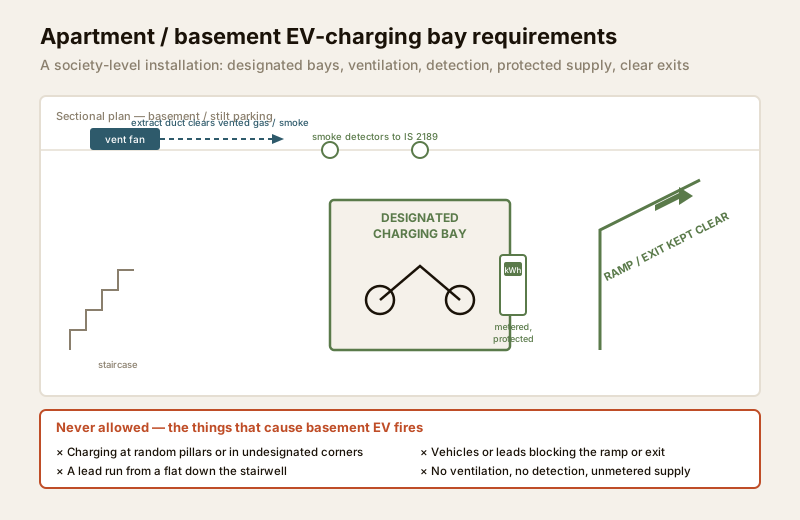
Charging inside an apartment complex or a basement stilt-parking is a different and more serious problem, because a single pack fire in an enclosed, vehicle-packed basement threatens the whole building — and the smoke fills the escape routes above. This is not a resident-DIY matter: it is a society-level electrical and fire installation.
| Requirement | Why | Who is responsible |
|---|---|---|
| Designated charging bays in an approved location, not random pillars and corridors | Keeps charging away from escape routes and concentrates the risk where it is managed | The RWA / society, with a licensed electrician and fire consultant |
| Adequate ventilation in basements to clear vented gas and smoke | Enclosed basements trap flammable gas and smoke; the basement fire-safety guide covers this in depth | The society, per NBC Part 4 and Fire NOC conditions |
| Fire detection covering the charging bays | Early warning is the difference between one burnt scooter and a basement fire | The society's fire-alarm system, to IS 2189 : 2026 |
| Dedicated, metered, protected supply to each bay | Prevents overload and lets faults be isolated | A licensed EPC/electrical contractor |
| Clear tender access and unblocked ramps/exits | A basement fire needs the fire engine in and residents out fast | The society, as a standing duty |
Residents charging in a stilt or basement should never run a lead from their flat down the stairwell, never charge in an undesignated spot, and never block a ramp or exit with a charging vehicle. If your society has EVs but no designated bays, ventilation plan or detection, that is a serious gap to raise formally — the apartment fire-safety guide sets out how residents hold a society to its fire-safety duties. For the rooftop-solar side of a building's energy setup, see the solar-system fire-safety guide, and for stationary storage the battery-room fire-safety guide and the home battery backup guide.
The standards behind safe charging
Nobody expects a homeowner to read standards, but knowing they exist helps you insist a vendor or society does the job properly.
- The charging point is an electrical installation. It falls under the CEA (Measures relating to Safety and Electric Supply) Regulations and IS 1646 : 2015 (fire safety of buildings — electrical installations), and must be wired by a licensed electrician on a dedicated, protected circuit.
- The building framework is the National Building Code, via SP 7 : 2026, Part 4 Fire and Life Safety (the older SP 7 : 2016 edition is withdrawn but still widely quoted), which governs ventilation, detection and compartmentation for parking and basements where charging happens.
- Detection follows IS 2189 : 2026 for automatic fire detection and alarm systems.
- The vehicle, its battery and its charger are covered by the applicable automotive and battery standards — cite these as the applicable AIS/BIS EV and battery standard, and verify the current edition via the BIS catalogue, rather than trusting any specific number quoted by a seller. Insist on genuine, certified, matched components; the cheap uncertified pack is the single commonest cause of these fires.
When the law or your society requires a professional. A home charging circuit is licensed-electrician work under the CEA Regulations and IS 1646 : 2015 — not a DIY extension-board job. In an apartment or basement, EV charging infrastructure is part of the building's electrical and fire systems under the NBC (via SP 7 : 2026, Part 4) and any Fire NOC conditions set by the State Fire Services, and must be designed and installed by licensed professionals. If your society is adding EV charging, confirm it is being done as a designed installation with designated bays, ventilation, detection and a proper supply — never as residents improvising leads and boards. This guide is educational, not legal advice, and not a substitute for a licensed electrician or fire consultant.
Key takeaways
- The hazard is the lithium-ion battery, not the vehicle. A damaged, overheated, overcharged or cheap cell can go into thermal runaway — it self-heats, vents flammable gas, burns ferociously, can reignite, and ordinary extinguishers have limited effect. Your only safe response to a pack fire is to isolate, evacuate and call 101 or 112.
- Charge on a dedicated, correctly-rated circuit wired by a licensed electrician to the CEA Regulations and IS 1646 : 2015 — never a bedroom 5-amp point through a coiled extension board.
- Use only the OEM charger and the genuine, matched battery. The cheap universal charger and aftermarket pack, with weak or absent battery-management, are the single commonest cause of these fires.
- Never charge on or under the escape route, and never unattended overnight or all day. Charging in a stairwell, corridor or doorway blocks the way out; charging while everyone sleeps means no one sees the swelling, smell or smoke in time. Watch for swelling, heat, a chemical smell, hissing or a charger that never stops.
- Apartment and basement EV charging is a society-level installation — designated bays away from exits, ventilation, detection and a proper protected supply, designed by licensed professionals under NBC Part 4 and any Fire NOC conditions.
References
- National Building Code of India, SP 7 : 2026 (the NBC), Part 4 "Fire and Life Safety" — the fire and life-safety framework for buildings, including parking, basements and detection; the older SP 7 : 2016 edition is withdrawn but still widely quoted. Verify the current edition via the BIS catalogue: https://www.services.bis.gov.in/
- IS 1646 : 2015 (fire safety of buildings — electrical installations, code of practice) and IS 2189 : 2026 (automatic fire detection and alarm systems), Bureau of Indian Standards — the standards behind a safely wired charging point and building detection. Verify current editions via the BIS catalogue: https://www.services.bis.gov.in/
- The CEA (Measures relating to Safety and Electric Supply) Regulations for electrical installations, and the applicable AIS/BIS EV and battery standards for the vehicle, pack and charger — verify the current editions and status via the BIS catalogue and the relevant regulator before relying on any number a seller quotes.
- The relevant State Fire Services Act and Rules and the Model Building Bye-Laws (MoHUA) — these set when a Fire NOC and the associated ventilation, detection and access requirements apply to parking and basement charging in your building.
This is an educational overview, not legal advice, and not a substitute for a licensed electrician or fire-safety consultant. EV charging circuits and building-scale charging, ventilation, detection and the Fire NOC are qualified professional tasks — engage licensed electricians, EPC contractors, fire-safety consultants and the State Fire Services, and verify any standard's current status via the BIS catalogue before relying on it.
Export this guide
Related Guides — Deep-dive reading
Staircase Fire Safety in India (2026): The Protected Stair That Gets Everyone Down
The staircase is the primary vertical escape route in almost every Indian building, so a protected, smoke-free stair is the spine of egress: enclosed, fire-doored, non-combustible, and above all kept clear.
SecurityBattery Room Fire Safety in India (2026): Lead-Acid Hydrogen Venting and Lithium-Ion Thermal Runaway
How the dedicated battery bank behind an apartment, office, data centre, hospital or solar-storage install should be compartmented, ventilated, detected and isolated, and why the two chemistries need two different controls.
SecurityElectrical Fire Safety in India (2026): Overloads, Wiring and the Right Protection
Why electrical faults cause so many Indian building fires, and the fix: correct cable sizing and a properly designed board by a licensed electrician, MCB plus RCCB protection, no overloading, and never water on a live fire.
SecurityRelated Tools — Try Free
Electrical Safety & Load Audit
Home electrical audit — 10 categories, 65+ checkpoints across earthing, RCCB, MCB, wiring, switchboards, appliance circuits, DG/inverter backup.
Safety AuditApartment Video Door System Planner
Enter flats, entrances, floors and guard desk for a first-pass building intercom plan — door stations, indoor monitors, guard station, the right architecture and an indicative cost band.
Building PlannerBefore vs After — Cost Reality Check
Compare what you expected to pay vs what you actually paid, category by category.
Reality Check