
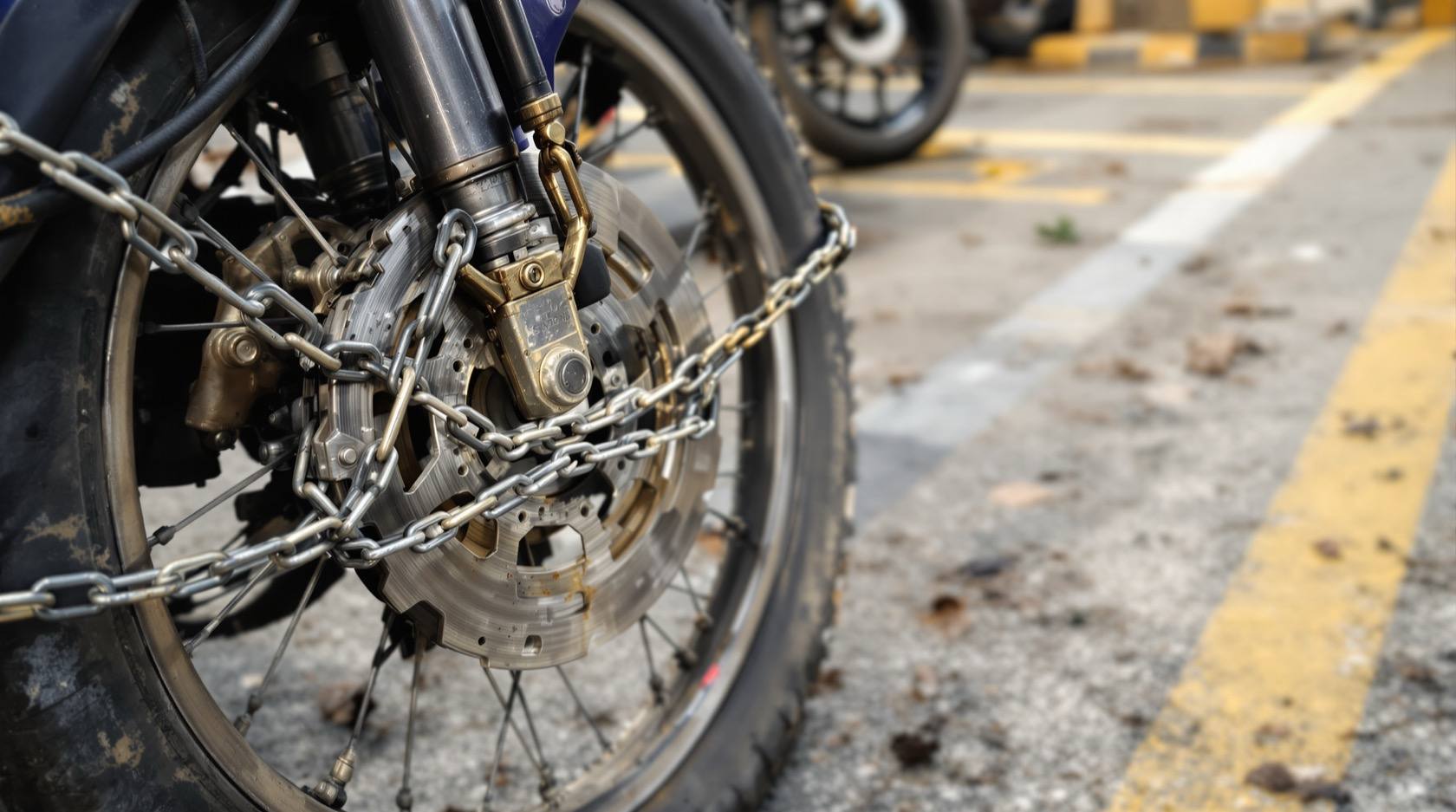
Vehicle Theft Prevention in India: An Owner's Guide
Most of what gets stolen in an Indian parking area is not a whole car. It is a two-wheeler, a battery, a mirror, a catalytic converter, a set of alloys or an EV cable. Here is the layered, strictly defensive way an owner makes the vehicle and its parts a poor target.
Ask most people to picture vehicle theft and they imagine a whole car driven away in the night. In India the everyday reality is quieter and more common. The vehicle most likely to be taken outright is a two-wheeler or an older car — cheap to move, easy to strip, and rarely fitted with modern security. And more often than a whole vehicle disappearing, it is a part that goes: the battery lifted from under the bonnet, a wing mirror unclipped at a traffic signal, a catalytic converter cut from beneath in a few minutes, a set of alloy wheels off a car left on bricks, an EV charging cable unplugged mid-charge. Accessory and part theft is a bigger daily loss than whole-vehicle theft, and it happens in exactly the places we treat as safe — the society basement, the stilt bay, the lane outside the gate.
This is an owner's guide to preventing that loss. It is strictly defensive throughout: it is about how you protect a vehicle and its parts, and it never explains how to steal one, hotwire an engine, defeat an immobiliser or bypass a lock. It sits in the Security Knowledge Hub under the parking and garage sub-hub, and it is the vehicle-owner companion to the complete parking and garage security guide, which frames how the parking area itself is secured.
Scope & safety. This is educational planning advice for a vehicle owner. You decide and coordinate; where a fitting touches your vehicle's wiring or an EV charger, an immobiliser, alarm or tracker is a qualified auto-electrician's install and mains and charger work is a licensed electrician's. Nothing here teaches how to defeat a security measure. In a shared building, any change to the parking area — lighting circuits, cameras, barriers — is an RWA and licensed-installer matter, and must never block a fire-escape route, obstruct the fire-tender lane, or compromise mandated emergency lighting and exit signage. Verify parking and fire provisions against the National Building Code of India (SP 7:2026, Part 4) and your local bye-laws.
No single lock does it — think in layers
A determined thief can beat almost any one device given time and quiet. The point of good security is not an unbeatable device; it is to make your vehicle slower, louder and more traceable than the next one — so the opportunist moves on. That is done in layers, each covering a different failure of the last.
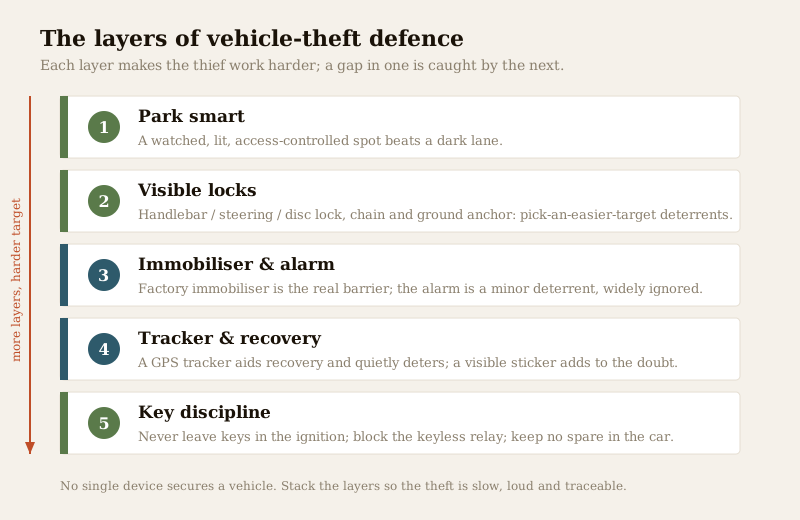
The five layers, from the outside in:
1. Where and how you park — a watched, lit, access-controlled spot.
2. Physical, visible deterrents — locks a thief can see from across the lane.
3. The vehicle's own security — factory immobiliser, and an alarm honestly rated.
4. Tracking and recovery — a GPS tracker that aids recovery and quietly deters.
5. Key discipline — including the modern keyless relay-theft defence.
The rest of the guide is those layers, plus the documentation that turns a theft into a recoverable, insurable event, and the specific guard for each commonly-stolen part.
Layer 1 — Where and how you park
The single biggest decision an owner makes is where the vehicle spends the night, and it costs nothing. A watched, lit, access-controlled spot beats a dark lane every time. A thief wants privacy, darkness and time; a parking choice that removes those is doing more than most gadgets.
- Choose light and eyes over convenience. Under a working light, within a camera's view, near natural surveillance from a guard post or overlooked window. The dark far corner of the basement is where the battery goes missing.
- Face the vulnerable parts inward. Bonnet to a wall makes the battery and catalytic converter harder to reach; wheels close to a kerb make a jacking job awkward and obvious.
- Prefer a controlled parking area. A bay behind a boom barrier, gate or access control is a bay a stranger cannot casually walk a stolen scooter or a cut converter out of.
How the parking area itself is secured is its own subject, and the parts fit together: get the light right with parking security lighting, place the cameras with CCTV placement for parking, and read the space-specific guides for the basement and the open or stilt lot. A well-lit, covered bay is the foundation every other layer rests on.
Layer 2 — Physical, visible deterrents
Layer two is the one a thief sees first, and its power is exactly that visibility. A good lock that is obvious from a distance tells an opportunist to pick an easier target — and the target next to yours, unlocked, usually is. The aim is not an unpickable device; it is to be visibly harder work than the vehicle beside you.
For two-wheelers and cycles, which are the commonest real loss:
- A quality handlebar lock and a disc lock on the brake disc — visible, and enough to make wheeling the machine away clumsy.
- A chain or U-lock through the frame to a fixed ground anchor turns a two-wheeler or bicycle from a lift-and-carry into a job that needs tools and time. The bicycle-specific method is in bicycle parking security.
- Park the two-wheeler on its stand within the frame's reach of an anchor point, not free-standing in the open.
For cars:
- A steering-wheel lock or a gear lock is a visible, old-fashioned but genuinely effective deterrent, especially on older cars without a factory immobiliser.
- A wheel or disc lock on a car left parked for long periods signals "not tonight" to an opportunist.
None of these is defeat-proof. Their job is deterrence: they make your vehicle the slow, awkward, noisy choice.
Layer 3 — The vehicle's own security, honestly
Layer three lives inside the vehicle, and honesty matters here because the market oversells it.
- The factory immobiliser is the real barrier. Almost every car sold new in India for years now carries an electronic immobiliser that stops the engine starting without the coded key. It is the reason casual whole-car theft of newer vehicles is harder than it once was. If your vehicle has one, keep the key coded and never leave a spare in the car; if you are buying, prefer the OEM system that is designed into the vehicle over an aftermarket add-on retrofitted into the wiring.
- The alarm is a minor deterrent — treat it as such. The blaring car alarm is so common and so often falsely triggered that most people, in India as everywhere, simply ignore it. It may still deter the most timid opportunist and it can be useful paired with an immobiliser, but do not mistake an alarm for security. It is the least load-bearing layer here.
- OEM versus aftermarket. A factory-fitted, warranty-safe system beats a cheap aftermarket unit spliced into the loom, which can create electrical faults and drain the battery. If you fit anything aftermarket, use a reputable auto-electrician so the wiring is done right.
The takeaway: rely on the immobiliser, respect the alarm as a small extra, and never let either replace the parking and lock layers above.
Layer 4 — Tracking and recovery
A tracker does not stop a theft; it improves the odds of getting the vehicle back and, when its presence is known, quietly deters. A GPS tracker reports the vehicle's location so that, working with the police after a report, there is a chance of recovery — qualitatively, that is the honest claim, with no promise of a rate. A visible "GPS tracked" sticker adds to a thief's doubt without revealing where the unit is hidden.
- Have it fitted so it is not obvious and not easily pulled out; a tracker a thief finds and removes in the first minute is no help.
- Keep the subscription live and the unit powered — a lapsed or dead tracker is a false sense of security.
- Understand its limits: signal can be lost in a deep basement or a shielded container, and it is a recovery aid, not a barrier.
Fit is an auto-electrician's job for anything wired to the vehicle. Combine the tracker with the documentation in the next section so that, if the vehicle is found, you can prove it is yours.
Layer 5 — Key discipline, and the keyless relay risk
The cheapest, most-overlooked layer is how you handle the keys — and modern keyless cars have added a new twist that every owner should understand defensively.
The old rules still catch people out:
- Never leave the key in the ignition or on the scooter, not even "just for a minute" at the shop or the pump.
- Never leave the vehicle running unattended to warm up or while you step away.
- Never leave a spare key inside the vehicle — the glovebox spare is a gift to a thief who gets in.
The new risk is keyless relay theft, and it is worth explaining plainly so you can defend against it. Many modern cars unlock and start when the fob is simply near them. Thieves can exploit this by relaying the fob's radio signal from where it sits inside your house — near the front door, on a hall table — out to the car on the street, so the car behaves as if the key were present. This is a real risk; the defence is entirely in your hands.
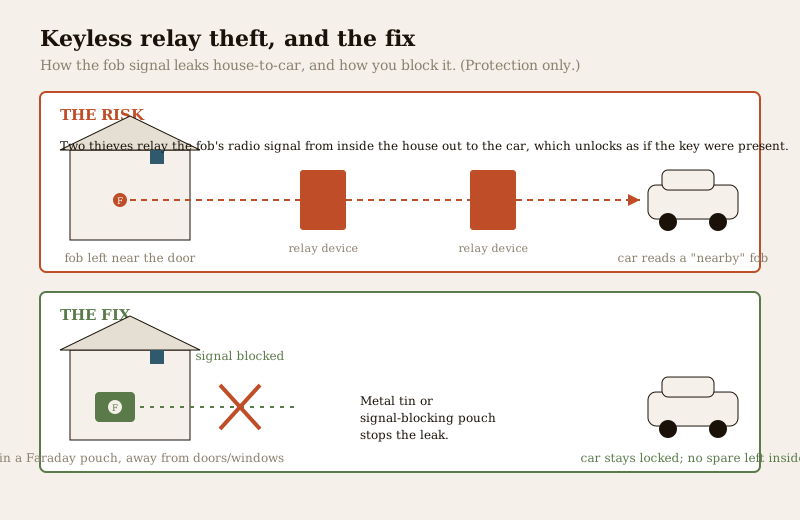
To protect against it:
- Keep the fob in a signal-blocking (Faraday) pouch or a metal tin. A pouch that blocks the radio signal, or an old-fashioned biscuit tin, stops the fob from being read from outside.
- Store keys away from the front door and windows, deep inside the house, so even an un-pouched fob is harder to reach by relay.
- Never leave a spare in the car, and check whether your model lets you disable keyless entry overnight.
This is protection advice, not a method: it tells you how to keep your own signal from leaking, nothing more.
What actually gets stolen — and the guard for each
Because parts are the everyday loss in India, it is worth naming what goes and how you guard each one. None of these guards is defeat-proof; each makes the part a slower, more visible, more traceable target.
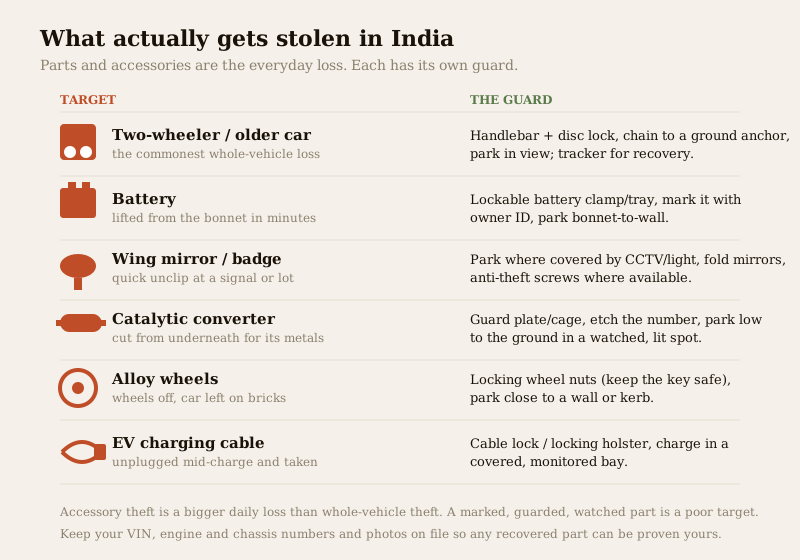
| Commonly stolen | Why it goes | The owner's guard |
|---|---|---|
| Two-wheeler / older car | Cheap to move, easy to strip, often unsecured | Handlebar + disc lock, chain to ground anchor, park in view, tracker |
| Battery | Lifted from the bonnet in minutes, easy resale | Lockable battery clamp/tray, mark with owner ID, park bonnet-to-wall |
| Wing mirror / badge | Quick unclip at a signal or in a lot | Park under CCTV and light, fold mirrors, anti-theft screws where available |
| Catalytic converter | Cut from underneath for its precious metals | Guard plate or cage, etch the number, park low and in a watched spot |
| Alloy wheels | Wheels off, car left on bricks | Locking wheel nuts (keep the key safe), park close to wall or kerb |
| EV charging cable | Unplugged mid-charge and taken | Cable lock or locking holster; charge in a covered, monitored bay |
A few accessory-specific notes worth stressing:
- Battery. A lockable battery clamp or tray, plus your name or vehicle number marked on the casing, turns a clean resale into a risky one.
- Catalytic converter. A bolt-on guard plate or cage slows the cut, and etching an identifying number onto the converter makes it traceable and harder to fence — deterrence and recovery together.
- Alloy wheels. A set of locking wheel nuts (one nut per wheel that needs a special key) is cheap and effective; just keep the key somewhere safe and not in the car.
- EV cable. Cable theft is a growing loss at charging points; a cable lock or locking holster and charging in a covered, monitored bay are the practical guards. The bay-security picture is in EV charging bay security.
Documentation and what to do after a theft
Good documentation does not prevent a theft, but it is what makes recovery and insurance work — and the time to prepare it is now, not after.
- Keep the vehicle's identity on file. The VIN, engine and chassis numbers, the registration, and clear photos of the vehicle and any distinctive parts. If a vehicle or a marked part is recovered, this is how you prove it is yours.
- Report fast. A prompt First Information Report (FIR) with the police is both the legal step and the trigger for insurance and any tracker-assisted recovery. Give them the identity details and the tracker information immediately.
- Know your insurance. Comprehensive motor insurance covers theft; read what it requires. Many insurers offer an anti-theft device discount on the premium when an approved device is fitted — a small ongoing saving that also nudges you toward better security. Keep the fitting certificate.
Prepare the file today: a printed and a digital copy of the numbers and photos, stored where you can reach them in a hurry.
The community angle
Much vehicle and part theft in a society is caught not at the bay but at the exit — the gate the stolen scooter has to be wheeled through, the plate an ANPR camera reads on the way out. As an owner you cannot install this, but you can raise it with your RWA. Society CCTV, ANPR and an alert guard at the gate turn a quiet theft into a recorded, interceptable one; number-plate capture at the boom is covered in ANPR CCTV cameras, and the whole shared-community picture — guards, access, cameras and the DPDP duties that come with them — is in the gated community security guide. Because parking CCTV and ANPR capture personal data, the society must run them under the DPDP Act 2023: collect only what security needs, secure the footage, post a visible notice, and never run ad-hoc recognition.
Key takeaways
- The real loss in India is not usually a whole car — it is a two-wheeler, an older car, or a part: battery, mirror, catalytic converter, alloy wheels, EV cable. Accessory theft is a bigger daily loss than whole-vehicle theft.
- No single lock secures a vehicle; layers do — park smart, add visible locks, rely on the factory immobiliser, fit a tracker for recovery, and keep strict key discipline. Make your vehicle the slower, louder, more traceable target.
- Rate each layer honestly. Where and how you park is the biggest free win; the immobiliser is the real electronic barrier; the alarm is a minor deterrent, widely ignored.
- Defend against keyless relay theft by keeping the fob in a signal-blocking (Faraday) pouch away from doors and windows, and never leaving a spare in the car — protection, not a method.
- Guard the parts specifically (battery clamp and marking, converter guard and etching, locking wheel nuts, EV cable lock), document the VIN/engine/chassis and photos, report a theft promptly by FIR, and claim any anti-theft insurance discount.
Where to go next
- Frame the whole subject with the complete parking and garage security guide and browse the parking sub-hub.
- Get the parking bay right with parking security lighting, CCTV placement for parking, and the space guides for the basement and the open or stilt lot.
- Protect two-wheelers and cycles with bicycle parking security, and guard EV charging against cable theft with EV charging bay security.
- See the exit-and-community layer with ANPR CCTV cameras and the gated community security guide.
- Score your own situation with the home security risk scorecard.
References
- Digital Personal Data Protection Act, 2023 — for parking CCTV and ANPR that capture personal data such as number plates.
- National Building Code of India, SP 7:2026 (Bureau of Indian Standards), Part 4 — Fire and Life Safety, for parking and basement provisions where a security change touches the shared parking area. Verify the current edition and local bye-laws.
- Your comprehensive motor insurance policy and its anti-theft-device discount terms — confirm the approved-device requirement and keep the fitting certificate.
- Local police procedure for filing a First Information Report (FIR) on a stolen vehicle or part.
This is an educational, strictly defensive guide for vehicle owners. It does not describe how to steal a vehicle or defeat any security device. Immobiliser, alarm, tracker and EV-charger work is qualified professional work — engage licensed installers, and never let any security measure block a fire-escape route, obstruct a fire tender, or violate an applicable National Building Code or municipal bye-law.
Export this guide
Related Guides — Deep-dive reading
The Complete Guide to Parking and Garage Security in India (2026): Access, CCTV, Lighting, People-Safety & Vehicle Protection
The pillar overview of parking and garage security for Indian apartments, offices and homes — how to control who enters, watch every corner, light and de-isolate the space, and protect the vehicles, without ever blocking the escape route or the fire tender.
SecurityBicycle Parking Security in India: Stand, Lock and Location
Cycles, e-cycles and e-scooters are among the most-stolen things in an Indian society precisely because we treat them casually. The fix is the same three-part logic as any theft: a good stand to lock to, a good lock used well, and a good place to leave it.
SecurityParking Panic Buttons in India: Fixed Help Points for the Walk to the Lift
A parking area — especially an enclosed basement or an unmanned stilt at night — is exactly where someone is alone, out of sight, and often out of mobile signal. A fixed, lit, well-marked help point turns the lonely walk from car to lift into a place where help is one press away.
SecurityRelated Tools — Try Free
Home Security Risk Scorecard
Score your home across six security layers — perimeter, entry points, lighting, detection, alarm and habits — and get a prioritised action plan.
Security ScorecardCCTV Camera Coverage & Count Calculator
Estimate how many CCTV cameras you need, the NVR channels, storage in TB for your retention period, and an indicative all-in cost with GST.
CCTV CalculatorElectrical Safety & Load Audit
Home electrical audit — 10 categories, 65+ checkpoints across earthing, RCCB, MCB, wiring, switchboards, appliance circuits, DG/inverter backup.
Safety Audit