
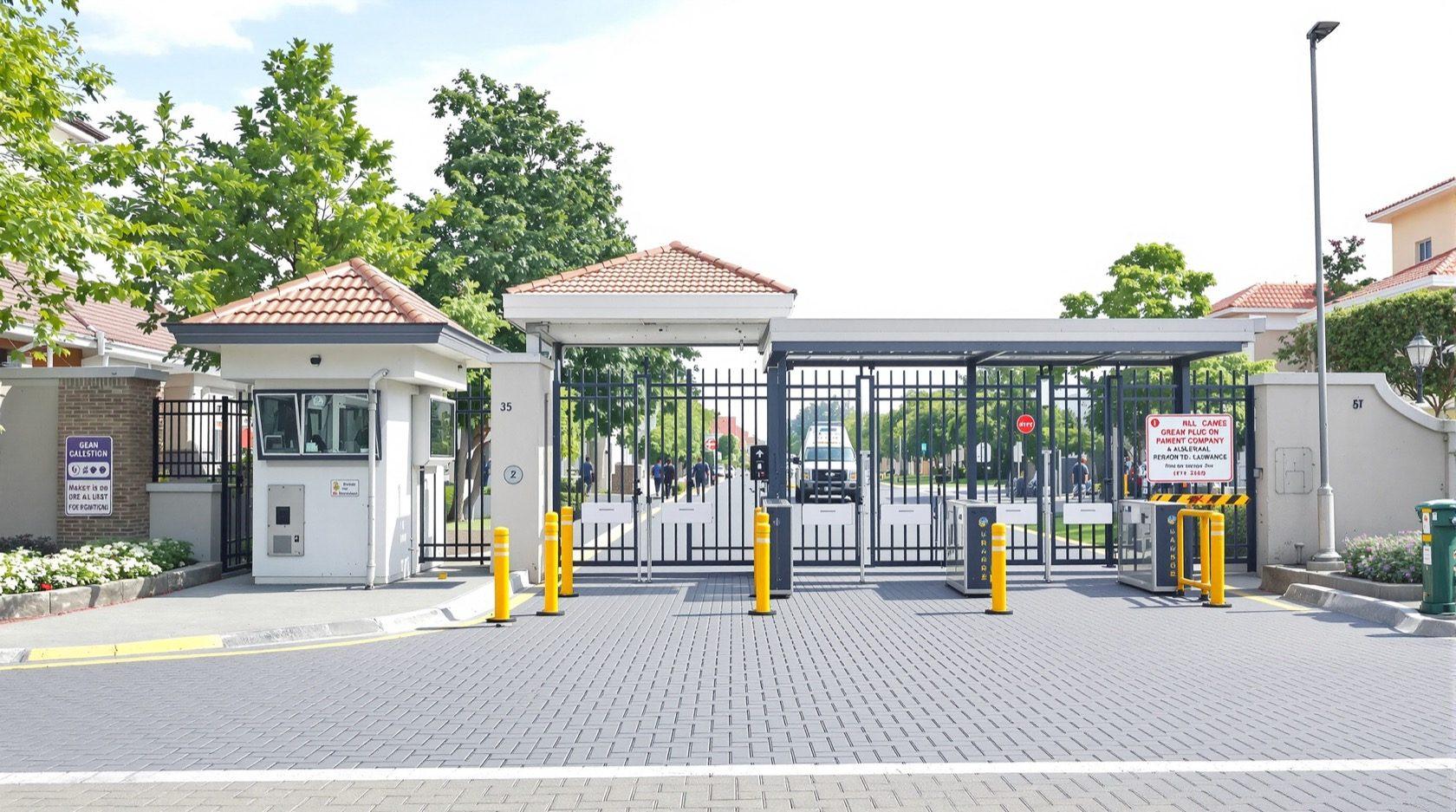
Gate Access Control in India (2026): The System at the Main Entrance
How the main gate of a society, villa or office actually controls who and what comes in — the guard, boom barrier, turnstile, cameras and intercom working as one layered system that still lets everyone out in an emergency.
The main gate is where security is either real or theatre. It is the one point every resident, guest, delivery rider, maid, cab and moving truck must pass, and it is usually the first thing a stranger tests. Get the gate right and everything behind it — the lobby, the lift, the flat door — has a fighting chance. Get it wrong and the smartest smart lock on your front door is guarding a house whose front gate anyone can walk through.
Gate access control is the system at that entrance: the mix of a guard, a boom barrier for vehicles, a turnstile or wicket gate for people, cameras, an intercom and a visitor-management book or app, all working together to decide who and what comes in. This guide is part of Studio Matrx's access-control hub and the smart locks and access control sub-hub. It is written for homeowners, RWA committees and facility managers who have to specify, approve or run a gate — not to fit one themselves.
One thing to settle at the start: this guide is about the system at the gate, not the lock on a gate leaf. If you want the electronic lock hardware that bolts a swing or sliding gate shut — the motor, the strike, the keypad on the leaf itself — that is a different topic, covered in smart gate locks. Here we are one level up: the guard, the barrier, the turnstile and how they feed the wider apartment or office system.
Scope & safety. This guide helps you plan, decide and coordinate a gate system and hold your integrator to account — it is not a fitting manual. The barrier, turnstile, gate motor, mains wiring and network belong to a licensed integrator, electrician and, where the gate sits on an escape route, a fire-safety consultant, all coordinated. The gate is almost always an emergency exit too: every barrier and turnstile on an escape route MUST fail-safe on power loss and on a fire-alarm signal — drop-arm or free-wheel for free exit — and carry a manual release, governed by the National Building Code. A boom barrier must never strike a person or vehicle. Never design a gate that can trap a crowd, and never teach anyone to defeat the emergency release. Access logs, visitor records and vehicle numbers are personal data under the Digital Personal Data Protection Act, 2023. This is educational guidance, not legal advice.
Why the gate is its own problem
A flat door faces one family and a handful of expected visitors. The main gate faces the whole city. In a typical Indian society it handles residents on foot and in cars, two-wheelers, guests, dozens of delivery riders an hour, domestic help, cabs, garbage trucks, water tankers, ambulances and the occasional fire engine — often all in the same five minutes at 8am. No single device solves that. The answer is a layered gate: several simple controls stacked so that if one is slow or fooled, the next still holds.
The layers are:
- The guard — the human judgement that no machine replaces, for the delivery rider, the unexpected guest, the emergency vehicle.
- The barrier — a boom barrier or sliding gate that physically stops a vehicle until it is cleared.
- The turnstile or wicket — a controlled pedestrian lane so people are not squeezing past cars.
- The reader — the card, phone, QR or face point that identifies residents automatically.
- The camera — an overview camera plus, for vehicles, an ANPR camera reading number plates.
- The intercom — so the guard can call a flat before letting a visitor in, tying the gate to guard-to-resident intercom.
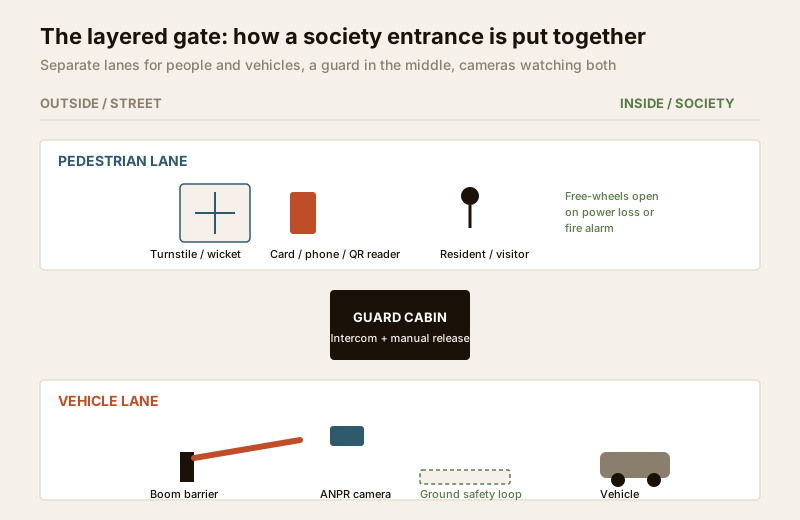
The single most important design move is the first one: separate people from vehicles. A pedestrian squeezing past a boom barrier, or a rider weaving between cars, is both a security gap and a safety hazard. Give people their own lane with a turnstile or wicket gate, and give vehicles their own lane with a barrier. The guard cabin sits between them with a clear view of both.
People entry and vehicle entry are two different jobs
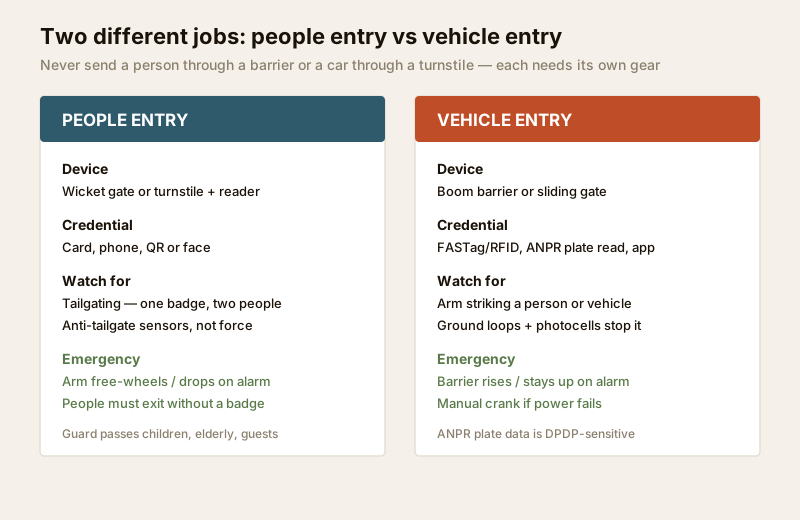
They look like one gate, but they need different hardware, different credentials and different safety thinking. Confusing them — waving people through the car barrier, or letting scooters ride the pedestrian lane — is the commonest gate mistake.
| People entry | Vehicle entry | |
|---|---|---|
| Device | Wicket gate or turnstile | Boom barrier or sliding gate |
| Credential | Card, phone, QR or face | FASTag/RFID sticker, ANPR plate read, or app |
| Speed | One person per read, walking pace | One vehicle per lift, must clear fast at rush hour |
| Main risk | Tailgating — two people, one badge | The arm striking a person or vehicle |
| Mitigation | Anti-tailgate sensors, guard oversight | Ground safety loop + photocell beams |
| Emergency | Arm free-wheels / drops for free exit | Barrier rises and stays up; manual crank |
On the people side, the enemy is tailgating: someone slips through behind a resident who just badged in. You never solve this by making the turnstile harder or faster to close on people — that is how crowds get hurt. You solve it with anti-tailgate optical sensors that simply flag or alert the guard, and with the guard's own eyes. The credential itself can be a card, a phone, a QR code for time-limited visitors, or face recognition for regular residents.
On the vehicle side, the enemy is the barrier itself: a boom arm coming down on a car or, far worse, a child. Every barrier on a busy gate needs a ground safety loop (a buried sensor that holds the arm up while a vehicle is under it) plus photocell beams, so the arm physically cannot close on anything in its path. Vehicle identification is usually a FASTag/RFID sticker or an ANPR camera that reads the number plate — which sends you straight into privacy territory, because a plate is personal data. For how the vehicle side connects to parking bays and counts inside, see parking access control.
The guard and the automation, together
A common sales pitch is that automation replaces the guard. At a gate it does not — it frees the guard from the boring, error-prone work so the human judgement lands where it matters. Residents on foot and in cars with a valid credential should flow through automatically; the guard's attention is then spent on the exceptions:
- The delivery rider who needs to be verified, logged and sometimes stopped at the gate rather than sent up.
- The unexpected guest who has to be called up to the flat before entry — the moment the visitor management system and the intercom earn their keep.
- The emergency vehicle, which the guard must clear instantly with the manual release.
The right division of labour is: automate the routine (residents, tagged vehicles), and give the guard good tools for the exceptions (a visitor app, a clear intercom, a camera view, a manual override). A gate that forces the guard to hand-write every entry in a paper register at 8am rush hour is a gate that fails, because the register becomes theatre and the barrier stays up. Move that to a visitor-management app so the guard photographs the visitor, the resident approves on their phone, and the record is searchable later — the backbone of a modern society gate, covered in visitor access management.
Who is allowed what: roles at the gate
Not everyone gets the same access, and the gate is where that policy is enforced. A role-based approach keeps it sane: residents have permanent credentials; domestic staff have credentials valid only in certain hours; delivery riders get a one-time QR pass or are held at the gate; contractors get a dated pass. For a society this usually lives in a cloud access-control platform the RWA manages, so a lost card is revoked in seconds and a moved-out resident loses access the same day.
How the gate feeds the wider system
The gate is the front door of a much bigger building. Whatever happens there should flow into the rest of the apartment or office access system rather than living on an island:
- A visitor approved at the gate can be pre-authorised for the lift and the specific floor, so they are not free to roam.
- The gate entry and the CCTV can be time-synced, so a gate log at 3:12pm lines up with the camera clip at 3:12pm — the value of shared audit trails.
- For a large society, the gate, clubhouse, lifts and parking all report into one cloud dashboard the committee can see, rather than six disconnected boxes.
This is also where the gate connects to the video door phone at the flat: in a multi-apartment system the guard at the gate can patch a visitor's video call straight to the resident's indoor panel before the barrier ever lifts. For the bigger picture of a whole society's security, see the gated-communities security guide and the apartments security guide.
The safety line no one may cross: the gate is an exit too
Here is the point that outranks every other in this guide. The main gate is not only how people come in — in a fire, an earthquake or a stampede it is how hundreds of people and their vehicles get out. A gate that is brilliant at keeping strangers out but slow to let residents out is not secure; it is a trap.
So every controlled point at the gate that sits on an escape route must obey three rules, without exception:
1. Fail-safe on power loss. When the power drops — and in India it will — the barrier must rise or stay up and the turnstile must free-wheel. "No power" must mean "open for exit," never "locked." Barriers and turnstiles on the escape path go on a UPS that keeps them controllable, and even then their default is fail-open.
2. Release on a fire-alarm signal. The gate hardware is interlocked with the building fire-alarm panel so that an alarm automatically frees every egress barrier and turnstile at once. This interlock is a fire-code requirement under the National Building Code and is a coordinated, licensed job — integrator plus fire-safety consultant plus electrician.
3. A manual release that always works. The guard must be able to raise the barrier and free the turnstile by hand — a physical button and a hand crank — for the emergency vehicle and the total-power-and-network failure. This is the one device in the whole system that no one is ever shown how to defeat. Testing it is part of the routine; disabling it is never on the table.
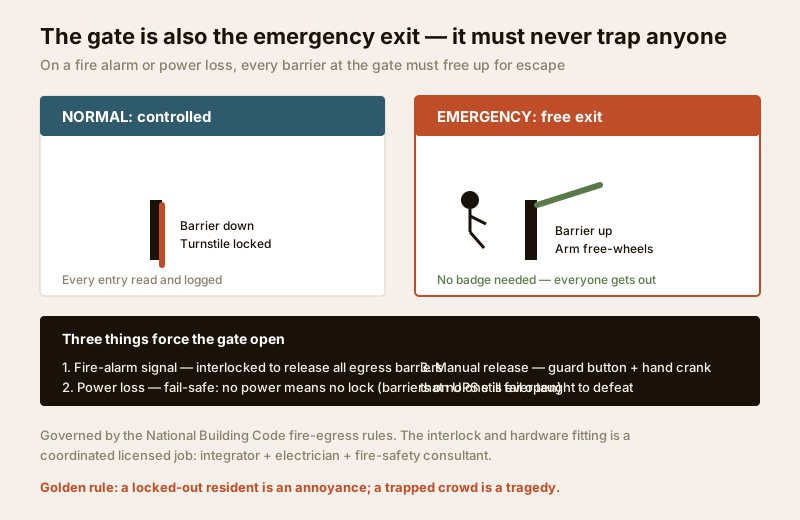
For pedestrians specifically, this means the turnstile must never be the only way out. A full-height turnstile on an escape route needs an adjacent gate that fails open, or the turnstile itself must drop its arms clear on alarm. The dedicated companion guide, emergency door release, covers the release hardware and the egress interlock in full; treat the gate as one more place those rules apply. For the individual gate-leaf lock hardware, smart gate locks explains the fail-safe versus fail-secure choice.
Privacy at the gate: logs, faces and number plates
A modern gate quietly collects a lot of personal data: who entered and when, visitor names and photos, and — with ANPR — the number plate of every car. Under the Digital Personal Data Protection Act, 2023, all of that is personal data, and some of it (a resident's face, a visitor's photo) is sensitive. The RWA or facility manager is effectively the data fiduciary and has real obligations:
- Lawful basis and notice. Put up a clear sign at the gate that the area is monitored and that entry data and plates are recorded, and why.
- Minimisation. Collect only what the gate genuinely needs. A visitor's photo and phone number, yes; their full home address, rarely.
- Retention. Decide how many days gate logs, visitor records and ANPR reads are kept, and delete on schedule — not "forever by default."
- Access. Name who in the committee or facility team may view logs and footage, and keep the guard from casually browsing them.
For the wider treatment of who administers this and how consent works, the visitor access management and audit-trails guides go deeper.
A realistic gate for an Indian society
Pulling it together, a well-specified society main gate in 2026 typically looks like this. Use it as a checklist for a quote, and size and cost it with the access-control system designer and the access-control cost estimator.
| Element | Typical choice | Why |
|---|---|---|
| Vehicle lane | Boom barrier with ground safety loop + photocells | Stops vehicles safely; never strikes anyone |
| Vehicle ID | FASTag/RFID for residents, ANPR overview | Fast resident flow; plate record for the rest |
| Pedestrian lane | Tripod turnstile or wicket + reader, plus a fail-open side gate | Separates people from cars; keeps an escape path |
| Credential | Phone or card for residents, QR for visitors | Convenient, revocable, no shared keys |
| Guard tools | Visitor-management app + intercom + camera view + manual release | Automates routine, empowers the exceptions |
| Cameras | Overview + ANPR, time-synced to the log | Evidence that lines up with entries |
| Backup | UPS on barrier, turnstile, readers and intercom | Load-shedding must not open a security hole — nor a safety trap |
| Emergency | Fire-alarm interlock + manual crank on every egress barrier | Free exit is non-negotiable |
| Management | Cloud platform the RWA controls | Instant revoke, one dashboard, shared audit trail |
Choose the readers and credentials to match the rest of the estate — if the lift and clubhouse use phone credentials, the gate should too, so a resident carries one thing, not five. For the electrical supply, earthing and UPS behind all of this, loop in the electrical hub.
When to bring in a professional. You can and should plan the gate, write the requirements, and hold the vendor to them. Hand the actual work — the barrier and turnstile installation, the gate motor, the mains and network wiring, and above all the fire-alarm interlock and emergency-release commissioning — to a licensed integrator working with your electrician and a fire-safety consultant. Insist on a documented test of the fail-safe behaviour: with the power off, and with the fire alarm triggered, every egress barrier and turnstile must free up on the spot. Get that test in writing before you sign off. For a whole-society view, the gated-communities and commercial-buildings security guides set the wider frame.
Key takeaways
- The gate is a layered system, not a single gadget — guard, boom barrier, turnstile, reader, camera and intercom together, with the first design move being to separate people from vehicles into their own lanes.
- People entry and vehicle entry are different jobs — a turnstile or wicket with anti-tailgate sensors for people, a boom barrier with ground safety loops and photocells for vehicles; never mix them.
- Automation frees the guard, it does not replace them — residents flow through automatically so the guard's judgement lands on deliveries, unexpected guests and emergency vehicles, backed by a visitor-management app and intercom.
- The gate is an emergency exit too — every egress barrier and turnstile must fail-safe on power loss, release on a fire-alarm signal and carry a manual release no one is taught to defeat; this interlock is a licensed, fire-code job.
- Gate data is personal data — entry logs, visitor photos and ANPR number plates are covered by the DPDP Act, 2023, so post notice, minimise, set retention and control who can view.
References
- Digital Personal Data Protection Act, 2023 — gate entry logs, visitor records, resident faces and ANPR number plates are personal (and partly sensitive) data; establish lawful basis, notice at the gate, minimisation, retention limits and controlled access, with the RWA or facility manager as fiduciary.
- Manufacturer specifications — verify boom-barrier safety-loop and photocell behaviour, turnstile fail-safe/drop-arm operation, reader IP ratings for outdoor gate conditions, and UPS runtime on the maker's own datasheet before ordering.
- National Building Code of India (SP 7), Bureau of Indian Standards, and local fire and municipal bye-laws for means of egress, the fire-alarm interlock and any electrical work at the gate; verify the current edition via the BIS catalogue: https://www.services.bis.gov.in/
This is an educational overview, not legal advice. Barrier, turnstile, gate-motor, mains, network and fire-egress work are qualified professional tasks — engage a licensed integrator, electrician and fire-safety consultant, and verify any standard's current status via the BIS catalogue before relying on it.
Export this guide
Related Guides — Deep-dive reading
Visitor Vehicle Management in India: A Professional Guide
The everyday weak point of every society and office gate is not the resident's car — it is the visitor, the cab, the delivery rider and the contractor who must be let in without opening the whole park to anyone. This is the process, not just the hardware: verify at the gate before the boom lifts, park visitors away from resident bays, and never jam the gate a fire tender needs.
SecurityAccess Control Maintenance in India (2026): Readers, Locks and Fail-Safe Egress
How to keep a card, keypad, fingerprint or face access-control system reading reliably and locking securely — and, above everything, how to test that its doors still release on a fire alarm and on power loss, so an access-controlled door never becomes a life-safety trap.
SecurityVisitor Data Protection in India (2026): The Gate Register Problem
Every day your gate collects the name, phone, photo and often an ID card of people who are just visiting. Most gates gather far more than they need. Here is how a home, an RWA or a small office can protect visitors' data, minimise what is kept, and use a gate-management app responsibly.
SecurityRelated Tools — Try Free
Apartment Video Door System Planner
Enter flats, entrances, floors and guard desk for a first-pass building intercom plan — door stations, indoor monitors, guard station, the right architecture and an indicative cost band.
Building PlannerElectrical Safety & Load Audit
Home electrical audit — 10 categories, 65+ checkpoints across earthing, RCCB, MCB, wiring, switchboards, appliance circuits, DG/inverter backup.
Safety AuditGate Access Planner
Size a vehicle gate or boom barrier — lanes needed at peak and the right credential speed (RFID, ANPR, manual).
Gate Flow