 Lesson 8.4
Lesson 8.4 · Placemaking, Heritage & Culture
Tactical & Participatory Urbanism
Lighter, quicker, cheaper, and made with the people who use the place
You can change a street on Sunday
The master plan takes twenty years; a can of paint, some planters and a closed street take an afternoon. Tactical and participatory urbanism is the discovery that cities can be tested, improved and co-owned through small, quick, low-cost interventions made with the people who live there, and that the best of these experiments grow into lasting policy.
Times Square began with folding lawn chairs. Test the future cheaply, then build the version that already works.
Lighter, quicker, cheaper
For most of the twentieth century, urban change meant one thing: the big plan, the capital project, the decade-long process from proposal to ribbon-cutting. Tactical urbanism is the counter-idea that emerged in the last two decades: that cities can also be improved through small-scale, low-cost, often temporary interventions that test a change in the real world before committing to it permanently. The movement's slogan, borrowed from Project for Public Spaces, is lighter, quicker, cheaper, and it captures a genuine shift in method. Instead of spending years and crores designing a perfect permanent scheme in the abstract, you make a cheap, reversible version now, paint a protected bike lane, close a street to cars for a day, drop planters and chairs into a dead corner, and watch what actually happens. The most famous example is New York City's transformation of Times Square, which began in 2009 not with a construction project but with folding lawn chairs and paint closing the roadway to traffic; the experiment proved so popular and safe that it was later made permanent in stone. Tactical urbanism inverts the usual sequence: act first at low cost, learn from real use, then decide whether and how to make it permanent. Its power is threefold. It is cheap, so failure is affordable and experiment is possible. It is fast, so a community sees change in weeks not decades, building the trust and momentum that big projects squander. And it is evidence-generating, replacing arguments about what might happen with observation of what does. It is not a substitute for serious long-term planning, but a way to de-risk it and to keep the city improving in the long gaps between capital projects.
Pop-ups, parklets and open streets
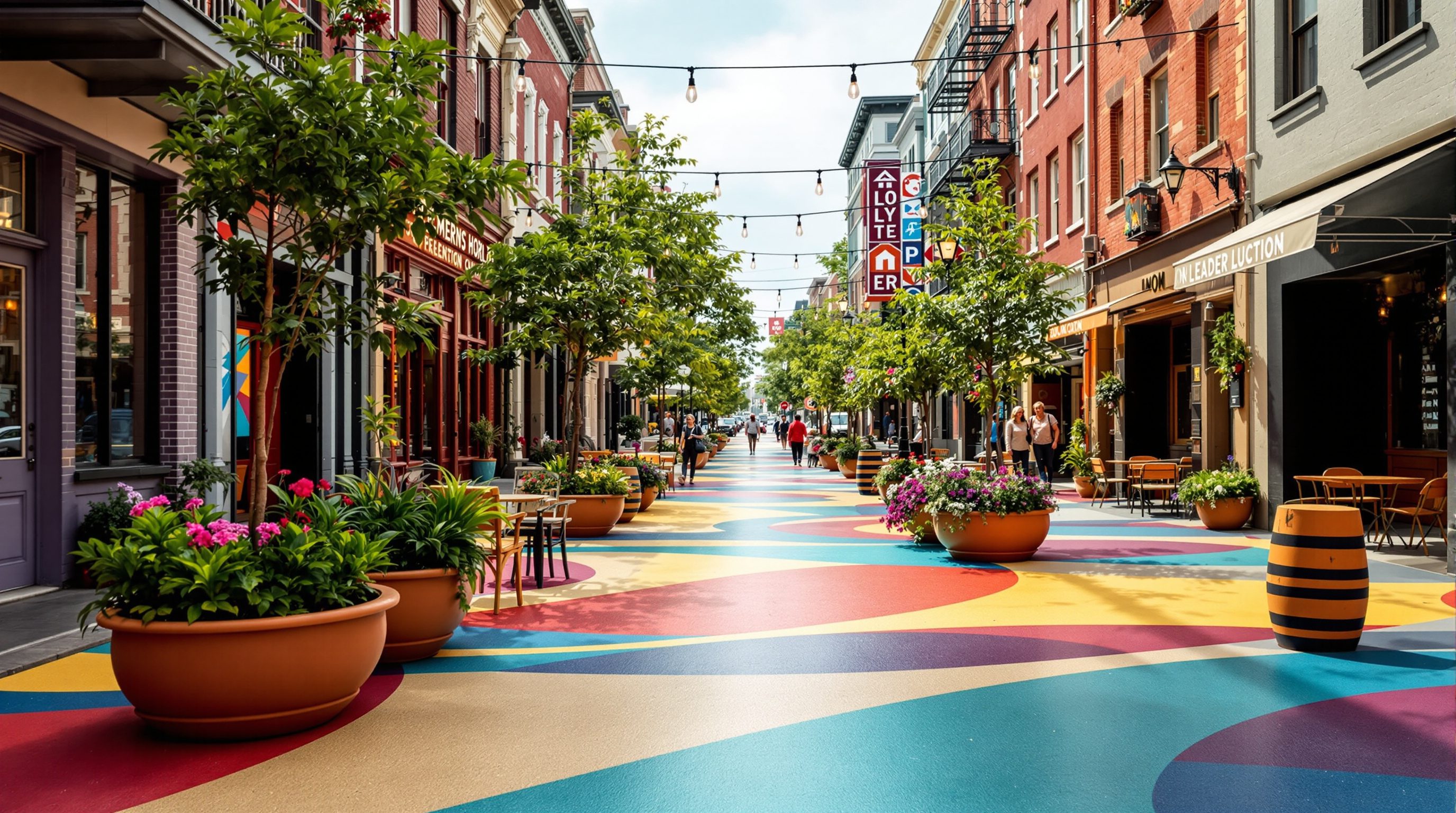
Tactical urbanism has a recognisable and growing toolkit, each tool a way of borrowing space and time to demonstrate a possibility. The pop-up takes a temporary use, a market, a cafe, a plaza, an exhibition, and installs it briefly in an underused space to show what that space could become. The parklet converts a parking bay or two into a tiny public seating space, dramatising how much valuable public land the city gives to stationary cars; the idea grew from Park(ing) Day, when designers around the world turn parking meters into pocket parks for a day. The protected bike lane laid out in paint and bollards tests a cycling network before it is built in concrete. And the largest and most joyful tool is the open streets event, in which a city temporarily closes a stretch of road to motor traffic and opens it to people walking, cycling, playing and gathering. India has a vibrant home-grown version in Raahgiri Day, which began in Gurugram in 2013 and spread to dozens of Indian cities: a weekly morning when arterial roads become car-free festivals of cycling, yoga, music and street games, giving residents a visceral, bodily experience of what a people-first street feels like. Bogota's long-running Ciclovia, which closes over a hundred kilometres of roads every Sunday, is the global ancestor of all of these. What unites the toolkit is that each intervention is a demonstration, a temporary reality that lets people feel a different city rather than merely being shown a rendering of it, and feeling is far more persuasive than argument.
Placemaking with communities, not for them
Tactical interventions are most powerful when they are also participatory, and here tactical urbanism converges with the older tradition of placemaking. Placemaking, championed by Project for Public Spaces and rooted in the observational work of William H. Whyte and the ideas of Jane Jacobs, is the practice of shaping public space around the way people actually want to use it, and its central conviction is that the community is the expert on its own place. Whyte's patient filming of New York plazas in the 1970s showed that people, not planners, reveal what makes a space work, they sit where there is something to watch, where there is sun and shelter and a place to perch, and his findings overturned decades of designers' assumptions. The placemaking method takes this seriously as a way of working: you begin by observing and asking the people who use a space what they need, you make small changes with them, movable chairs, shade, a play element, a stall, and you keep adjusting based on what you see. The crucial preposition is with. Placemaking done for a community, however well-intentioned, imposes an outsider's idea of the good; placemaking done with a community treats residents' knowledge as design intelligence and produces spaces people recognise, use and defend. This matters especially in the diverse, intensely used public spaces of Indian cities, where a plaza must serve vendors, elders, children, worshippers and commuters at once, a complexity no designer can fully anticipate from a drawing board but which the community lives every day. Placemaking is, in the end, less a style than a humility: the discipline of designing the public realm as a collaboration rather than a delivery.
Co-design and the ladder of participation
Participation is a word everyone endorses and few practise honestly, so it needs a sharp analytical tool, and the sharpest is Sherry Arnstein's ladder of citizen participation, published in 1969 and still unmatched. Arnstein arranged participation as a ladder of eight rungs grouped into three bands. At the bottom are two rungs she bluntly called non-participation: manipulation and therapy, where authorities pretend to involve people but really aim to educate or placate them, extracting consent without ceding anything. In the middle are three rungs of tokenism: informing, consultation and placation, where people are told about plans, asked their views, or given a token seat, but have no power to ensure their input changes the outcome, the public meeting where a decided scheme is presented as a consultation is the classic example. At the top are three rungs of genuine citizen power: partnership, delegated power and citizen control, where decision-making is actually shared or handed over. The figure lays out the full ladder. Arnstein's enduring provocation is that most of what cities call participation lives on the tokenism rungs, a survey here, a display board there, ritual exercises that generate legitimacy without sharing power, and that real participation begins only when citizens can affect the result. Co-design is the practical name for working on the higher rungs: designers and residents developing solutions together, sharing the pen, so that the community is a co-author of the scheme rather than a reviewer of the designer's. This is not the abdication of professional skill; the designer still brings technical craft, but deploys it in service of a shared decision rather than a delivered one. Honest practice means naming, for any process, which rung you are actually on, and pushing upward.
From tactical to permanent
The deepest question about tactical urbanism is what happens next, because a pop-up that vanishes changes nothing lasting. The mature framing, articulated by advocates such as Mike Lydon and Anthony Garcia who named the movement, is that tactical interventions are most valuable as the first phase of a longer arc: a pilot that gathers evidence and builds constituency for permanent change. The sequence runs from demonstration, a one-day or one-weekend event that sparks imagination, to pilot, a semi-permanent installation held for months while data is gathered on safety, use, footfall and local business, to permanent, the change built properly in durable materials once it has proven itself and won support. Times Square walked this exact path from lawn chairs to a rebuilt public plaza; many protected bike networks began as painted pilots. This pilot-to-permanent logic is powerful because it turns the usual politics of urban change on its head: instead of fighting over a hypothetical, the community and the city decide on the basis of a lived trial, and opposition rooted in fear of the unknown often melts once people experience the change. But the transition is also where tactical urbanism most often fails, when a beloved pilot is never institutionalised, when there is no budget line, no policy mandate and no agency owner to carry it into permanence, so the planters are removed and the street reverts. Avoiding that fate means designing the pilot with the transition in mind from the start: agreeing in advance what evidence would justify permanence, who owns the decision, and where the capital would come from. In India, the 74th Constitutional Amendment's provision for ward committees and area sabhas offers, at least on paper, an institutional home for participatory and neighbourhood-scale action, a reminder that tactical energy needs formal channels to become durable change rather than a pleasant memory.
Cautions and the designer's stance
Tactical and participatory urbanism is powerful, but it is not a panacea, and a serious practitioner holds its cautions alongside its promise. The first caution is equity: because tactical projects are cheap and citizen-led, they can flourish in confident, well-resourced neighbourhoods and bypass poorer ones, so a city must deliberately steer tactical energy and support toward those with the least, not simply enable those who already have voice. The second is that tactical must not become an excuse for the state to abdicate: a painted crossing is no substitute for the serious, funded infrastructure and services that are government's duty, and communities should not be left to patch with planters what should be delivered as a right. The third is co-optation, the risk that participation becomes a tokenistic ritual, high on Arnstein's tokenism rungs, that manufactures consent for decisions already taken. Held with these cautions, the approach offers the designer a genuinely different stance: humble, experimental, collaborative and iterative, willing to test rather than pronounce, to learn from use rather than defend a drawing, and to share authorship rather than hoard it. It closes this module fittingly, because everything the module has argued, that places have identity worth reading, that heritage is a living inheritance to steward, that informal citizens are experts in their own city, points to the same conclusion: the best places are not delivered to people but made with them, and the designer's highest skill is to enable that making well.
Arnstein, Ladder of Citizen Participation (1969)
A framework grading participation from non-participation through tokenism to genuine citizen power
Use it to diagnose honestly which rung any engagement process is really on, and to push upward toward co-design.
74th Constitutional Amendment, ward committees and area sabhas
Institutional provisions for neighbourhood-scale participation in urban governance
The formal channel through which tactical and participatory action can become durable local decision-making.
Project for Public Spaces placemaking method; NACTO / Global Street Design Guide (interim design)
Community-led public-space practice and guidance on interim and pilot street projects
Practical references for lighter-quicker-cheaper interventions and for taking a pilot toward permanence.
Design a pilot-to-permanent intervention
Plan a small tactical intervention for a real place, run it as a participatory process, and design its path to permanence.
Sketchbook, a base map (OpenStreetMap), a camera, and a genuine willingness to listen
Identify a small underused or car-dominated public space, a dead corner, a wide junction, an oversized parking strip, that you could imagine reclaiming.
- 1Observe and ask: spend time watching how the space is used and talk to at least three people who use it about what they need, treating their knowledge as design input.
- 2Design a lighter-quicker-cheaper pilot, paint, planters, seating, a temporary closure, that tests one clear change, and note what evidence (footfall, safety, dwell time, business reaction) you would gather.
- 3Place your process on Arnstein's ladder and describe one concrete way to move it up a rung, from consultation toward genuine co-design.
- 4Sketch the transition: what result would justify permanence, who owns that decision, and where the budget and policy mandate would come from.
You’ll walk away with
A one-page pilot proposal covering the tactical intervention, the participatory method with its ladder rung, the evidence plan, and an explicit pilot-to-permanent pathway.
Three altitudes on the same idea
Read the band that fits you — or all three.
For the architect, tactical urbanism is permission to prototype. Before committing a permanent design, test its public-realm ideas cheaply and reversibly, a pop-up forecourt, a painted plaza, a temporary shade structure, and let real use refine the drawing. Treat the community as co-authors of the ground-floor and public interface of your building, and design pilots with their transition to permanence in mind so a good experiment is not lost for want of a budget line.
As the urban designer, tactical and participatory methods are core craft. Use lighter-quicker-cheaper pilots, open streets like Raahgiri, painted lanes, parklets, to de-risk and build support for permanent public-realm change, and gather evidence on safety and use to carry a pilot to permanence. Run genuine co-design on the higher rungs of Arnstein's ladder, steer tactical resources toward under-served neighbourhoods, and secure the policy mandate and budget that turn a demonstration into durable street.
The core idea: you do not need a decade or a fortune to improve a place; you can test a change with paint, planters and a closed street, then make permanent what works. Make it real by visiting a Raahgiri or open-streets event, or by running a tiny parklet, and observe how differently people behave. Then place your project on Arnstein's ladder and ask honestly which rung its participation is really on.
“Tactical urbanism is just temporary decoration or a stunt, and participation means holding a public meeting to show people the plan.”
Do it yourself
Quick checks before you finish the module.
- 1Explain lighter-quicker-cheaper and give one real example of a tactical intervention that became permanent.
- 2Name Arnstein's three bands and the rung at which genuine participation begins.
- 3Describe the pilot-to-permanent sequence and the single most common reason the transition fails.
Pulling it together
Peer-reviewed journals & authoritative standards
- 01Project for Public Spaces, placemaking and Lighter, Quicker, Cheaper — Project for Public Spaces, 2016.
- 02Global Designing Cities Initiative, Global Street Design Guide (interim and pilot design) — Global Designing Cities Initiative, 2016.
- 03ITDP India, open streets and people-first public space — Institute for Transportation and Development Policy, India, 2019.
- 04India Code, Constitution (Seventy-fourth Amendment) Act on urban local governance — India Code, Legislative Department, 1992.
This closes the module on placemaking, heritage and culture: places have identity worth reading, heritage worth stewarding, informal life worth respecting, and futures best made with the people who live them.
The author
Amogh N P
Architect, interior designer, and creative polymath. Studio Matrx began in his notebooks — his vision of design made honest, useful, and open to everyone. Its Academy is written and taught in his memory, and free, forever.
More about Amogh →