
 Lesson 8.3
Lesson 8.3 · Placemaking, Heritage & Culture
Informal Urbanism & Indian Cities
The self-built city that most planning never planned for
The city the plan forgot to draw
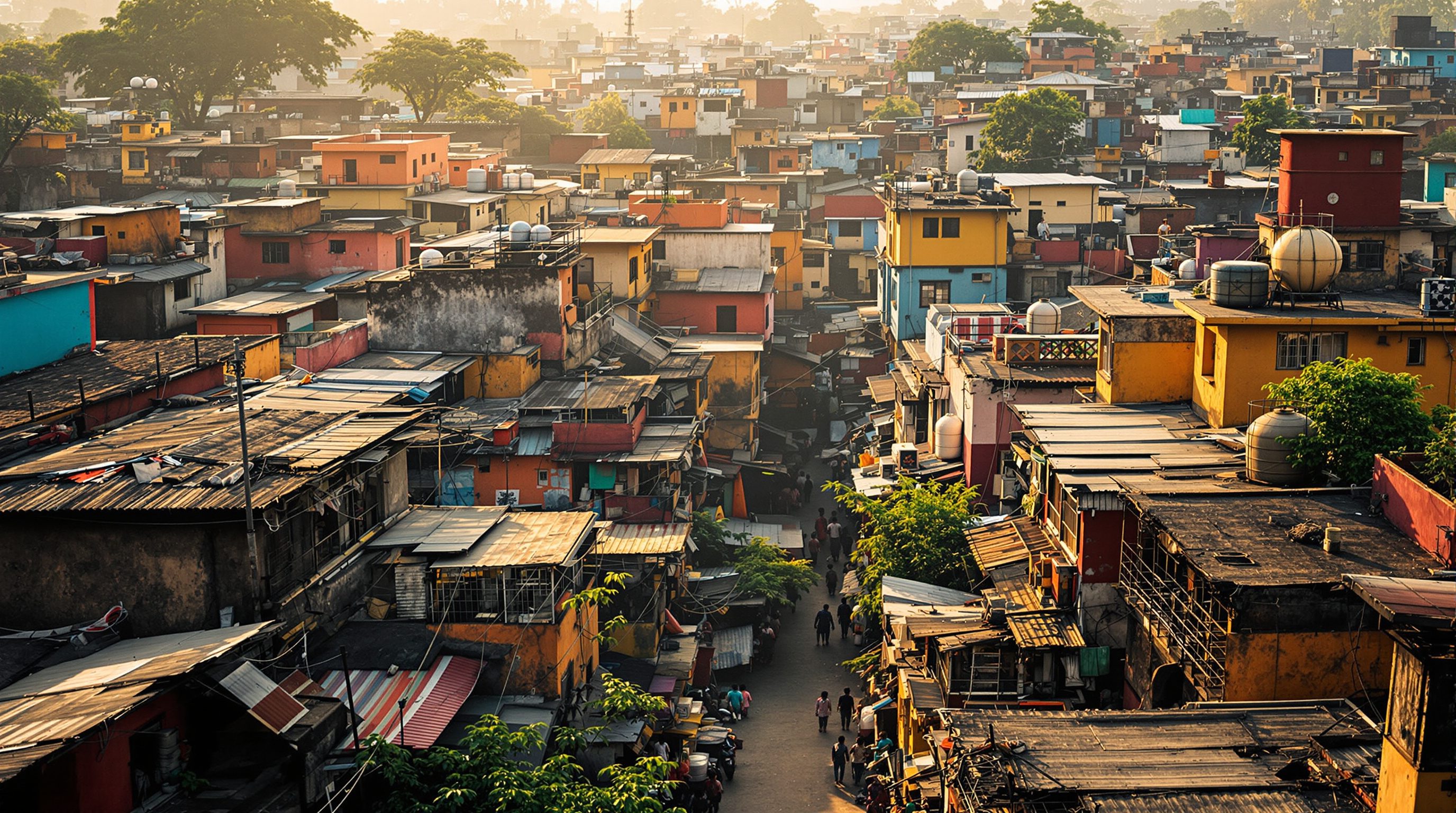
Walk any Indian city off its arterial roads and you enter the urbanism that houses and employs most of its people, and that almost no master plan ever drew. It is self-built, dense, negotiated and astonishingly efficient. To dismiss it as chaos is to misread the largest and most important pattern in the urban world. This lesson learns to see it clearly, and to work with it justly.
Housing is a verb, not a noun. When people control the process, they build better than any scheme delivers.
Most of the urban world is self-built
Begin with a fact that reorders everything a formal planning education teaches: across much of the global South, the majority of urban fabric is produced informally, built incrementally by residents and small builders outside the formal system of plans, permits and titles. UN-Habitat has long estimated that a very large share of the urban population in developing regions lives in informal settlements or self-built housing, and in Indian cities a substantial fraction of residents live in areas the plan classes as unauthorised, unplanned or slum. This is not a marginal exception to the real, planned city; in sheer extent and population it often is the city. The word informal is a poor label, because it defines a vast, generative phenomenon only by what it lacks, official sanction, rather than by what it is. What it is, is a mode of city-making: land occupied or subdivided outside formal channels, housing built room by room as families can afford it, livelihoods pursued in the street and the home, and services obtained through improvisation and negotiation. It arises not from lawlessness but from a structural failure, the formal system's inability to supply legal, affordable land and housing at the pace and price the urban poor need. Faced with cities that offer them work but no formal way to live in them, people build the city they are denied. The first professional discipline, then, is to replace the reflex of contempt or pity with the effort of accurate seeing: to study informal urbanism as a serious and skilful response to real constraints, which is exactly what thinkers from John Turner to the researchers of Dharavi have urged.
How the self-built settlement actually works
Look closely at an established informal settlement and you find not chaos but an intricate, adaptive order. Housing is typically incremental: a family secures a foothold, builds a single room, and over years adds floors, rooms and finishes as income and security permit, so the settlement literally grows denser and more permanent with time. This is the logic John Turner captured decades ago in his argument that housing is best understood as a verb, a process controlled by dwellers, rather than a noun delivered as a finished product; when people control their own housing process, he showed, they invest, adapt and maintain far better than any top-down scheme achieves. The settlement mixes uses at the finest grain, the same structure often houses a family upstairs and a workshop or shop below, so home and livelihood are inseparable. Streets narrow into a capillary network of lanes and shared courts that carry intense social life and pedestrian movement. Services are obtained through a patchwork of shared standpipes, informal power connections and community arrangements, often precarious and unjust in their pricing, but functioning. Dharavi in Mumbai is the world-famous case, not because it is typical in its scale but because it makes visible what informal settlements can be: a dense, mixed, productive district with a recycling and manufacturing economy turning over enormous value, embedded in a fabric that formal zoning would never have permitted. Seeing this order is not romanticising hardship, the deprivation of poor services, insecurity and health risk is real and must be fixed, but recognising the skill and rationality in the fabric is the precondition for improving it without destroying it.
The everyday, negotiated city
Informality is not only about where people live but about how the whole city is used, and here the street is the stage. Street vending, hawking, home-based work and the countless micro-enterprises of the pavement are the visible economy of the everyday city, providing affordable goods and services to all classes and a livelihood to millions who have no formal employment. Scholars of what is called everyday urbanism describe the city as continuously negotiated: the same stretch of pavement is footpath by day, a vendor's stall at rush hour, a sleeping place at night, its use worked out through informal rules, tolerance and constant adjustment among vendors, residents, customers and the authorities. This negotiated order is fragile and often unjust, vendors face harassment, eviction and rent-seeking, precisely because the formal system treats their essential activity as an encroachment rather than a legitimate use of public space. India took an important step to correct this with the Street Vendors (Protection of Livelihood and Regulation of Street Vending) Act of 2014, which recognises vending as a legitimate livelihood, requires cities to survey and register vendors, and mandates Town Vending Committees to designate vending zones and protect vendors from arbitrary eviction. The Act is imperfectly implemented, but its principle is exactly right: the everyday city should be regulated and accommodated, not erased. For the designer this reframes the street entirely. A street is not only a channel for traffic but a site of livelihood and social life, and good street design in an Indian city plans positively for vending, for the informal, for the negotiated uses that make the public realm work, rather than designing them out.
Eviction versus in-situ upgrading
When the state confronts an informal settlement, it faces a fork with profound human consequences, and the evidence strongly favours one path. The first path is eviction and clearance, often followed by relocation to distant resettlement colonies. This has been the default for decades and its record is grim: it destroys homes, social networks and, critically, livelihoods, because it severs people from the locations and clients their incomes depend on, pushing them into peripheral estates far from work, sometimes so unviable that families drift back to new informal settlements. The second path is in-situ upgrading, improving the settlement where it stands, providing secure tenure, water, sanitation, drainage, paved lanes, electricity and community facilities, while leaving the fabric and its social and economic networks intact. Decades of international experience, championed by UN-Habitat and the World Bank and rooted in Turner's insights, show upgrading to be cheaper, faster, less disruptive and far more humane than clearance, because it works with the enormous investment residents have already made rather than destroying it. A hybrid is redevelopment, rebuilding a settlement in place at higher density, as in Mumbai's slum rehabilitation schemes that cross-subsidise rehousing with market flats; this can deliver durable housing but often at the cost of the fine grain and ground-floor livelihoods, replacing a productive horizontal fabric with tenement towers that suit families poorly and micro-enterprises worse. The figure contrasts these approaches. The mature position is a strong presumption toward in-situ upgrading and secure tenure, with relocation only where a site is genuinely hazardous or essential public infrastructure requires it, and even then with rehabilitation that protects livelihoods and proximity.
What the fine grain teaches designers
Beyond the ethics of how we treat informal settlements lies a quieter, humbling proposition: that formal urbanism has a great deal to learn from informal urbanism as design. The qualities planners spend careers trying to engineer, walkability, fine-grained mixed use, active streets, high density without high-rise, adaptability, are precisely the qualities informal fabric produces spontaneously. Its buildings are close and low, so density is achieved on the ground where life happens rather than in isolating towers. Its uses are woven together at the scale of the single plot, so daily needs are a few steps away and the street is always overlooked and alive, delivering the natural surveillance Jane Jacobs prized. Its fabric is incremental and therefore adaptable, changing use and form as needs change, exactly the resilience that rigid single-use zoning forbids. Its streets are sized for people, not cars. None of this excuses the deprivation, and the lesson is not to build slums but to extract the transferable principles: the value of fine grain over superblocks, of mixed use over segregation, of incremental over finished, of the ground-oriented dense low-rise over the tower-in-the-park. Charles Correa built much of his career on exactly this reading, designing incremental, low-rise high-density housing and celebrating the open-to-sky, ground-oriented life of the Indian city; Balkrishna Doshi's Aranya housing in Indore offered serviced sites and starter cores that families completed themselves, a formal design that deliberately borrowed informality's incremental logic. To learn from informality is to let the most efficient urbanism most of the world actually builds inform the urbanism we design.
Dignity, rights and the designer's stance
Everything in this lesson finally rests on an ethical foundation, because informal urbanism is not an abstract pattern but the homes and livelihoods of real people who are usually poor and often powerless. The governing idea is dignity and rights: that residents of informal settlements are citizens with a right to the city, to secure shelter, to livelihood, to services, and to a voice in decisions that reshape their lives, not encroachers to be managed off the map. The concept of the right to the city, associated with Henri Lefebvre and taken up worldwide, insists that those who make and use the city have a claim on how it is shaped. Practically this means several commitments. It means security of tenure as the foundation, because people who fear eviction will not invest, and secure households transform their own settlements. It means participation, not for informal residents but with them, treating their knowledge of their own place as expertise, a theme the next lesson develops. It means protecting livelihoods as fiercely as shelter, since a home without an income nearby is not a solution. And it means the designer approaching this work with humility rather than saviourism, aware that a plan drawn from above has repeatedly destroyed more than it built. Government programmes such as the housing missions and the Street Vendors Act reflect a slow official shift from clearance toward inclusion and upgrading; the professional's job is to push that shift further, to design with the grain of people's own efforts, and never to mistake the tidiness of a rendering for the justice of an outcome.
Street Vendors (Protection of Livelihood and Regulation of Street Vending) Act, 2014
Recognition of vending as a legitimate livelihood; survey, registration, vending zones and Town Vending Committees
Requires cities to accommodate rather than evict vendors; design streets to include planned vending under this Act.
National / state housing missions and in-situ slum upgrading and rehabilitation policy
Affordable housing, tenure and settlement improvement or redevelopment
Favour in-situ upgrading and secure tenure; treat relocation as a last resort that must protect livelihoods and proximity.
UN-Habitat guidance on informal settlements and the right to adequate housing
International principles on upgrading, participation and security of tenure
The reference framework establishing upgrading over eviction and residents as rights-holders.
Read a self-built fabric on its own terms
Study a small piece of informal urbanism to see its order, then propose an upgrading move that keeps what works.
Sketchbook, camera or phone (used respectfully), OpenStreetMap for a base, and above all a listening, non-intrusive attitude
Choose a small, accessible area of self-built fabric or a vending street you can observe respectfully and safely, from public space, without intruding.
- 1Map the fine grain: sketch a short stretch showing how buildings mix home and work, how lanes branch, and where shared services and public life concentrate.
- 2Note the incremental evidence, added floors, changing materials, extensions, and infer how the fabric has grown over time.
- 3Observe the negotiated street through part of a day: who uses which space when, and how vending, walking and dwelling share it.
- 4Propose one in-situ upgrading intervention, drainage, a paved and lit lane, a water point, a vending zone, that improves life while preserving the grain, the mix and the livelihoods.
You’ll walk away with
An annotated fine-grain map plus a one-paragraph upgrading proposal that explicitly protects tenure, livelihoods and the existing fabric.
Three altitudes on the same idea
Read the band that fits you — or all three.
For the architect, informal urbanism reframes what good housing is: not a finished object handed down but a process people control. Design for the incremental, serviced sites, starter cores, structures that can grow floor by floor, as Doshi did at Aranya, and keep the ground floor free for the livelihoods that fund and inhabit the home. When you touch an existing settlement, add services and security without erasing the fine-grained, mixed, ground-oriented fabric that already works.
As the urban designer you decide whether the public realm accommodates the everyday, negotiated city or designs it out. Plan streets positively for vending and informal use under the Street Vendors Act, not as encroachment but as legitimate livelihood and life. At settlement scale, choose in-situ upgrading and secure tenure over eviction, protect the capillary lane network and mixed grain, and let informality's efficiencies, density on the ground, fine grain, mixed use, inform the formal fabric you design.
The core idea: most of the urban world is self-built, and that self-building is skilful, not chaotic. Make it real by mapping a small informal settlement or a vending street near you, noting how housing grows incrementally, how home and work mix, and how the street's uses are negotiated through the day. Then ask what upgrading, not clearance, would improve life there while keeping what already works.
“Informal settlements are chaotic, illegal encroachments that should be cleared and their residents rehoused elsewhere in proper housing.”
Do it yourself
Quick checks before you move on.
- 1Explain in one sentence why informal urbanism is better understood as a response to structural failure than as lawlessness.
- 2State two concrete advantages of in-situ upgrading over eviction and distant relocation.
- 3Name three design qualities that informal fabric produces spontaneously and that formal planners struggle to engineer.
Pulling it together
Peer-reviewed journals & authoritative standards
- 01UN-Habitat, guidance on informal settlements and adequate housing — UN-Habitat, 2020.
- 02World Bank, Urban Development and settlement upgrading — World Bank, 2021.
- 03Ministry of Housing and Urban Affairs, Street Vendors Act and urban livelihoods — MoHUA, Government of India, 2014.
- 04India Code, Street Vendors (Protection of Livelihood and Regulation of Street Vending) Act — India Code, Legislative Department, 2014.
If informal residents are experts in their own place, the final lesson asks how designers work with communities directly: tactical, participatory and co-designed urbanism.
The author
Amogh N P
Architect, interior designer, and creative polymath. Studio Matrx began in his notebooks — his vision of design made honest, useful, and open to everyone. Its Academy is written and taught in his memory, and free, forever.
More about Amogh →