
 Lesson 8.3
Lesson 8.3 · Regenerative Design in Practice
Ecosystem Services and Biodiversity Gain
A regenerative site does not just avoid harming nature - it leaves the land measurably richer in life, cleaner in water, healthier in soil, and busier with pollinators than before
The greenest wall on the brochure means nothing if the site holds less life than the field it replaced.
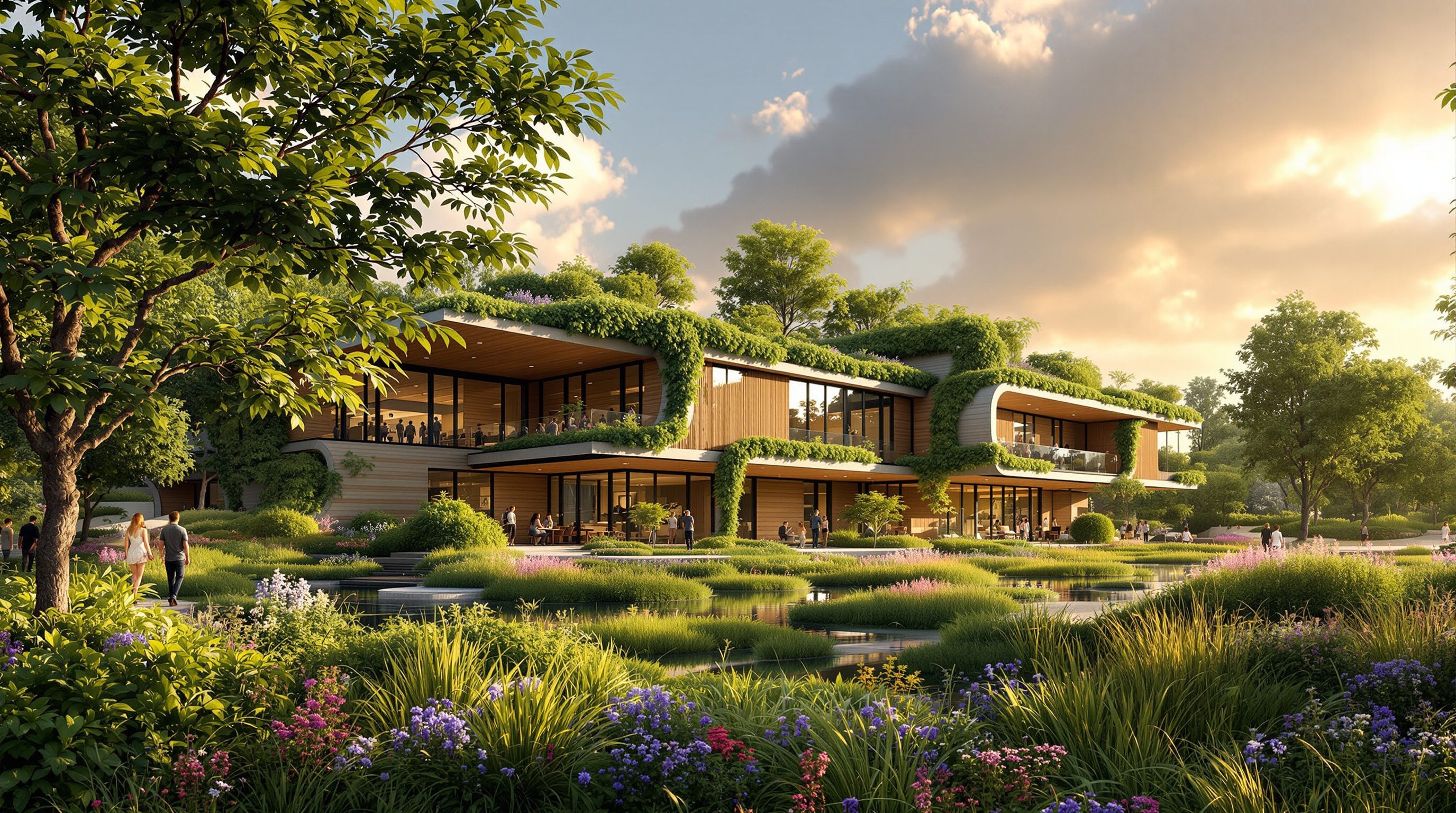
For most of building history, a site was something to clear, level, seal and forget. Even much 'green' design treats landscape as a decorative afterthought - a lawn, a few ornamental shrubs, a photogenic green wall. Regenerative design refuses that. It treats the site as living infrastructure that can clean air and water, cool the microclimate, store carbon, feed pollinators and shelter wildlife.
The shift is from looking green to being ecologically richer - and, crucially, to being able to prove it. This lesson introduces the two ideas that make that possible: ecosystem services (the concrete benefits nature provides) and biodiversity net gain (leaving the site measurably richer in life than you found it).
Looking green is not being green. Measure the uplift: units, canopy, permeable area, species - and secure the management.
Ecosystem services: what nature does for free
Ecosystem services are the benefits people and the wider environment receive from functioning ecosystems - the work nature does that we would otherwise have to pay for, or do without. The framing comes from the Millennium Ecosystem Assessment, which grouped them into four families. Provisioning services are tangible products: food, fresh water, timber, fibre. Regulating services are the quiet, vital ones: air and water purification, climate and temperature regulation, flood and stormwater control, pollination, pest control. Supporting services underpin all the others: soil formation, nutrient cycling, photosynthesis, the water cycle. Cultural services are the non-material benefits: recreation, beauty, sense of place, mental restoration.
Why does this matter to a designer? Because a building site sits inside this web whether you acknowledge it or not, and conventional development mostly degrades these services: sealing soil kills its filtration and carbon storage, removing vegetation ends cooling and habitat, and channelling runoff overwhelms rivers instead of letting the land absorb water. Once you see a site as a bundle of ecosystem services, design choices reappear as ecological decisions. A green roof is not decoration - it is stormwater regulation plus cooling plus habitat. Native planting is not landscaping - it is pollination and pest control. Permeable ground is not paving - it is soil, water cycle and flood control (blue-green infrastructure, Module 5).
The regenerative move is to design so the site delivers more of these services after development than before - measurably more clean water, more cooling, more carbon storage, more habitat. That is what turns landscape from a cost into living infrastructure that pays back for the life of the building.
This reframing has hard economic weight, not just ecological sentiment. Regulating services a healthy site provides for free - shading and evapotranspiration that cut cooling loads, soil and vegetation that slow and clean stormwater, canopy that filters air - are services a conventional development must otherwise buy as mechanical cooling, drainage engineering and air handling. In dense, hot Indian cities facing severe urban heat-island effects and overwhelmed drains, a site designed to deliver those services is doing genuine infrastructural work. Seeing landscape this way changes the design conversation from 'how much green can we afford?' to 'which services should this site provide, and how do we design it to provide more of them?'.
Biodiversity net gain: leaving the site richer
If ecosystem services are the benefits, biodiversity is the living machinery that produces them - and it is in steep global decline. Biodiversity net gain (BNG) is the principle that a development should leave biodiversity in a measurably better state than before, not merely 'protected'. In England this became a legal requirement: from 2024, most new developments must deliver a minimum 10% biodiversity net gain, measured with a statutory metric and secured for at least 30 years. It is one of the first times ecological improvement has been made mandatory and quantified in planning, and its influence is spreading internationally.
The mechanism matters because it forces honesty. BNG is calculated in biodiversity units using a metric that scores habitats by their type, condition, size and strategic significance - a species-rich native meadow scores far higher than an amenity lawn of the same area. You assess the site's baseline units before development, then design the post-development landscape to exceed that baseline by the required margin. Because a lawn or a sealed car park scores low, and native, well-managed habitat scores high, the metric rewards genuine ecological quality, not square metres of generic green.
Crucially, BNG enforces a mitigation hierarchy: first avoid harming existing valuable habitat, then minimise, then restore on site, and only as a last resort offset elsewhere. Retaining a mature tree or an existing hedgerow is worth far more than planting saplings to replace it, because established habitat carries units that take decades to rebuild. For designers, BNG turns 'we added some planting' into a number you must actually beat - which is exactly the discipline regenerative claims need.
The wider significance is that BNG makes 'nature-positive' operational. For years, biodiversity was the flow that regenerative rhetoric embraced most warmly and measured least rigorously, precisely because life is harder to quantify than kilowatt-hours. A metric, however imperfect, breaks that impasse: it gives planners, clients and designers a common currency for ecological gain, forces the ecological baseline to be established before design decisions foreclose it, and makes the difference between a lawn and a meadow show up as a number rather than an opinion. Even where it is not legally required, adopting the same method voluntarily is one of the most credible ways to keep a biodiversity claim honest.
Habitat, pollinators, soil and the water cycle
Ecological uplift is built from specific, designable moves across four systems. Habitat: the goal is variety and connection. Layered planting (ground, shrub, canopy), native species that co-evolved with local wildlife, green and brown roofs, retained deadwood, ponds and wetlands, and bird, bat and insect boxes all add habitat - and connecting them into corridors matters as much as their area, because isolated patches support far less life than linked ones.
Pollinators deserve specific attention given their global decline and the food-web role they play. Flowering native plants with a succession of blooms across the seasons, minimal or no pesticides, undisturbed nesting ground and water sources turn a site into pollinator habitat - achievable even on small urban plots, balconies and roofs. Soil is the most overlooked living system: healthy soil stores carbon, filters and holds water, and hosts a vast web of organisms. Regenerative design protects existing topsoil (rather than stripping and selling it), avoids compaction, keeps ground unsealed where possible, and builds soil health with organic matter - treating soil as a living system, not inert fill.
The water cycle ties them together. Instead of sealing ground and piping rain away, regenerative sites slow, spread and soak water - rain gardens, swales, permeable surfaces, wetlands - so it recharges groundwater, feeds vegetation and is filtered by soil (blue-green infrastructure and SUDS, Module 5). Each system reinforces the others: soil holds water, water grows habitat, habitat feeds pollinators, and the whole delivers the ecosystem services the first section named. Designing them together, early, is what produces real uplift rather than scattered green features - and it is why a landscape ecologist belongs on the team from concept, not after the building is fixed.
Habitat + pollinators + soil + water are ONE system. Connect the patches, keep the topsoil, plant natives, unseal the ground.
Measuring ecological uplift honestly
The line between regenerative and greenwash here is measurement. A green wall in a photo proves nothing; a documented increase in biodiversity units, canopy cover, permeable area or recorded species proves something. Several tools make ecological uplift measurable. Biodiversity metrics (like England's statutory metric) convert habitat into comparable units so you can show a genuine net gain. Baseline ecological surveys by a qualified ecologist record what species and habitats exist before you touch the site - without a baseline, 'gain' is unmeasurable. Post-occupancy monitoring over years checks whether the promised habitat actually established and is being managed, because planting that dies or is mown to nothing delivers no uplift.
Be candid about the difficulties. Ecosystems take years to establish - a newly planted meadow or young trees deliver a fraction of a mature habitat's value, which is exactly why retaining existing habitat beats replacing it and why the 30-year securing period in BNG exists. Metrics are useful but imperfect proxies; they can be gamed by choosing convenient habitat types, so they need honest application and ecological judgement. And uplift depends entirely on long-term management - the maintenance regime, budget and skills - which designers must specify and clients must commit to, or the gain evaporates.
The professional standard is therefore simple to state and demanding to meet: survey the baseline, design for measurable net gain across ecosystem services and biodiversity, and secure the management that keeps it real. Do that, and the site genuinely gives back to nature - the clearest, most literal form of regeneration there is, and the one a client and a planning authority can actually verify.
Biodiversity Net Gain (BNG)
Mandatory measurable ecological improvement
England requires a minimum 10% net gain from 2024, measured by a statutory metric and secured for 30 years; the idea is spreading internationally.
Ecosystem services
Provisioning, regulating, supporting, cultural benefits
The Millennium Ecosystem Assessment framing; makes nature's free work visible and designable as living infrastructure.
Mitigation hierarchy
Avoid, minimise, restore, offset - in that order
Retaining mature habitat beats replacing it, because established habitat holds value that takes decades to rebuild.
Green roofs and green infrastructure
Vegetated surfaces and connected natural systems
Deliver stormwater regulation, cooling, carbon and habitat together; count only if planted for biodiversity and maintained. Module 5.
Workshop - map the ecosystem services of a site
Ecological uplift starts with seeing what a site does and holds today. In this exercise you read a real plot as a bundle of ecosystem services and a rough biodiversity baseline, then design realistic net gain.
A real site to visit and a notebook. (For formal assessment, a qualified ecologist and a biodiversity metric are needed - this exercise builds the eye that briefs them.)
Goal: learn to see a site ecologically and design for measurable uplift
Inputs: a real outdoor site you can visit + a notebook or sketch plan
Time: ~40 minutes
- 1Visit a site (a plot, garden, campus corner or car park) and list the ecosystem services it currently provides across the four families - provisioning, regulating, supporting, cultural - and note where it is sealed, bare or a low-value lawn.
- 2Make a rough biodiversity baseline: name the habitat types present (lawn, hedge, mature tree, bare ground, water) and rank them low-to-high for wildlife value, noting anything mature that would be costly to replace.
- 3Identify what a typical development would degrade here - sealed soil, felled trees, piped runoff - and estimate the ecosystem services lost.
- 4Design three concrete moves that would deliver net gain: e.g. retain the mature tree, replace lawn with native pollinator meadow, add a green or brown roof, unseal and plant a rain garden - and say which ecosystem services each restores.
- 5Note the long-term management each move needs (mowing regime, watering, budget, skills) and who would have to commit to it for the gain to be real.
You’ll walk away with
A one-page ecological read of one site: its current ecosystem services, a ranked habitat baseline, the services a typical development would lose, three net-gain moves with the services they restore, and the management commitment each requires.
Three altitudes on the same idea
Read the band that fits you — or all three.
Treat the site plan as an ecological instrument from the first sketch. Where the building sits, how much ground is sealed, which existing trees and hedgerows survive, and how green and brown roofs, permeable ground and habitat corridors are woven in - these are architectural decisions that set the biodiversity baseline you must beat. Commission an ecological survey early, bring a landscape ecologist onto the team, and design for a measurable net gain rather than adding token planting at the end.
Extend the living-systems thinking indoors and to the threshold. Interior planting, biophilic connection to the outside, and specifying finishes and pesticides that do not poison soil and pollinators all link the interior to the site's ecology. On terraces, courtyards, balconies and roof gardens - often within your scope - native, pollinator-friendly, layered planting turns leftover outdoor space into genuine habitat rather than decorative greenery, contributing real ecosystem services.
Learn to read a site as a bundle of ecosystem services and a biodiversity baseline. Practise walking any plot and naming what it provides - cooling, water filtration, habitat, pollination - and what development would degrade or could enhance. Understanding biodiversity net gain and how a biodiversity metric works is a fast-growing, employable skill as more jurisdictions make ecological improvement mandatory, and it sets you apart from designers who still see landscape as decoration.
“Adding lots of greenery - a lawn, some plants, a green wall - means a project is good for biodiversity.”
Do it yourself
Answer from understanding.
- 1Name the four families of ecosystem services and give one example of each.
- 2What does biodiversity net gain require, and why is it measured in units rather than area?
- 3Why is retaining a mature tree usually worth more than planting several saplings?
- 4Name three specific design moves that increase habitat for pollinators.
- 5Why is a baseline ecological survey essential to any claim of ecological uplift?
The one line to carry out
Peer-reviewed journals & authoritative standards
- 01Ecosystem services — Wikipedia, 2026.
- 02Biodiversity — Wikipedia, 2026.
- 03Green roof — Wikipedia, 2026.
- 04Green infrastructure — Wikipedia, 2026.
Designing the site to give back leads naturally to the deepest regenerative idea of all: designing with the whole living place - its watershed, ecosystems and community - which is where the final lesson takes us.
The author
Amogh N P
Architect, interior designer, and creative polymath. Studio Matrx began in his notebooks — his vision of design made honest, useful, and open to everyone. Its Academy is written and taught in his memory, and free, forever.
More about Amogh →