
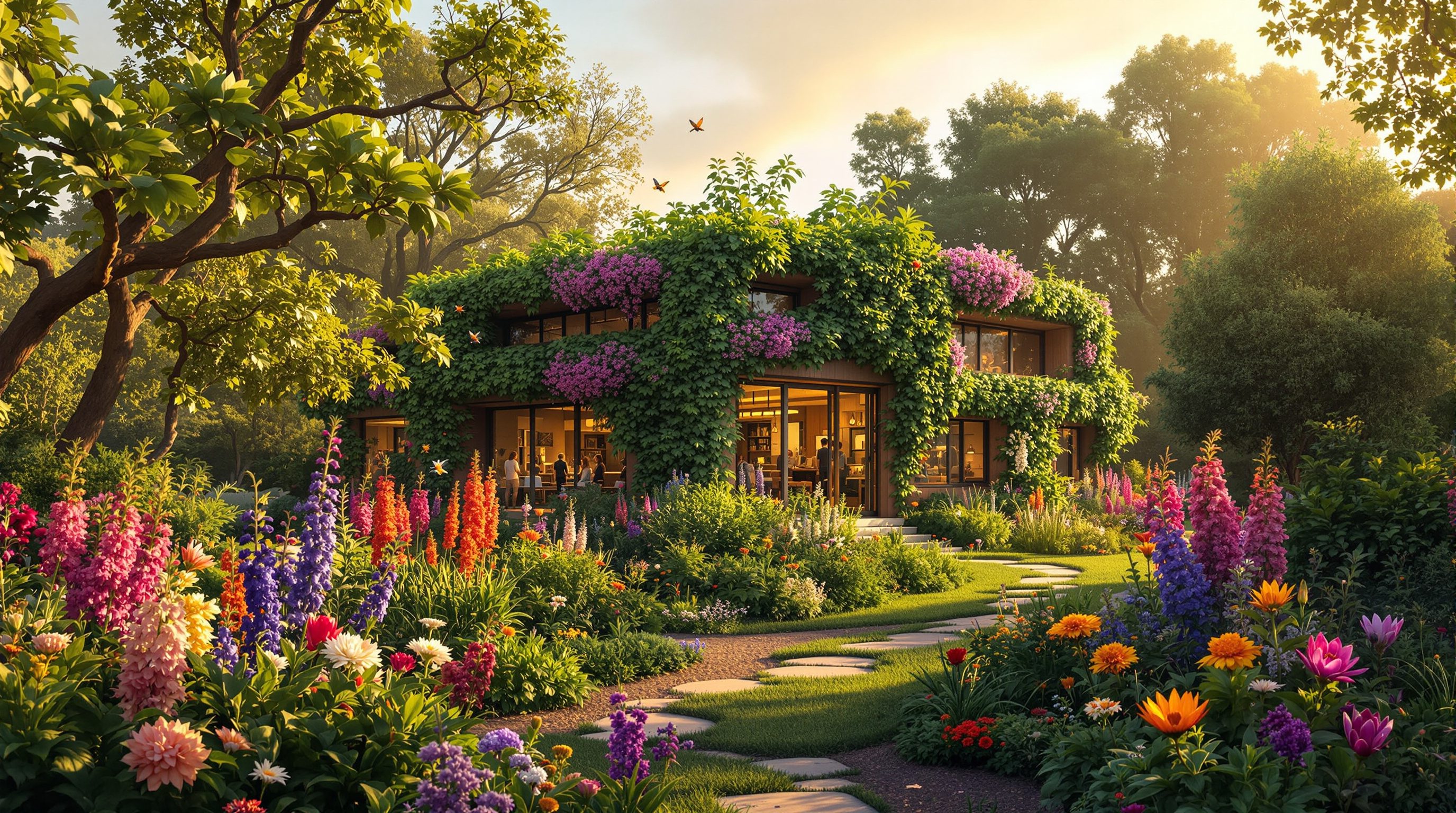
 Lesson 5.3
Lesson 5.3 · Water, Land & Biodiversity
Landscape & Biodiversity
The site is a living system, not a leftover: native planting, healthy soil and habitat make landscape do real ecological and climatic work
The landscape is the one part of a project that can be more alive after you build than before - if you let it.
In most projects the landscape is an afterthought: a lawn, a few ornamental shrubs and a border of imported palms, drawn last, watered constantly, and doing almost nothing for the place. Meanwhile the building has sealed the soil, felled the trees, and driven off the birds and insects that were there. On the impact spectrum from Lesson 0.1, that is a degenerative site - it leaves its ground poorer.
Yet landscape is the easiest place in the whole project to be genuinely regenerative - to leave the site measurably richer in life than you found it. Native planting, healthy soil and thoughtful habitat turn the ground plane into working infrastructure: it cools the site and the city, cleans and soaks up water, stores carbon, supports pollinators and birds, and heals the people who use it. This lesson treats the site as a living system - not the space left over once the building is placed, but a designed ecology in its own right.
Green is not the same as ecological. Species and soil matter more than colour.
Landscape as living infrastructure, not decoration
The mental shift this lesson asks for is to stop seeing planting as cosmetic and start seeing it as infrastructure that happens to be alive. A well-designed landscape delivers a stack of measurable ecosystem services - the benefits nature provides for free that we would otherwise have to engineer. It regulates temperature (shade and evapotranspiration), manages water (interception, infiltration, filtration), stores carbon in biomass and soil, supports biodiversity (food and habitat for insects, birds and animals), and improves human health and wellbeing (the biophilic benefits developed in Module 6). Priced out, these services are worth far more than most planting budgets.
The contrast with conventional landscaping is stark. A clipped exotic lawn is close to an ecological desert: it needs constant water, mowing and often chemicals, supports almost no wildlife, and stores little carbon. A layered planting of native trees, shrubs, grasses and groundcover, over healthy soil, does the opposite on every count - and usually needs less maintenance once established. The regenerative move is not to add more planting to a conventional scheme; it is to design the landscape as a functioning ecosystem from the start.
This reframing also changes when landscape is decided. Treated as infrastructure, it belongs in the earliest site strategy alongside water and orientation - which trees to keep, where soil and habitat can be protected or built, how the ground plane manages rain (Lessons 5.2 and 5.4) - not tacked on when the building is done.
Plant native, plant for drought, protect the soil
The single most consequential planting decision is what to plant, and the answer, overwhelmingly, is native and climate-adapted species. Native plants evolved with the local climate, soil, rainfall and wildlife, so they need little or no irrigation once established, resist local pests without chemicals, and - crucially - support the local food web: native insects feed on native plants, and native birds feed on those insects. An imported ornamental may look lush but is often a dead end ecologically, and a thirsty one at that. In dry regions, xeriscaping - designing with drought-tolerant, low-water planting - can cut landscape irrigation, often the largest single water use on a site, by the great majority.
Beware the flip side: invasive exotics that escape and outcompete native flora are a genuine ecological harm (think of aggressive spreaders that choke Indian water bodies and grasslands), so 'green' is not automatically good - the species matters. Choose from local native palettes and regional plant guides.
Underneath it all is soil, the most overlooked living system on any site. Healthy soil is a vast reservoir of biodiversity, a major carbon store, and the sponge that makes infiltration and planting work. Construction routinely destroys it - stripped, compacted by machinery, or buried under fill. Protecting existing topsoil, avoiding compaction, and building soil health with organic matter is foundational: without living soil, native planting struggles and the water strategy fails. Treat topsoil as the valuable, slow-to-form resource it is.
Cooling the city: landscape against the heat island
One ecosystem service deserves its own focus because it is becoming a matter of survival: urban heat island mitigation. Cities built of concrete, asphalt and glass absorb and re-radiate heat, running several degrees Celsius hotter than surrounding vegetated land - a gap that is worst at night and worsening as the climate warms. In Indian cities facing lengthening, intensifying heatwaves, this is a public-health emergency, and landscape is one of the most effective, lowest-tech responses available. The figure shows how surface temperature falls across sealed, paved and vegetated ground.
Planting cools in two ways. Shade keeps direct sun off surfaces and people, and a mature tree canopy over paving or a building's west face can cut surface temperatures dramatically. Evapotranspiration - plants releasing water vapour - works like natural air-conditioning, absorbing heat as water evaporates; a large tree can have a cooling effect equivalent to several room air-conditioners running, for free. Together, generous tree canopy, green roofs and walls (Lesson 5.4) and planted ground can lower local temperatures by a few degrees, cutting both discomfort and the building's cooling energy.
The design implications are concrete: prioritise large-canopy shade trees over ornamental shrubs, shade paving and parking (a sea of hot tarmac is a heat-island generator), plant the sun-facing sides of buildings, and choose light-coloured or permeable surfaces where planting is not possible. Landscape here is not amenity - it is climate adaptation infrastructure.
Shade + evapotranspiration = free cooling. A car park of hot tarmac is a heat-island machine.
Biodiversity net gain: leave the site richer
The regenerative benchmark for a site is simple to state and demanding to meet: leave it richer in life than you found it. This is what biodiversity net gain (BNG) formalises. You measure the ecological value of the site before development (its habitat types and condition, converted into 'habitat units'), then design so the value after - habitat retained plus habitat created and enhanced - is measurably higher. England now legally requires a minimum 10% net gain on most new development, and the idea is spreading; green-rating systems reward habitat creation, and Module 8 treats ecosystem-services and biodiversity gain in depth. The figure shows the before-and-after logic.
Crucially, BNG follows a strict mitigation hierarchy, and the order is the whole point: avoid harming existing habitat first (a mature tree or existing wetland is worth far more than anything you can plant to replace it, and takes decades to regrow); then minimise and restore on site; and only offset elsewhere as a genuine last resort. Bulldozing a rich habitat and promising to plant saplings is not net gain - it is a loss dressed up, and a classic biodiversity greenwash.
Practically, creating habitat is often cheap and delightful: layered native planting, a pond or rain garden (which doubles as water management), log piles and undisturbed corners, nest boxes and bee hotels, hedgerows instead of walls, and simply not over-tidying. The aim is structural variety - different heights, densities, wet and dry, sunny and shaded - because variety of habitat is variety of species. A regenerative site is one where the birds, bees and butterflies come back.
Avoid -> restore -> offset. A 40-year-old tree is not replaceable by a sapling. Measure before + after.
From audit to action: stewarding a living site over time
A landscape is not a finished object handed over on completion day - it is a living system that changes for decades, so designing it means designing its trajectory, not just its opening image. This is where regenerative landscape differs most sharply from conventional planting, which is designed to look complete on day one (hence instant lawns and mature transplanted specimens) and then fights nature to hold that frozen picture with water, mowing and chemicals forever. A regenerative planting is designed to establish and mature: it may look sparse at first, then fill in, self-seed and develop structure as it settles into its site, needing more attention early (watering to establish, weeding out invasives) and far less later. Selling that trajectory to a client who expects instant lushness is part of the designer's job.
That reframes maintenance from a cost to be minimised into a design decision that determines whether the ecology survives. The maintenance regime for a living landscape is different in kind, not just amount: less mowing and spraying, more observation and selective intervention - letting areas grow wild, cutting meadows once a year rather than weekly, topping up mulch and organic matter to feed the soil, and resisting the cultural urge to over-tidy that strips out exactly the leaf litter, seed heads and dead wood that wildlife needs. A brief that specifies how the landscape is to be managed - and by someone who understands it - is as important as the planting plan, because a regenerative scheme handed to a mow-and-blow contractor will be destroyed within a season.
Finally, think about connectivity and time. A single rich site is good; a site connected to others - via hedgerows, tree lines, green corridors and continuous soft edges - is far better, because wildlife needs to move, and isolated habitat patches slowly lose species. Align your site's green structure with whatever corridors exist beyond its boundary so it becomes a stepping-stone in a larger network (the neighbourhood scale Lesson 5.4 develops). And be patient with carbon and habitat value: soil carbon builds over years, trees deliver their canopy and cooling over decades, and a habitat matures into its full richness long after handover. Designing a living site is an act of stewardship across time - which is exactly what makes it regenerative rather than merely green.
Biodiversity net gain (BNG)
Designing so post-development habitat value exceeds the baseline
Legally required (min 10%) on most new development in England; spreading elsewhere. Measured in habitat units before and after.
Mitigation hierarchy
Avoid -> minimise -> restore -> offset
The order is binding: protecting existing mature habitat beats any promise to recreate it. Offsetting is a last resort.
Ecosystem services
The free benefits nature provides - cooling, water, carbon, habitat, health
The economic case for landscape as infrastructure; often worth far more than the planting budget.
Native / xeriscape planting
Climate-adapted, low-water, locally-appropriate species
Cut irrigation and chemicals, support the local food web. Beware invasive exotics - green is not automatically good.
Workshop - a biodiversity-and-cooling audit of a real site
This exercise trains the ecological eye. You will read a real site for what it does for life and climate today, then design realistic moves to leave it richer and cooler.
A site you can walk, a phone camera, optionally an IR thermometer or weather app for surface temperatures, and a regional native-plant guide. No specialist software needed.
Goal: judge and improve a site's ecological and cooling performance
Inputs: a real garden, campus, plot or courtyard you can walk + a phone camera
Time: ~40 minutes
- 1Baseline the life: walk the site and note habitat types (lawn, paving, trees, hedges, water, wild corners). Estimate the split of sealed versus living surface, and note any mature trees and where wildlife actually is (birds, insects). This is your rough 'before'.
- 2Spot the heat: on a sunny day, feel or (if you can) measure surface temperatures across paving, tarmac, lawn and under a tree canopy. Identify the hottest sealed areas and the coolest shaded ones - the heat-island hot-spots and refuges.
- 3Judge the planting: identify native versus exotic species, flag any invasives, and rate how much water and maintenance the current scheme needs. Note the ecological deserts (lawn, ornamental beds) and the ecological assets (mature trees, wild edges).
- 4Design net gain: propose realistic moves up the mitigation hierarchy - first what to protect (which trees/habitat must not be lost), then what to restore and create (native layered planting, a rain garden, canopy over paving, log piles, hedges for walls).
- 5Estimate the uplift: describe how the site would be richer in habitat and cooler after your moves, and roughly how much sealed surface you converted to living ground. Be honest about maintenance and establishment time.
You’ll walk away with
A one-page site ecology audit: a before sketch (habitat types, sealed vs living, heat hot-spots, mature assets), a native-vs-invasive planting note, and an after proposal following avoid-restore-offset that leaves the site measurably richer in life and cooler, with honest caveats.
Three altitudes on the same idea
Read the band that fits you — or all three.
Landscape is a site-strategy decision you make first, not a garnish added last. Survey and protect existing trees, soil and habitat before anything moves; place the building to keep the best of them; and design the ground plane as living infrastructure that cools, soaks and hosts life. Set a biodiversity-net-gain target for the project, shade paving and parking with canopy, and coordinate landscape with the water strategy so ponds and rain gardens do double duty. The greenest site move is often keeping what is already there.
Bring the living landscape inside and onto every terrace, balcony and courtyard. Interior and semi-outdoor planting extends habitat and the cooling, air-cleaning and wellbeing benefits into the building (a bridge to biophilic design, Module 6). Specify native and climate-adapted species even in planters, design real growing conditions (soil depth, light, drainage) rather than doomed decorative pots, and favour permeable, planted courtyards over sealed hardscape. Choose durable, low-water planting schemes clients can actually keep alive.
Learn to read a site as an ecologist would, not just a plan-maker. Practise identifying native versus exotic and invasive species, mapping existing trees and habitat worth keeping, and proposing planting that delivers ecosystem services - cooling, water, habitat, carbon - rather than just looking green on the render. Understand the biodiversity-net-gain and mitigation-hierarchy logic; it is fast becoming standard practice, and speaking it fluently marks you out in studio and in interviews.
“Any greenery is good for the environment - a lush lawn and some imported ornamental plants make a site 'green'.”
Do it yourself
Reason these through - observation, not software.
- 1Name four ecosystem services a well-designed landscape provides.
- 2Why is native planting usually far better for biodiversity than imported ornamentals?
- 3State the mitigation hierarchy in order, and explain why the order matters.
- 4By what two mechanisms does planting cool a site against the urban heat island?
- 5What does biodiversity net gain measure, and roughly what uplift does England mandate?
The one line to carry out
Peer-reviewed journals & authoritative standards
- 01Biodiversity — Wikipedia, 2026.
- 02Ecosystem services — Wikipedia, 2026.
- 03Green infrastructure — Wikipedia, 2026.
- 04Green roof — Wikipedia, 2026.
We have made the ground plane living and biodiverse and the water managed. Next we integrate the two - water and greenery working as one - into blue-green infrastructure: green roofs and walls, bioswales and wetlands, multi-benefit systems at building and neighbourhood scale.
The author
Amogh N P
Architect, interior designer, and creative polymath. Studio Matrx began in his notebooks — his vision of design made honest, useful, and open to everyone. Its Academy is written and taught in his memory, and free, forever.
More about Amogh →