
 Lesson 5.2
Lesson 5.2 · Region & Vernacular
Plantation & Hill Homestays
A Coorg coffee bungalow and a Himachal apple-belt farmhouse are solving different problems with the same instinct - let the estate or the mountain do the selling, and build only snug enough to survive the season.
A plantation bungalow and a Himalayan farmhouse are a hundred degrees apart in climate and agree on almost everything else.
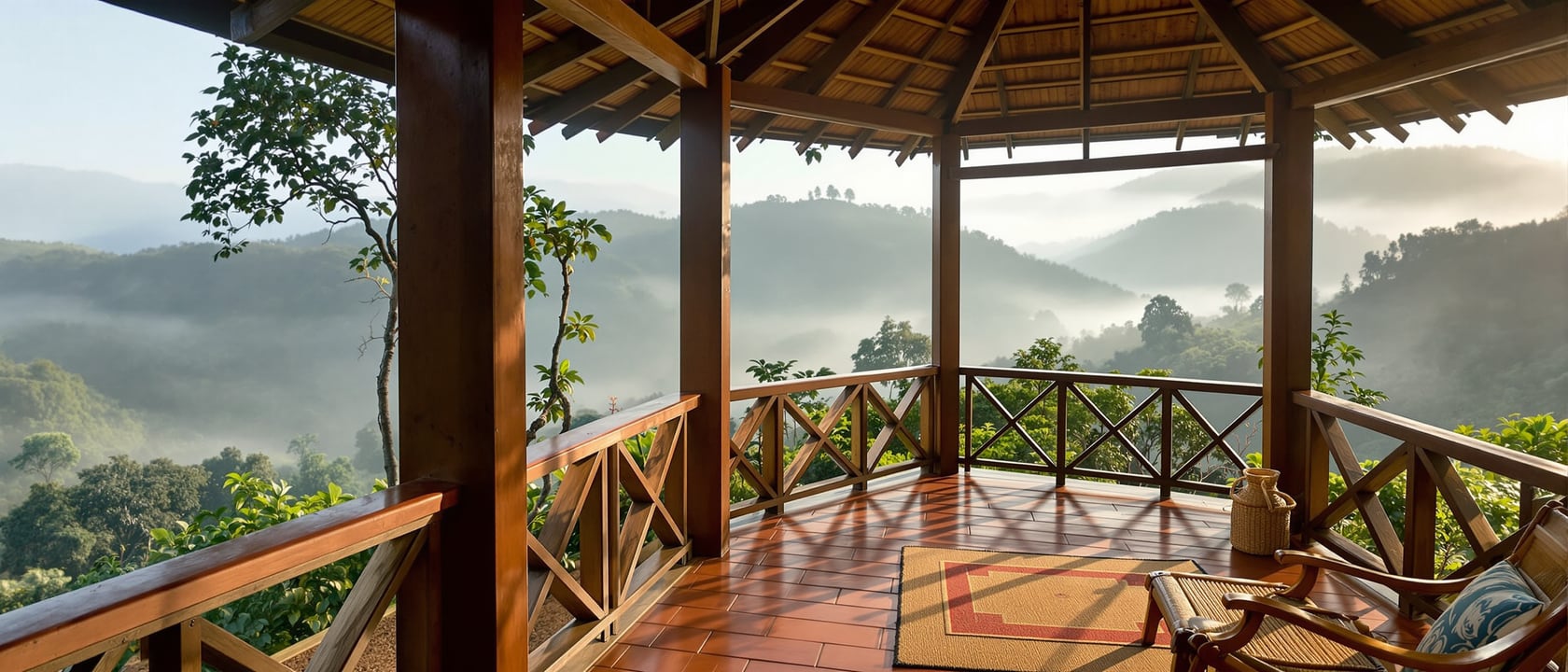
Drive up from the plains of Karnataka into Coorg or Chikmagalur and the buildings change before the road signs do: steep tiled roofs that shed relentless monsoon rain, timber posts darkened by decades of damp, and verandahs deep enough to sit out a downpour in a cane chair with a cup of estate coffee. Drive instead into the Himachal or Uttarakhand hills and the buildings change again, but toward a different problem: stone plinths, close-set deodar and pine timber, steep metal or slate roofs that shed snow rather than rain, and small windows guarding a snug, easily heated room against a cold that can bite for five months of the year.
These are opposite climates solving opposite problems - heavy monsoon humidity in one, biting dry cold in the other - yet both arrive at the same underlying homestay instinct: build in response to what the land is actually doing, and let that land do most of the selling. A plantation homestay's real amenity is not a swimming pool, it is the coffee or cardamom walk at dawn; a hill homestay's real amenity is not a gym, it is the mountain view from the verandah and the quiet after dark. This lesson walks through both forms in turn, then looks at how their very different seasons - estate blossom and harvest on one hand, snow and monsoon landslide risk on the other - should shape your pricing and packaging, not just your architecture.
Opposite climates, opposite forms, same instinct: build the answer the land already worked out, and let it do the selling.
The plantation bungalow: Coorg, Chikmagalur, Wayanad
The classic plantation bungalow across Coorg, Chikmagalur and Wayanad traces back to colonial-era coffee, tea and cardamom estates, and its form has barely changed because the climate problem it answers - relentless monsoon rain from roughly June to September, high humidity year-round, and strong midday sun between monsoons - has not changed either. The roof is the single most important element: steep-pitched, tiled (traditionally terracotta Mangalore tile, now sometimes replaced with sheet roofing on working estate buildings), with generous overhangs that throw rainwater well clear of the walls. Timber construction - posts, beams, window frames - remains common because timber was locally available on a forested estate and because it tolerates the damp better than untreated masonry when properly maintained.
The deep verandah is the plantation bungalow's signature move, and it is doing real climate work, not just looking atmospheric: it keeps driving monsoon rain off the main walls and windows, it gives a genuinely usable outdoor-feeling space on days when actually walking the estate is not sensible, and it is where the colonial-era bungalow owner, and now the homestay host, would sit with guests over coffee grown on the very land in front of them. A well-run plantation homestay in Coorg or Chikmagalur today typically charges somewhere in the ₹4,000-6,000 range per night including meals and a guided coffee, cardamom or spice walk - a price that reflects the land and the host's knowledge of it far more than the size of the room.
The estate itself is the real amenity, and this is the point many first-time owners miss when they focus their renovation budget on the building alone. A guided walk through the coffee or cardamom under the shade trees, a visit to the pulping and drying yard during harvest, a conversation with the estate's own workers - these cost little to offer and are precisely the 'story' layer Module 1 described, one that a resort built from scratch on cleared land can never genuinely replicate, however much it tries to landscape its way there.
The hill home: Himachal, Uttarakhand, Sikkim
Move to the hill states and the problem inverts almost completely. Here the defining climate fact is not humidity but a cold that can run for five or six months, with snow at higher elevations from roughly December to February and night-time temperatures that can drop sharply even in the shoulder seasons. The traditional hill home answers this with a stone plinth and lower storey - stone is locally abundant, extremely durable, and provides thermal mass that buffers the cold - topped by a timber upper storey, very often in deodar or pine, both locally available, workable and reasonably rot-resistant at altitude. The roof pitches steeply, traditionally in slate in parts of Himachal and Uttarakhand or in simple sheet roofing more widely today, specifically so that snow sheds rather than accumulating and loading the structure.
Windows are deliberately small, which looks austere to an eye used to large glazing but is doing exactly the opposite job of a plantation bungalow's open verandah: minimising heat loss rather than maximising airflow. Rooms are correspondingly snug - genuinely small by design, not merely small by budget - because a smaller volume is far easier and cheaper to heat through a long winter, whether by wood stove (a bukhari in parts of the western Himalaya), by a simple fireplace, or by modern electric heating where power is reliable. A hill homestay room done well should feel cosy rather than cramped: good insulation, warm materials (wood, wool textiles, a rug on a stone floor), and a wood stove or heater that genuinely works, matter far more here than square footage.
As in Coorg, the land is the real amenity. The mountain view from a verandah or a window seat, the silence after dark that a city guest rarely experiences, a short walk to an apple orchard in Himachal or a terraced field in Uttarakhand, local produce at breakfast - these are what a guest actually remembers, not the room's dimensions. A hill homestay in Himachal or Uttarakhand commonly charges somewhere in the ₹2,500-4,500 range per night depending on altitude, season and proximity to a known destination, again a price built on the view and the quiet far more than on fixtures.
Reading the seasons: estate time and mountain time
Both regions run on a seasonal clock that a first-time owner must plan around rather than be surprised by, and Module 3's occupancy lesson treats this in financial depth - here the point is simply to read your own region's calendar honestly. On a coffee or cardamom estate, the blossom typically arrives around March, a short and genuinely beautiful window that estates increasingly market as its own small season; the main harvest runs roughly October through January depending on the crop, and this is when the estate is most alive, most photogenic and most interesting to a curious guest who wants to see the actual work of growing and processing happen. The intervening months are quieter on the estate itself, though the plantation districts still draw general hill-escape tourism through much of the year given Karnataka and Kerala's own heat.
In the hill states, the calendar splits more sharply into three bands. Summer (roughly April to June) is peak season almost everywhere, driven by plains-dwellers escaping the heat - this is when a Himachal or Uttarakhand hill homestay will see its highest occupancy and can reasonably charge its highest rates. Winter (December to February) is a smaller, different season built around snow itself - families and couples specifically seeking a white Christmas or New Year, or early-season skiing in the handful of towns that support it - genuinely profitable but shorter and more weather-dependent than summer. The monsoon (roughly July to September) is the honest low point for most hill homestays, not just because fewer people travel but because landslide risk on hill roads is real and can cut off access for days at a time; many experienced hill owners simply plan for reduced bookings, and sometimes planned downtime for maintenance, through these months rather than fighting the season.
Treat both calendars as indicative, not fixed - exact timing shifts year to year with the actual monsoon and winter, and differs meaningfully between, say, Coorg's relatively gentle climate and Sikkim's higher, colder one. The owners who do best are the ones who build a small seasonal package around each genuine high point - a harvest-walk weekend, a blossom-season rate, a snowfall package - rather than pricing flatly across a year that the land itself refuses to treat as flat.
Designing guest rooms that work with the materials, not against them
The single most common renovation mistake in both regions is the same mistake in different clothing: treating the traditional materials and verandah as outdated rather than as the business's real asset. In a plantation bungalow, that looks like glassing in the verandah to create 'one more AC-cooled room' for extra revenue, which both removes the space guests most want to sit in and increases your running costs in a climate where cross-ventilation, not sealed cooling, is the better long-term answer per Lesson 5.1. In a hill home, it looks like knocking through small windows into large picture windows for a 'modern' look, which dramatically increases heat loss through a long winter and can make a previously comfortable room genuinely hard and expensive to heat.
The better instinct in both cases is to retrofit within the vernacular logic rather than against it: in a plantation bungalow, maintain the verandah as the social and climate buffer it always was, and spend fit-out budget instead on a genuinely good mattress, reliable hot water (a real comfort gap on many working estates) and effective mosquito screening rather than sealing the building up; in a hill home, keep rooms reasonably compact and invest instead in proper insulation, a dependable heat source and warm materials, rather than chasing square footage a guest in a cold climate will not actually value as much as a host might assume.
Both regions also reward investing in the experience layer over the building layer, echoing Module 1's value proposition: a genuinely good guided estate walk or a knowledgeable host who can point out which ridge to walk for the best sunset view costs far less than a renovation and does more for the guest's memory of the stay. The next lesson moves to Kerala's warm-humid coast, where the climate problem shifts again - not monsoon-on-a-slope or dry cold, but sustained heat and humidity at sea level - and the nalukettu courtyard answers it with yet another, equally specific, logic.
A glassed-in verandah earns one extra room and loses the one space every guest actually wanted to sit in.
Estate bungalow
A colonial-era plantation residence, typically timber-and-tile, built for a working coffee, tea or cardamom estate
The common base building type for a Coorg, Chikmagalur or Wayanad homestay.
Deodar
A Himalayan cedar valued for its workability and relative rot resistance, widely used in traditional hill construction
Usually paired with a stone plinth or lower storey in Himachal and Uttarakhand homes.
Bukhari
A traditional wood-burning stove used for heating in parts of the western Himalaya
One practical, low-cost way to keep a snug hill guest room genuinely warm through winter.
Harvest season (plantation)
The period, roughly October to January depending on the crop, when an estate is most active and visually interesting
A natural basis for a themed harvest-walk guest package; see Module 3 on seasonality.
Workshop - your land, your season
A planning exercise for an owner in either a plantation or hill region: map your own property's real seasonal high points and the one or two building features worth protecting rather than renovating away.
Just your property and a notebook; no special tools.
Goal: a seasonal package idea plus a protect-don't-renovate list for your own home
Inputs: your property, a rough sense of your local blossom/harvest or summer/snow calendar
Time: ~25 minutes
- 1Write down your region's real seasonal high points (blossom, harvest, summer escape, snowfall) and roughly which months each falls in, treating this as indicative based on your own local knowledge.
- 2List the one or two experiences on your actual land - a walk, a view, a local activity - that cost you little to offer and that a guest cannot get anywhere else.
- 3Walk your property and identify any verandah, deep eave, small window or stone/timber feature a previous renovation (or a planned one) might be tempted to remove or enlarge.
- 4For each feature identified, write one sentence on what it is currently doing for comfort or cost, so you have a reason to defend it before a contractor suggests changing it.
- 5Sketch one simple seasonal package built around your highest point - name it, decide roughly what it includes, and note which months it should run.
You’ll walk away with
A one-page note: your region's seasonal calendar, your protect-don't-renovate list, and one named seasonal package idea.
Three altitudes on the same idea
Read the band that fits you — or all three.
For you, the owner-host, the discipline here is to resist 'upgrading' the very features that make your estate or hill home sellable. Protect the verandah on a plantation property and the small, snug-but-warm rooms on a hill property; spend your renovation budget instead on mattresses, hot water, heating and genuinely good guided experiences on the land you already have. Price around the harvest, blossom, summer or snow season honestly rather than flatly across a year the land itself does not treat as flat.
If you are advising on a plantation or hill homestay, your job is largely to protect the vernacular logic from well-meaning modernisation. Push back gently on requests to glass in a plantation verandah or to enlarge a hill home's small windows into picture glazing - both moves photograph well in isolation but quietly damage the climate response and the guest experience the owner is actually selling. Where comfort genuinely needs upgrading, target hot water, insulation and heating rather than square footage or glazing.
If this is new to you, notice that both of these very different regions reach the same conclusion from opposite directions. A Coorg bungalow opens up and shades itself against relentless rain and humidity; a Himachal home closes down and insulates itself against biting cold. Neither is 'better' architecture - each is the correct, locally worked-out answer to its own climate, which is exactly the lesson to carry into whichever region you end up building in.
“A hill homestay's small, snug rooms are a sign of a cheap or unfinished building, and should be enlarged to feel more premium.”
Do it yourself
No tools needed - reason it through for your own region.
- 1What specific climate problem does a plantation bungalow's deep verandah solve, and how is that different from the problem a hill home's small windows solve?
- 2Why is timber construction common on plantation estates and deodar common in the hills?
- 3Name the three broad seasonal bands a hill homestay typically sees, and which is usually the honest low point.
- 4Why might enlarging a hill home's small windows into large picture glazing backfire for a homestay?
- 5What is the real amenity in both a plantation and a hill homestay, according to this lesson?
The one line to carry out
Peer-reviewed journals & authoritative standards
- 01Plantation Homestay (Coorg & Chikmagalur) - the regional design and operating guide — Studio Matrx, 2026.
- 02Hill Homestay (Himachal & Uttarakhand) - the regional design and operating guide — Studio Matrx, 2026.
- 03Vernacular architecture - locally adapted building traditions and climate response — Wikipedia, 2026.
- 04Ecotourism - land- and nature-based tourism that a plantation or hill homestay sits within — Wikipedia, 2026.
- 05Architecture of India - regional building traditions including hill and plantation forms — Wikipedia, 2026.
Kerala's warm-humid coast presents a third, equally specific climate problem, and its nalukettu courtyard house answers it with a layout this module has not yet seen.
The author
Amogh N P
Architect, interior designer, and creative polymath. Studio Matrx began in his notebooks — his vision of design made honest, useful, and open to everyone. Its Academy is written and taught in his memory, and free, forever.
More about Amogh →