
 Lesson 6.4
Lesson 6.4 · Setting Up
Branding, Naming & Your Story
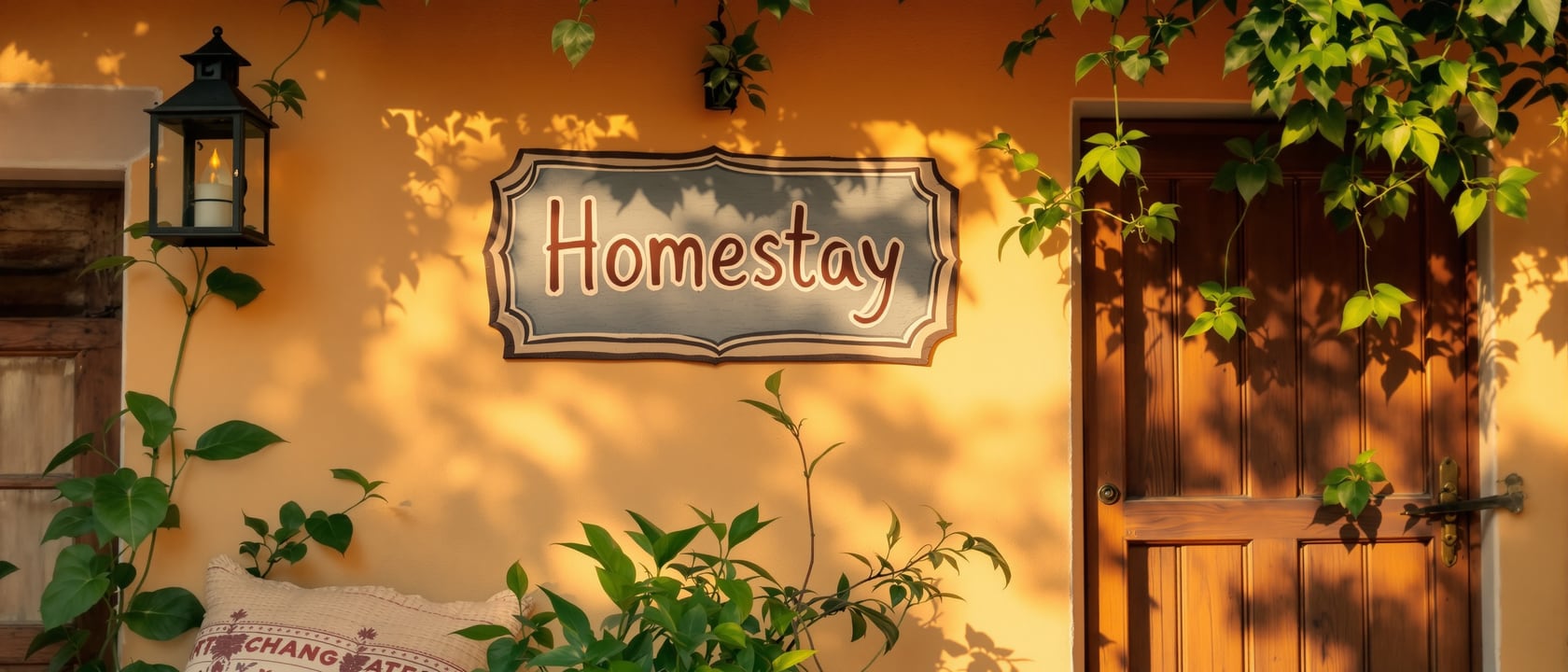
A homestay's name is the first promise it makes to a stranger who has never met you — and the whole stay only has to do one thing after that: keep it.
The name you choose today is a promise your guests will hold you to for as long as the homestay runs.
A homestay's name does real work before a single guest ever arrives. It is the first thing a searcher reads on an OTA listing, the word painted on the gate a taxi driver looks for in the dark, the phrase a happy guest repeats to a friend who asks where they stayed. Get it wrong — too grand for what you actually offer, too generic to remember, too hard to spell or pronounce — and you are quietly working against your own bookings before the room, the breakfast or the welcome ever get a chance to speak for themselves.
This closing lesson of Module 6 is about making that first promise an honest one, and then keeping it consistent everywhere a guest encounters it — the signage at your gate, the words on your listing, the tone of your welcome message, and the story you tell about why this particular home, in this particular place, is worth a stranger's trust. None of this requires a professional branding agency or a logo designer, and in fact the hosts who over-invest in gloss at the expense of honesty tend to generate exactly the kind of expectation-mismatch reviews this lesson will show you how to avoid.
Name it true. Tell your real story. Say the same thing everywhere. Let the stay over-deliver, not the listing.
Why a name is a promise, not decoration
Every homestay name implicitly promises something, whether the host intended it to or not. "Heritage Haveli" promises genuine age and architectural character; "Palace View" promises grandeur or at least a palace somewhere in sight; "Eco Farmstay" promises sustainable practice and a working farm; a family surname attached to "House" or "Home" promises a personal, family-run welcome. Guests read these signals before they ever arrive, and they arrive with expectations already calibrated to whatever the name told them.
The practical rule follows directly from this: name your homestay for something that is actually, verifiably true about it. If the house genuinely has heritage architectural character — a century-old haveli structure in Rajasthan, a traditional nalukettu courtyard home in Kerala — a name that signals that is earned and will be confirmed, not contradicted, the moment a guest walks in. If the house is a modest, comfortable, ordinary family home with no particular architectural claim, a grander name is setting up a disappointment the moment the gate opens, however pleasant the actual stay turns out to be. This does not mean modest homes need modest, boring names — a name built around a genuine feature (a mountain view, a specific tree, the family's actual craft or occupation, the name of the lane or village) can be just as evocative as a grand one, while staying honest about what is actually being promised.
A few practical naming conventions that tend to work well in the Indian homestay context: place-plus-feature names ("Riverside Cottage, Coorg"), family-name-plus-home names ("The Iyer Homestay"), or a name drawn from a genuine local or regional term the host can explain with pride when asked. Avoid names that could belong to literally any property in the country — generic words like "Paradise", "Comfort" or "Royal" attached to nothing specific tend to be both unmemorable and, because so many other properties use the same generic words, actively hard to find in a crowded search.
Name for something true. A guest who arrives expecting exactly what they got leaves happy; one expecting more leaves unhappy, however nice the stay actually was.
Finding your own story
The single most underused branding asset most first-time hosts already possess is their own actual story, and it is free. A Coorg homestay run by a third-generation coffee-planting family has a story no competitor, however well-funded, can copy: the family's own history with the land, the coffee, the specific hill it sits on. A Himachal homestay run by a family that has grown apples in the same orchard for two generations has the same kind of unreplicable asset. A homestay in a city, with no estate or heritage claim at all, still has a story — perhaps it is the host's own career (a retired teacher, an architect, a chef) brought home into the way they run the place, or the specific neighbourhood's own character the host genuinely knows and loves.
The exercise worth doing before writing a single word of listing copy is simply to write down, honestly, why this particular home in this particular place is worth a guest's time — not in marketing language, but in the way you would actually explain it to a friend. What does the family actually do, or used to do? What is genuinely specific about this location that a generic hotel room fifty kilometres away could not offer? What do guests who have already stayed tend to comment on unprompted? That honest answer, lightly polished rather than inflated, is almost always a better piece of brand copy than anything invented from scratch, because it is specific, verifiable, and impossible for a competitor to simply copy.
This story also does real operational work beyond marketing: it gives you something genuine to talk about at breakfast, something to put in your one-page local guide note from Lesson 6.2, and something that naturally differentiates you in a crowded regional market — covered in more depth in Module 7's listing-and-photography lesson — without requiring any invented gimmick.
Consistency across signage, listing and welcome
A name and a story only work as a brand if they sound and feel the same everywhere a guest encounters them, and this is the step most first-time hosts skip without realising it. It is entirely common to find a homestay whose online listing uses warm, personal, first-person language ("we love sharing our garden with guests"), whose physical gate signage is a plain, generic board that could belong to any guesthouse, and whose actual welcome message on arrival is a brief, transactional run-through of check-in times with none of the listing's warmth carried through. Each individual piece might be perfectly fine on its own; together, they tell a guest three slightly different things about who is hosting them, and the inconsistency itself reads as a small, nagging sense that something does not quite add up.
The fix is not expensive — it does not require a graphic designer or a professional photographer, though both help if affordable. It requires deciding, once, on the actual tone of voice this specific homestay speaks in — warm and personal, quietly elegant, rustic and straightforward, whatever genuinely fits the story from the previous section — and then checking that your gate signage, your online listing description, and the actual words you say or write to a guest on arrival all carry that same voice. A homestay whose listing promises a warm family welcome and whose host actually delivers one, consistently, in the same words and spirit from the signage to the goodbye, builds a far stronger sense of trust than a far more polished listing that does not match the lived experience.
Practically, write your welcome message and your listing description in the same sitting, in the same voice, and read them both aloud — if they sound like two different people wrote them, revise until they do not.
Authenticity over gloss
The single most common branding mistake this course sees among first-time Indian homestay hosts is not under-branding — it is over-promising. A listing built from the most flattering possible wide-angle photographs, stock-photo-style language borrowed from a luxury resort's website, and adjectives like "boutique" or "luxury" attached to a modest, comfortable, perfectly pleasant family home sets up an expectation gap that the actual stay then has to fight against from the moment the guest arrives. This is, specifically, one of the most common causes of an otherwise undeserved negative review: not that the stay was genuinely bad, but that it was good and ordinary when the listing had promised extraordinary.
The corrective principle running through this entire lesson, and arguably through this whole module, is to let the actual experience exceed the promise rather than the reverse. Describe the home honestly — simple and comfortable rather than luxurious, if that is accurate; a working farm rather than a boutique retreat, if that is accurate — and let guests arrive calibrated correctly, so that every small generous touch from Lesson 6.2's essentials checklist lands as a pleasant surprise rather than the bare minimum of what was promised. This is not a call to undersell a genuinely special property; a homestay with real heritage architecture, a spectacular view or an exceptional host should say so, honestly and specifically. It is a call to make sure every claim in your name, your listing and your welcome message is one the actual stay will confirm, not contradict — because the gap between promise and delivery, in either direction, is what guests actually feel and write about, far more than the absolute quality level of the stay itself.
Let the stay exceed the promise, never the other way round.
Brand identity
The consistent name, visual style and voice a business presents across every touchpoint
For a homestay, this is mainly the name, the signage, the listing copy and the host's own welcome tone.
Tone of voice
The consistent personal style and language a brand speaks in
Should be decided once, deliberately, and then checked for consistency across signage, listing and welcome message.
Unique selling proposition (USP)
The specific, genuine reason a guest should choose this property over a comparable alternative
Almost always rooted in the host's own real story, covered earlier in this lesson, rather than an invented claim.
Workshop — name and story worksheet
Branding decisions tend to stay vague until they are written down and tested against reality. This exercise has you draft candidate names, write your actual story in plain words, and check consistency across your real touchpoints.
Honest self-reflection, two or three outside testers, and your existing or planned listing and signage.
Goal: a chosen name, a written 100-word story, and a consistency check across signage, listing and welcome
Inputs: honest reflection, 30 to 40 minutes, feedback from two or three outsiders
Time: ~45 minutes plus feedback time
- 1Draft three candidate names, each built around something genuinely true about your home, family or location.
- 2Write a plain, honest, roughly 100-word paragraph explaining why this specific home in this specific place is worth a guest's time — no marketing language, just the real answer.
- 3Test your top name and story on two or three outsiders who do not know your home well — can they spell and pronounce the name, and does the story make them want to stay?
- 4Write your actual arrival welcome message or script, in the same voice as your story paragraph.
- 5Read your listing description, your story paragraph and your welcome script aloud, back to back — revise any that sound like a different person wrote them.
- 6Check your physical gate signage (or your plan for it) against the same name and voice, and update it if it currently reads as generic or mismatched.
You’ll walk away with
A chosen, tested name; a written honest story paragraph; and a consistency check confirming your listing, welcome message and signage all carry the same name and voice.
Three altitudes on the same idea
Read the band that fits you — or all three.
As the owner-host, write your listing description and your actual arrival welcome script in the same sitting, in the same honest voice, and read both aloud to check they sound like the same person. Resist the pull toward grander language than your home can deliver on — the gap between a promise and the lived stay is what guests write reviews about, far more than the absolute level of luxury on offer.
If you are advising a homestay client on branding or signage, push back gently on names or descriptions that overclaim relative to what the design and the space actually deliver. A design brief that says 'heritage haveli' for a structure with no real heritage claim sets the client up for a review problem no amount of good design work can later fix.
If this is new to you, the one habit worth building is simply writing down your own honest story before writing any marketing copy at all. Your name, your story and your welcome should all describe the same, real place — resist the temptation to borrow language from a luxury resort you are not actually running.
“A fancier-sounding name or a more polished, luxury-style listing will get more bookings than an honest, modest one.”
Do it yourself
Reason it through using the principles in this lesson.
- 1Why is a homestay's name described in this lesson as a promise rather than a decoration?
- 2What is the single most underused, free branding asset most first-time hosts already have?
- 3Why does inconsistency between a listing's tone and a host's actual welcome manner damage guest trust, even if neither one is individually bad?
- 4Why does this lesson argue that over-promising, not under-branding, is the more common and more damaging mistake?
- 5A homestay is named 'Royal Heritage Retreat' but is actually a comfortable, ordinary twenty-year-old family home with no heritage claim at all. What specific risk does this create, and how would you fix it?
The one line to carry out
Peer-reviewed journals & authoritative standards
- 01Homestays guide hub — Studio Matrx — Studio Matrx, 2026.
- 02How to Start a Homestay in India — Studio Matrx — Studio Matrx, 2026.
- 03Hospitality — Wikipedia, 2026.
- 04Regional Homestay Playbooks — Studio Matrx — Studio Matrx, 2026.
With the house fitted out, the essentials checked, the food settled and the name and story honestly told, Module 6 is complete — the next module turns outward, to actually getting the guests who will experience all of it.
The author
Amogh N P
Architect, interior designer, and creative polymath. Studio Matrx began in his notebooks — his vision of design made honest, useful, and open to everyone. Its Academy is written and taught in his memory, and free, forever.
More about Amogh →